

Square hydraulic flanges are mechanical connection components used in hydraulic equipment to secure components, create mounting interfaces, and maintain reliable fluid connections. Their square-shaped profile provides a defined mounting arrangement, while bolts and appropriate sealing elements help keep connected components firmly joined under operating conditions.
These flanges can be found in specialized hydraulic assemblies, pumps, manifolds, and industrial machinery where the equipment design calls for a square mounting interface. However, not all square hydraulic flanges share the same dimensions, sealing methods, or pressure ratings. Choosing the correct design requires careful attention to the equipment’s specifications.
Understanding how square hydraulic flanges work can help engineers, maintenance technicians, and equipment buyers select compatible components, reduce leakage risks, and maintain dependable hydraulic system performance.
What Are Square Hydraulic Flanges?
Square hydraulic flanges are components with a square-shaped mounting profile designed to connect or secure compatible hydraulic equipment. Depending on their design, they may provide a mounting interface, connect fluid passages, or support the installation of a hydraulic component.
Unlike a threaded fitting that connects directly through mating threads, a bolted flange connection generally uses a flat or machined mounting surface, a specified bolt arrangement, and a sealing method appropriate for the application.
The square shape describes the flange’s external geometry, not necessarily its connection standard. Its bolt-hole pattern, dimensions, sealing arrangement, and rated operating pressure depend on the particular design.
For example, a square flange used on a specialized hydraulic pump may have a different mounting pattern from a square flange designed for another machine. Even when two components look similar, their dimensions and sealing features must be checked before they can be used together.
Square hydraulic flanges are therefore selected according to the equipment manufacturer’s requirements rather than appearance alone.
Key Components of a Square Hydraulic Flange
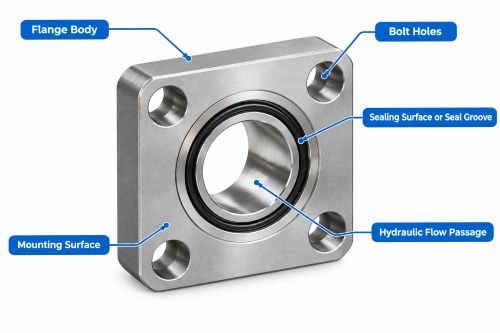
Although square hydraulic flange designs vary, several features are commonly found in these components.
1. Flange Body
The flange body is the main structural part of the component. It provides the material and geometry needed to support the connection and transfer mechanical loads to the mounting structure.
The body’s thickness, dimensions, and material affect its strength and suitability for the intended application. Carbon steel is commonly used in hydraulic components because of its mechanical strength, while stainless steel may be selected when greater corrosion resistance is required.
The body must be designed to withstand the forces associated with the connection’s operating conditions without excessive deformation.
2. Mounting Surface
The mounting surface contacts the mating component and establishes the position of the flange connection.
Depending on the design, this surface may be flat, machined, or shaped to accommodate a specific sealing arrangement. Its flatness, finish, and dimensional accuracy can influence how evenly the components fit together.
Damaged or uneven mounting surfaces can interfere with sealing and may contribute to leakage. For this reason, mounting surfaces should be inspected before installation.
3. Bolt Holes
Bolt holes allow the flange to be fastened securely to a compatible component or mounting structure.
Their diameter, spacing, and position must match the corresponding holes in the mating component. Correct alignment allows the fasteners to apply the intended clamping force across the joint.
Using the wrong bolt pattern or unsuitable fasteners can lead to uneven loading, poor alignment, or an insecure connection. Bolt-hole dimensions should always be verified against the relevant drawing or product specification.
4. Sealing Surface or Seal Groove
The sealing area helps prevent hydraulic fluid from escaping through the connection.
Some designs use an O-ring seated in a groove, while others use a different specified seal or sealing arrangement. The correct configuration depends on the flange design and the mating interface.
When the connection is assembled correctly, the sealing element provides the contact needed to restrict fluid leakage under the specified operating conditions.
Seal material also matters. It must be compatible with the hydraulic fluid, operating temperature, and expected pressure conditions.
5. Hydraulic Flow Passage
For flanges designed to carry hydraulic fluid, the internal passage allows fluid to move between connected components.
The passage must align correctly with the corresponding port or passage in the mating component. A mismatch can restrict flow or prevent proper assembly.
Passage dimensions are particularly important in systems where flow rate, pressure drop, and fluid velocity affect overall performance.
Not every square mounting flange carries fluid directly, however. Some are primarily structural mounting components, so their function should be confirmed from the product drawing.
How Do Square Hydraulic Flanges Work?
Square hydraulic flanges work by creating a secure mechanical interface between compatible components. When the connection carries hydraulic fluid, the assembly must also provide a suitable seal to prevent leakage.
The square profile establishes the mounting geometry, while the fasteners hold the mating components together. The sealing arrangement, where required, closes the potential leakage path between the connected surfaces.
Here is how the process generally works.
Step 1: Position the Flange
The flange is placed against its corresponding port, housing, or mounting component.
The mounting surfaces and bolt holes must align correctly. If the flange does not sit naturally in the required position, the installer should check for incorrect dimensions, obstructions, or incompatible components rather than forcing the connection together.
Step 2: Install the Required Seal
If the design uses an O-ring or another sealing element, it must be installed in the specified location.
The seal should be clean and free from cuts, deformation, contamination, or other damage. Its dimensions and material must match the application.
Incorrect seal placement or an unsuitable seal can result in leakage even when the flange itself is manufactured correctly.
Step 3: Secure the Connection
The appropriate bolts and fasteners are installed through the flange’s mounting holes.
Fasteners are tightened according to the manufacturer’s specified procedure and torque requirements. Where a cross-pattern or staged tightening sequence is specified, following it helps distribute clamping force more evenly.
Overtightening should be avoided because excessive force can damage threads, distort components, or compromise the sealing arrangement.
Step 4: Establish the Seal
As the connection is tightened, the mating surfaces and specified sealing elements come into their intended working position.
For an O-ring connection, the seal must have the correct dimensions and compression for the designed groove and interface. The bolts maintain the required joint clamping force.
The effectiveness of the seal depends on the complete assembly, not simply on how tightly the bolts are fastened.
Step 5: Inspect the Connection
Before returning the equipment to normal operation, the connection should be inspected for correct assembly and obvious defects.
Where appropriate, the system should be checked for leakage under controlled operating conditions and according to the equipment manufacturer’s safety procedures.
A properly designed, compatible, and correctly installed flange connection can provide reliable service within its specified operating limits.
Common Types of Square Hydraulic Flanges
Square hydraulic flanges can be grouped according to their intended function, sealing arrangement, and manufacturing requirements. These categories are descriptive rather than a universal classification system, because actual flange designs vary by equipment and manufacturer.
Standard Square Mounting Flanges
Standard square mounting flanges are designed for equipment with a defined square mounting interface.
They may be used to secure components in place or provide a connection between compatible assemblies. Their dimensions and hole patterns are determined by the particular equipment design.
Before replacement, the original component’s drawing or specifications should be checked to confirm compatibility.
Square Hydraulic Pump Flanges
Some hydraulic pump assemblies use square-shaped mounting or connection interfaces.
Depending on the pump design, the flange may help secure the pump to its mounting structure or form part of a fluid connection. Not every pump uses a square flange, so the correct arrangement must be identified from the pump documentation.
Square Flanges with O-Ring Seals
Some square flange designs incorporate an O-ring to provide a reliable seal between mating surfaces.
The O-ring sits in a specified groove and seals when the connection is assembled correctly. The groove dimensions, O-ring size, material, and assembly conditions must all be suitable for the application.
O-ring sealing can help control leakage, but it does not compensate for an incorrect flange interface or damaged mounting surfaces.
Custom Square Hydraulic Flanges
Custom square hydraulic flanges are manufactured to meet particular equipment requirements when standard components do not provide the necessary fit or function.
Customization may involve flange dimensions, bolt-hole positions, material selection, sealing features, surface treatments, or other machining details.
For OEMs and equipment manufacturers, custom flanges can help accommodate specialized designs. However, any changes to dimensions or sealing features should be evaluated to ensure that the finished component meets the required mechanical and hydraulic performance criteria.
Materials Used in Square Hydraulic Flanges
Material selection affects a square hydraulic flange’s strength, durability, corrosion resistance, and suitability for different operating environments.
The right material depends on the application rather than a single universal preference.
Carbon Steel
Carbon steel is widely used in hydraulic components because it provides good mechanical strength and can be machined into precise shapes.
It is suitable for many industrial applications, including machinery and hydraulic assemblies operating under demanding mechanical conditions.
Surface treatments, such as zinc plating or other specified protective coatings, may improve corrosion resistance. The appropriate treatment depends on the environment and the component’s requirements.
Stainless Steel
Stainless steel may be chosen when corrosion resistance is a major concern.
It can be useful in equipment exposed to moisture, certain chemicals, or other corrosive conditions. However, the specific stainless steel grade must be suitable for the expected environment and mechanical loads.
Stainless steel is not automatically the best choice for every hydraulic system. Cost, strength requirements, fluid compatibility, and manufacturing considerations should all be evaluated.
Other Specialized Materials
Some applications may require specialized alloys or other engineered materials.
The choice depends on factors such as temperature, chemical exposure, mechanical loading, and the required service life. Material specifications should be confirmed before production or purchase, particularly for custom components.
Advantages of Square Hydraulic Flanges
When designed for the application, square hydraulic flanges offer several practical advantages.
Secure bolted mounting: The bolt arrangement helps hold compatible components in position and maintain the intended joint clamping force.
Defined installation geometry: The square profile and specified hole pattern provide a clear mounting arrangement for equipment designed around that interface.
Serviceability: Bolted connections can generally be disassembled for inspection, repair, or component replacement when the system has been safely depressurized.
Flexible design options: Manufacturers may offer different materials, dimensions, and sealing arrangements to meet specific equipment requirements.
Potential for reliable sealing: When the interface, seal, fasteners, and installation procedure are correct, a flange connection can help prevent hydraulic fluid leakage.
These advantages depend on correct engineering and installation. A square flange is not inherently stronger or more leak-resistant than every other flange design.
Common Applications of Square Hydraulic Flanges
Square hydraulic flanges are used where equipment design calls for a compatible square mounting or connection interface.
Hydraulic Pumps and Power Units
A square flange may serve as a mounting interface or part of a connection arrangement in certain hydraulic pump and power-unit designs.
The exact function depends on the pump configuration and the manufacturer’s specifications.
Industrial Machinery
Manufacturing equipment may use specialized flanges to secure hydraulic components or connect assemblies in limited installation spaces.
The flange must match the equipment’s mounting dimensions and operating requirements.
Construction and Agricultural Equipment
Some mobile hydraulic systems contain customized or equipment-specific flange interfaces.
These components must be selected for the expected pressure, vibration, mechanical loading, temperature, and environmental exposure.
Hydraulic Manifolds and Specialized Assemblies
A square mounting interface may be incorporated into a manifold or a specialized hydraulic assembly when required by the design.
Correct alignment between fluid passages is important where the flange carries fluid, particularly in systems that depend on predictable flow and pressure characteristics.
Across all these applications, the equipment manufacturer’s design determines whether a square hydraulic flange is appropriate.
Checkout these other resources ⬇️⬇️⬇️
What Are NPT Hydraulic Bulkhead Fittings and How Do They Work?
Hydraulic Flange Seals: Types, Materials, and Applications
What Is the Purpose of a Hydraulic Motor Flanges?
Square Hydraulic Flanges vs. Other Flange Designs
Understanding the differences between square hydraulic flanges and other connection types helps prevent incorrect component selection.
Square vs. Round Hydraulic Flanges
The most obvious difference is the external mounting geometry.
Square flanges have a square-shaped profile, while round flanges use a circular profile. This difference affects the available mounting area, bolt-hole arrangement, and space required for installation.
However, shape alone does not determine pressure capacity, sealing performance, or durability. These properties depend on the component’s dimensions, material, fastening arrangement, and design requirements.
A square flange should not be replaced with a round flange unless the equipment design explicitly supports the alternative.
Square Hydraulic Flanges vs. SAE Split-Flange Connections
SAE Code 61 and Code 62 are established hydraulic split-flange connection designs with defined interface requirements.
These connections commonly use a flange head, an appropriate O-ring, and a split-flange clamp arrangement secured by bolts. Code 61 and Code 62 have different dimensional and pressure-related requirements.
A square external profile does not automatically make a component compatible with either standard. The interface dimensions, bolt arrangement, seal groove, and rated pressure must match the specified connection.
Always identify the actual connection standard rather than relying on the flange’s appearance.
Square Hydraulic Flanges vs. Threaded Connections
Threaded hydraulic connections join components through compatible male and female threads, often with a specified sealing method.
Flanged connections instead use a bolted mounting interface and the sealing arrangement specified for that design.
Threaded connections may be convenient where space and equipment configuration allow, while flanged designs may be appropriate where a bolted interface is required. The better option depends on pressure, service requirements, available space, and equipment compatibility.
How to Choose the Right Square Hydraulic Flange
Choosing the correct square hydraulic flange requires more than matching its outside dimensions. Several technical details should be confirmed before ordering.
1. Verify Dimensions and Bolt Patterns
Check the flange’s overall dimensions, thickness, bolt-hole diameter, hole spacing, and mounting configuration.
Where available, compare the component with the original engineering drawing or equipment manufacturer’s specifications.
Small dimensional differences can prevent proper installation or cause the mounting surfaces to fit incorrectly.
2. Confirm the Operating Pressure
Determine the system’s normal working pressure and account for pressure fluctuations or spikes where applicable.
The selected flange and its mating components must be rated for the intended operating conditions. The pressure capability of the complete connection may be limited by the weakest component, including the seal, fasteners, or mating interface.
Do not assume that a flange is suitable for high-pressure service based on its material or appearance alone.
3. Select the Appropriate Material
Consider the hydraulic fluid, operating temperature, external environment, mechanical loads, and corrosion risks.
Carbon steel may be appropriate for many industrial applications, while stainless steel may be preferable in certain corrosive environments.
The material and any protective surface treatment should meet the equipment’s requirements.
4. Check the Sealing Arrangement
Identify whether the flange uses an O-ring, another seal, or a different specified sealing interface.
Confirm the seal dimensions, material, groove geometry, and compatibility with the hydraulic fluid and temperature range.
If the flange is part of an existing assembly, matching the original sealing specification is generally the safest starting point.
5. Review Manufacturing Quality
Dimensional accuracy and surface condition are important for reliable flange connections.
When evaluating a product, consider the manufacturer’s machining capabilities, inspection procedures, material verification, and dimensional quality controls.
Technical drawings and inspection records can help buyers confirm whether a component meets their requirements.
6. Evaluate the Supplier’s Capabilities
For OEMs, distributors, and industrial buyers, the supplier’s ability to meet technical and delivery requirements is also important.
Ask whether the manufacturer can provide the required materials, surface treatments, customized dimensions, quality documentation, and production quantities.
For custom components, provide a complete drawing or specification whenever possible. This reduces ambiguity and helps the manufacturer evaluate feasibility before production begins.
Installation and Maintenance Tips
Correct installation helps preserve the sealing performance and service life of square hydraulic flanges.
Before assembly, clean the mating surfaces and inspect them for scratches, corrosion, deformation, and contamination. Check the flange body, bolt holes, fasteners, and sealing elements for visible damage.
Install the specified seal in its correct position, taking care not to twist, pinch, or contaminate it. Align the components without forcing them together.
Tighten the fasteners using the manufacturer’s recommended sequence and torque values. Avoid substituting generic torque values for the requirements of the specific assembly.
After installation, conduct the appropriate inspection and leak checks before returning the equipment to normal service.
Routine maintenance should include checking for leakage, corrosion, damaged seals, loose or damaged fasteners, and other signs of deterioration. Any repair or retightening must follow the equipment manufacturer’s instructions.
Safety note: Hydraulic systems can retain dangerous pressure even after equipment has stopped operating. Always follow the approved shutdown and depressurization procedure before loosening or removing a flange. Never use your hand to search for a high-pressure hydraulic leak.
Common Problems with Square Hydraulic Flanges
Several problems can affect the performance of square hydraulic flange connections.
Hydraulic Fluid Leakage
Leakage may result from a damaged or incorrectly sized seal, unsuitable sealing material, surface defects, poor alignment, or incorrect assembly.
The connection should be safely depressurized before inspection. Check the seal, mounting surfaces, and assembly specifications to identify the cause rather than simply tightening the bolts further.
Misaligned Bolt Holes
Misaligned holes may indicate that the flange dimensions or bolt pattern do not match the mating component.
Forcing the bolts into position can damage threads, create uneven loading, or distort the assembly. Confirm the part number, drawing, and mounting dimensions before proceeding.
Loose or Damaged Fasteners
Fastener problems can develop because of incorrect installation, vibration, unsuitable hardware, or excessive mechanical loading.
Inspect the fasteners and surrounding components and follow the manufacturer’s replacement and tightening requirements. Do not assume that repeatedly retightening a connection will correct the underlying problem.
Corrosion and Surface Damage
Corrosion may weaken the component or affect the condition of its mounting and sealing surfaces.
Material selection, suitable surface protection, and regular inspection help reduce this risk. If the flange has significant deformation, cracking, or sealing-surface damage, it should be evaluated and replaced when required.
Frequently Asked Questions
1. What is a square hydraulic flange?
A square hydraulic flange is a component with a square-shaped mounting profile used to secure or connect compatible hydraulic equipment. Depending on its design, it may provide a structural mounting interface or form part of a hydraulic fluid connection.
2. How does a square hydraulic flange prevent leaks?
When the flange is part of a fluid connection, leakage prevention depends on the specified sealing arrangement, correctly aligned mating surfaces, and appropriate bolt clamping. The seal and flange interface must be compatible with the system’s operating conditions.
3. Are square hydraulic flanges suitable for high-pressure applications?
They may be suitable when specifically designed and rated for the required pressure. Buyers must verify the flange specifications, sealing arrangement, fasteners, mating components, and operating conditions before using the connection in a high-pressure system.
4. What materials are commonly used for square hydraulic flanges?
Carbon steel and stainless steel are common material options. The appropriate choice depends on mechanical strength, corrosion exposure, operating temperature, hydraulic fluid compatibility, and other application requirements.
5. Can square hydraulic flanges be customized?
Yes. Depending on the manufacturer’s capabilities, customization may include dimensions, bolt-hole patterns, materials, surface treatments, and sealing features. Custom designs should be evaluated against the required mechanical and hydraulic performance specifications.
6. What is the difference between square and round hydraulic flanges?
The primary difference is the mounting geometry. Square flanges have a square-shaped profile, whereas round flanges have a circular profile. Their compatibility and performance depend on the actual dimensions, bolt arrangement, sealing design, and equipment requirements.
7. How do I choose the correct square hydraulic flange?
Start by confirming the required dimensions, bolt-hole pattern, mating interface, working pressure, material, and sealing method. Review the equipment specifications and consult the manufacturer if the connection type or compatibility is uncertain.
Conclusion
Square hydraulic flanges provide mounting and connection interfaces for hydraulic equipment designed around a square-shaped flange profile. Their reliability depends on the complete design, including the flange body, mounting surfaces, bolt arrangement, sealing method, and material selection.
Before choosing a square hydraulic flange, verify its dimensions, pressure requirements, fluid compatibility, and installation specifications. Correct assembly and regular inspection also help reduce leakage risks and prevent avoidable equipment problems.
For hydraulic equipment manufacturers and industrial buyers, working with an experienced hydraulic fittings supplier can make it easier to identify suitable components and address specific application requirements. Sannke provides hydraulic fitting and adapter manufacturing capabilities, including OEM/ODM support and material and surface-treatment options for applicable products. Buyers seeking a specialized flange or related hydraulic component should provide their technical drawings and operating requirements to confirm whether a suitable standard or custom solution is available.
Post time: Oct-14-2026