

NPT hydraulic bulkhead fittings provide a practical way to connect hydraulic lines through panels, tank walls, and equipment enclosures. They combine NPT (National Pipe Taper) threaded connections with a bulkhead mounting design, allowing hydraulic fluid to pass between components while keeping the connection securely positioned.
These fittings are commonly used in hydraulic power units, industrial machinery, mobile equipment, and fluid handling systems. By providing a fixed connection point through a wall or panel, they help simplify hose routing, improve equipment layout, and make hydraulic connections easier to access during maintenance.
Understanding how NPT hydraulic bulkhead fittings work can help engineers, equipment manufacturers, and maintenance technicians select the right components for their systems. Let’s look at their design, working principle, common types, applications, and selection considerations.
What Are NPT Hydraulic Bulkhead Fittings?
NPT hydraulic bulkhead fittings are threaded connectors designed to pass through a mounting surface while providing one or more connections for hydraulic fluid lines. The term NPT refers to National Pipe Taper, a thread standard commonly used for pipe connections in fluid systems.
Unlike a standard NPT fitting that connects directly to a threaded port or another component, a bulkhead fitting is designed to be mounted through a panel, tank wall, or similar structure. A threaded mounting section and retaining hardware, such as a locknut, help hold the fitting in position.
The NPT threads create a seal through the interaction of the tapered male and female threads. Depending on the application and manufacturer’s instructions, a compatible thread sealant may also be needed to achieve a reliable connection.
These fittings are available in different sizes, configurations, and materials. Carbon steel is a common option for general industrial applications, while stainless steel may be preferred in environments where corrosion resistance is important. Brass is also available for certain applications, provided its mechanical properties and compatibility meet system requirements.
When selecting an NPT hydraulic bulkhead fitting, it is important to consider more than just thread size. The mounting dimensions, sealing arrangement, operating pressure, temperature, and hydraulic fluid compatibility all affect the suitability of the fitting.
Key Components of an NPT Hydraulic Bulkhead Fitting
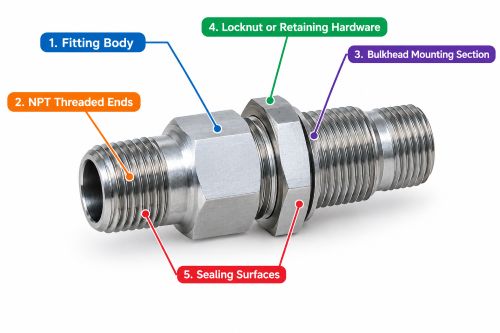
Although designs vary between manufacturers, most NPT hydraulic bulkhead fittings include several important features.
1. Fitting Body
The fitting body is the main structural component. It contains the internal passage that allows hydraulic fluid to flow between connected lines or components.
The body must withstand the mechanical loads and operating conditions expected in the hydraulic system. Its dimensions, material, and internal bore influence how it fits into the installation and supports fluid flow.
2. NPT Threaded Ends
The threaded ends provide the connection points for compatible components. NPT threads have a tapered profile, meaning their diameter changes along the threaded length.
When a male NPT thread engages with a matching female NPT thread, the threads tighten together and form the sealing interface. Correct thread engagement and assembly are essential for reducing the risk of leakage.
NPT threads should not be confused with straight-thread connections, which generally use a different sealing arrangement.
3. Bulkhead Mounting Section
The bulkhead mounting section passes through a prepared hole in a panel, tank wall, or equipment enclosure. It allows the fitting to create a connection between components on opposite sides of the mounting surface.
The mounting section must be compatible with the thickness of the panel and the dimensions of the installation hole. If the fitting is too short, too long, or incorrectly sized, it may not sit securely in the intended position.
4. Locknut or Retaining Hardware
A locknut is commonly used to secure the fitting against the mounting surface. Once positioned, it helps prevent the fitting from moving or rotating during normal operation.
The locknut primarily provides mechanical retention. It should not automatically be treated as a fluid seal between the fitting and the panel. If fluid must be contained at the mounting interface, the design may require a separate gasket, O-ring, or other suitable sealing arrangement.
5. Sealing Surfaces
Sealing is essential to the performance of any hydraulic connection.
At the NPT threaded connection, the tapered threads create the primary sealing interface when properly assembled. A compatible sealant may be required according to the fitting specification and intended service.
At the bulkhead mounting surface, sealing requirements depend on the application. For example, a fitting installed through a tank wall may need a separate seal to prevent fluid from escaping around the mounting hole.
Understanding these two sealing areas helps prevent installation mistakes and makes it easier to identify the source of a leak.
How Do NPT Hydraulic Bulkhead Fittings Work?
NPT hydraulic bulkhead fittings work by providing a secure passage through a mounting surface and connecting hydraulic components on either side. Their operation involves several basic steps.
Step 1: Mounting the Fitting
The fitting is inserted through a properly sized hole in the panel, tank wall, or equipment enclosure. The mounting section must be long enough to accommodate the wall thickness and the required retaining hardware.
Before installation, the hole and surrounding surface should be checked for burrs, damage, or irregularities that could interfere with proper mounting.
Step 2: Securing the Fitting
Once the fitting is positioned, the locknut or specified retaining hardware is tightened against the mounting surface.
This keeps the fitting in place and provides a stable connection point for the hydraulic lines. The installation should follow the manufacturer’s instructions to avoid damaging the threads or deforming the mounting surface.
Step 3: Connecting Hydraulic Lines
The hydraulic hoses, pipes, adapters, or other components are connected to the fitting’s NPT-threaded ends.
The connected components must have matching thread specifications and compatible dimensions. For example, an NPT connection should not be assumed to fit correctly with a BSPT or straight-thread port simply because the threads appear similar.
Step 4: Creating a Reliable Seal
The male and female NPT threads are assembled according to the manufacturer’s recommended procedure. Where required, a compatible thread sealant is applied to the threaded connection.
The sealant must be suitable for the hydraulic fluid, pressure, temperature, and materials involved. Excessive sealant should be avoided because it can enter the hydraulic circuit and contaminate sensitive components.
If the mounting interface also needs to retain fluid, its separate sealing arrangement must be installed correctly.
Step 5: Allowing Hydraulic Fluid to Flow
After installation, hydraulic fluid passes through the fitting’s internal bore from one connected component to another.
The fitting maintains a fixed connection through the panel while allowing the hydraulic circuit to operate as intended. Its performance depends on proper installation, suitable materials, compatible connections, and compliance with the specified operating limits.
Before the system returns to service, the completed assembly should be inspected and tested under appropriate controlled conditions.
Common Types of NPT Hydraulic Bulkhead Fittings
NPT hydraulic bulkhead fittings are available in different configurations to suit equipment layouts and connection requirements.
Straight NPT Bulkhead Fittings
Straight bulkhead fittings provide a direct connection through a mounting surface. They are useful when hydraulic lines can approach the fitting without requiring a change in direction.
Their relatively simple layout can make installation and maintenance more convenient.
Male-to-Male NPT Bulkhead Fittings
These fittings have male NPT threads on both connection ends. They can connect two compatible female NPT ports or components, depending on the fitting’s design and mounting arrangement.
Before purchasing, verify that the thread sizes and connection lengths match the intended application.
Male-to-Female NPT Bulkhead Fittings
Male-to-female configurations combine a male NPT connection with a female NPT connection. They are useful when the components on either side of a panel require different thread genders.
The exact configuration should be checked against the equipment drawings or connection specifications.
Elbow Bulkhead Fittings
Some bulkhead fitting designs incorporate an angled passage, such as a 45-degree or 90-degree elbow. These fittings help redirect a hydraulic line when space is limited or a straight connection would create an awkward hose route.
Not every manufacturer offers every elbow configuration with NPT threads and bulkhead mounting features, so availability should be confirmed before ordering.
Custom NPT Bulkhead Adapters
Custom bulkhead adapters can be produced for equipment that requires specific dimensions, thread combinations, materials, or mounting arrangements.
These options may be useful for OEM equipment manufacturers that need fittings to match a particular hydraulic circuit or enclosure design.
NPT Hydraulic Bulkhead Fittings vs. Standard NPT Fittings
Although both use NPT threads, bulkhead fittings and standard NPT fittings serve different mounting purposes.
|
Feature |
NPT Bulkhead Fittings |
Standard NPT Fittings |
|
Main purpose |
Provides a connection through a panel or wall |
Connects threaded pipes, ports, or components |
|
Mounting design |
Includes features for bulkhead installation |
May be designed for direct port installation or line connections |
|
Retaining hardware |
Often includes a locknut or similar hardware |
Usually does not require a bulkhead locknut |
|
Panel installation |
Specifically designed for mounting through a surface |
Not necessarily suitable for panel mounting |
|
Thread standard |
Uses NPT threads on specified ends |
Uses NPT threads on specified ends |
|
Sealing requirements |
Thread sealing plus a separate panel seal when required |
Sealing depends on the threaded connection and fitting design |
The main difference is the mounting arrangement, not the thread standard. Both fitting types can use NPT threads, but a standard NPT connector may not provide the mounting features needed for installation through a panel or tank wall.
Common Applications of NPT Hydraulic Bulkhead Fittings
NPT hydraulic bulkhead fittings are used in a variety of industrial and mobile hydraulic systems.
Hydraulic Power Units
Hydraulic power units often contain pumps, reservoirs, valves, filters, and other components within a compact frame or enclosure. Bulkhead fittings provide convenient connection points through enclosure walls, helping organize hydraulic lines and improve access during maintenance.
Hydraulic Oil Reservoirs and Tanks
When hydraulic lines need to connect through a reservoir wall, bulkhead fittings can provide a practical mounting solution.
The fitting’s material and sealing arrangement must be suitable for the tank and hydraulic fluid. The mounting design should also account for the tank wall thickness and the possibility of fluid leakage around the installation hole.
Construction and Agricultural Equipment
Construction machinery, tractors, and other mobile equipment often have limited space for hydraulic piping and hoses. Bulkhead fittings help route connections through structural panels and equipment compartments.
For these applications, resistance to vibration, mechanical loads, corrosion, and changing temperatures should be considered when selecting the fitting.
Industrial Machinery and Automation Equipment
Manufacturing equipment may require hydraulic connections between separate compartments or through protective enclosures. Bulkhead fittings help create organized connection points while keeping hoses and pipes routed through designated openings.
They can also make it easier to disconnect or service equipment without disturbing unrelated connections.
Mobile Hydraulic Systems
Mobile hydraulic systems frequently operate in environments where space and accessibility are important. Properly selected bulkhead fittings help support practical hose routing and reduce unnecessary bends in the installation.
However, the fitting must be rated for the actual pressure, vibration, and environmental conditions of the equipment.
Advantages of NPT Hydraulic Bulkhead Fittings
One of the main advantages of NPT hydraulic bulkhead fittings is their ability to provide a fixed connection through a panel or wall. This can simplify hydraulic system layouts and reduce the need to route hoses around structural barriers.
Their other benefits include:
1. Organized hose routing: They provide designated connection points through equipment walls and panels.
2. Flexible configurations: Different thread sizes, genders, materials, and body designs support a range of installation needs.
3. Convenient maintenance: Accessible connection points can make inspection and servicing easier.
4. Material options: Carbon steel, stainless steel, and other materials are available for different operating environments.
5. Compact installation: Bulkhead mounting can help make better use of limited space in hydraulic equipment.
6. Compatibility with NPT systems: Correctly specified fittings can connect with matching NPT-threaded components.
These advantages depend on choosing a fitting that matches the application. Not every NPT bulkhead fitting is suitable for every hydraulic pressure range or service condition.
How to Choose the Right NPT Hydraulic Bulkhead Fitting
Selecting the right fitting requires checking the connection requirements, mounting dimensions, and operating conditions together.
1. Confirm the NPT Thread Size
Start by identifying the required nominal pipe thread size. NPT sizes are nominal designations and do not directly correspond to the measured outside diameter of the thread.
Check the equipment specifications or use appropriate thread identification tools rather than relying on visual estimates alone.
2. Check Thread Gender and Configuration
Determine whether the connected components require male or female NPT threads. Then confirm whether a straight, elbow, or other configuration is appropriate for the installation.
If the connection joins different thread types, select a suitable adapter rather than attempting to force incompatible threads together.
3. Choose the Right Material
Carbon steel is commonly used for general industrial hydraulic applications where adequate strength and suitable corrosion protection are available.
Stainless steel may be a better option in corrosive or demanding environments, depending on the grade and fluid compatibility. Brass can be appropriate for certain lower-load or specialized applications, but its pressure and mechanical limits must be checked carefully.
The best material depends on operating conditions, environmental exposure, cost, and maintenance requirements.
4. Verify Pressure and Temperature Ratings
Confirm that the fitting is rated for the system’s maximum operating pressure, including relevant pressure surges. Temperature limits and hydraulic fluid compatibility should also be reviewed.
The rating of the overall connection may be limited by the weakest component in the assembly, including adapters, hoses, ports, and sealing materials.
5. Measure the Panel Thickness and Mounting Hole
Check the thickness of the wall or panel where the fitting will be installed. The mounting thread length must accommodate the panel and the specified retaining hardware.
Also verify the required hole diameter, clearance, and space available for tightening tools. Incorrect mounting dimensions can lead to poor retention or installation difficulties.
6. Understand the Sealing Requirements
Determine how each part of the assembly is intended to seal. NPT threads typically seal through tapered thread engagement, often with a compatible sealant where specified.
The bulkhead interface may require a separate O-ring, gasket, or other seal if the mounting surface must contain hydraulic fluid. Do not assume that tightening the locknut automatically makes the panel interface leakproof.
Installation Tips and Common Mistakes to Avoid
Correct installation helps prevent leaks, thread damage, and unnecessary maintenance.
First, inspect the fitting and mating threads before assembly. Damaged or contaminated threads can interfere with proper engagement and sealing. Clean the parts as needed and ensure that debris does not enter the hydraulic circuit.
Next, use the correct assembly procedure and tightening instructions provided by the manufacturer. Excessive tightening can damage threads, distort components, or create problems during future removal.
If thread sealant is required, choose one that is compatible with the hydraulic fluid, system temperature, pressure, and fitting materials. Apply it as directed and keep excess material out of the fluid passage.
Another common mistake is overlooking the panel seal. The NPT threads may seal the threaded connection, but the interface between the fitting and a tank wall can have different sealing requirements. Use the specified gasket or O-ring where the design calls for one.
Finally, inspect and test the completed assembly under suitable controlled conditions before putting the hydraulic system back into service. Check for leakage, verify that the fitting remains securely mounted, and follow the equipment manufacturer’s safety procedures.
Frequently Asked Questions
1. What does NPT mean in hydraulic fittings?
NPT stands for National Pipe Taper. It is a tapered pipe thread standard used to create threaded connections in many fluid systems. Proper thread matching and assembly are necessary to achieve a reliable seal.
2. Are NPT hydraulic bulkhead fittings suitable for high-pressure systems?
Some NPT bulkhead fittings are suitable for hydraulic applications at elevated pressures, but suitability depends on the specific fitting design, size, material, connection arrangement, and rated operating conditions. Always confirm the manufacturer’s pressure rating for the complete assembly.
3. Do NPT bulkhead fittings require thread sealant?
Many NPT connections use a compatible thread sealant to help create a reliable seal. However, the correct product and application method depend on the fitting specifications and service conditions. Follow the manufacturer’s instructions.
4. What is the difference between NPT and BSPT threads?
NPT and BSPT are different tapered pipe thread standards. They differ in thread geometry and pitch conventions across common sizes, so they should not be treated as interchangeable. Use the specified thread standard or an appropriate adapter when connecting components with different thread types.
5. Can NPT bulkhead fittings be used in hydraulic oil tanks?
Yes, they can be used in suitable tank installations when the fitting material, pressure rating, mounting arrangement, and sealing method meet the application requirements. A separate seal may be needed between the fitting and tank wall to prevent leakage.
6. How can I prevent leaks in NPT hydraulic bulkhead fittings?
Use matching NPT threads, inspect the threads before installation, apply compatible sealant when required, and follow the manufacturer’s tightening procedure. Also verify the panel sealing arrangement and test the assembly before returning the equipment to service.
Conclusion
NPT hydraulic bulkhead fittings provide a practical solution for connecting hydraulic lines through panels, tank walls, and equipment enclosures. Their tapered threads support threaded sealing, while the bulkhead mounting arrangement helps keep the connection securely positioned.
Choosing the right fitting involves more than matching thread sizes. Material selection, pressure and temperature ratings, mounting dimensions, thread compatibility, and sealing requirements all influence the reliability of the finished assembly.
For equipment manufacturers, hydraulic engineers, and industrial buyers, working with a reliable hydraulic fitting manufacturer can make it easier to source the correct sizes, materials, and configurations. Before purchasing, confirm the fitting specifications and ensure they meet the requirements of the intended hydraulic system.
Post time: Oct-09-2026