

Hydraulic hose fittings play an important role in connecting hoses to pumps, cylinders, valves, and other components in hydraulic systems. Choosing the right fittings helps maintain secure connections, prevent fluid leakage, and ensure reliable system operation. Among the commonly referenced industry standards, SAE J516 provides requirements for hydraulic hose fittings used in fluid power applications.
SAE J516 hose fittings are designed to provide standardized connection interfaces for compatible hydraulic hose assemblies. They are available in different configurations, materials, and connection styles to accommodate various equipment designs and operating conditions.
Understanding the SAE J516 standard, fitting types, material options, and applications can help engineers and buyers make better purchasing decisions. This guide explains the essential information about SAE J516 hose fittings and what to consider when selecting them for hydraulic systems.
What Is the SAE J516 Standard?
SAE J516 is a standard published by SAE International that covers hydraulic hose fittings. It establishes technical requirements for fittings used in hydraulic hose assemblies, helping manufacturers maintain consistent connection designs and product performance.
The standard is commonly referenced in hydraulic equipment manufacturing, industrial machinery, and mobile hydraulic applications. It helps ensure that compatible hose fittings meet specified requirements for dimensions, construction, and performance.
SAE J516 is closely associated with SAE J517, which covers hydraulic hose requirements. While SAE J517 focuses on hose specifications, SAE J516 addresses the fittings used to connect hydraulic hoses to other system components.
When selecting fittings, buyers should consider both standards because a compatible hose and fitting combination is essential for a reliable hydraulic assembly.
It is also important to understand that compliance with a fitting standard does not automatically mean that every fitting can be used with every hydraulic hose. Compatibility depends on the specific fitting series, hose construction, connection interface, and manufacturer’s assembly requirements.
Key Features of SAE J516 Hose Fittings
SAE J516 hose fittings are developed for hydraulic connection applications where dimensional consistency and dependable performance are important.
Several characteristics make these fittings suitable for industrial and mobile hydraulic systems.
Standardized Connection Design
Standardized dimensions help manufacturers produce fittings with consistent connection interfaces. This makes it easier for equipment manufacturers and hydraulic distributors to identify compatible components and assemble hydraulic connections.
Secure Hose Connections
Properly matched hose fittings help create reliable connections between hydraulic hoses and system ports. The correct fitting and assembly method are essential for preventing leakage and maintaining system integrity.
Multiple Fitting Configurations
Hydraulic installations have different routing and space requirements. SAE J516-related fitting product ranges are available in configurations such as straight, angled, and other connection arrangements, depending on the fitting series.
Different Material Options
Carbon steel and stainless steel are common materials for hydraulic hose fittings. The appropriate material depends on operating conditions, corrosion exposure, pressure requirements, and application environment.
Suitability for Different Hydraulic Applications
With appropriate material selection and assembly, compatible SAE J516 hose fittings can be used in industrial machinery, construction equipment, agricultural machinery, and other hydraulic systems.
Common Types of SAE J516 Hose Fittings
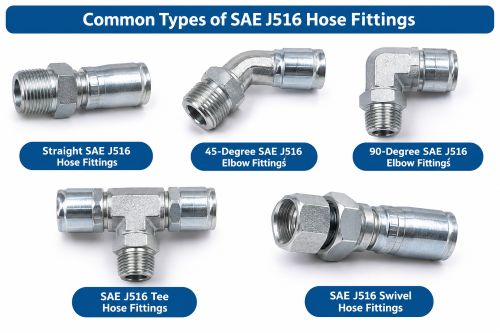
Hydraulic hose fittings come in different shapes and configurations to accommodate equipment layouts and connection requirements. The following are common configurations found in hydraulic hose fitting product ranges.
Straight SAE J516 Hose Fittings
Straight hose fittings provide a direct connection between a hydraulic hose and a compatible threaded port or adapter.
Their simple design makes them suitable for installations where the hose can follow a relatively straight routing path. They are widely used because they are easy to install and generally require less space than angled alternatives.
Common applications include:
1. Hydraulic pump connections.
2. Hydraulic cylinder ports.
3. Industrial production machinery.
4. Hydraulic power units.
5. General-purpose hydraulic hose assemblies.
Straight fittings are a practical choice when the hose and connection port are aligned. However, engineers should still consider the minimum hose bending radius to prevent excessive stress during installation.
45-Degree SAE J516 Elbow Fittings
45-degree elbow fittings change the direction of a hydraulic hose by 45 degrees. They are useful when a straight connection would interfere with nearby components or create an unsuitable hose routing arrangement.
The angled design provides greater flexibility when connecting hydraulic components positioned at different orientations.
Common applications include:
1. Compact industrial hydraulic systems.
2. Mobile construction machinery.
3. Agricultural equipment.
4. Hydraulic power assemblies.
5. Equipment with angled hose routing requirements.
When selecting a 45-degree elbow fitting, consider the available installation clearance, hose dimensions, connection orientation, and potential interference with surrounding components.
90-Degree SAE J516 Elbow Fittings
90-degree elbow fittings redirect a hydraulic hose at a right angle. They are particularly useful in equipment where available installation space is limited or where hydraulic components are positioned perpendicular to each other.
Compared with straight fittings, 90-degree configurations provide more flexibility for routing hoses around machine structures and other components.
Common applications include:
1. Hydraulic cylinders.
2. Construction equipment.
3. Agricultural machinery.
4. Industrial production systems.
5. Hydraulic manifolds and power units.
A properly selected 90-degree fitting can help simplify hose routing and reduce unnecessary bending. It is important to check the fitting orientation and ensure that the hose is not twisted after installation.
SAE J516 Tee Hose Fittings
Tee fittings feature three connection ports arranged in a T-shaped configuration. They allow hydraulic lines to branch from a main connection, making them useful in systems that distribute fluid to multiple components.
Depending on the design, tee configurations may connect different hose assemblies or combine hose and threaded-port connections.
Common applications include:
1. Hydraulic fluid distribution systems.
2. Multi-cylinder hydraulic circuits.
3. Industrial machinery.
4. Hydraulic power units.
5. Equipment requiring multiple branch connections.
When selecting a tee fitting, check the connection sizes, port types, pressure requirements, and intended flow arrangement. The fitting must also be suitable for the hydraulic circuit’s operating conditions.
SAE J516 Swivel Hose Fittings
Swivel hose fittings feature a rotating connection component that allows easier alignment during installation. This design is particularly useful when connecting hydraulic hoses to components where the final hose orientation needs adjustment.
Swivel fittings can help reduce installation difficulties and prevent unnecessary hose twisting when properly selected and assembled.
Common applications include:
1. Mobile hydraulic equipment.
2. Industrial machinery.
3. Hydraulic power systems.
4. Equipment with restricted installation access.
5. Hydraulic hose assemblies requiring adjustable orientation.
Buyers should verify the swivel design, thread compatibility, sealing method, and pressure rating before selecting these fittings.
Materials Used in SAE J516 Hose Fittings
Material selection has a direct impact on fitting strength, corrosion resistance, durability, and overall service life.
The most suitable material depends on the hydraulic system’s operating pressure, working environment, fluid compatibility, and maintenance requirements.
Carbon Steel
Carbon steel is widely used in hydraulic hose fitting manufacturing because it offers good mechanical strength and is generally cost-effective.
It is suitable for many industrial and mobile hydraulic applications where the fittings are exposed to typical operating conditions.
Advantages include:
1. Good mechanical strength.
2. Suitable for many high-pressure hydraulic applications when properly designed.
3. Cost-effective for large-scale manufacturing.
4. Available in various fitting configurations.
5. Compatible with different protective surface treatments.
Carbon steel fittings are commonly used in construction machinery, agricultural equipment, industrial hydraulic systems, and hydraulic power units.
Stainless Steel
Stainless steel fittings are selected when corrosion resistance is an important requirement. They are particularly useful in environments exposed to moisture, chemicals, or other corrosive substances.
Common advantages include:
1. Excellent corrosion resistance, depending on the stainless steel grade.
2. Good durability in demanding environments.
3. Suitable for many industrial and outdoor applications.
4. Reduced dependence on external protective coatings.
Stainless steel hydraulic hose fittings are commonly used in marine equipment, chemical processing facilities, food-related industrial equipment, and other environments where corrosion protection is important.
Brass
Brass offers good corrosion resistance and machinability. It is used in certain fluid connection applications where its mechanical and chemical properties are suitable.
However, brass is not a universal replacement for steel hydraulic fittings. Its strength and pressure capabilities must be evaluated against the requirements of the specific application.
Before selecting brass fittings, buyers should verify the manufacturer’s pressure ratings, fluid compatibility, and intended service conditions.
Surface Treatments and Finishing Options
Surface treatment helps improve the corrosion resistance and appearance of hydraulic fittings. For carbon steel components in particular, protective coatings can extend service life when fittings are exposed to moisture and other environmental factors.
Common finishing options include:
Zinc Plating
Zinc plating provides a protective coating that helps reduce corrosion on carbon steel fittings. It is commonly used for general industrial and hydraulic applications.
Zinc-Nickel Plating
Zinc-nickel plating provides enhanced corrosion protection compared with conventional zinc plating when properly applied. It is suitable for applications requiring improved resistance to harsh environmental conditions.
Trivalent Chromium (Cr3) Finishing
Trivalent chromium treatments are used in certain protective finishing systems to improve coating performance and support environmental compliance requirements.
Hexavalent Chromium (Cr6) Finishing
Hexavalent chromium has historically been used in some corrosion-protection processes. However, its use is restricted or regulated in many markets because of environmental and health concerns.
Stainless Steel Passivation
Passivation helps improve the corrosion resistance of stainless steel by removing free iron contaminants and supporting the formation of its protective passive surface layer.
Electroless Nickel Plating
Electroless nickel provides a uniform coating that can improve corrosion and wear resistance. It may be selected for specialized applications requiring particular surface properties.
The appropriate finishing option depends on the operating environment, required corrosion resistance, applicable regulations, and customer specifications.
Common Applications of SAE J516 Hose Fittings
Hydraulic hose fittings are used across many industries because they connect flexible hydraulic lines to different components and help transport pressurized fluid throughout a system.
SAE J516-compatible fittings are used in applications where the selected hose and fitting combination meets the relevant technical and operating requirements.
Construction and Earthmoving Equipment
Excavators, loaders, bulldozers, and other construction machines use hydraulic systems to operate cylinders, motors, and other equipment. Hose fittings connect hydraulic lines to these components and must withstand demanding operating conditions.
Agricultural Machinery
Tractors, harvesters, sprayers, and other agricultural machines depend on hydraulic systems for lifting, steering, and equipment control. Reliable hose connections help maintain consistent machine operation.
Industrial Hydraulic Systems
Manufacturing equipment, hydraulic presses, injection molding machines, and automated production systems use hydraulic hose assemblies to transfer pressurized fluid between components.
Hydraulic Power Units
Hydraulic power units supply pressurized fluid to cylinders, motors, and other hydraulic equipment. Hose fittings connect pumps, valves, reservoirs, and other components through compatible hydraulic lines.
Material Handling Equipment
Forklifts, lifting platforms, and industrial handling machines use hydraulic systems to control lifting and movement functions. Properly selected hose fittings help maintain dependable hydraulic connections.
Transportation and Mobile Equipment
Various mobile machines and specialized vehicles use hydraulic systems for steering, braking-related auxiliary functions, lifting, and other mechanical operations. Fitting selection must account for vibration, temperature, pressure, and installation conditions.
How to Select the Right SAE J516 Hose Fittings
Choosing the correct hose fitting requires more than matching the thread size. Buyers and engineers should evaluate several technical factors to ensure that the fitting works properly with the hose and hydraulic system.
Here are the most important considerations.
1. Check Hydraulic Hose Compatibility
Start by identifying the hydraulic hose specification, size, construction, and intended working conditions.
The hose and fitting must be designed to work together. Using an incompatible fitting can result in poor retention, leakage, or premature assembly failure.
2. Verify Connection Type and Thread Specifications
Hydraulic hose fittings are available with different connection interfaces and thread types.
Check the thread dimensions, sealing method, and mating connection requirements. Common hydraulic connection systems include JIC, ORFS, BSP, NPT, and metric connections.
Do not assume that fittings with similar thread dimensions are interchangeable because their sealing mechanisms may differ.
3. Consider Operating Pressure
The fitting must be rated for the hydraulic system’s maximum operating pressure, including relevant pressure surges.
Also, remember that the pressure capability of a complete hose assembly depends on the hose, fitting, assembly method, and other components. The lowest-rated component limits the assembly’s overall pressure capability.
4. Evaluate Hydraulic Fluid Compatibility
The fitting material and sealing elements must be compatible with the hydraulic fluid being used.
Different fluids can affect metals, elastomers, and protective coatings in different ways. Check the manufacturer’s compatibility information before purchasing.
5. Select the Appropriate Material
Choose carbon steel for many general-purpose hydraulic applications, stainless steel for environments requiring greater corrosion resistance, or brass where its properties are appropriate.
The material should meet both mechanical and environmental requirements.
6. Consider Installation Space and Orientation
Straight, 45-degree, and 90-degree fittings serve different hose routing requirements.
Consider the available installation space, nearby components, hose bending radius, and accessibility for maintenance. Selecting the right configuration can make installation easier and reduce unnecessary hose stress.
7. Verify Applicable Standards
Check the relevant SAE, ISO, or other applicable specifications for the hose, fitting, and connection interface.
Standard compliance should be verified against the manufacturer’s technical documentation rather than assumed from the product name alone.
8. Choose a Reliable Manufacturer
A dependable manufacturer should provide consistent dimensions, material information, quality control, and technical support.
For OEM buyers and distributors, manufacturing capacity, customization options, production lead times, and product consistency are also important purchasing considerations.
SAE J516 Hose Fittings vs. Other Hydraulic Hose Fitting Standards
Several international standards are used in hydraulic hose and connection manufacturing. Understanding their different purposes helps buyers avoid compatibility problems.
|
Standard |
Main Focus |
|
SAE J516 |
Hydraulic hose fittings |
|
Hydraulic hose specifications |
|
|
Hydraulic hose fittings and connections |
|
|
Metallic tube connections for fluid power and general use |
SAE J516 vs. SAE J517
SAE J516 and SAE J517 are closely related but cover different components.
SAE J516 addresses hydraulic hose fittings, while SAE J517 specifies requirements for hydraulic hoses.
When manufacturing a hydraulic hose assembly, both hose and fitting requirements need to be considered. A fitting should be selected based on its compatibility with the particular hose type and assembly instructions.
SAE J516 vs. ISO 12151
ISO 12151 is an international standard series covering hydraulic hose fittings and connections.
Both SAE J516 and ISO 12151 are relevant to hydraulic hose connection applications. However, their requirements and individual fitting configurations should be checked separately.
Buyers should not assume that a fitting manufactured to one standard automatically meets every requirement of another standard.
SAE J516 vs. ISO 8434
ISO 8434 covers metallic tube connections used in fluid power and general applications.
Unlike hose fitting standards, ISO 8434 primarily addresses tube connection systems. These connections are commonly used in rigid hydraulic tube assemblies.
Understanding this distinction helps engineers choose the correct components for flexible hose lines and rigid tube connections.
Common Installation and Maintenance Considerations
Even high-quality hydraulic hose fittings can fail prematurely if they are installed incorrectly or operated outside their intended conditions.
Following proper installation and maintenance practices helps improve connection reliability.
Verify Compatibility Before Assembly
Confirm that the hose, fitting, thread type, and sealing components are compatible. Check the manufacturer’s assembly instructions before beginning installation.
Follow Recommended Assembly Procedures
Use the correct assembly equipment and follow the specified insertion, crimping, or tightening procedures for the fitting design.
Incorrect assembly can damage the hose or reduce fitting retention.
Avoid Excessive Hose Twisting
Twisting a hydraulic hose during installation can create additional stress on the hose and fitting connection. Ensure that the hose is properly aligned before tightening the connection.
Maintain the Correct Bending Radius
Avoid sharp bends and excessive hose curvature. Always follow the hose manufacturer’s minimum bending radius recommendations.
Inspect Connections Regularly
Check hydraulic hose assemblies for visible damage, corrosion, leakage, loose connections, and signs of wear.
Damaged components should be replaced according to the equipment manufacturer’s maintenance recommendations.
Conduct Appropriate Pressure Testing
Newly assembled hydraulic hose systems should be tested using suitable procedures and equipment before being placed into service. Follow applicable safety requirements and manufacturer recommendations.
Never use your hands to check for hydraulic fluid leaks because high-pressure fluid can penetrate the skin and cause serious injuries.
Why Choose Sannke for SAE J516 Hose Fittings?
Selecting a reliable hydraulic fitting manufacturer is important for equipment manufacturers, distributors, and industrial buyers who require consistent product quality and dependable supply.
Sannke specializes in hydraulic fittings and connection components, providing manufacturing and customization solutions for different industrial and mobile hydraulic applications.
With 15 years of manufacturing experience, Sannke supports customers looking for standard hydraulic fittings as well as customized OEM and ODM products.
Key manufacturing services include:
OEM and ODM Manufacturing
Sannke provides OEM and ODM services to support customers with different product specifications, connection requirements, and application needs. Custom hydraulic hose fittings, adapters, ferrules, flanges, and related accessories can be manufactured according to approved drawings and technical requirements.
Multiple Material Options
Customers can choose from carbon steel, stainless steel, and brass, depending on the intended application and performance requirements.
Surface Treatment Options
Available finishing solutions include zinc plating, zinc-nickel plating, Cr3 and Cr6-related finishing options where applicable, stainless steel passivation, and electroless nickel plating.
Engineering and Manufacturing Support
Sannke combines engineering expertise with advanced manufacturing equipment to support product development, dimensional requirements, and customized fitting production.
Free Sample Support
Free samples are available for product evaluation, helping customers assess fitting dimensions, workmanship, and compatibility before moving forward with larger orders.
Custom Branding
Customers can request customized product designs and logo printing to support their own brands and distribution requirements.
Whether you need standard hydraulic hose fittings or customized connection components, working with an experienced manufacturer can help simplify sourcing and support consistent product quality.
Frequently Asked Questions (FAQs)
1. What is the SAE J516 standard?
SAE J516 is an SAE International standard covering hydraulic hose fittings. It provides requirements for fittings used in hydraulic hose assemblies and helps establish consistent connection designs and performance expectations.
2. What are SAE J516 hose fittings used for?
SAE J516 hose fittings are used to connect compatible hydraulic hoses to pumps, cylinders, valves, manifolds, and other hydraulic components. They are commonly found in construction equipment, agricultural machinery, industrial systems, and mobile hydraulic applications.
3. What types of SAE J516 hose fittings are available?
Hydraulic hose fitting product ranges include straight fittings, 45-degree elbows, 90-degree elbows, tee fittings, and swivel configurations. The available designs depend on the specific fitting series and manufacturer.
4. What materials are commonly used for SAE J516 hose fittings?
Carbon steel and stainless steel are commonly used materials. Brass is also available for certain fluid connection applications where its mechanical properties and pressure capabilities are suitable.
5. Are SAE J516 hose fittings compatible with SAE J517 hydraulic hoses?
SAE J516 and SAE J517 address related but different components. SAE J516 covers hydraulic hose fittings, while SAE J517 covers hydraulic hose requirements. Compatibility depends on the specific hose and fitting series, so manufacturers’ assembly specifications should always be checked.
6. What is the difference between SAE J516 and ISO 12151?
Both standards address hydraulic hose fitting applications, but they have their own technical requirements and connection specifications. Buyers should verify the applicable fitting design and dimensional compatibility before using products from different standards.
7. How do you select the correct SAE J516 hose fitting?
Consider hose size, fitting connection type, thread specifications, operating pressure, hydraulic fluid compatibility, material, installation space, and manufacturer requirements. The fitting must be compatible with the hose and the complete hydraulic assembly.
8. Can SAE J516 hose fittings be customized?
Yes. Hydraulic fitting manufacturers can provide OEM and ODM customization based on customer drawings, dimensions, materials, connection requirements, and application specifications. Customization should be verified against the relevant technical and performance requirements.
Conclusion
SAE J516 hose fittings are important components in hydraulic hose assemblies, providing standardized connection solutions for different industrial and mobile equipment applications.
Understanding the standard, fitting configurations, material options, and installation requirements helps engineers and buyers select suitable components for their hydraulic systems.
Before purchasing, always verify hose compatibility, connection specifications, operating pressure, material requirements, and manufacturer documentation.
For businesses seeking reliable hydraulic fitting solutions, Sannke offers OEM and ODM manufacturing, multiple material and finishing options, engineering support, and customized product services to meet different hydraulic connection requirements.
Post time: Nov-25-2026