

Hydraulic hose fittings play an important role in connecting hoses to different components of a hydraulic system. They help maintain secure connections, support fluid transfer, and ensure that hydraulic equipment operates reliably. However, not all hose fittings have the same design. Depending on the installation requirements, straight, elbow, and tee configurations serve different purposes.
ISO 12151 is a series of international standards covering hydraulic hose fittings and their connection requirements. These fittings are available in different configurations to accommodate various hydraulic system layouts, pressure requirements, and installation conditions.
Understanding the differences between straight, elbow, and tee ISO 12151 hose fittings can help engineers, equipment manufacturers, and hydraulic system buyers select the right components for their applications.
In this guide, we’ll explore their designs, advantages, common applications, and the factors to consider when choosing the right hydraulic hose fitting.
What Are ISO 12151 Hose Fittings?
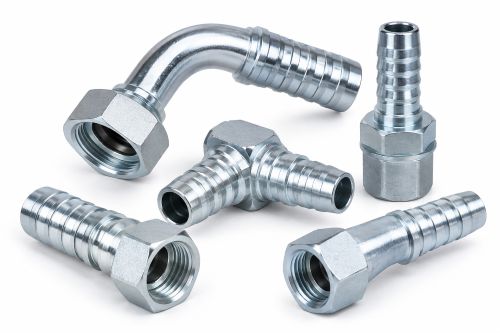
ISO 12151 hose fittings are hydraulic connectors designed according to the applicable requirements of the ISO 12151 series. They are used to connect hydraulic hoses to pumps, valves, cylinders, manifolds, and other hydraulic components.
These fittings help create secure connections that can withstand the pressure, vibration, and operating conditions commonly found in hydraulic systems.
The ISO 12151 series covers different hose fitting connection designs. For example:
1. ISO 12151-1: Hose fittings with ISO 8434-3 O-ring face seal (ORFS) connections.
2. ISO 12151-2: Hose fittings with ISO 8434-1 24-degree cone connections.
3. ISO 12151-3: Hose fittings with ISO 6162 flange connections.
The specific requirements depend on the relevant standard part and connection design.
Besides connection standards, hydraulic hose fittings are available in different body configurations. Straight, elbow, and tee designs are commonly used to accommodate different hose routing and connection requirements.
Straight ISO 12151 Hose Fittings: Design and Applications
Straight hydraulic hose fittings have a linear body that allows the hose to connect directly to a hydraulic port or component. Their simple design makes them a practical choice for installations where the hose can follow a relatively direct path.
Key Features of Straight Hose Fittings
A typical straight hydraulic hose fitting consists of several components:
1. Fitting body: Provides the main structure and connection passage for hydraulic fluid.
2. Hose connection end: Connects the fitting to the hydraulic hose assembly.
3. Threaded or mating connection: Attaches the fitting to the corresponding hydraulic component.
4. Sealing surface: Creates a leak-resistant connection using the specified sealing arrangement.
Depending on the applicable connection standard, the fitting may use an O-ring face seal, a 24-degree cone connection, or a flange connection.
Advantages of Straight Hydraulic Hose Fittings
Straight fittings offer several practical benefits:
1. Simple installation: Their linear design makes them relatively easy to position and install.
2. Direct hose routing: They provide a straightforward connection between hydraulic components.
3. Compact connection design: They are useful when the hose and port are already aligned.
4. Fewer directional changes: They can help avoid unnecessary bends in hydraulic hose assemblies.
Common Applications
Straight ISO 12151 hose fittings are commonly used in:
1. Hydraulic power units
2. Industrial machinery
3. Hydraulic cylinders
4. Construction equipment
5. Agricultural machinery
6. Mobile hydraulic systems
They are particularly suitable when the hose can connect directly to the equipment without requiring a significant change in direction.
Elbow ISO 12151 Hose Fittings: Design and Applications
Elbow hydraulic hose fittings are designed to change the direction of a hose connection. Unlike straight fittings, their bodies have an angled configuration that allows hoses to connect to ports positioned at different orientations.
They are especially useful in hydraulic systems where installation space is limited or where direct hose routing would create excessive bending.
Common Types of Elbow Hose Fittings
Elbow fittings are available in several angular configurations.
A 45-degree elbow fitting changes the hose direction by 45 degrees. It provides a moderate directional change while helping maintain a smoother hose routing path.
Common applications include industrial hydraulic equipment, agricultural machinery, and hydraulic assemblies with angled connection points.
A 90-degree elbow fitting changes the connection direction by 90 degrees. It is useful when hydraulic hoses need to turn around corners or connect to ports positioned perpendicular to the hose.
These fittings are frequently used in compact machinery, construction equipment, and hydraulic systems with limited installation clearance.
Key Features of Elbow Hose Fittings
A typical elbow fitting includes:
1. Angled fitting body: Changes the direction of the hydraulic connection.
2. Hose connection end: Provides the connection to the hydraulic hose.
3. Threaded or mating connection: Attaches to the hydraulic port.
4. Sealing components: Help prevent hydraulic fluid leakage.
The connection and sealing design must match the applicable ISO 12151 and mating connection requirements.
Advantages of Elbow Hydraulic Hose Fittings
Elbow fittings provide several advantages:
1. Flexible hose routing: They allow hoses to follow different directions.
2. Space optimization: They can simplify connections in compact installations.
3. Reduced hose bending: Properly selected elbow fittings can help avoid tight bends near connection points.
4. Improved accessibility: They can make hydraulic connections easier to position in difficult installation areas.
Common Applications
Elbow ISO 12151 hose fittings are widely used in:
1. Construction and earthmoving equipment
2. Agricultural machinery
3. Industrial hydraulic systems
4. Mining equipment
5. Mobile hydraulic equipment
6. Compact hydraulic power units
When selecting an elbow fitting, engineers should consider the angle, available clearance, hose bending radius, and connection orientation.
Tee ISO 12151 Hose Fittings: Design and Applications
Tee hydraulic hose fittings have three connection points arranged in a T-shaped configuration. Their primary purpose is to connect a main hydraulic line with a branch connection.
Unlike straight and elbow fittings, which primarily provide direct or angled connections, tee fittings allow hydraulic systems to distribute or combine fluid through multiple connection points.
Common Types of Tee Hose Fittings
Tee fittings are available in different configurations depending on the connection requirements.
Equal Tee Fittings
Equal tee fittings have three connection ports of the same nominal connection size. They are commonly used when a hydraulic line needs to branch into two lines with matching connection dimensions.
Reducing Tee Fittings
Reducing tee fittings have connection ports with different nominal sizes. They are useful when connecting hydraulic lines or components with different connection dimensions.
Branch Tee Fittings
Branch tee fittings provide a main connection path with an additional branch connection. Their exact configuration depends on the hydraulic connection design and application requirements.
Key Features of Tee Hose Fittings
A typical tee hydraulic fitting includes:
1. Main fitting body: Forms the central structure of the connector.
2. Three connection ports: Allow multiple hydraulic connections.
3. Hose or component connection ends: Connect to hydraulic hoses or compatible components.
4. Sealing surfaces: Provide the required sealing at each connection.
Advantages of Tee Hydraulic Hose Fittings
Tee fittings offer several benefits:
1. Multiple connections: They connect three hydraulic lines or components through one fitting body.
2. Fluid distribution: They can provide a branch connection for distributing hydraulic fluid.
3. Simplified layouts: They help reduce the need for several separate connection components.
4. Flexible system design: They support different hydraulic circuit configurations.
Common Applications
Tee ISO 12151 hose fittings are commonly found in:
1. Hydraulic distribution systems
2. Industrial machinery
3. Agricultural equipment
4. Construction machinery
5. Mobile hydraulic circuits
6. Hydraulic power systems
It is important to remember that a tee fitting does not automatically control or regulate fluid flow. Its primary function is to provide a branching connection. The actual flow distribution depends on the hydraulic circuit design and operating conditions.
Straight vs. Elbow vs. Tee ISO 12151 Hose Fittings: Key Differences
Although all three configurations are used in hydraulic hose assemblies, their structural designs and functions are different.
Understanding these differences makes it easier to determine which fitting is appropriate for a particular installation.
|
Comparison |
Straight Fittings |
Elbow Fittings |
Tee Fittings |
|
Design |
Linear body |
Angled body |
T-shaped body |
|
Connection direction |
Direct connection |
Changes direction |
Provides a branch connection |
|
Main purpose |
Connect two components |
Redirect hose routing |
Connect three lines or components |
|
Installation |
Straight hose routing |
Angled hose routing |
Branching hydraulic circuits |
|
Space requirements |
Depends on hose alignment |
Useful for restricted routing areas |
Requires clearance for three connections |
|
Typical application |
Direct hydraulic connections |
Tight or angled installations |
Hydraulic fluid distribution |
Which Configuration Should You Choose?
The best choice depends on the hydraulic system layout.
1. Choose straight fittings when the hose and hydraulic port are aligned.
2. Choose elbow fittings when the hose needs to change direction or avoid installation obstacles.
3. Choose tee fittings when a hydraulic line needs an additional branch connection.
Selecting the appropriate configuration can simplify installation, improve hose routing, and help maintain reliable hydraulic connections.
How to Choose the Right ISO 12151 Hose Fitting Configuration
Choosing the correct hydraulic hose fitting involves more than selecting a straight, elbow, or tee design. You also need to consider connection compatibility, operating pressure, materials, and installation conditions.
Here are several important factors to evaluate.
Consider the Hydraulic System Layout
Start by examining the arrangement of the hydraulic components and connection ports.
Determine whether the hose can connect directly or requires a directional change. If multiple hydraulic lines need to connect to the same circuit, a suitable tee configuration may be necessary.
A basic selection approach is:
1. Straight fittings for direct connections.
2. Elbow fittings for directional changes.
3. Tee fittings for branching connections.
Check Operating Pressure and Flow Requirements
Hydraulic systems operate under different pressure and flow conditions. Therefore, the selected fitting must be suitable for the system’s operating requirements.
Consider the following:
1. Maximum working pressure
2. Pressure spikes and pulsation
3. Required flow capacity
4. Hydraulic fluid compatibility
5. Operating temperature
Always check the manufacturer’s pressure ratings for the complete fitting and hose assembly. Do not assume that fittings with similar dimensions have identical pressure capabilities.
Confirm Thread and Connection Compatibility
Connection compatibility is essential for preventing leaks and installation problems.
Before purchasing ISO 12151 hose fittings, verify:
1. Connection standard and applicable ISO 12151 part
2. Thread type and size
3. Mating port specifications
4. Sealing arrangement
5. Hose connection dimensions
For example, an ORFS connection uses a different sealing arrangement from a 24-degree cone connection. These connection types should not be treated as interchangeable simply because their threads or dimensions appear similar.
Evaluate Installation Space
Available installation space can determine which fitting configuration is most suitable.
Straight fittings work well when there is sufficient room for direct hose routing. Elbow fittings are useful when the hose needs to turn around nearby components. Tee fittings require additional clearance for the branch connection.
Also consider the manufacturer’s recommended minimum hose bending radius. Even when an elbow fitting is used, the hose should not be forced into an excessively tight bend.
Select Suitable Materials and Surface Treatments
Material selection affects fitting strength, corrosion resistance, and service life.
Common material options include:
Carbon Steel: A widely used option for general hydraulic applications. It offers good mechanical strength and can be supplied with protective surface treatments.
Stainless Steel: Suitable for environments where corrosion resistance is particularly important, including certain marine, chemical, and outdoor applications.
Brass: Used in selected fluid connection applications where its mechanical and chemical properties are appropriate. Its suitability for a specific hydraulic pressure rating must be verified.
Surface treatments such as zinc plating, zinc-nickel plating, and passivation can provide additional corrosion protection, depending on the base material.
Common Applications of ISO 12151 Hose Fittings
ISO 12151 hose fittings are used across various industries where hydraulic hose assemblies connect equipment components and transfer pressurized fluid.
Some common applications include:
Construction Equipment
Excavators, loaders, bulldozers, and other construction machines use hydraulic hose fittings to connect pumps, cylinders, control valves, and hydraulic circuits.
Straight fittings provide direct connections, elbow fittings help with compact hose routing, and tee fittings support branching connections.
Agricultural Machinery
Tractors, harvesters, and other agricultural machines rely on hydraulic connections for lifting, steering, and operating attachments.
Different fitting configurations help accommodate the varying connection positions found in agricultural equipment.
Industrial Hydraulic Systems
Manufacturing machinery, hydraulic presses, and automated production equipment use hose fittings to connect hydraulic components.
Reliable connections are important for maintaining system performance and minimizing fluid leakage.
Mining Equipment
Mining machinery often operates in demanding environments involving vibration, dust, and heavy mechanical loads. Properly specified hydraulic fittings help maintain secure connections under these conditions.
Material Handling Equipment
Forklifts, lifting platforms, and other material handling machines use hydraulic systems for lifting and positioning loads. Different hose fitting configurations help accommodate their hydraulic layouts.
Common Mistakes When Selecting ISO 12151 Hose Fittings
Even a high-quality hydraulic fitting may cause problems if it is incorrectly selected or installed.
Here are some common mistakes to avoid.
1. Choosing the wrong configuration: Using a straight fitting when an elbow is needed can create unnecessary hose bending or installation difficulties.
2. Mixing incompatible connection standards: Different sealing designs and connection specifications are not necessarily interchangeable.
3. Ignoring pressure requirements: A fitting must have an appropriate pressure rating for the hydraulic system.
4. Selecting incorrect thread sizes: Incorrect thread dimensions can lead to poor engagement, damaged connections, and leakage.
5. Overlooking hose bending radius: Excessive bending can damage the hose and shorten its service life.
6. Using unsuitable materials: Material selection should account for operating conditions, hydraulic fluid, and corrosion exposure.
7. Incorrect installation: Improper tightening or assembly can damage sealing surfaces and compromise connection reliability.
Following the relevant installation instructions and checking connection specifications before assembly can help prevent these issues.
Why Quality Matters When Choosing ISO 12151 Hose Fittings
The quality of hydraulic hose fittings directly affects connection reliability and overall system performance.
Poorly manufactured fittings may have dimensional inconsistencies, inadequate surface finishes, or defective sealing areas. These problems can result in installation difficulties, leakage, and premature component failure.
When evaluating a hydraulic fittings manufacturer, consider the following factors:
1. Dimensional accuracy: Fittings should meet the applicable dimensional and connection requirements.
2. Material quality: Materials should be appropriate for the intended pressure and operating environment.
3. Sealing performance: Connection surfaces and sealing components should provide reliable leak resistance.
4. Corrosion protection: Suitable surface treatments help protect fittings from environmental exposure.
5. Manufacturing consistency: Controlled production processes support consistent product quality.
6. Quality inspection: Inspection procedures help identify manufacturing defects before shipment.
Working with an experienced manufacturer can make it easier to source hydraulic hose fittings that meet specific equipment and application requirements.
Why Choose Sannke for Hydraulic Hose Fittings?
Sannke is a hydraulic fittings manufacturer offering a range of hydraulic connection products and customized manufacturing solutions for industrial customers.
For buyers looking for straight, elbow, tee, and other hydraulic hose fitting configurations, Sannke provides manufacturing support based on different application requirements.
Key services and capabilities include:
OEM and ODM Manufacturing
Sannke supports OEM and ODM projects, allowing customers to request hydraulic hose fittings based on their drawings, samples, technical specifications, and application requirements.
Custom Hydraulic Fitting Solutions
Customers can request customized hose fittings, adapters, ferrules, flanges, and related hydraulic accessories. Available configurations and specifications can be discussed with the engineering team.
Multiple Material Options
Sannke offers hydraulic fitting products in carbon steel, stainless steel, and brass, depending on product design and application requirements.
Surface Treatment Options
Available finishing options include zinc plating, zinc-nickel plating, Cr3 and Cr6-related finishes, and stainless steel passivation. Specific treatments can be selected according to corrosion protection requirements and applicable regulations.
Engineering and Manufacturing Support
With experienced engineers and advanced manufacturing equipment, Sannke supports customers in developing hydraulic connection products for different industrial applications.
Free Sample Support
Free samples are available for product evaluation, subject to product specifications and availability. This allows buyers to assess product suitability before moving forward with larger orders.
Whether you need standard hydraulic hose fittings or customized connection solutions, Sannke can help you identify suitable products for your hydraulic equipment and manufacturing projects.
Frequently Asked Questions (FAQs)
1. What is the difference between straight and elbow hydraulic hose fittings?
Straight fittings have a linear body that provides a direct connection between hydraulic components. Elbow fittings have an angled body, typically available in 45-degree and 90-degree configurations, to change the direction of the hose connection.
2. When should you use a 90-degree hydraulic hose fitting?
A 90-degree hydraulic hose fitting is useful when a hose needs to connect to a port positioned perpendicular to its routing direction. It is particularly helpful in compact hydraulic systems where installation space is limited.
3. What is the purpose of a tee hydraulic hose fitting?
A tee hydraulic hose fitting provides three connection points, allowing a hydraulic line to branch into another line or connect multiple components. It is commonly used in hydraulic distribution circuits.
4. Are straight, elbow, and tee fittings covered by ISO 12151?
ISO 12151 is a series of standards covering hydraulic hose fittings with different connection designs. The applicable requirements depend on the relevant part of the series and the fitting’s connection configuration. Not every possible straight, elbow, or tee design is automatically covered by every part.
5. How do I choose the correct ISO 12151 hose fitting?
Consider the required fitting configuration, connection standard, thread size, operating pressure, hose dimensions, material, and installation space. Always verify compatibility with the mating hydraulic components.
6. What materials are commonly used for ISO 12151 hose fittings?
Carbon steel and stainless steel are commonly used materials. Brass is also available for selected applications where its mechanical properties and pressure suitability meet the requirements.
7. Can ISO 12151 hose fittings be customized?
Yes. Hydraulic fitting manufacturers can offer customized configurations, dimensions, materials, surface treatments, and connection specifications according to customer drawings and application requirements.
8. How do you ensure compatibility between hydraulic hose fittings and connectors?
Check the applicable connection standard, thread dimensions, sealing design, hose specifications, and pressure rating. Using components designed for compatible connection systems helps ensure proper installation and reliable sealing.
Conclusion
Straight, elbow, and tee ISO 12151 hose fittings serve different purposes in hydraulic systems. Straight fittings provide direct connections, elbow fittings help change hose direction, and tee fittings create additional connection branches.
Choosing the right configuration requires careful consideration of system layout, operating pressure, thread compatibility, available installation space, and material requirements.
For hydraulic equipment manufacturers, distributors, and industrial buyers, working with a reliable hydraulic fittings manufacturer can help ensure consistent product quality and suitable connection solutions.
Sannke provides standard and customized hydraulic fitting solutions, including OEM and ODM manufacturing, multiple material options, and engineering support for different hydraulic applications.
Post time: Nov-20-2026