

Hydraulic fittings play an important role in connecting tubes, pipes, and other components within hydraulic systems. They help maintain reliable fluid flow, prevent leakage, and ensure that equipment operates safely under different pressure conditions. However, not all hydraulic connections are designed in the same way. Differences in thread types, sealing methods, dimensions, and materials can affect the performance and compatibility of hydraulic components.
This is where ISO 8434 becomes important. It is an international standard that specifies requirements for metallic tube connections used in hydraulic and general-purpose fluid power applications. The standard covers several connection designs, including 24° cone, 37° flared, and O-ring face seal fittings.
Understanding ISO 8434 hydraulic fittings helps engineers, equipment manufacturers, and purchasing professionals select compatible connections for their applications. In this guide, we will explore the different parts of ISO 8434, common fitting types, materials, technical specifications, and industrial applications.
What Is the ISO 8434 Standard?
ISO 8434 is an international standard covering metallic tube connections for fluid power and general-purpose applications. It establishes requirements for connection designs, dimensions, performance, and other technical characteristics to support reliable connections between compatible hydraulic components.
The standard is divided into several parts, each addressing a different connection design.
Its primary purpose is to help manufacturers and users maintain consistency when designing, producing, and selecting hydraulic fittings. Standardized connections make it easier to identify suitable components and reduce compatibility problems during installation or equipment maintenance.
ISO 8434 is particularly relevant in industries where hydraulic systems operate under demanding conditions, including construction, agriculture, manufacturing, transportation, and industrial automation.
Some important benefits include:
1. Standardized dimensions: Helps ensure dimensional consistency between compatible components.
2. Reliable sealing: Defines connection designs intended to provide dependable sealing performance.
3. Component compatibility: Makes it easier to select matching tubes and fittings.
4. Manufacturing consistency: Provides technical requirements that manufacturers can use during production and inspection.
5. Wide industrial applications: Supports hydraulic connection requirements across different equipment types.
Different Parts of the ISO 8434 Standard
ISO 8434 consists of different parts covering specific types of metallic tube connections. The three commonly referenced parts are ISO 8434-1, ISO 8434-2, and ISO 8434-3.
Each uses a different connection design and sealing method.
ISO 8434-1: 24° Cone Connectors
ISO 8434-1 covers 24° cone connectors used in hydraulic and general-purpose fluid power applications.
These fittings are commonly associated with metric hydraulic tube connection systems. Their design uses a 24° cone sealing interface to connect a tube to a fitting body.
Depending on the connection design, sealing may involve a cutting ring, an elastomeric seal, or another specified sealing arrangement.
A typical 24° cone fitting assembly includes:
1. Fitting body
2. Tube nut
3. Cutting ring or applicable sealing component
4. Hydraulic tube
During installation, the tube is positioned inside the fitting body and secured using the appropriate nut and sealing components. The connection creates a mechanical joint designed to resist leakage and withstand operating pressure when correctly assembled.
Common applications:
1. Construction machinery
2. Agricultural equipment
3. Industrial hydraulic systems
4. Mobile hydraulic equipment
5. Hydraulic power units
ISO 8434-1 is closely related to DIN 2353-style hydraulic tube connections, making it particularly relevant for equipment using metric tube fitting systems. However, users should verify the applicable dimensions and connection requirements rather than assuming every DIN and ISO component is interchangeable.
ISO 8434-2: 37° Flared Connectors
ISO 8434-2 covers 37° flared connectors used in hydraulic and general-purpose fluid power systems.
Unlike 24° cone fittings, these connectors use a 37° flared tube end to create the sealing interface.
A typical 37° flare connection consists of:
1. Fitting body
2. Flare nut
3. Flared tube end
4. Hydraulic tube
During installation, the flared tube end is positioned against the matching 37° seat on the fitting body. Tightening the flare nut secures the connection and brings the two metal surfaces together.
The resulting metal-to-metal sealing interface provides a compact connection when the tube is properly prepared and assembled.
Common applications:
1. Industrial hydraulic equipment
2. Mobile machinery
3. Agricultural hydraulic systems
4. Hydraulic control assemblies
5. General-purpose fluid power installations
One important consideration is that a 37° flare connection should not be confused with a 45° flare fitting. Although their designs may look similar, the sealing angles are different, and they should not be mixed.
ISO 8434-3: O-Ring Face Seal Connectors
ISO 8434-3 covers O-ring face seal connectors, commonly known as ORFS fittings.
These fittings use an elastomeric O-ring positioned in a groove on the fitting face. When the connection is assembled, the O-ring is compressed against the matching flat face of the mating component.
This creates a reliable sealing interface that helps reduce fluid leakage, including in applications involving vibration and pressure fluctuations.
A typical ORFS fitting includes:
1. Fitting body
2. Flat sealing face
3. O-ring groove
4. O-ring
5. Connection nut or mating component
ORFS fittings are widely used in modern hydraulic systems because their face-seal design provides dependable sealing performance.
Common applications:
1. Construction equipment
2. Agricultural machinery
3. Industrial hydraulic systems
4. Heavy-duty mobile equipment
5. High-pressure hydraulic assemblies
The O-ring material must be selected according to the hydraulic fluid, operating temperature, and environmental conditions. Common options include NBR and FKM, depending on application requirements.
Common Types of ISO 8434 Hydraulic Fittings
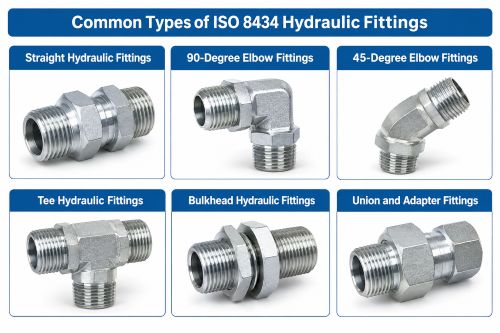
ISO 8434 connection systems are available in different configurations to accommodate hydraulic system layouts and installation requirements.
The appropriate fitting depends on the connection standard, tube dimensions, available space, and required flow direction.
Straight Hydraulic Fittings
Straight fittings provide direct connections between two hydraulic components.
They are commonly used when tubes, pipes, or other components can be connected along the same axis. Their relatively simple design makes installation and maintenance easier.
Typical applications include hydraulic power units, machinery pipelines, and fluid distribution assemblies.
90-Degree Elbow Fittings
90-degree elbow fittings allow hydraulic lines to change direction at a right angle.
They are useful when equipment has limited installation space or when tubes need to be routed around other components.
These fittings help simplify hydraulic line arrangements while maintaining an appropriate connection design.
45-Degree Elbow Fittings
45-degree elbow fittings provide an angled connection between hydraulic components.
Compared with 90-degree elbows, they allow a more gradual change in direction. They are useful in hydraulic assemblies where a straight connection is not practical but a sharp turn is unnecessary.
Tee Hydraulic Fittings
Tee fittings feature three connection points and are used to divide or combine hydraulic flow.
They are commonly installed in systems that require multiple fluid lines to connect to a shared hydraulic circuit.
The fitting configuration and size should be selected according to the required flow capacity and pressure conditions.
Bulkhead Hydraulic Fittings
Bulkhead fittings are designed to connect hydraulic lines through panels, equipment walls, or mounting plates.
They typically include a threaded section and locking nut that secure the fitting in position.
These connections are useful in hydraulic power units, equipment enclosures, and machinery where fluid lines need to pass through structural barriers.
Union and Adapter Fittings
Union fittings connect two compatible tube or fitting connections, while adapters allow connections between different specified port or thread configurations.
They are useful when modifying existing hydraulic assemblies or connecting components with different connection arrangements.
However, the connection interfaces must be compatible. An adapter should not be selected based on thread size alone because sealing geometry and pressure ratings are equally important.
Materials Used in ISO 8434 Hydraulic Fittings
Material selection affects the strength, durability, corrosion resistance, and overall service life of hydraulic fittings.
The most common material options include carbon steel, stainless steel, and brass.
Carbon Steel
Carbon steel is widely used in hydraulic fitting manufacturing because it provides good mechanical strength and is generally more economical than stainless steel.
It is suitable for many industrial and mobile hydraulic applications.
To improve corrosion resistance, carbon steel fittings are often treated with protective surface coatings such as zinc plating or zinc-nickel plating.
Advantages include:
1. Good mechanical strength
2. Cost-effective manufacturing
3. Suitable for many hydraulic pressure applications
4. Compatible with different protective coating options
Stainless Steel
Stainless steel fittings are commonly selected for environments where corrosion resistance is especially important.
They are suitable for marine equipment, chemical processing facilities, food-related machinery, and other demanding industrial environments.
Common advantages include:
1. Excellent corrosion resistance, depending on grade and environment
2. Good durability
3. Resistance to many industrial chemicals
4. Suitable for demanding environmental conditions
Stainless steel grades should be selected according to the operating environment. For example, 304 and 316 stainless steel have different corrosion-resistance characteristics.
Brass
Brass is another material used for certain hydraulic and fluid connection applications.
It offers good corrosion resistance in many environments and is relatively easy to machine.
However, its mechanical strength is generally lower than that of comparable steel fittings. Therefore, brass should only be used when its mechanical and pressure capabilities meet the application requirements.
Surface Treatments and Corrosion Protection
Surface treatments help improve the durability and appearance of hydraulic fittings, particularly those manufactured from carbon steel.
The appropriate treatment depends on the operating environment, required corrosion resistance, and customer specifications.
Common surface treatment options include:
Zinc Plating
Zinc plating provides a protective coating that helps reduce corrosion on carbon steel fittings. It is widely used for general industrial applications.
Zinc-Nickel Plating
Zinc-nickel plating offers enhanced corrosion protection compared with conventional zinc coatings. It is often selected for hydraulic components exposed to demanding environmental conditions.
Trivalent Chromium Passivation (Cr3)
Trivalent chromium passivation is commonly used as a post-treatment for zinc-plated components. It helps improve corrosion resistance and provides an additional protective layer.
Stainless Steel Passivation
Passivation helps improve the corrosion resistance of stainless steel by supporting the formation of its protective chromium-rich oxide layer.
Electroless Nickel Plating
Electroless nickel plating creates a uniform coating that can improve surface protection and wear characteristics. It is an option for certain specialized hydraulic components.
When choosing a surface treatment, buyers should consider coating specifications, corrosion testing requirements, and the intended working environment.
Key Technical Specifications of ISO 8434 Hydraulic Fittings
Before selecting ISO 8434 hydraulic fittings, it is important to understand their technical specifications.
These specifications help determine whether a fitting is suitable for a particular hydraulic system.
Connection Dimensions
Fitting dimensions must match the corresponding tube or mating component.
Important measurements include:
1. Tube outside diameter
2. Thread size
3. Thread pitch
4. Connection geometry
5. Sealing surface dimensions
Incorrect dimensions can cause installation difficulties, leakage, or connection failure.
Thread Types
Different ISO 8434 connection designs use specific thread arrangements.
Thread specifications should be checked carefully, including nominal diameter, pitch, and thread form.
A matching thread does not automatically guarantee a compatible sealing connection.
Sealing Methods
The sealing method depends on the applicable ISO 8434 part.
1. ISO 8434-1: 24° cone connection designs with specified sealing arrangements.
2. ISO 8434-2: 37° flared metal-to-metal sealing.
3. ISO 8434-3: O-ring face seal connections.
Understanding these differences helps prevent incorrect component selection.
Working Pressure
Working pressure is one of the most important specifications when choosing hydraulic fittings.
The pressure capacity depends on several factors, including:
1. Fitting size and design
2. Material grade
3. Manufacturing quality
4. Tube dimensions and wall thickness
5. Installation conditions
6. Operating temperature
Always check the manufacturer’s rated working pressure for the complete connection assembly. Do not assume that every fitting covered by ISO 8434 has the same pressure rating.
Temperature Requirements
Hydraulic fittings must operate within the temperature range of the hydraulic system.
Temperature can affect material strength, seal performance, and corrosion resistance.
For fittings using elastomeric seals, the seal material must be compatible with both the hydraulic fluid and operating temperature.
Applications of ISO 8434 Hydraulic Fittings
ISO 8434 fittings are used in various industries that rely on dependable fluid power connections.
Their different connection designs make them suitable for a wide range of hydraulic installations.
Construction Machinery
Construction equipment such as excavators, loaders, bulldozers, and cranes relies on hydraulic systems to operate lifting mechanisms, steering systems, and working attachments.
ISO 8434 fittings help connect hydraulic tubes and components throughout these systems.
Agricultural Equipment
Tractors, harvesters, and other agricultural machines use hydraulic connections for lifting, steering, and operating different implements.
Reliable fittings help maintain fluid flow and reduce leakage during continuous equipment operation.
Industrial Machinery
Manufacturing facilities use hydraulic systems in presses, injection molding machines, production equipment, and automated machinery.
ISO 8434 fittings provide standardized connection options for hydraulic circuits used in these applications.
Mobile Hydraulic Systems
Mobile hydraulic equipment often operates under vibration, changing loads, and demanding environmental conditions.
Appropriately selected fittings help maintain connection reliability in transportation equipment, lifting machinery, and other mobile systems.
Marine and Offshore Equipment
Marine and offshore environments expose hydraulic components to moisture, salt, and potentially corrosive conditions.
Stainless steel fittings and suitable protective treatments can help improve corrosion resistance in these applications.
Material selection should account for the actual exposure conditions and applicable equipment requirements.
ISO 8434 vs. Other Hydraulic Fitting Standards
Hydraulic systems use several international and industry-specific connection standards. Understanding their differences is essential when selecting replacement fittings or designing new hydraulic assemblies.
ISO 8434 vs. DIN 2353
ISO 8434-1 and DIN 2353 are closely related standards for 24° cone hydraulic tube connections.
Both are associated with metric tube fitting systems and are widely used in industrial and mobile hydraulic equipment.
Their connection designs include components such as fitting bodies, tube nuts, and cutting rings.
However, users should always check the applicable standard, dimensions, and component specifications before assuming interchangeability.
ISO 8434 vs. SAE Standards
ISO and SAE standards cover different hydraulic connection designs and requirements.
For example, SAE J514 covers 37° flare and other hydraulic tube connection configurations, while SAE J1453 addresses O-ring face seal connections.
These designs have similarities to connection types covered by ISO 8434-2 and ISO 8434-3, respectively.
However, dimensional and technical requirements must be checked before using components from different standards together.
ISO 8434 vs. JIC Fittings
JIC fittings are commonly associated with 37° flare hydraulic connections.
Their sealing design is based on contact between matching 37° metal surfaces.
ISO 8434-2 also covers 37° flared connectors, making the two relevant when comparing hydraulic connection systems.
However, compatibility should be confirmed through the applicable dimensional and thread specifications rather than assumed from the shared 37° sealing angle.
How to Choose the Right ISO 8434 Hydraulic Fittings
Choosing the correct hydraulic fitting requires more than identifying the connection size. Several technical and operating factors should be considered to ensure reliable performance.
Here are eight important selection criteria.
1. Identify the Applicable Standard
Determine whether the application requires ISO 8434-1, ISO 8434-2, or ISO 8434-3. Each part uses a different connection design.
2. Check Tube Size
Measure the tube outside diameter and verify that it matches the fitting specifications.
3. Verify Thread Specifications
Check the thread diameter, pitch, and type to ensure that the fitting matches the corresponding port or connection.
4. Consider Operating Pressure
Choose fittings with appropriate working pressure ratings for the hydraulic system, including expected pressure fluctuations.
5. Select the Right Material
Carbon steel is suitable for many general applications, while stainless steel may be preferable in corrosive environments.
6. Evaluate Sealing Requirements
Consider whether the application requires a 24° cone, 37° flare, or O-ring face seal connection.
7. Check Installation Space
Select straight, elbow, tee, or bulkhead configurations according to the available installation space and hydraulic line routing.
8. Work with a Reliable Manufacturer
Choose a manufacturer that can provide consistent dimensions, material traceability where required, quality inspection, and technical support.
Why Choose a Reliable ISO 8434 Hydraulic Fittings Manufacturer?
The quality of hydraulic fittings directly affects the reliability of fluid power systems. Even when a product follows the correct connection standard, poor machining, unsuitable materials, or inconsistent production can lead to leakage and premature failure.
Working with an experienced hydraulic fittings manufacturer helps reduce these risks.
Important factors to consider include:
1. Manufacturing capabilities: Look for CNC machining equipment and production processes suitable for precision hydraulic components.
2. Material selection: Confirm that the manufacturer offers materials appropriate for the intended application.
3. Quality control: Ask about dimensional inspection, thread verification, and pressure or leakage testing.
4. Surface treatments: Check whether the manufacturer offers suitable corrosion-protection options.
5. OEM and ODM services: Custom manufacturing capabilities are valuable when standard fittings do not meet specific equipment requirements.
6. Production capacity: Ensure the supplier can meet your order quantities and delivery schedules.
7. Technical support: A knowledgeable manufacturer should help verify drawings, dimensions, and connection specifications.
Sannke: Your Hydraulic Fittings Manufacturing Partner
Sannke is a hydraulic fittings manufacturer offering solutions for customers who need reliable standard and customized hydraulic connection components.
With 15 years of manufacturing experience, Sannke supports OEM and ODM projects for hydraulic fittings, adapters, hose fittings, ferrules, flanges, and related accessories.
Its manufacturing services include:
1. Custom manufacturing: OEM and ODM production based on customer drawings, samples, or technical requirements.
2. Material options: Carbon steel, stainless steel, and brass.
3. Surface treatments: Zinc plating, zinc-nickel plating, Cr3 and Cr6 treatments where specified, stainless steel passivation, and electroless nickel plating.
4. Product customization: Optional logo printing and customized product designs.
5. Engineering support: Technical assistance for product development and manufacturing requirements.
6. Sample support: Free samples are available for product evaluation.
For customers sourcing ISO 8434-related hydraulic tube connections, Sannke can help review technical requirements and identify suitable manufacturing solutions. Specific standards, dimensions, and product compatibility should be confirmed during the quotation and engineering review process.
Whether you need standard hydraulic fittings or customized connection components, choosing a manufacturer with suitable production capabilities and quality control can help improve the consistency of your hydraulic assemblies.
Frequently Asked Questions (FAQs)
Q1. What is ISO 8434 used for?
ISO 8434 specifies requirements for metallic tube connections used in hydraulic and general-purpose fluid power applications. It covers different connection designs, including 24° cone, 37° flare, and O-ring face seal connectors.
Q2. What are the main types of ISO 8434 hydraulic fittings?
The three commonly referenced parts are:
➡️ ISO 8434-1: 24° cone connectors.
➡️ ISO 8434-2: 37° flared connectors.
➡️ ISO 8434-3: O-ring face seal connectors.
Each part defines a different connection design and sealing arrangement.
Q3. What is the difference between ISO 8434-1 and ISO 8434-2?
The main difference is the sealing geometry. ISO 8434-1 covers 24° cone connectors, commonly used in metric tube fitting systems, while ISO 8434-2 covers 37° flared connectors.
Their connection dimensions and components are different, so they should not be treated as interchangeable.
Q4. Are ISO 8434 and DIN 2353 fittings the same?
ISO 8434-1 and DIN 2353 are closely related standards for 24° cone hydraulic tube connections. However, users should verify the applicable specifications, dimensions, and component requirements before mixing products from different standards.
Q5. Are ISO 8434 hydraulic fittings suitable for high-pressure applications?
Yes, suitable ISO 8434 fittings can be used in high-pressure hydraulic systems when their rated working pressure matches the application requirements. The pressure rating depends on fitting size, design, material, tube specifications, and installation conditions.
Q6. What materials are commonly used for ISO 8434 hydraulic fittings?
Common materials include carbon steel, stainless steel, and brass. Carbon steel is widely used for general hydraulic applications, stainless steel provides improved corrosion resistance, and brass is suitable for selected applications with appropriate mechanical requirements.
Q7. How do I select the correct ISO 8434 hydraulic fitting?
Start by identifying the applicable ISO 8434 part, then check tube dimensions, thread specifications, sealing method, working pressure, temperature requirements, and material compatibility. It is also important to verify the manufacturer’s technical specifications.
Q8. Can ISO 8434 hydraulic fittings be customized?
Yes. Manufacturers may offer customized dimensions, connection configurations, materials, surface treatments, and other specifications depending on their production capabilities. OEM and ODM services can help meet specific hydraulic equipment requirements.
Conclusion
ISO 8434 plays an important role in standardizing metallic tube connections for hydraulic and general-purpose fluid power systems. Its different parts cover 24° cone, 37° flare, and O-ring face seal connectors, providing connection solutions for a wide range of industrial applications.
Understanding the differences between these standards helps engineers and buyers select suitable fittings, avoid connection compatibility problems, and improve hydraulic system reliability.
When sourcing ISO 8434 hydraulic fittings, pay attention to connection dimensions, sealing methods, material selection, pressure ratings, and manufacturing quality. Working with an experienced supplier such as Sannke can also provide access to OEM and ODM services, material options, and customized hydraulic fitting solutions.
Post time: Nov-19-2026