

Hydraulic systems rely on secure connections to keep fluid contained and maintain consistent pressure. Even a small leak at a connection point can affect equipment performance, reduce efficiency, and lead to costly maintenance. This is why choosing the right type of hydraulic plug is important.
Metric compression plugs are designed to close and seal openings in hydraulic tubing, fittings, and fluid circuits that use metric dimensions. They provide a practical way to terminate unused ports, protect open connections, and help prevent hydraulic fluid from escaping.
But how exactly do metric compression plugs work, and what should you consider when selecting one? This guide explains their construction, working principle, applications, advantages, and installation.
What Are Metric Compression Plugs?
Metric compression plugs are mechanical components used to seal the ends of tubes, ports, or connections in hydraulic and fluid-handling systems. They are designed around metric sizing, making them suitable for systems that use metric tubing and fitting dimensions.
Depending on the design, a compression plug may use a threaded body, compression components, and a sealing element to create a secure connection. Once properly installed, the plug closes the opening and helps prevent fluid leakage.
These plugs are commonly found in hydraulic machinery, industrial equipment, agricultural machinery, construction equipment, and other systems where reliable fluid connections are required.
One of their main advantages is their versatility. A plug can be used to close an unused connection during maintenance, seal a hydraulic line, or protect an open port from contamination.
How Do Metric Compression Plugs Work?
The basic principle behind a metric compression plug is straightforward: the plug creates a mechanical connection while its sealing components prevent fluid from escaping.
1. Threaded Connection
Many metric compression plugs have a threaded section that connects with a compatible fitting or port. The thread provides mechanical engagement and holds the plug securely in place.
The thread must match the mating component in size, pitch, and thread form. Using an incorrect thread can result in poor engagement, leakage, or permanent thread damage.
2. Compression and Sealing
The sealing mechanism is responsible for creating a fluid-tight connection. Depending on the plug design, sealing may be achieved through a compression ring, ferrule, seal, or another sealing element.
As the connection is tightened, the sealing component is compressed against the appropriate surfaces. This reduces the possibility of fluid passing through the connection.
Proper installation is essential. Too little tightening may result in leakage, while excessive tightening can damage the plug, fitting, threads, or sealing components.
3. Pressure Containment
Hydraulic systems can operate at significant pressures, so the plug must be capable of handling the application’s operating conditions.
A properly selected compression plug provides a secure closure that helps contain hydraulic fluid. The material, design, thread engagement, sealing method, and installation all contribute to the plug’s overall performance.
Main Components of a Metric Compression Plug
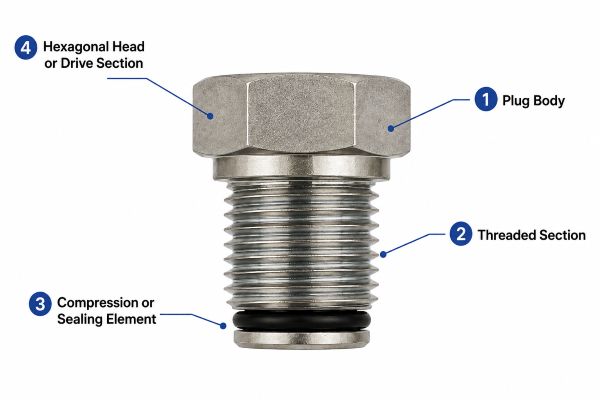
Although metric compression plugs are relatively simple components, each part contributes to their performance.
Plug Body
The plug body provides the main structural support. It is typically manufactured from materials such as carbon steel or stainless steel.
The body must withstand mechanical loads and the pressure conditions of the application.
Threaded Section
The threaded section connects the plug to the mating port or fitting. Metric thread dimensions must be selected correctly to ensure proper engagement.
Matching the thread is one of the most important steps when choosing a plug.
Compression or Sealing Element
The sealing component helps prevent fluid from escaping through the connection. Its exact design depends on the type of compression plug.
The material should also be compatible with the hydraulic fluid, temperature range, and operating environment.
Hexagonal Head or Drive Section
Many plugs feature a hexagonal head that allows a wrench to be used during installation and removal. Other designs may use an internal hex or another drive configuration.
The drive section makes it easier to apply controlled tightening force without damaging the plug.
Materials Used for Metric Compression Plugs
Material selection can have a significant impact on the durability and corrosion resistance of a compression plug.
Carbon Steel
Carbon steel is widely used for hydraulic components because it provides good strength and durability. It is often combined with a protective surface finish to improve resistance to corrosion.
Zinc-plated carbon steel plugs are a common option for general hydraulic applications.
Stainless Steel
Stainless steel offers excellent corrosion resistance and is useful in environments where moisture, chemicals, or harsh operating conditions are concerns.
Stainless steel metric compression plugs may be suitable for applications where long-term corrosion resistance is more important than the lower cost associated with standard carbon steel.
Surface Finishes
Carbon steel plugs can receive protective finishes such as zinc plating or zinc-nickel plating. These coatings help protect the underlying steel from corrosion.
The appropriate finish depends on the operating environment and required service life.
Metric Compression Plug Sizes and Specifications
Choosing the correct size is essential for reliable performance. Metric compression plugs can be available in different sizes and configurations, so users should verify the technical specifications before installation.
Important specifications may include:
➡️ Metric thread size
➡️ Thread pitch
➡️ Tube outside diameter
➡️ Plug configuration
➡️ Sealing method
➡️ Material
➡️ Surface finish
➡️ Working pressure
➡️ Temperature range
➡️ Applicable standard
It is important not to select a plug based only on appearance. Two plugs can look similar while having different thread dimensions or sealing arrangements.
Always check the manufacturer’s specifications or technical drawing before ordering or installing a plug.
Metric Compression Plugs vs. Other Hydraulic Plugs
Metric compression plugs are not interchangeable with every other type of hydraulic plug.
Metric Compression Plugs vs. Standard Threaded Plugs
A standard threaded plug may rely primarily on the thread and a sealing feature to close a port. A compression plug, on the other hand, uses a compression-based sealing arrangement depending on its specific design.
The best choice depends on the fitting design and application requirements.
Metric Compression Plugs vs. BSP Plugs
Metric and BSP threads are based on different dimensional systems and thread specifications. A metric thread should not automatically be considered compatible with a BSP thread simply because the two appear similar.
Always verify the exact thread specification before making a connection.
Metric Compression Plugs vs. NPT Plugs
NPT is a tapered pipe thread system commonly used in certain hydraulic and industrial applications. Metric compression plugs are designed for metric systems and may use a different sealing principle.
Using the wrong thread type can lead to leakage and damaged components.
Metric Compression Plugs vs. DIN-Based Plugs
DIN standards cover many types of hydraulic fittings and connections. Some metric compression plugs may be manufactured according to specific DIN-related designs or dimensions.
However, the term “metric” alone does not identify a particular standard. Always check the exact specification rather than assuming that all metric plugs are interchangeable.
Advantages of Metric Compression Plugs
Metric compression plugs offer several practical benefits when correctly selected and installed.
Reliable Sealing
A properly installed plug helps close hydraulic connections and reduce the risk of fluid leakage.
Metric Compatibility
They are designed for systems using metric tubing and connection dimensions, making them convenient for many European and international hydraulic applications.
Easy Installation
Many designs can be installed using standard hand tools, making maintenance and servicing relatively straightforward.
Compact Design
Their small size allows them to be used in areas where installation space is limited.
Good Durability
When manufactured from suitable materials and properly protected against corrosion, metric compression plugs can provide long service life.
Maintenance Convenience
Plugs can be useful during equipment maintenance because they allow unused ports or lines to be securely closed.
Common Applications of Metric Compression Plugs
Metric compression plugs can be used across a wide range of industries.
Hydraulic Equipment
They may be used in:
➡️ Hydraulic power units
➡️ Pumps
➡️ Valves
➡️ Manifolds
➡️ Hydraulic cylinders
➡️ Fluid control systems
Industrial Machinery
Manufacturing and processing equipment often contains multiple hydraulic or fluid connections. Compression plugs can be used to close unused or disconnected ports.
Construction Equipment
Excavators, loaders, cranes, and other mobile machinery may use metric hydraulic connections. Plugs can be useful during repairs, servicing, and system modifications.
Agricultural Machinery
Tractors, harvesters, sprayers, and other agricultural equipment can use hydraulic circuits that require reliable plugs and fittings.
Automotive and Transportation Equipment
Metric hydraulic connections are also found in various vehicle and transportation systems, particularly where metric components are standard.
How to Choose the Right Metric Compression Plug
Selecting the correct plug involves more than choosing the right diameter. Consider the complete operating environment.
Step 1: Identify the Thread and Tube Size
Start by determining the exact metric dimensions of the connection. Measure the tube or port where necessary and verify the thread size and pitch.
Step 2: Check the Sealing Method
Determine how the plug seals against the mating component. The sealing method should be compatible with the fitting and application.
Step 3: Select the Right Material
Choose carbon steel for many general applications or stainless steel when greater corrosion resistance is required.
Step 4: Check Pressure and Temperature Requirements
Make sure the selected plug is rated for the system’s working pressure and temperature range.
Step 5: Consider Corrosion Resistance
If the equipment operates outdoors, around water, or in a corrosive environment, consider stainless steel or a suitable protective coating.
Step 6: Verify Compatibility
Finally, check the manufacturer’s technical information to confirm compatibility with the fitting, tubing, fluid, pressure, and applicable standards.
How to Install Metric Compression Plugs Correctly
Proper installation is just as important as choosing the correct plug.
1. Inspect the connection. Make sure the port or fitting is clean and free from dirt, debris, and damage.
2. Confirm the plug specifications. Check the size, thread, sealing method, and material.
3. Inspect the sealing components. Look for cuts, deformation, contamination, or other visible damage.
4. Align the plug carefully. Start the connection by hand to reduce the risk of cross-threading.
5. Tighten correctly. Use the manufacturer’s recommended installation procedure and tightening requirements.
6. Avoid excessive force. Over-tightening can damage threads or sealing components.
7. Inspect the connection. Check for signs of leakage after installation.
8. Test under operating conditions. If appropriate, verify the connection after the system reaches its normal operating pressure.
Never use excessive torque to compensate for an incorrectly sized plug.
Common Problems With Metric Compression Plugs
Even a high-quality plug can perform poorly if it is incorrectly selected or installed.
Fluid Leakage
Leakage may be caused by:
1. Incorrect plug size
2. Damaged sealing components
3. Contaminated sealing surfaces
4. Incorrect installation
5. Improper tightening
6. Damaged threads
The first step is to confirm that the plug and mating component are compatible.
Cross-Threading
Cross-threading can happen when a plug is forced into a connection at the wrong angle. This can permanently damage the threads.
Starting the plug by hand helps ensure proper alignment before using a wrench.
Corrosion
Exposure to moisture and chemicals can cause corrosion, particularly when unsuitable materials or finishes are used.
Selecting the correct material and surface treatment can improve service life.
Plug Loosening
Vibration and incorrect installation can contribute to loosening. The plug should be installed according to the manufacturer’s requirements and used within its intended operating conditions.
Maintenance Tips for Metric Compression Plugs
Routine inspection can help identify problems before they become more serious.
During maintenance, check for:
1. Fluid leakage
2. Corrosion
3. Damaged threads
4. Deformed sealing components
5. Loose connections
6. Visible mechanical damage
Keep spare plugs clean and protected from contamination. If a sealing component is damaged, replace it according to the manufacturer’s recommendations.
When replacing a plug, use one with matching specifications rather than choosing a similar-looking alternative.
Why Proper Sizing Matters
Correct sizing is one of the most important factors in hydraulic connection performance.
An incorrectly sized metric compression plug may fail to seal properly or may damage the mating connection. Even a small mismatch in thread size or pitch can create installation problems.
A poor connection can result in:
1. Hydraulic fluid leakage
2. Pressure loss
3. Equipment downtime
4. Component damage
5. Increased maintenance costs
6. Potential safety concerns
For this reason, always verify the exact dimensions and specifications before purchasing or installing a metric compression plug.
For more information about hydraulic plugs, refer to the below resources ⬇️⬇️⬇️
DIN Compression Plug Specifications: A Complete Guide
Zinc Plated Hydraulic Plugs: Features, Applications, and Advantages
What Is a Hydraulic Bonded Seal Plug and How Does It Work?
Frequently Asked Questions
What is a metric compression plug?
A metric compression plug is a component used to close and seal a tube, fitting, or hydraulic port that uses metric dimensions. Depending on the design, it uses mechanical compression and sealing components to create a secure connection.
How does a metric compression plug seal?
The plug creates a mechanical connection with the mating component, while a compression or sealing element helps prevent fluid from passing through the connection.
Are metric compression plugs suitable for hydraulic systems?
Yes, metric compression plugs can be used in hydraulic systems when their size, material, sealing method, pressure rating, and other specifications are suitable for the application.
Can metric compression plugs be reused?
Reuse depends on the plug design and the condition of its sealing components. Always follow the manufacturer’s recommendations. A plug or seal showing damage should generally be replaced rather than reused.
How do I identify the correct metric compression plug size?
You need to identify the relevant tube diameter, thread size, thread pitch, sealing configuration, and other specifications. Manufacturer catalogs and technical drawings can help confirm the correct component.
Are metric compression plugs compatible with BSP or NPT threads?
Not necessarily. Metric, BSP, and NPT threads use different specifications. Never assume that two threads are compatible simply because they appear similar.
What materials are metric compression plugs made from?
Common materials include carbon steel and stainless steel. Carbon steel may be supplied with protective coatings such as zinc plating, while stainless steel provides greater corrosion resistance.
How can I prevent leaks from a metric compression plug?
Use the correct plug size, keep sealing surfaces clean, inspect the components before installation, and follow the manufacturer’s recommended installation procedure.
Conclusion
Metric compression plugs are small but important components in hydraulic and fluid-handling systems. They provide a practical way to close ports, terminate connections, protect hydraulic circuits, and reduce the risk of fluid leakage.
Their performance depends on several factors, including correct sizing, compatible threads, suitable materials, proper sealing, pressure rating, and correct installation.
Whether you are maintaining hydraulic machinery, replacing a damaged fitting, or designing a new fluid system, selecting the right metric compression plug can help create a dependable connection and support long-term equipment performance.
Before installation, always verify the plug’s technical specifications and ensure they match the requirements of your hydraulic system.
Post time: Aug-26-2026