

Hydraulic systems depend on secure connections to keep fluid contained and maintain consistent pressure. Even a small leak around a threaded port can reduce system efficiency, create maintenance problems, and eventually lead to equipment downtime. This is why choosing the right sealing component is important.
A hydraulic bonded seal plug is a practical solution for closing threaded hydraulic ports while providing reliable sealing. It combines a threaded metal plug with a bonded sealing washer that helps prevent hydraulic fluid from escaping.
But how exactly does a bonded seal plug work, and when should you use one? In this guide, we will explain its construction, working principle, benefits, applications, installation, and selection factors.
What Is a Hydraulic Bonded Seal Plug?
A hydraulic bonded seal plug is a threaded plug designed to close and seal an unused or service port in a hydraulic system. Unlike a basic threaded plug, it typically uses a bonded sealing washer to create an additional sealing barrier between the plug and the port.
The bonded seal consists of a metal washer with an elastomer sealing element bonded to its inner surface. When the plug is tightened, the seal is compressed against the port’s sealing face. This compression helps close small gaps and surface imperfections that could otherwise allow hydraulic fluid to leak.
These plugs are commonly used in hydraulic machinery, mobile equipment, industrial systems, pumps, valves, and other applications where reliable fluid containment is required.
How Does a Hydraulic Bonded Seal Plug Work?
The working principle is relatively simple.
First, the plug is inserted into a compatible threaded hydraulic port. As the plug is tightened, the bonded sealing washer is pressed between the plug and the sealing surface.
The elastomer portion of the washer deforms slightly under compression. This creates a tight barrier around the connection and helps prevent hydraulic fluid from passing through the joint.
A typical installation works as follows:
1. The correct plug is selected for the port.
2. The hydraulic port and sealing surface are cleaned.
3. The bonded seal is positioned correctly.
4. The plug is aligned with the port.
5. The plug is tightened without cross-threading.
6. The recommended installation torque is applied.
7. The compressed seal creates the leak-resistant connection.
8. The system is inspected for leakage after pressurization.
The key to the sealing process is controlled compression. Too little compression may result in leakage, while excessive tightening can damage the seal, threads, or port.
Main Components of a Hydraulic Bonded Seal Plug
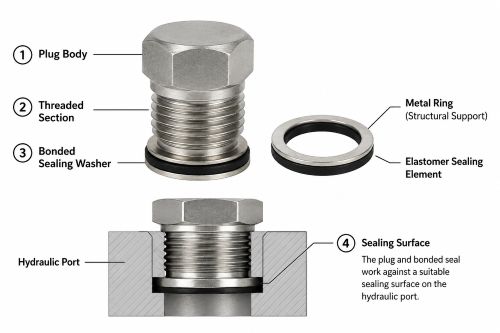
Although bonded seal plugs are relatively simple components, each part has an important function.
1. Plug Body
The plug body provides the main structural support. It contains the threaded section and may feature a hexagonal head, internal hex, or another drive configuration for installation and removal.
Common plug materials include carbon steel and stainless steel.
2. Threaded Section
The threaded section connects the plug to the hydraulic port. The thread must match the port in both size and thread standard.
Depending on the application, hydraulic bonded seal plugs may be available with metric, BSP, and other thread configurations.
Using the wrong thread can result in poor engagement, leakage, or permanent damage to the port.
3. Bonded Sealing Washer
The bonded washer is the component that gives this type of plug its sealing advantage.
It generally consists of a metal ring and an elastomer sealing element. The metal ring provides structural support, while the elastomer creates the actual sealing interface.
4. Sealing Surface
The plug and bonded seal work against a suitable sealing surface on the hydraulic port. The surface should be clean, free from damage, and properly machined.
Dirt, scratches, corrosion, or other contamination can interfere with sealing performance.
Materials Used for Hydraulic Bonded Seal Plugs
The material of the plug and bonded seal should be selected according to the application.
Carbon Steel
Carbon steel is widely used for hydraulic fittings and plugs because it provides good mechanical strength and is generally cost-effective. Protective finishes such as zinc plating may be used to improve corrosion resistance.
Stainless Steel
Stainless steel is a popular choice when the component needs greater resistance to corrosion or harsh environmental conditions.
Stainless steel plugs can be particularly useful in applications exposed to moisture, chemicals, or demanding outdoor environments.
Elastomer Sealing Materials
The sealing element may be manufactured from different elastomers, including:
➡️ NBR
➡️ FKM/Viton
➡️ EPDM for suitable applications
The correct seal material depends on the hydraulic fluid, temperature, pressure, and environmental conditions.
A seal that is mechanically suitable may still fail if its elastomer is incompatible with the hydraulic fluid.
Common Types of Hydraulic Bonded Seal Plugs
Hydraulic bonded seal plugs are available in different configurations to accommodate different hydraulic systems.
Hex-Head Bonded Seal Plugs
These plugs feature an external hex head that can be tightened with a standard wrench. They are useful where there is sufficient space around the installation point.
Internal Hex Bonded Seal Plugs
Internal hex designs are tightened using an Allen or hex key. They are useful in applications where a compact external profile is preferred.
Metric Bonded Seal Plugs
Metric versions are designed for hydraulic ports using metric threads. They are commonly found in machinery and equipment manufactured according to metric standards.
BSP Bonded Seal Plugs
BSP configurations are designed for compatible British Standard Pipe threaded connections. The exact thread type should always be confirmed before installation.
Benefits of Hydraulic Bonded Seal Plugs
There are several reasons bonded seal plugs are used in hydraulic applications.
Reliable Leak Prevention
The bonded washer provides an additional sealing barrier around the threaded connection. When properly selected and installed, it helps reduce the risk of hydraulic fluid leakage.
Suitable for Demanding Applications
Many bonded seal plugs are designed for hydraulic applications where pressure and vibration can be significant. However, the actual pressure capability depends on the plug design, materials, port, and manufacturer’s specifications.
Compact Design
Bonded seal plugs are generally compact and can be installed directly into threaded ports without requiring a large sealing assembly.
Easy Installation
Installation is straightforward when the correct plug and sealing washer are used. The plug can generally be installed using the appropriate wrench or drive tool.
Good Vibration Resistance
Hydraulic machinery can experience continuous vibration and movement. A properly compressed bonded seal can help maintain a reliable seal under these conditions.
Corrosion-Resistant Options
Carbon steel plugs with protective coatings and stainless steel options can provide improved resistance to corrosion, depending on the operating environment.
Cost-Effective Maintenance
Bonded seal plugs can be useful for closing unused hydraulic ports during manufacturing, maintenance, system modification, or component replacement.
Where Are Hydraulic Bonded Seal Plugs Used?
Hydraulic bonded seal plugs are found in many types of hydraulic equipment and machinery.
Common applications include:
1. Hydraulic power units
2. Construction equipment
3. Excavators
4. Forklifts
5. Agricultural machinery
6. Industrial machinery
7. Hydraulic pumps
8. Hydraulic valves
9. Hydraulic cylinders
10. Mobile hydraulic systems
11. Manufacturing equipment
12. Heavy-duty machinery
They can be used to close unused ports, service openings, test points, and other threaded connections where hydraulic fluid must remain contained.
Hydraulic Bonded Seal Plug vs. Standard Hydraulic Plug
One of the main differences is the sealing method.
A basic hydraulic plug may rely on the thread itself, a sealing compound, an O-ring, a tapered thread, or another sealing design. A bonded seal plug uses a dedicated bonded washer to create a sealing interface.
|
Feature |
Hydraulic Bonded Seal Plug |
Standard Hydraulic Plug |
|
Sealing method |
Bonded sealing washer |
Varies by design |
|
Installation |
Threaded connection with compressed seal |
Depends on design |
|
Leak protection |
Reliable when correctly installed |
Depends on sealing method |
|
Applications |
Hydraulic ports and service connections |
Various hydraulic applications |
|
Seal replacement |
Usually possible depending on design |
Depends on plug type |
|
Selection factors |
Thread, pressure, material, seal compound |
Thread and sealing design |
Neither design is automatically better for every application. The correct choice depends on the hydraulic port, pressure, temperature, fluid, and equipment requirements.
How to Choose the Right Hydraulic Bonded Seal Plug
Choosing the right plug involves more than matching the thread size.
1. Check the Thread Type and Size
Start by identifying the hydraulic port’s thread. Check both the nominal size and thread standard.
For example, a metric thread should not be confused with BSP or another thread configuration simply because the dimensions appear similar.
2. Consider the Pressure Rating
The plug must be suitable for the system’s operating pressure. Do not assume that all plugs with the same thread size have the same pressure capability.
Always check the manufacturer’s specifications.
3. Check Temperature Requirements
Temperature can affect the performance and service life of the sealing element.
Select an elastomer that can handle the expected operating temperature range.
4. Check Hydraulic Fluid Compatibility
Different hydraulic fluids can interact differently with sealing materials. Make sure the bonded seal material is compatible with the fluid being used.
5. Select the Correct Plug Material
Carbon steel may be suitable for many general hydraulic applications, while stainless steel can be preferable where increased corrosion resistance is required.
6. Consider the Installation Space
The plug head or drive style should fit the available space. An external hex plug may not be practical in a confined area where an internal hex design would be easier to install.
7. Check Dimensions
In addition to thread size, consider thread length, overall plug length, head dimensions, and sealing washer dimensions.
How to Install a Hydraulic Bonded Seal Plug
Correct installation is essential for achieving reliable sealing performance.
Step 1: Inspect the Hydraulic Port
Check the port for damaged threads, corrosion, dirt, or other contamination.
Step 2: Clean the Sealing Area
Remove debris, old seal material, and contaminants from the port and sealing surface.
Step 3: Inspect the Plug and Bonded Seal
Make sure the threads are undamaged and the elastomer seal is free from cuts, cracks, deformation, or other visible damage.
Step 4: Align the Plug
Place the plug into the port carefully. Start threading it by hand to reduce the risk of cross-threading.
Step 5: Tighten Correctly
Use the recommended tool and follow the manufacturer’s specified torque.
Avoid simply tightening the plug as much as possible. Over-tightening can damage the bonded seal, threads, or hydraulic port.
Step 6: Check the Connection
Once the system is safely pressurized, inspect the connection for signs of leakage.
If leakage occurs, do not simply continue tightening the plug. Depressurize the system and investigate the cause.
Common Installation Mistakes to Avoid
Even a high-quality bonded seal plug can leak if it is installed incorrectly.
Common mistakes include:
1. Choosing the wrong thread type
2. Using the wrong plug size
3. Cross-threading the connection
4. Installing a damaged bonded seal
5. Reusing a worn sealing washer
6. Over-tightening the plug
7. Under-tightening the connection
8. Installing the seal on a dirty surface
9. Using an incompatible elastomer
10. Ignoring the manufacturer’s torque requirements
Taking a few minutes to verify the plug, seal, port, and installation procedure can prevent much larger problems later.
Maintenance Tips for Hydraulic Bonded Seal Plugs
Bonded seal plugs generally require little maintenance, but they should still be inspected during routine hydraulic system servicing.
Look for:
1. Hydraulic fluid around the plug
2. Damaged or hardened sealing material
3. Corrosion
4. Damaged threads
5. Loose connections
6. Cracks or deformation
7. Signs of excessive heat
If the seal has deteriorated or the plug has been damaged, replacement is usually the safest option.
Keeping compatible replacement plugs and seals available can also reduce equipment downtime during maintenance.
Common Problems With Hydraulic Bonded Seal Plugs
Hydraulic Fluid Leakage
Leakage may be caused by an incorrect thread, damaged seal, contaminated sealing surface, insufficient or excessive torque, or an unsuitable plug.
Damaged Threads
Cross-threading and over-tightening can damage both the plug and hydraulic port.
Always start the plug by hand and make sure it is correctly aligned.
Bonded Seal Failure
The elastomer can deteriorate because of age, excessive temperature, chemical incompatibility, or mechanical damage.
Corrosion
Exposure to moisture, chemicals, salt, or harsh environments can cause corrosion, particularly when an unsuitable material or surface finish is selected.
Difficult Removal
A plug that has been over-tightened or exposed to corrosion may be difficult to remove. Always depressurize the hydraulic system before attempting removal.
Safety Considerations
Hydraulic systems can operate at extremely high pressures, so safety should always be a priority.
Before removing or servicing a bonded seal plug:
1. Shut down the equipment.
2. Relieve hydraulic pressure completely.
3. Follow the equipment manufacturer’s safety procedures.
4. Wear appropriate personal protective equipment.
5. Use the correct tools.
6. Never attempt to loosen a plug from a pressurized hydraulic system.
7. Confirm that the replacement plug has the correct pressure and temperature ratings.
Hydraulic fluid released under pressure can cause serious injury, so never treat a leaking or pressurized connection as a minor maintenance issue.
Frequently Asked Questions
What is a hydraulic bonded seal plug?
A hydraulic bonded seal plug is a threaded plug used to close a hydraulic port. It uses a bonded sealing washer to create a leak-resistant connection between the plug and the port.
How does a bonded seal plug prevent leaks?
When the plug is tightened, the bonded sealing washer is compressed against the sealing surface. The elastomer portion deforms to create a tight barrier that helps prevent hydraulic fluid from escaping.
Are hydraulic bonded seal plugs suitable for high-pressure systems?
They can be suitable for high-pressure hydraulic applications when the plug, bonded seal, port, and installation method are correctly specified. Always follow the manufacturer’s pressure rating.
What materials are hydraulic bonded seal plugs made from?
Common plug materials include carbon steel and stainless steel. The bonded sealing element may use materials such as NBR, FKM, or other application-specific elastomers.
Can a hydraulic bonded seal plug be reused?
Reuse depends on the plug design and condition of the sealing element. A bonded seal that is damaged, hardened, deformed, or otherwise compromised should be replaced.
What is the difference between a bonded seal and an O-ring?
A bonded seal typically consists of a metal washer with an elastomer element bonded to it, while an O-ring is a separate circular elastomer ring installed in a groove or sealing location. Their installation methods and applications are different.
Why is my hydraulic bonded seal plug leaking?
Possible causes include the wrong thread, damaged seal, incorrect torque, contamination, damaged sealing surfaces, or an incompatible sealing material. The system should be safely depressurized before inspecting the connection.
How do I select the correct hydraulic bonded seal plug?
Consider the thread type and size, pressure rating, temperature range, hydraulic fluid compatibility, plug material, sealing material, dimensions, and available installation space.
Conclusion
A hydraulic bonded seal plug is a simple but important component for maintaining reliable hydraulic connections. By combining a threaded metal plug with a bonded sealing washer, it provides an effective way to close hydraulic ports while helping prevent fluid leakage.
The best results come from selecting the correct thread, material, seal compound, pressure rating, and dimensions for the application. Proper installation is equally important. The sealing surface should be clean, the plug should be correctly aligned, and the manufacturer’s recommended torque should be followed.
Whether used in construction equipment, industrial machinery, agricultural systems, hydraulic power units, or mobile equipment, the right bonded seal plug can help maintain a clean, secure, and dependable hydraulic system.
Post time: Aug-20-2026