

Hydraulic flange heads are essential components in hydraulic systems that require strong, reliable connections for transferring pressurized fluid. They connect hydraulic hoses, pipes, pumps, valves, and other equipment while helping maintain a secure seal under demanding operating conditions. Their robust design makes them particularly useful in heavy machinery, industrial equipment, and other high-pressure applications.
Unlike conventional threaded fittings, hydraulic flange connections use a bolted interface to secure components together. This design can provide reliable performance in systems exposed to high pressure, vibration, and mechanical stress.
Understanding the design, functions, and applications of hydraulic flange heads helps engineers, equipment manufacturers, and maintenance professionals select the right components for their systems. This guide explores their main features, common types, materials, and selection considerations.
What Is a Hydraulic Flange Head?
A hydraulic flange head is a fitting component designed to connect hydraulic lines or equipment through a flange interface. It typically features a flange face, bolt holes, a fluid passage, and a connection section that attaches to a hose, pipe, or another hydraulic component.
The flange is secured to a compatible port or mating flange using bolts. A suitable sealing element, commonly an O-ring in SAE-style flange connections, helps prevent hydraulic fluid from escaping during operation.
Hydraulic flange heads are widely used in systems where reliable connections are essential. They are particularly valuable in high-pressure applications where conventional threaded connections may be less suitable because of installation constraints, vibration, or the forces acting on the connection.
Common flange connection standards include SAE J518 and ISO 6162. These standards define important interface dimensions and requirements for compatible flange connections. However, the exact design and pressure rating depend on the flange series, size, and manufacturer specifications.
Key Design Features of a Hydraulic Flange Head
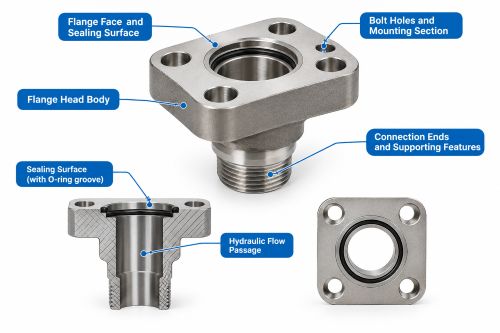
Although hydraulic flange heads vary in shape and configuration, most designs include several features that contribute to their strength, sealing performance, and compatibility.
1. Flange Head Body
The flange head body forms the main structure of the component. It provides the strength needed to withstand operating pressure and supports the connection between hydraulic components.
Manufacturers typically produce hydraulic flange heads from materials such as carbon steel or stainless steel, depending on the intended application. The body’s dimensions, wall thickness, and manufacturing quality all influence its ability to perform reliably under pressure.
Accurate machining is also important because dimensional inconsistencies can affect assembly, alignment, and sealing.
2. Flange Face and Sealing Surface
The flange face is the mating surface that connects with a compatible hydraulic port or flange assembly. It must have the correct dimensions and surface condition to support proper installation.
Many SAE-style hydraulic flange connections use an O-ring seated in a designated groove to provide the primary seal. When the flange is assembled and tightened correctly, the O-ring helps prevent fluid leakage.
The sealing surface should remain clean and free from scratches, dents, and other damage. Even small imperfections can interfere with sealing performance, especially in high-pressure hydraulic systems.
3. Bolt Holes and Mounting Section
Bolt holes allow the flange head to be fastened securely to the mating component. Their number, spacing, and dimensions depend on the applicable flange standard and size.
Correct bolt alignment is essential. If the holes do not match the mating flange, installation may place unnecessary stress on the components or prevent the connection from being assembled properly.
The correct fasteners and tightening procedure also matter. Uneven tightening can cause poor sealing or uneven loading across the flange interface.
4. Hydraulic Flow Passage
The hydraulic flow passage is the internal channel through which fluid moves. Its diameter and geometry affect how fluid travels through the fitting.
A properly designed passage helps maintain the required flow capacity while limiting unnecessary restrictions. The passage must also be compatible with the hydraulic system’s flow requirements and the connected equipment.
5. Connection Ends and Supporting Features
Depending on its design, a hydraulic flange head may include a hose connection, threaded section, or another interface for attaching to hydraulic equipment.
These features allow the flange head to integrate with different parts of a hydraulic circuit. Selecting the correct connection type is important because the fitting must match both the flange interface and the connected hose, pipe, or component.
How Does a Hydraulic Flange Head Work?
A hydraulic flange head works by creating a mechanically secured connection between hydraulic components while maintaining a sealed path for fluid flow.
During installation, the flange head is positioned against a compatible port or mating flange. The installer checks the alignment of the bolt holes and confirms that the specified sealing element is correctly positioned. The bolts are then tightened according to the applicable installation requirements.
Once assembled, the bolted connection holds the components together while the sealing element helps prevent hydraulic fluid from escaping. During operation, fluid passes through the internal flow passage to the connected component.
The flange assembly must withstand the pressure and mechanical loads generated by the system. These loads can include pressure fluctuations, vibration, and forces transferred through the connected hose or pipe.
Proper installation is therefore essential. A flange head with the correct pressure rating may still leak or fail prematurely if it is incorrectly aligned, fitted with an incompatible seal, or assembled using unsuitable fasteners.
Main Functions of a Hydraulic Flange Head
Hydraulic flange heads perform several important functions that help hydraulic equipment operate safely and efficiently.
Creating a Secure Hydraulic Connection
The primary function of a hydraulic flange head is to connect hydraulic components securely. Its bolted interface provides a firm mechanical connection between compatible parts.
This arrangement is especially useful for larger hydraulic lines and equipment that require a robust connection capable of handling substantial mechanical loads.
Preventing Hydraulic Fluid Leakage
Leak prevention is another important function. A correctly designed flange interface and compatible sealing element help keep hydraulic fluid inside the system.
Maintaining a reliable seal reduces fluid loss, minimizes contamination risks, and helps preserve the system’s operating pressure. It also reduces the need for frequent repairs caused by leaking connections.
Supporting High-Pressure Operation
Many hydraulic flange connections are designed for demanding pressure conditions. Their bolted construction can provide a strong connection when the flange series, size, materials, and fasteners are properly selected.
However, not all flange heads have the same pressure capacity. The maximum allowable working pressure must be verified for the specific connection and the complete assembled system.
Improving Maintenance and Accessibility
Bolted flange connections can make certain hydraulic assemblies easier to inspect and service. Technicians can disconnect compatible components when maintenance or replacement is required, following the correct depressurization and disassembly procedures.
This can be particularly helpful in industrial machinery and heavy equipment where hydraulic components may require periodic servicing.
Maintaining Reliable Fluid Flow
The internal passage allows hydraulic fluid to move between connected components. Choosing a suitable flange head helps maintain the required flow capacity and supports the overall performance of the hydraulic circuit.
Common Types of Hydraulic Flange Heads
Hydraulic flange heads are available in different configurations to accommodate installation requirements, connection standards, and hydraulic circuit layouts.
1. Straight Hydraulic Flange Head
A straight hydraulic flange head provides a direct connection between components. Its simple geometry makes it suitable for installations where the hose or pipe can follow a relatively straight route.
Straight designs are commonly used in hydraulic power units, industrial machinery, and mobile equipment.
2. 90-Degree Hydraulic Flange Head
A 90-degree hydraulic flange head changes the direction of the hydraulic line by approximately a right angle.
This configuration is useful when space is limited or when a hose must be routed around nearby equipment. It can also help reduce awkward hose routing, provided the fitting is correctly sized and positioned.
3. 45-Degree Hydraulic Flange Head
A 45-degree hydraulic flange head provides an angled connection that changes the direction of the hydraulic line by approximately 45 degrees.
It can be useful when a straight fitting does not provide the required clearance and a 90-degree fitting would create an unsuitable routing angle.
Both angled configurations should be selected with consideration for available space, hose bend radius, flow requirements, and the manufacturer’s specifications.
4. Split-Flange Hydraulic Connection
A split-flange connection uses two flange halves to secure a compatible flange head or port interface to its mating surface. The halves are fastened with bolts, allowing the connection to be assembled and serviced without requiring a single-piece flange clamp.
Split-flange connections are commonly associated with SAE-style hydraulic flange systems. Their exact configuration and dimensions depend on the applicable standard and flange series.
5. SAE Code 61 and Code 62 Flange Heads
SAE Code 61 and Code 62 are widely used hydraulic flange connection series.
Code 61 is generally associated with standard-pressure hydraulic flange applications, while Code 62 is intended for higher-pressure applications within the relevant standardized size and design limits.
The two series have different dimensional and pressure requirements. They should not be treated as interchangeable simply because their nominal sizes appear similar.
Before selecting either type, verify the flange standard, nominal size, bolt pattern, sealing interface, and rated working pressure. Always refer to the applicable standard and manufacturer data rather than relying on the series name alone.
Materials Used in Hydraulic Flange Heads
Material selection affects a hydraulic flange head’s strength, corrosion resistance, service life, and suitability for different environments.
Carbon Steel
Carbon steel is a common choice for hydraulic flange heads used in industrial machinery, construction equipment, and general hydraulic systems. It provides good mechanical strength and is suitable for many demanding applications.
Protective surface treatments, such as zinc plating or other specified coatings, may be used to improve corrosion resistance. The appropriate treatment depends on the operating environment and the manufacturer’s available options.
Stainless Steel
Stainless steel is often selected for applications exposed to moisture, corrosive substances, or environments where improved corrosion resistance is important.
It may be suitable for certain chemical-processing, marine, and specialized industrial applications. However, the exact stainless steel grade must be evaluated against the operating pressure, fluid compatibility, temperature, and environmental conditions.
Other Material Considerations
Other materials may be available for specialized requirements, depending on the design and manufacturer. Regardless of material, the flange head must meet the mechanical and dimensional requirements of the intended connection.
Surface coatings should also be considered when evaluating service life. A suitable coating can improve corrosion protection, but it cannot compensate for incorrect installation, poor material quality, or incompatible operating conditions.
Hydraulic Flange Head Standards and Specifications
Standards help ensure that hydraulic flange heads can connect correctly with compatible ports and mating components.
Two important standards are SAE J518 and ISO 6162, which cover hydraulic flange connections and related dimensional requirements. The appropriate standard depends on the equipment design and connection specification.
When evaluating a hydraulic flange head, pay attention to the following specifications:
1. Flange standard: Confirm whether the connection follows SAE J518, ISO 6162, or another applicable specification.
2. Nominal size: Check that the flange size matches the mating port and required flow capacity.
3. Bolt pattern: Verify the bolt-hole spacing, dimensions, and required fasteners.
4. Sealing arrangement: Confirm the correct O-ring size, groove configuration, and sealing interface.
5. Working pressure: Check the rated pressure for the specific size and connection series.
6. Temperature range: Ensure the component and sealing materials can withstand the system’s operating temperature.
7. Material and finish: Consider fluid compatibility, corrosion exposure, and service conditions.
A flange head should never be selected based on appearance alone. Two fittings may look similar but have different dimensions, sealing arrangements, or pressure ratings. Checking technical drawings and product specifications before ordering helps avoid compatibility problems.
Applications of Hydraulic Flange Heads
Hydraulic flange heads are used across many industries because they provide reliable connections for hydraulic fluid lines and equipment.
Construction Equipment
Excavators, loaders, bulldozers, and other construction machines use hydraulic systems to operate cylinders, motors, and other components.
Hydraulic flange heads help connect the lines and equipment involved in these systems. Their suitability for heavy-duty applications depends on the selected pressure rating, installation quality, and resistance to operating stresses.
Agricultural Machinery
Tractors, harvesters, and other agricultural machines rely on hydraulic power for lifting, steering, and operating attachments.
Hydraulic flange heads can provide secure connections in these systems, where equipment may experience vibration, dirt, moisture, and changing operating loads.
Industrial Hydraulic Systems
Hydraulic presses, manufacturing equipment, production machinery, and automated industrial systems use hydraulic fluid to transmit power.
Flange connections are useful in these environments when a strong, serviceable connection is required between pumps, valves, manifolds, and hydraulic lines.
Mining and Heavy-Duty Equipment
Mining machinery often operates under demanding conditions involving heavy loads, vibration, dust, and long operating hours.
Suitable hydraulic flange heads can help maintain reliable connections in these applications. Material quality, pressure compatibility, and regular inspection are especially important in environments where equipment downtime can be costly.
Hydraulic Power Units and Mobile Equipment
Hydraulic power units supply pressurized fluid to cylinders, motors, and other hydraulic components. Mobile equipment also uses hydraulic connections throughout its power and control circuits.
Hydraulic flange heads can connect components where the system design calls for a bolted flange interface. Choosing the right configuration helps accommodate installation space, fluid flow, and maintenance requirements.
How to Choose the Right Hydraulic Flange Head
Selecting the right hydraulic flange head involves more than finding a fitting that physically fits the connection. Several factors should be considered before placing an order.
1. Identify the Required Flange Standard
Start by confirming the connection standard used by the equipment. Check the relevant drawing or existing component specifications to determine whether the system requires SAE, ISO, or another flange interface.
Matching the standard helps ensure correct dimensions and compatibility with the mating component.
2. Check the Flange Size and Dimensions
Verify the nominal size, bolt-hole pattern, flange dimensions, and connection details. Incorrect dimensions can prevent proper assembly or compromise the sealing interface.
If replacing an existing component, use the equipment manufacturer’s specifications rather than relying solely on visual comparison.
3. Verify the Working Pressure
Choose a flange head rated for the system’s operating conditions. Consider the maximum working pressure, potential pressure surges, and other loads that may affect the connection.
The pressure rating of the entire assembly matters. The flange head, bolts, seals, hoses, and mating ports must all be suitable for the intended application.
4. Select the Right Material
Consider the hydraulic fluid, operating temperature, moisture exposure, and potential corrosive substances.
Carbon steel may be appropriate for many general industrial applications, while stainless steel can be beneficial where corrosion resistance is a higher priority. Always confirm that the selected material meets the application’s mechanical requirements.
5. Confirm the Sealing Arrangement
Check the required O-ring dimensions, material, and compatibility with the hydraulic fluid and temperature range.
A seal that is too large, too small, damaged, or chemically incompatible may cause leakage even when the flange head itself is correctly manufactured.
6. Consider Installation Space and Hose Routing
Choose a straight, 45-degree, or 90-degree configuration according to the available space and the required hose or pipe route.
Ensure that the selected design does not force the hose into an excessively tight bend or place unnecessary stress on the connection.
7. Evaluate Manufacturer Quality
Look for a manufacturer that can provide consistent dimensions, suitable materials, reliable quality control, and clear technical documentation.
For OEMs, distributors, and hydraulic equipment manufacturers, additional considerations may include custom configurations, surface treatments, sample availability, production capacity, and delivery lead times.
Working with a qualified supplier can help simplify sourcing and reduce the risk of receiving incompatible components.
Checkout these other resources ⬇️⬇️⬇️
What Are Square Hydraulic Flanges and How Do They Work?
Hydraulic Blind Flanges: Types, Functions, and Applications
What Are Hydraulic Flange Blanks and How Do They Work?
Common Hydraulic Flange Head Problems and Maintenance Tips
Even a high-quality hydraulic flange head can develop problems if it is incorrectly installed, exposed to unsuitable conditions, or used beyond its specified limits.
Hydraulic Oil Leakage
Leakage may result from a damaged O-ring, a contaminated sealing surface, incorrect assembly, or an incompatible seal.
Inspect the connection for visible damage and replace defective seals with the correct specification. Always depressurize the hydraulic system before inspecting or disassembling a connection.
Never use your hands to search for a high-pressure hydraulic leak, as escaping fluid can penetrate the skin and cause serious injury.
Loose or Damaged Bolts
Loose fasteners can compromise the flange connection and contribute to leakage. Damaged threads or incorrect fasteners may also prevent the assembly from maintaining the required clamping force.
Use the specified fasteners and tightening procedure. Apply the manufacturer’s recommended torque rather than guessing or tightening the bolts unevenly.
Corrosion and Surface Damage
Corrosion, scratches, and dents can weaken the component or affect the sealing surface.
Inspect flange heads periodically, especially in wet, outdoor, or corrosive environments. Replace components when damage compromises their strength or sealing performance.
Incorrect Flange Alignment
Misalignment can place unnecessary stress on the connection and interfere with proper sealing.
Before tightening the bolts, ensure that the flange faces align correctly and that the connected hoses or pipes are not forcing the fitting out of position.
Preventive Maintenance Practices
A regular maintenance routine can help extend the service life of hydraulic flange connections.
1. Inspect connections for leakage, corrosion, and visible damage.
2. Check sealing elements and replace worn or damaged seals.
3. Keep sealing surfaces clean during assembly.
4. Follow the specified bolt-tightening sequence and torque requirements.
5. Verify that replacement components match the required flange standard and pressure rating.
Investigate recurring leakage rather than repeatedly tightening the same connection without identifying the cause.
These practices help maintain connection reliability and reduce the risk of unplanned equipment downtime.
Hydraulic Flange Head vs. Traditional Threaded Hydraulic Fitting
Hydraulic flange heads and threaded hydraulic fittings both connect components in hydraulic systems, but they use different connection methods.
A hydraulic flange head uses a bolted interface and a compatible sealing arrangement. This design is often suitable for larger hydraulic connections and applications where the connection must withstand substantial pressure or mechanical loads.
A threaded hydraulic fitting connects through matching threads. Depending on the design, it may use tapered threads, an O-ring, a bonded seal, or another sealing method. Threaded fittings are available in many sizes and are often convenient for compact installations.
The main differences include:
1. Installation: Flange heads require suitable bolt access and a compatible flange interface. Threaded fittings require the correct thread type, size, and installation method.
2. Sealing: Flange connections commonly use an O-ring or another specified seal at the mating face. Threaded fittings may seal through threads or a separate sealing element.
3. Pressure suitability: Both connection types are available for demanding hydraulic applications, but their suitability depends on the particular design and rated specifications.
4. Maintenance: Bolted flange connections can be convenient for servicing certain larger assemblies, while threaded fittings may be more practical in smaller or space-constrained installations.
5. Application: Flange heads are commonly used where a bolted interface is specified, while threaded fittings serve a wide range of general hydraulic connections.
Neither type is automatically better for every application. The correct choice depends on the equipment design, operating conditions, installation space, and applicable connection standards.
Conclusion
Hydraulic flange heads play an important role in creating secure, reliable connections in hydraulic systems. Their flange body, mounting features, sealing surface, and internal flow passage work together to support fluid transfer and maintain connection integrity.
They are widely used in construction machinery, agricultural equipment, industrial hydraulic systems, mining equipment, and hydraulic power units. Selecting the correct flange head requires careful attention to connection standards, dimensions, working pressure, materials, sealing requirements, and installation conditions.
For equipment manufacturers, maintenance teams, and hydraulic system designers, choosing a dependable supplier is equally important. A qualified manufacturer can provide accurately machined hydraulic flange heads, consistent product quality, and technical specifications that support reliable system performance.
By matching the component to the application and following proper installation and maintenance practices, users can improve connection reliability, reduce leakage risks, and support the long-term performance of hydraulic equipment.
Post time: Oct-19-2026