

Hydraulic flange blanks are components used to close off compatible flange openings in hydraulic systems. They help prevent fluid leakage, protect unused connections from contamination, and keep hydraulic equipment in suitable condition during maintenance, assembly, and storage. When correctly selected and installed, they provide a reliable way to close a hydraulic connection without replacing the entire component.
These parts are commonly used in industrial machinery, construction equipment, agricultural machinery, and other hydraulic applications. However, not all flange blanks are designed for the same purpose. Material, flange dimensions, sealing arrangements, and pressure ratings all affect their suitability for a particular system.
Understanding how hydraulic flange blanks work and how to choose the right type can help engineers, maintenance teams, and equipment manufacturers maintain reliable hydraulic connections.
What Are Hydraulic Flange Blanks?
Hydraulic flange blanks are solid components designed to cover and close compatible hydraulic flange ports or openings. Unlike a standard flange fitting that connects two fluid passages, a flange blank closes an opening where fluid flow is not required.
A typical hydraulic flange blank consists of a solid metal body with a flat sealing surface and mounting holes. Bolts secure the blank to a compatible flange connection, while an appropriate gasket or O-ring may provide the seal, depending on the connection design.
These components are useful when a hydraulic port is no longer needed, a system requires temporary isolation, or equipment must be prepared for transportation or storage. They can also be used during equipment assembly when certain hydraulic connections are reserved for future use.
It is important to distinguish a pressure-rated hydraulic flange blank from a simple protective cover. A dust cover may protect an opening from dirt but may not be designed to contain hydraulic pressure. Before using a flange blank to close an active hydraulic circuit, always verify its intended purpose and pressure rating.
How Do Hydraulic Flange Blanks Work?
Hydraulic flange blanks work by physically closing a compatible flange opening and creating a sealed connection. Their effectiveness depends on proper alignment, suitable sealing components, secure fastening, and compatibility with the system’s operating conditions.
The installation process generally follows several steps.
1. Position the blank. The flange blank is placed against the mating flange, with the bolt holes and sealing surfaces correctly aligned. Both mating surfaces should be clean and free from damage.
2. Install the appropriate seal. Depending on the flange design, a compatible gasket, O-ring, or other specified sealing element is fitted between the mating surfaces. The seal helps prevent hydraulic fluid from escaping through small gaps.
3. Secure the connection. The specified bolts or fasteners are installed and tightened according to the equipment manufacturer’s instructions. Correct tightening helps maintain even contact across the sealing surface and reduces the risk of leakage.
4. Verify the installation. Before returning the system to service, check that the blank is correctly fitted and that the connection meets the applicable pressure and safety requirements. Any pressure testing should follow the equipment manufacturer’s procedures.
Once installed, the flange blank closes the opening and prevents fluid from passing through that connection. In a pressurized system, the blank and its fastening arrangement must withstand the forces created by the hydraulic pressure.
For this reason, choosing a blank based only on its external dimensions is not enough. The flange standard, material, seal design, and pressure rating must all be considered.
Key Components of a Hydraulic Flange Blank
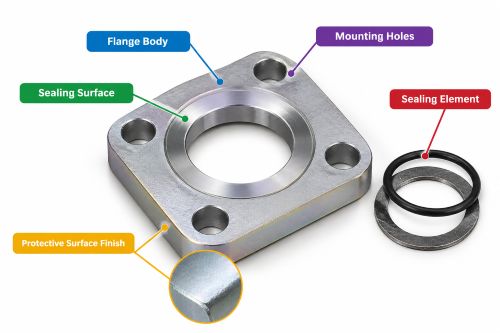
Hydraulic flange blanks vary in shape and construction, but most designs have several important features that support reliable installation and sealing.
1. Flange Body
The flange body is the main structural part of the component. It covers the hydraulic opening and provides the strength needed for the intended operating conditions.
Carbon steel is commonly used for industrial applications because of its strength and durability. Stainless steel may be preferred where corrosion resistance is particularly important. The required material depends on the hydraulic fluid, operating environment, pressure, and temperature.
The body’s thickness and dimensions should match the design specifications. An incorrectly sized or unsuitable blank may deform under load or fail to provide a reliable closure.
2. Mounting Holes
Mounting holes allow the flange blank to be secured to a compatible flange connection. Their number, diameter, and spacing must match the mating flange’s bolt pattern.
Correct alignment helps distribute the fastening load and keeps the blank properly positioned. A blank with an incompatible bolt pattern should not be forced into place or modified without appropriate engineering approval.
3. Sealing Surface
The sealing surface is the area that contacts the mating flange or sealing element. Its flatness, finish, and condition can affect the reliability of the connection.
Scratches, dents, corrosion, and other surface defects may create leakage paths. Inspecting the sealing area before installation helps identify problems that could otherwise lead to fluid loss.
4. Sealing Element
Depending on the design, a hydraulic flange blank may use an O-ring, gasket, or another specified sealing element. The seal fills the intended sealing interface and helps contain hydraulic fluid.
The correct seal depends on the flange design, fluid compatibility, temperature range, and pressure requirements. Not every flange blank uses a separate seal, so the manufacturer’s specifications should always guide selection and installation.
5. Protective Surface Finish
Some hydraulic flange blanks receive surface treatments to improve corrosion resistance and extend service life. Zinc plating and other suitable protective finishes may be used on carbon steel components.
Stainless steel blanks may use appropriate finishing or passivation processes to support corrosion resistance. The best surface treatment depends on the working environment, exposure to moisture or chemicals, and maintenance requirements.
Common Types of Hydraulic Flange Blanks
Hydraulic flange blanks are available in different designs to suit various connection standards and operating conditions. The correct type depends on the equipment’s flange geometry and the demands of the application.
SAE Hydraulic Flange Blanks
SAE hydraulic flange blanks are designed for compatible SAE flange connections. SAE J518 is a widely used standard for hydraulic flange connections, including Code 61 and Code 62 configurations.
These configurations have different dimensional and pressure requirements. A blank intended for one configuration should not automatically be assumed suitable for the other. Buyers should confirm the flange size, bolt pattern, sealing arrangement, and rated working pressure before ordering.
SAE-compatible blanks are used in many industrial and mobile hydraulic systems, including equipment with pumps, valves, manifolds, and hydraulic cylinders.
DIN Hydraulic Flange Blanks
DIN-compatible hydraulic flange blanks are designed for equipment using applicable DIN flange connection specifications. They are commonly found in industrial hydraulic systems and machinery built around metric or European connection standards.
When selecting a DIN flange blank, verify the exact standard and dimensions required by the equipment. Similar-looking flange designs may have differences in bolt spacing, sealing geometry, or other critical features.
High-Pressure Hydraulic Flange Blanks
High-pressure hydraulic flange blanks are designed for applications where the closure must withstand substantial hydraulic forces. Their suitability depends on the complete assembly, including the blank body, fasteners, mating flange, and sealing components.
The term high-pressure alone does not establish a safe working limit. Always check the manufacturer’s rated pressure and confirm that the entire connection is suitable for the maximum expected system pressure and operating conditions.
Custom Hydraulic Flange Blanks
Custom hydraulic flange blanks are useful when standard products do not match an equipment manufacturer’s specifications. Customization may include dimensions, bolt-hole patterns, material selection, surface treatment, and sealing arrangements.
OEM equipment manufacturers may require custom blanks to match specific hydraulic manifolds, pumps, valves, or machinery designs. Working with a qualified manufacturer can help ensure that the component fits the intended connection and meets the relevant technical requirements.
Materials Used in Hydraulic Flange Blanks
Material selection affects strength, corrosion resistance, durability, and overall suitability. The best option depends on the operating environment rather than price alone.
Carbon Steel
Carbon steel is a common choice for hydraulic flange blanks used in industrial machinery. It offers good mechanical strength and can be machined into a wide range of flange designs.
Protective coatings can improve corrosion resistance, making carbon steel suitable for many general-purpose applications. However, the coating must be appropriate for the environment, and damaged finishes may require attention to prevent corrosion.
Stainless Steel
Stainless steel offers greater corrosion resistance in many environments than unprotected carbon steel. It may be suitable for equipment exposed to moisture, certain chemicals, or demanding industrial conditions.
The appropriate stainless steel grade should be selected according to the environment, fluid compatibility, temperature, and mechanical requirements. Stainless steel is not automatically suitable for every corrosive application.
Surface Treatments and Coatings
Surface treatments can improve the service life of carbon steel hydraulic flange blanks by reducing corrosion. Common options include zinc plating and other protective coating systems.
When comparing products, buyers should consider coating performance, environmental exposure, and any relevant corrosion-resistance requirements. A coating should never be treated as a substitute for selecting the correct base material or maintaining the component properly.
Main Applications of Hydraulic Flange Blanks
Hydraulic flange blanks serve several practical purposes across industrial and mobile equipment.
Closing unused hydraulic ports: Equipment designs sometimes include ports that are not required for a particular configuration. A compatible blank can close these openings when the application and pressure requirements permit.
Protecting connections during storage and transportation: When hydraulic equipment is shipped or stored, suitable blanks and protective covers help prevent dust, moisture, and debris from entering open connections. For pressurized service, a properly rated blank is required; a simple transport cover is not a substitute.
Supporting maintenance and repairs: During equipment servicing, a flange blank may be used to isolate an appropriate connection or close an opening after a component has been removed. The circuit must be safely depressurized and isolated before work begins.
Closing openings on hydraulic components: Pumps, valves, manifolds, and other hydraulic assemblies may have flange connections that need to be closed according to the equipment design.
Supporting equipment manufacturing: Manufacturers may install flange blanks on unused connections during assembly or use them as part of a specified equipment configuration. Standard and custom options can help meet different OEM requirements.
Benefits of Using Hydraulic Flange Blanks
When correctly specified and installed, hydraulic flange blanks provide several benefits.
Reduced Risk of Fluid Leakage
A properly designed and installed blank closes the intended hydraulic opening. The correct sealing arrangement and fastening procedure help reduce leakage risks and prevent unnecessary fluid loss.
However, reliable sealing depends on more than the blank itself. Damaged mating surfaces, incorrect fasteners, unsuitable seals, or improper tightening can still cause problems.
Protection Against Contamination
Unused hydraulic ports can allow dust, moisture, and debris to enter a system. A suitable blank or protective closure helps reduce this risk and supports cleaner hydraulic fluid.
This is particularly important during transportation, equipment assembly, and maintenance, when open connections may be exposed to the surrounding environment.
Improved Equipment Reliability
Closing unused connections properly helps protect hydraulic components and supports consistent system operation. It also reduces the chance of contamination-related problems that may contribute to wear or component damage.
Support for Maintenance and Storage
Appropriate flange blanks help keep equipment connections closed when components are removed, machinery is stored, or systems are being prepared for installation. Selecting the correct product for the specific task is essential.
How to Choose the Right Hydraulic Flange Blank
Choosing a suitable hydraulic flange blank requires checking several technical factors. A part that fits physically may still be unsuitable for the system’s pressure or sealing requirements.
1. Confirm the Flange Standard and Bolt Pattern
Start by identifying the connection standard and flange configuration. Check the nominal size, bolt-hole spacing, hole diameter, and sealing geometry.
For SAE, DIN, or other standardized connections, verify the exact applicable specification rather than relying on appearance alone. When replacing an existing blank, compare its dimensions with the equipment drawings or manufacturer’s documentation.
2. Verify the Operating Pressure
Determine whether the blank will be used only for contamination protection or to close a connection exposed to hydraulic pressure.
For pressure-containing applications, confirm the rated working pressure of the blank and the complete assembled connection. Consider the system’s maximum operating pressure and any pressure fluctuations specified by the equipment manufacturer.
Do not assume that all blanks made to a similar size have the same pressure rating.
3. Choose the Appropriate Material
Consider the hydraulic fluid, operating temperature, surrounding environment, and potential exposure to moisture or chemicals.
Carbon steel may be suitable for many standard industrial applications, while stainless steel may be preferred when corrosion resistance is a priority. The final selection should account for both mechanical and environmental requirements.
4. Confirm the Sealing Requirements
Check whether the connection requires an O-ring, gasket, or another specified sealing arrangement. The seal’s material and dimensions must be compatible with the fluid, temperature, and flange design.
Inspect the mating surfaces for damage, and replace worn or damaged seals as recommended by the manufacturer.
5. Consider Standard and Custom Options
Standard hydraulic flange blanks are often the most practical choice when the dimensions and performance requirements match an existing connection.
Custom blanks may be appropriate for specialized equipment, nonstandard dimensions, or OEM projects. In these cases, provide the manufacturer with drawings, specifications, material requirements, and intended operating conditions.
Common Installation and Selection Mistakes to Avoid
Even a well-manufactured hydraulic flange blank can perform poorly if it is selected or installed incorrectly.
One common mistake is choosing a blank with the wrong bolt pattern or flange standard. A close visual match does not guarantee correct alignment or sealing. Always confirm the dimensions before installation.
Another mistake is overlooking the pressure rating. A protective cover designed for storage may not withstand hydraulic pressure. Using an unrated component to close a pressurized port can create a serious safety hazard.
Incorrect seal selection can also lead to leakage. The seal must match the connection design and be compatible with the hydraulic fluid and operating temperature.
Fastening errors are another source of problems. Uneven tightening, excessive torque, or unsuitable fasteners can damage the connection or compromise sealing. Follow the manufacturer’s tightening sequence and torque specifications.
Finally, avoid installing a blank against dirty or damaged mating surfaces. Clean the connection, inspect the sealing area, and replace defective components before assembly.
Important safety note: Hydraulic systems must be depressurized and safely isolated before installation or removal. Never loosen a flange connection to check for residual pressure. Follow the equipment manufacturer’s safety procedures and use appropriate pressure-rated components.
Hydraulic Flange Blanks vs. Hydraulic Flange Covers
Hydraulic flange blanks and hydraulic flange covers may look similar, and some manufacturers use these terms differently. Their intended functions, however, can differ.
A hydraulic flange blank is generally intended to close a compatible flange opening. Depending on its design and rating, it may be suitable for containing hydraulic pressure.
A hydraulic flange cover may refer to a protective component used to keep dirt, moisture, or debris away from a flange connection during storage, shipping, or maintenance. Some covers are not designed to withstand operating pressure.
|
Feature |
Hydraulic flange blank |
Hydraulic flange cover |
|
Main purpose |
Close a compatible flange opening |
Protect a flange or connection |
|
Pressure containment |
Possible when specifically rated |
Must not be assumed |
|
Typical use |
System closure or unused-port isolation |
Storage, shipping, or contamination protection |
|
Sealing arrangement |
May require a pressure-rated seal or gasket |
Depends on the protective design |
|
Selection priority |
Standard, pressure rating, sealing, and fastening |
Fit, coverage, and environmental protection |
Because terminology varies, confirm the manufacturer’s product description and rated application before selecting either component.
Maintenance Tips for Hydraulic Flange Blanks
Hydraulic flange blanks usually require limited maintenance, but periodic inspection can help identify problems before they affect the system.
Check the blank body for cracks, deformation, corrosion, or other damage. Inspect the sealing surface and mating flange for scratches, dents, or wear that could affect sealing performance.
Examine the gasket or O-ring where applicable, and replace it if it shows signs of damage or deterioration. Fasteners should also be inspected according to the equipment manufacturer’s maintenance schedule.
Before reinstalling a blank, clean the mating surfaces and confirm that the part remains compatible with the connection. Use the specified fasteners and tightening procedure, and verify that the assembled connection meets the requirements for its intended service.
If a blank has been exposed to excessive pressure, impact, or significant corrosion, have it evaluated against the manufacturer’s acceptance criteria before reuse.
Checkout these other resources ⬇️⬇️⬇️
What Are Square Hydraulic Flanges and How Do They Work?
Hydraulic Flange Seals: Types, Materials, and Applications
What Is the Purpose of a Hydraulic Motor Flanges?
Frequently Asked Questions
1. What is a hydraulic flange blank used for?
A hydraulic flange blank is used to close a compatible flange opening in a hydraulic system. Depending on its design and pressure rating, it can help prevent fluid leakage, isolate an unused connection, or protect equipment during assembly and maintenance.
2. How does a hydraulic flange blank work?
The blank is positioned over a compatible flange opening and secured with the specified fasteners. An appropriate gasket, O-ring, or other sealing arrangement may be used to create a reliable seal. The blank must be suitable for the connection’s intended operating conditions.
3. Are hydraulic flange blanks suitable for high-pressure systems?
Some hydraulic flange blanks are designed for high-pressure applications, but suitability depends on the product’s rated working pressure and the complete assembled connection. Always verify the blank, fasteners, mating flange, and seal specifications before use.
4. What is the difference between a hydraulic flange blank and a flange cover?
A flange blank generally closes an opening and may be designed to contain pressure. A flange cover often provides protection against dust, moisture, and debris during storage or transportation. Since product terminology varies, confirm the intended application and pressure rating.
5. Which materials are commonly used to manufacture hydraulic flange blanks?
Carbon steel and stainless steel are common options. Carbon steel offers strength and durability for many industrial applications, while stainless steel provides corrosion resistance in suitable environments. Surface treatments may also be used to improve corrosion protection.
6. How do I choose the correct size of hydraulic flange blank?
Check the flange standard, nominal size, bolt-hole pattern, dimensions, and sealing arrangement. Equipment drawings and manufacturer specifications are reliable references. Do not select a blank based on appearance alone.
7. Do hydraulic flange blanks require O-rings or gaskets?
Some designs require an O-ring, gasket, or another specified seal, while others use a different sealing arrangement. The correct configuration depends on the flange design and manufacturer’s instructions.
8. Can hydraulic flange blanks be customized?
Yes. Depending on the manufacturer’s capabilities, custom options may include dimensions, bolt-hole patterns, materials, surface finishes, and sealing features. Custom blanks are useful when standard products do not meet specific OEM or equipment requirements.
Conclusion
Hydraulic flange blanks are practical components for closing compatible flange openings and protecting hydraulic systems. Depending on their design and pressure rating, they can help contain hydraulic fluid, prevent contamination, and support equipment assembly, maintenance, and storage.
Choosing the right blank involves more than matching its size. The flange standard, bolt pattern, material, sealing arrangement, and pressure rating must all suit the intended application. Proper installation and regular inspection are equally important for maintaining a reliable connection.
For equipment manufacturers and hydraulic system builders, working with an experienced hydraulic fittings supplier can simplify product selection and sourcing. A reliable supplier should be able to provide clear dimensional specifications, material options, suitable surface treatments, and custom manufacturing support when required.
Post time: Oct-15-2026