

In industrial fluid and gas handling systems, reliable tube connections are critical for maintaining safety, efficiency, and operational performance. Among the many fitting configurations available, bite type cross fittings play a vital role in distributing fluids or gases through four interconnected tubing lines from a single connection point.
Known for their secure grip, leak-tight sealing capabilities, and durability under demanding operating conditions, bite type cross fittings are widely used in instrumentation, hydraulic, pneumatic, chemical processing, and process control applications. Understanding their key components and functions can help engineers, technicians, and maintenance professionals select the right fitting for their systems and ensure long-term reliability.
This article explores the essential components of bite type cross fittings, how they work, and the advantages they offer in industrial environments.
What Are Bite Type Cross Fittings?
A bite type cross fitting is a four-way tube fitting designed to connect four tubing lines at a central junction. It utilizes a ferrule-based gripping mechanism that creates a secure mechanical hold and a leak-tight seal when properly assembled.
Unlike threaded or welded connections, bite type fittings use ferrules that compress around the tubing as the nut is tightened. This design allows for easy installation while maintaining excellent sealing performance under pressure.
Common Applications
Bite type cross fittings are commonly found in:
1. Instrumentation systems
2. Hydraulic equipment
3. Pneumatic control systems
4. Chemical processing plants
5. Oil and gas facilities
6. Power generation plants
7. Pharmaceutical manufacturing
8. Semiconductor production
Their ability to create multiple flow paths from a single connection point makes them especially useful in complex tubing networks.
Key Components of Bite Type Cross Fittings
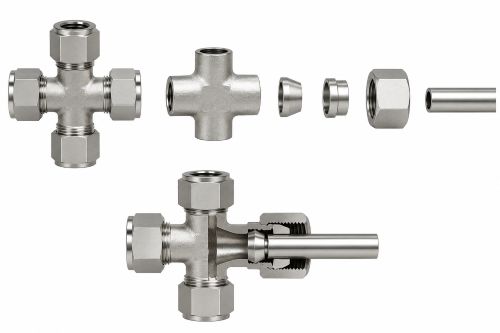
1. Fitting Body
The fitting body serves as the central structure of the assembly.
Function
➡️ Connects four tubing lines
➡️ Provides internal flow passages
➡️ Supports the ferrule sealing system
➡️ Maintains structural integrity under pressure
Benefits
➡️ High mechanical strength
➡️ Corrosion resistance
➡️ Long service life
➡️ Stable performance in demanding environments
The fitting body is typically manufactured from stainless steel, brass, or specialty alloys depending on the application requirements.
2. Front Ferrule
The front ferrule is primarily responsible for sealing the connection.
Function
As the fitting is tightened, the front ferrule moves forward and compresses against both the tube and the fitting body. This creates a tight seal that prevents fluid or gas leakage.
Benefits
➡️ Leak-tight sealing
➡️ High-pressure capability
➡️ Reliable performance under varying temperatures
➡️ Enhanced system safety
The effectiveness of the sealing mechanism largely depends on the proper positioning and compression of the front ferrule.
3. Back Ferrule
The back ferrule provides the gripping action that secures the tubing within the fitting.
Function
When the nut is tightened, the back ferrule moves forward and bites into the outer surface of the tube. This action creates a strong mechanical hold that prevents tube movement or pullout.
Benefits
➡️ Secure tube retention
➡️ Resistance to vibration
➡️ Improved connection stability
➡️ Enhanced durability
The back ferrule is essential for maintaining connection integrity in dynamic operating environments.
4. Nut
The nut supplies the force needed to activate the ferrule system.
Function
As it is tightened, the nut drives the ferrules into their working positions, enabling both sealing and gripping functions.
Benefits
➡️ Controlled ferrule compression
➡️ Consistent installation
➡️ Reliable sealing performance
➡️ Easy assembly and maintenance
Proper tightening is critical to achieving the desired sealing and gripping characteristics.
5. Tube
Although not technically part of the fitting assembly itself, the tube is a critical component of the overall connection.
Function
➡️ Carries fluids or gases through the system
➡️ Interfaces directly with the ferrules
➡️ Supports system pressure requirements
Considerations
➡️ Material compatibility
➡️ Wall thickness
➡️ Pressure rating
➡️ Corrosion resistance
Selecting the correct tubing material ensures optimal fitting performance and longevity.
How Bite Type Cross Fittings Work
The operation of a bite type cross fitting follows a straightforward but highly effective process.
Step 1: Tube Insertion
The tubing is inserted fully into the fitting body until it reaches the internal stop.
Step 2: Nut Tightening
The nut is tightened according to the manufacturer’s recommended specifications.
Step 3: Ferrule Engagement
As tightening continues:
➡️ The front ferrule creates a seal against the fitting body and tube.
➡️ The back ferrule grips the tube securely.
Step 4: Secure Connection
Once properly assembled, the fitting provides:
1. Leak-free sealing
2. Strong tube retention
3. Resistance to vibration
4. Reliable pressure containment
This combination of sealing and gripping actions is what makes bite type fittings highly dependable in industrial applications.
Key Functions of Bite Type Cross Fittings
Fluid and Gas Distribution
Cross fittings allow multiple flow paths from a single connection point, simplifying system layouts and reducing the need for additional fittings.
Leak Prevention
The ferrule-based sealing mechanism helps maintain leak-free operation, even in high-pressure environments.
Vibration Resistance
The back ferrule’s gripping action minimizes tube movement and helps maintain connection integrity under vibration.
Pressure Handling
Bite type cross fittings are designed to perform reliably in medium- and high-pressure systems.
System Flexibility
Their four-way configuration provides greater flexibility when designing complex tubing networks.
Advantages of Using Bite Type Cross Fittings
Leak-Tight Performance
The dual-ferrule design creates a highly effective seal that minimizes leakage risks.
Strong Mechanical Grip
The back ferrule securely holds the tube, preventing accidental pullout.
Easy Installation
No welding or specialized equipment is required for assembly.
Long Service Life
High-quality materials and robust construction contribute to extended operational life.
Corrosion Resistance
Available in corrosion-resistant materials suitable for aggressive environments.
Reduced Maintenance
Reliable sealing performance helps minimize downtime and maintenance requirements.
Industries That Commonly Use Bite Type Cross Fittings
Oil and Gas
Used in instrumentation and process control systems where reliability is critical.
Chemical Processing
Provides secure connections for handling aggressive chemicals and process fluids.
Power Generation
Supports steam, water, and instrumentation systems in power plants.
Pharmaceutical Manufacturing
Maintains clean and reliable fluid transport in production environments.
Semiconductor Manufacturing
Offers precise and contamination-resistant connections for specialized processes.
Industrial Automation
Facilitates efficient fluid and pneumatic distribution within automated systems.
Check out these other resources ⬇️⬇️⬇️
What Are Double Ferrule Bite Fittings and How Do They Work?
Hydraulic NPSF Thread vs NPT: Understanding the Key Differences
What Are DIN 2353 Bite Type Fittings? A Complete Guide
Factors to Consider When Selecting Bite Type Cross Fittings
Material Selection
Common materials include:
1. Stainless Steel 316
2. Stainless Steel 304
3. Brass
4. Monel
5. Hastelloy
Pressure Rating
Ensure the fitting meets the system’s maximum operating pressure requirements.
Temperature Range
Verify compatibility with both operating and ambient temperatures.
Tube Size Compatibility
Select fittings that match the tube’s outside diameter and wall thickness.
Media Compatibility
Consider the chemical properties of the fluid or gas being transported.
Installation Best Practices
To maximize performance and reliability:
1. Use properly prepared tubing.
2. Inspect components before installation.
3. Follow manufacturer tightening instructions.
4. Avoid over-tightening.
5. Conduct pressure and leak testing after installation.
6. Replace damaged components immediately.
Proper installation significantly improves fitting longevity and system safety.
Common Issues and Troubleshooting
Leakage
Possible causes:
➡️ Insufficient tightening
➡️ Damaged ferrules
➡️ Improper tube insertion
Tube Slippage
Possible causes:
➡️ Incorrect ferrule installation
➡️ Excessive vibration
➡️ Damaged tubing
Corrosion
Possible causes:
➡️ Incompatible material selection
➡️ Harsh operating environment
Routine inspections and preventive maintenance can help identify and resolve these issues before they impact system performance.
Conclusion
Bite type cross fittings are essential components in modern industrial tubing systems, providing secure four-way connections for fluid and gas distribution. Their effectiveness comes from a carefully engineered combination of components, including the fitting body, front ferrule, back ferrule, nut, and tubing.
Together, these elements create a connection that delivers leak-tight sealing, strong tube retention, vibration resistance, and long-term reliability. By understanding the key components and functions of bite type cross fittings, engineers and maintenance professionals can make informed decisions that improve system performance, safety, and operational efficiency.
Whether used in instrumentation, hydraulic, pneumatic, chemical processing, or industrial automation applications, bite type cross fittings continue to be a trusted solution for demanding fluid handling systems.
Post time: Jun-09-2026