

In industrial fluid and gas systems, the reliability of every connection matters. Even a minor leak can lead to reduced efficiency, costly downtime, safety hazards, and equipment damage. As industries continue to demand higher performance, engineers and maintenance professionals rely on advanced fitting technologies that provide secure, leak-free connections under challenging operating conditions.
Among the most trusted solutions are double ferrule bite fittings. Widely used in instrumentation, hydraulic, pneumatic, oil and gas, chemical processing, and power generation applications, these fittings offer exceptional sealing performance, vibration resistance, and durability.
This guide explains what double ferrule bite fittings are, how they work, their advantages, common applications, and best practices for installation and maintenance.
What Are Double Ferrule Bite Fittings?
Double ferrule bite fittings are mechanical tube fittings designed to create secure, leak-tight connections without the need for welding, brazing, or threading the tubing itself. They utilize two separate ferrules that work together to provide both sealing and gripping functions.
Unlike single ferrule fittings, which rely on one ferrule to perform multiple tasks, double ferrule fittings divide these responsibilities between two components:
1. The front ferrule creates the primary seal.
2. The tube is grasped by the back ferrule, which offers mechanical support.
This dual-action design improves reliability, especially in high-pressure and high-vibration environments.
Components of a Double Ferrule Bite Fitting
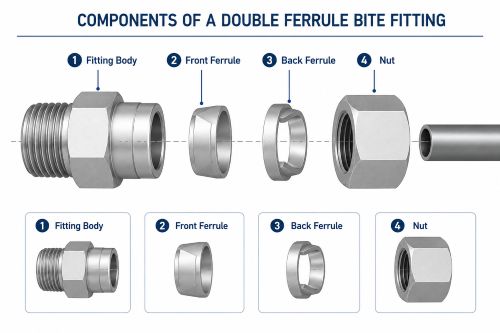
Understanding the individual components helps explain why these fittings are so effective.
1. Fitting Body
The fitting body serves as the foundation of the assembly. It contains the seating surface where the front ferrule creates the seal and provides the connection point to the system.
2. Front Ferrule
The front ferrule is responsible for sealing. As the fitting is tightened, the front ferrule compresses against both the tube and the fitting body, creating a leak-tight seal.
3. Back Ferrule
The back ferrule performs the gripping function. During assembly, it moves forward and “bites” into the tube’s outer surface, creating a strong mechanical hold that prevents tube pullout.
4. Nut
The nut applies the necessary compression force. Tightening the nut drives the ferrules into their working positions and activates the sealing and gripping mechanisms.
How Do Double Ferrule Bite Fittings Work?
The effectiveness of double ferrule fittings lies in their carefully engineered assembly process.
Step 1: Tube Insertion
The tubing is inserted fully into the fitting body until it reaches the internal shoulder. Proper insertion ensures correct ferrule positioning and reliable sealing.
Step 2: Nut Tightening
As the nut is tightened, axial force is applied to the ferrules. This force initiates the controlled deformation of both ferrules.
Step 3: Front Ferrule Creates the Seal
The front ferrule moves forward and compresses against the fitting body and tubing. This action forms the primary seal that prevents fluid or gas leakage.
Step 4: Back Ferrule Grips the Tube
At the same time, the back ferrule moves forward and applies a controlled gripping force to the tubing. This creates the characteristic “bite” that gives the fitting its name.
The back ferrule’s design allows it to securely grip the tube without causing excessive damage or weakening the tubing.
Step 5: Formation of a Leak-Free Connection
Once properly tightened, the fitting creates a robust mechanical connection capable of withstanding pressure fluctuations, vibration, thermal cycling, and mechanical stress.
Understanding the Bite Mechanism
The term “bite fitting” refers to the action of the back ferrule engaging the tubing surface.
Rather than simply compressing against the tube, the back ferrule slightly penetrates the tube’s outer diameter. This controlled interaction provides:
1. Superior tube retention
2. Increased vibration resistance
3. Improved pullout resistance
4. Enhanced mechanical stability
Importantly, the front ferrule handles sealing while the back ferrule handles gripping. Separating these functions allows each ferrule to perform its role more effectively.
Key Benefits of Double Ferrule Bite Fittings
Leak-Free Performance
One of the primary advantages of double ferrule fittings is their ability to provide reliable sealing under demanding conditions. Properly installed fittings maintain leak-free performance even in high-pressure systems.
Excellent Vibration Resistance
Industrial equipment often experiences vibration from pumps, compressors, motors, and machinery. Double ferrule fittings are specifically designed to maintain connection integrity in these environments.
High Pressure Capability
These fittings are commonly used in applications involving substantial operating pressures. Their dual-ferrule design distributes forces more effectively than many alternative connection methods.
Easy Installation
Unlike welded joints, double ferrule fittings can be installed quickly with standard tools. This reduces installation time and labor costs.
Reusability
Many double ferrule fittings can be disconnected and reassembled when properly handled, making maintenance and system modifications more convenient.
Enhanced Safety
Reliable sealing reduces the risk of fluid or gas leaks, helping protect personnel, equipment, and the environment.
Double Ferrule vs Single Ferrule Fittings
When selecting tube fittings, engineers often compare single ferrule and double ferrule designs.
|
Feature |
Single Ferrule |
Double Ferrule |
|
Sealing Performance |
Good |
Excellent |
|
Tube Grip |
Moderate |
Superior |
|
Vibration Resistance |
Moderate |
High |
|
Pullout Resistance |
Moderate |
High |
|
High-Pressure Capability |
Good |
Excellent |
|
Reliability |
Good |
Excellent |
Because sealing and gripping functions are separated, double ferrule fittings generally provide superior performance in critical applications.
Common Applications of Double Ferrule Bite Fittings
Instrumentation Systems
Double ferrule fittings are widely used in instrumentation lines where leak-free performance is essential.
Applications include:
➡️ Pressure gauges
➡️ Flow meters
➡️ Analytical instruments
➡️ Sampling systems
Hydraulic Systems
Hydraulic systems operate under high pressure and require secure connections. Double ferrule fittings help ensure system integrity and reliability.
Pneumatic Systems
Compressed air systems benefit from the sealing performance and ease of installation offered by double ferrule fittings.
Oil and Gas Industry
Oil and gas facilities rely on these fittings for:
➡️ Process instrumentation
➡️ Control panels
➡️ Offshore platforms
➡️ Refining operations
Chemical Processing Plants
Chemical facilities often use corrosion-resistant stainless steel double ferrule fittings to handle aggressive fluids safely.
Power Generation
Power plants use double ferrule fittings in steam systems, instrumentation networks, and process control applications.
Materials Used in Double Ferrule Fittings
Stainless Steel
Stainless steel is the most common material due to its:
➡️ Corrosion resistance
➡️ Strength
➡️ Temperature resistance
➡️ Long service life
Brass
Brass fittings are often selected for lower-pressure applications and environments where corrosion resistance is still important.
Carbon Steel
Carbon steel fittings offer excellent strength and are frequently used in heavy industrial settings.
Specialty Alloys
For extreme environments, manufacturers may offer alloys such as Monel®, Hastelloy®, or Inconel® to provide enhanced chemical and temperature resistance.
Best Practices for Installation
Proper installation is critical for achieving optimal performance.
Prepare the Tubing
Ensure the tubing is:
1. Clean
2. Properly cut
3. Free of burrs
4. Undamaged
Inspect Components
Verify that all fitting components are free from contamination, scratches, or visible damage.
Follow Manufacturer Instructions
Each manufacturer may specify unique assembly procedures and tightening requirements. Always follow recommended installation guidelines.
Avoid Over-Tightening
Excessive tightening can damage ferrules, deform tubing, and compromise fitting performance.
Perform Leak Testing
After installation, test the system to verify connection integrity before full operation.
Common Installation Mistakes
Even high-quality fittings can fail if installed incorrectly.
Common mistakes include:
1. Under-tightening the nut
2. Over-tightening the assembly
3. Using damaged tubing
4. Improper tube insertion
5. Mixing components from different manufacturers
6. Failing to inspect ferrules before installation
Avoiding these errors helps maximize fitting reliability and lifespan.
Maintenance and Inspection
Although double ferrule fittings require minimal maintenance, periodic inspection is recommended.
Regular inspections should include:
1. Visual leak checks
2. Corrosion assessment
3. Tube condition evaluation
4. Verification of fitting integrity
Preventive maintenance helps identify potential issues before they affect system performance.
How to Choose the Right Double Ferrule Bite Fitting
Selecting the appropriate fitting requires consideration of several factors.
Operating Pressure
Ensure the fitting’s pressure rating exceeds system requirements.
Temperature Range
Verify material compatibility with operating temperatures.
Fluid Compatibility
Choose materials that resist corrosion and chemical attack from the process media.
Tube Size
Confirm compatibility with tubing dimensions and wall thickness.
Industry Standards
Consider applicable standards, certifications, and regulatory requirements.
Manufacturer Quality
Select fittings from reputable manufacturers with proven performance records and quality control processes.
Frequently Asked Questions
What is the purpose of the second ferrule?
The second (back) ferrule grips the tubing and provides mechanical support, while the front ferrule creates the seal.
Are double ferrule fittings reusable?
In many cases, yes. However, fittings should always be inspected before reassembly and manufacturer recommendations should be followed.
Can double ferrule fittings handle high pressure?
Yes. They are commonly used in high-pressure hydraulic, instrumentation, and process control applications.
Do double ferrule fittings require thread sealants?
The sealing mechanism occurs at the ferrules, not the tube connection itself, so thread sealants are generally not required for the ferrule-to-tube seal.
Why are stainless steel double ferrule fittings popular?
Stainless steel offers excellent corrosion resistance, strength, and durability across a wide range of industrial applications.
Conclusion
Double ferrule bite fittings have become a preferred solution for creating reliable, leak-free tube connections in industrial fluid and gas systems. Their unique two-ferrule design separates sealing and gripping functions, resulting in superior performance, enhanced vibration resistance, and improved safety.
Whether used in instrumentation systems, hydraulic equipment, chemical processing facilities, or oil and gas operations, double ferrule fittings provide the reliability and durability required for critical applications. By selecting the appropriate materials, following proper installation procedures, and performing routine inspections, users can achieve long-lasting performance and maximize system efficiency.
For industries where connection integrity is essential, double ferrule bite fittings remain one of the most trusted and effective tube fitting solutions available.
Post time: Jun-08-2026