

Hydraulic systems rely on secure connections to maintain pressure, control fluid flow, and keep equipment operating efficiently. However, not every hydraulic port needs to remain connected at all times. Some openings are reserved for future use, while others need to be closed during equipment assembly, maintenance, or transportation. This is where hydraulic stopper plugs become useful.
Hydraulic stopper plugs are small but important components designed to close unused ports and openings in hydraulic systems. They help prevent fluid leakage, keep contaminants out, and protect connection points from damage. Although their design may look simple, choosing the right stopper plug requires attention to thread type, material, sealing method, and operating pressure.
In this guide, we will explore what hydraulic stopper plugs are, how they work, their common types, materials, and applications, as well as how to select the right option for your hydraulic equipment.
What Are Hydraulic Stopper Plugs?
Hydraulic stopper plugs are threaded or specially designed components used to close unused openings in hydraulic circuits. They are commonly installed in ports found on pumps, valves, manifolds, cylinders, and other hydraulic equipment.
Their main purpose is to create a secure closure that prevents hydraulic fluid from escaping and stops unwanted contaminants from entering the system. Depending on the design, a stopper plug may seal through tapered threads, an O-ring, a bonded seal, or a machined sealing surface.
These plugs are available in different sizes, thread configurations, and materials to accommodate various hydraulic connections. Common thread options include metric, BSP, NPT, and other industry-standard configurations.
Unlike protective caps, which are generally designed to cover external connection points during storage or transportation, hydraulic stopper plugs are intended to close compatible ports and provide a functional seal. The correct design depends on the port configuration and the pressure requirements of the application.
How Do Hydraulic Stopper Plugs Work?
Hydraulic stopper plugs work by fitting into an unused or open port and creating a sealed barrier. Once correctly installed, they help maintain the integrity of the hydraulic connection.
Their operation involves several important functions.
Closing Unused Hydraulic Ports
Hydraulic equipment often has multiple connection points, but not all of them are needed in every configuration. For example, a hydraulic manifold may include additional ports for different circuit arrangements.
A stopper plug closes these unused openings by engaging with the corresponding threads or sealing surfaces. This prevents hydraulic fluid from flowing through an unnecessary connection and keeps the system properly configured.
Preventing Hydraulic Fluid Leakage
One of the main reasons for using hydraulic stopper plugs is to prevent fluid leakage.
Depending on the design, the plug creates a seal through thread engagement, an O-ring, a bonded washer, or a dedicated sealing face. When the plug is compatible with the port and installed according to the manufacturer’s specifications, it helps prevent hydraulic oil from escaping.
Proper installation is particularly important in high-pressure applications, where an unsuitable plug or damaged sealing surface can lead to leakage and equipment problems.
Protecting Against Contamination
Dust, dirt, moisture, and metal particles can affect hydraulic fluid cleanliness. If contaminants enter through an open port, they may damage sensitive components such as pumps, valves, and cylinders.
Hydraulic stopper plugs help reduce this risk by closing exposed openings. They are especially useful during equipment assembly, maintenance, storage, and transportation.
For equipment that will remain unused for an extended period, properly selected plugs can help protect connection points from environmental exposure.
Maintaining System Pressure
A properly rated hydraulic stopper plug helps maintain the integrity of a pressurized hydraulic circuit by securely closing an unused port.
However, not every stopper plug is suitable for every pressure level. Its pressure capability depends on factors such as material strength, thread design, sealing configuration, dimensions, and installation conditions.
For this reason, always check the manufacturer’s specifications before using a stopper plug in a pressurized system.
Key Components of a Hydraulic Stopper Plug
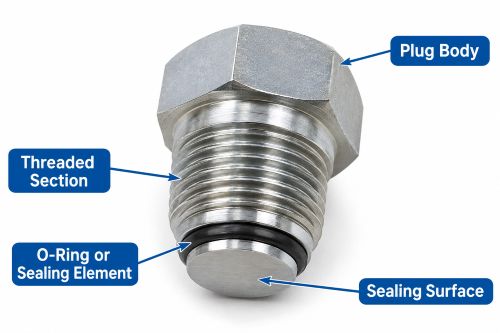
Hydraulic stopper plugs come in different designs, but many share several basic components.
Plug Body
The plug body is the main structural part of the component. It provides the strength needed to close the hydraulic opening and withstand the mechanical loads associated with installation and operation.
It is commonly manufactured from carbon steel, stainless steel, or brass, depending on the intended application.
Threaded Section
The threaded section allows the plug to connect securely to a compatible hydraulic port. Thread dimensions and profiles must match the port to ensure proper engagement.
Common configurations include metric, BSP, and NPT threads. Some designs also use specialized hydraulic thread standards.
Sealing Surface
The sealing surface helps prevent hydraulic fluid from escaping through the connection.
Depending on the stopper plug design, sealing may occur at the end face, a shoulder, a tapered thread, or another specially machined area.
The condition and accuracy of this surface directly affect sealing performance.
O-Ring or Sealing Element
Some hydraulic stopper plugs include an O-ring or another sealing element to improve leakage protection.
The seal compresses against the corresponding port surface during installation, creating a barrier between the connected components.
The sealing material must be compatible with the hydraulic fluid, operating temperature, and pressure conditions.
Common Types of Hydraulic Stopper Plugs
Hydraulic stopper plugs are available in several configurations. Understanding their differences helps buyers and engineers select suitable products for different equipment requirements.
Threaded Hydraulic Stopper Plugs
Threaded stopper plugs are among the most common designs. They use external threads to connect directly to a compatible port.
They are available in different thread standards and dimensions, making them suitable for a wide range of hydraulic equipment.
Hydraulic Stopper Plugs with O-Rings
These plugs feature an O-ring that provides an additional sealing interface. The O-ring compresses against the mating surface to help prevent fluid leakage.
They are commonly used in hydraulic connections where reliable sealing is required and the port is designed to accommodate an O-ring.
Hex Head Hydraulic Plugs
Hex head plugs feature a hexagonal external or internal drive section that allows installation and removal with standard tools.
Their design makes them convenient for maintenance and assembly, particularly when plugs need to be installed in equipment with limited access.
Metric Hydraulic Stopper Plugs
Metric stopper plugs use metric thread dimensions and are commonly found in hydraulic equipment manufactured according to European or international specifications.
They are available in various diameters and thread pitches. Selecting the correct dimensions is essential for proper installation and sealing.
BSP and NPT Hydraulic Stopper Plugs
BSP and NPT stopper plugs are designed for ports using British Standard Pipe and National Pipe Thread configurations.
BSP threads may be parallel or tapered, while NPT threads use a tapered design. Their thread profiles and dimensions differ, so they should not be treated as interchangeable.
Choosing the correct thread standard helps prevent cross-threading, poor engagement, and leakage.
Materials Used in Hydraulic Stopper Plugs
Material selection affects the strength, corrosion resistance, durability, and overall performance of hydraulic stopper plugs.
The most common material options include carbon steel, stainless steel, and brass.
Carbon Steel
Carbon steel is widely used in hydraulic stopper plug manufacturing because of its strength, durability, and cost-effectiveness.
It is suitable for many industrial and mobile hydraulic applications. Depending on the required corrosion protection, carbon steel plugs may receive surface treatments such as zinc plating or zinc-nickel plating.
These finishes help improve resistance to corrosion and extend service life in suitable operating environments.
Stainless Steel
Stainless steel stopper plugs offer better corrosion resistance than standard carbon steel options.
They are commonly selected for equipment exposed to moisture, chemicals, or demanding environmental conditions. Stainless steel is also useful in applications where long-term surface durability is important.
Passivation may be used to improve the corrosion resistance of suitable stainless steel components.
Brass
Brass offers good corrosion resistance and machinability, making it useful for selected fluid connection applications.
However, its mechanical properties differ from those of carbon steel and stainless steel. Therefore, brass stopper plugs should only be used when their pressure and mechanical ratings meet the requirements of the hydraulic system.
Common Applications of Hydraulic Stopper Plugs
Hydraulic stopper plugs are used in different industries wherever hydraulic ports need to be securely closed.
Common applications include:
1. Hydraulic pumps and motors: Used to close unused ports and protect connection points during assembly or maintenance.
2. Hydraulic cylinders: Help seal compatible openings and prevent contaminants from entering exposed connections.
3. Control valves and manifolds: Close additional ports that are not required in a particular hydraulic circuit.
4. Industrial machinery: Protect unused hydraulic connections in manufacturing equipment and production systems.
5. Agricultural equipment: Help close unused hydraulic ports in tractors, harvesters, and other hydraulic machinery.
6. Construction equipment: Used in hydraulic systems found in excavators, loaders, cranes, and other heavy-duty machines.
7. Hydraulic hose and tube assemblies: Help close compatible connection points during assembly, servicing, and transportation.
Their versatility makes them useful in both equipment manufacturing and routine hydraulic system maintenance.
Check out these other resources ⬇️⬇️⬇️
Hydraulic Tube Insert Threaded Fittings: Design, Function, and Applications
What Is a Tube Nut Adapter and How Does It Work?
A Complete Guide to Tube Reducer Fittings: Types, Uses, and Benefits
How to Choose the Right Hydraulic Stopper Plug
Selecting the correct hydraulic stopper plug is important for achieving reliable sealing and preventing connection problems. Before purchasing, consider the following factors.
Identify the Thread Type
Start by identifying the thread standard used by the hydraulic port. Common options include metric, BSP, and NPT.
Check the thread diameter, pitch, and profile rather than relying on appearance alone. Using an incompatible thread can damage the port and prevent proper sealing.
Check the Pressure Rating
The stopper plug must be suitable for the maximum pressure it may experience in service.
Consider the system’s operating pressure, possible pressure spikes, and the manufacturer’s rated specifications. Never assume that all plugs with similar dimensions have the same pressure capability.
Select the Right Material
Choose a material based on the operating environment and hydraulic fluid compatibility.
Carbon steel is a practical option for many general-purpose applications, while stainless steel is suitable for environments requiring greater corrosion resistance. Brass may be appropriate for selected applications with suitable pressure requirements.
Consider the Sealing Design
Different hydraulic ports require different sealing methods.
Some plugs rely on tapered threads, while others use O-rings, bonded seals, or dedicated sealing faces. Always match the plug’s sealing design to the port configuration.
Verify Dimensions and Installation Requirements
Check the plug’s overall dimensions, thread length, head design, and required installation torque.
A plug that is too long may interfere with internal components, while an incorrect thread length may result in insufficient engagement.
Evaluate the Operating Environment
Consider temperature, vibration, moisture, chemicals, and exposure to external contaminants.
These conditions influence the choice of material, surface treatment, and sealing element.
Common Installation Mistakes to Avoid
Even a well-manufactured hydraulic stopper plug may fail to perform properly if installed incorrectly.
Here are some common mistakes to avoid:
1. Using incompatible threads: Always confirm that the plug and port share the same thread standard and dimensions.
2. Overtightening the plug: Excessive torque can damage threads, sealing surfaces, or the plug itself.
3. Ignoring damaged O-rings: Worn, cracked, or incorrectly sized seals can cause leakage.
4. Installing plugs on dirty ports: Dirt and metal particles can interfere with sealing and contaminate the hydraulic system.
5. Using an unsuitable pressure rating: A plug that cannot handle the system pressure may become a leakage or safety risk.
6. Mixing sealing methods: Do not apply thread sealant or additional sealing materials unless they are approved for the specific connection design.
Before installation, depressurize the hydraulic system and follow the equipment manufacturer’s safety procedures. After installation, inspect the connection for leakage under the appropriate operating conditions.
Why Quality Matters When Choosing Hydraulic Stopper Plugs
Hydraulic stopper plugs may be small components, but their manufacturing quality can have a direct impact on system reliability.
Poor thread accuracy can lead to improper engagement, while rough or uneven sealing surfaces may create leakage paths. Inconsistent material quality can also affect mechanical strength and corrosion resistance.
When sourcing hydraulic stopper plugs, buyers should pay attention to several quality factors:
1. Accurate thread dimensions and machining tolerances.
2. Consistent material composition and mechanical properties.
3. Smooth and properly finished sealing surfaces.
4. Suitable corrosion-resistant surface treatments.
5. Compatible sealing materials.
6. Inspection and testing procedures that match the product specifications.
Working with an experienced hydraulic fitting manufacturer can help ensure consistent product quality and compatibility with different hydraulic applications.
Why Choose Sannke for Hydraulic Stopper Plugs?
Choosing a reliable manufacturer is important when sourcing hydraulic stopper plugs for industrial equipment, hydraulic machinery, and OEM applications.
Sannke is a hydraulic fittings manufacturer with 15 years of manufacturing experience, offering products and customization services for different hydraulic connection requirements.
The company provides OEM and ODM services, allowing customers to request specific dimensions, thread configurations, materials, and product designs. Available material options include carbon steel, stainless steel, and brass.
Sannke also offers different surface treatments, including zinc plating, zinc-nickel plating, and stainless steel passivation, depending on the product requirements.
With engineering support and advanced manufacturing equipment, Sannke can develop customized hydraulic fittings, plugs, adapters, ferrules, flanges, and related accessories. Free samples are also available for product evaluation.
For distributors, equipment manufacturers, and hydraulic system suppliers, working directly with a manufacturer can make it easier to discuss product specifications, customization requirements, and bulk purchasing needs.
Frequently Asked Questions (FAQs)
1. What is the main purpose of a hydraulic stopper plug?
The main purpose is to close unused hydraulic ports and openings. It helps prevent hydraulic fluid leakage and protects the system from dust, moisture, and other contaminants.
2. Are hydraulic stopper plugs suitable for high-pressure systems?
Yes, certain hydraulic stopper plugs are designed for high-pressure applications. However, their suitability depends on the material, thread design, sealing method, dimensions, and specified pressure rating. Always check the manufacturer’s technical data.
3. What is the difference between a hydraulic stopper plug and a pipe plug?
Both components close threaded openings, but hydraulic stopper plugs are selected for hydraulic connection requirements, which may involve higher pressures and specialized sealing designs. Standard pipe plugs may not have the necessary pressure or sealing specifications for hydraulic applications.
4. Can hydraulic stopper plugs prevent fluid leakage?
Yes. When correctly matched to the port and properly installed, they help prevent fluid from escaping. Their sealing performance depends on thread compatibility, sealing design, surface condition, and installation torque.
5. What materials are commonly used to manufacture hydraulic stopper plugs?
Carbon steel, stainless steel, and brass are common materials. The appropriate choice depends on pressure requirements, corrosion exposure, hydraulic fluid compatibility, and operating conditions.
6. How do I determine the correct thread size for a hydraulic stopper plug?
Check the port’s thread diameter, pitch, and profile. You should also identify the applicable thread standard, such as metric, BSP, or NPT. Thread gauges and technical drawings can help confirm the correct dimensions.
7. Can hydraulic stopper plugs be customized?
Yes. Manufacturers can offer customized stopper plugs with specific thread sizes, dimensions, materials, sealing configurations, and surface finishes to meet different equipment requirements.
8. When should hydraulic stopper plugs be replaced?
Replace a stopper plug if it shows damaged threads, corrosion, deformation, cracks, or sealing surface damage. O-rings and other sealing elements should also be replaced when worn or damaged.
Conclusion
Hydraulic stopper plugs play an important role in protecting hydraulic systems by closing unused ports, preventing fluid leakage, and reducing the risk of contamination. Although their structure is relatively simple, their performance depends on choosing the correct thread type, material, sealing design, and pressure rating.
Whether used in hydraulic pumps, cylinders, manifolds, or industrial machinery, a properly selected stopper plug helps maintain reliable connections and supports long-term equipment performance.
For consistent quality and customized hydraulic connection solutions, working with an experienced manufacturer such as Sannke can help buyers find products that meet their specific application requirements.
Post time: Nov-02-2026