

Hydraulic cylinder vent plugs are small components that help manage air movement and pressure inside certain hydraulic cylinder cavities while reducing the risk of contamination. Although they may look simple, the right vent plug can contribute to reliable cylinder operation, especially in equipment exposed to dust, moisture, temperature changes, and demanding working conditions.
A hydraulic cylinder needs more than just a piston, rod, seals, and barrel to operate reliably. Different cylinder designs can also require components that allow air to move in or out of non-pressurized areas. This is where a vent plug becomes useful.
In this guide, we will look at what hydraulic cylinder vent plugs are, how they work, their main components, common applications, and the factors to consider when selecting one.
What Are Hydraulic Cylinder Vent Plugs?
A hydraulic cylinder vent plug is a fitting installed in a cylinder or related housing to provide a controlled path for air exchange. It is generally used in areas that need to breathe rather than remain completely sealed.
During cylinder operation, air pressure inside a non-pressurized cavity can change because of piston movement, temperature fluctuations, or changes in the surrounding environment. Without a suitable venting path, pressure can build up or a vacuum can develop.
A vent plug provides a controlled opening while helping keep dirt, dust, moisture, and other contaminants from entering the cylinder.
The exact design depends on the cylinder and application. Some vent plugs are relatively simple, while others incorporate a filter, breather element, or specialized protective structure.
How Do Hydraulic Cylinder Vent Plugs Work?
The basic principle is straightforward: the vent plug allows air to move through a controlled passage while limiting the entry of contaminants.
Consider a cylinder with a cavity that is not directly exposed to hydraulic pressure. As the piston or rod moves, the volume of air within that cavity may change. Temperature changes can also cause air to expand or contract.
A completely sealed cavity can therefore experience pressure changes.
A vent plug provides a path for air to move according to these changes. At the same time, the plug can incorporate a filter or protective element to reduce the amount of dirt and moisture entering the cavity.
The result is controlled pressure equalization without leaving the opening completely exposed to the surrounding environment.
If the vent passage becomes blocked, however, the plug may no longer perform its intended function. This is why vent plugs should be included in routine cylinder inspections when the application requires them.
Main Components of a Hydraulic Cylinder Vent Plug
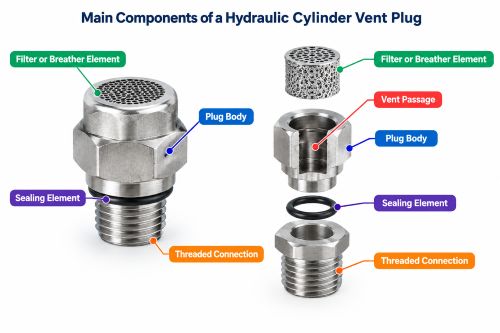
Although designs vary between manufacturers, most hydraulic cylinder vent plugs contain several basic features.
Plug Body
The plug body is the main structural part of the component. It provides the connection between the vent plug and the cylinder or housing.
The body needs to withstand the environmental conditions around the cylinder and provide sufficient mechanical strength for installation and service.
Common materials include carbon steel, stainless steel, brass, and engineering plastics, depending on the application.
Vent Passage
The vent passage provides the route through which air can move.
Its design can vary considerably. Some plugs use a relatively simple internal passage, while others are designed with specific airflow or filtration characteristics.
The passage needs to provide adequate ventilation without creating an unnecessarily open path for contaminants.
Filter or Breather Element
Some vent plugs include a filter or breather element. Its purpose is to allow air exchange while helping prevent dust, particles, and other contaminants from entering the cylinder cavity.
This feature can be particularly useful on equipment operating outdoors, in construction environments, agricultural machinery, or other areas where contamination is a concern.
Threaded Connection
The threaded section allows the vent plug to be installed into the corresponding port.
Thread type and size must match the cylinder or housing. Depending on the design and market, different metric or inch thread configurations may be available.
Using the wrong thread can lead to poor engagement, leakage, or damage to the mounting port.
Sealing Element
Some vent plugs use an O-ring, sealing washer, bonded seal, or another sealing method.
The sealing element helps control the interface between the plug and the cylinder while preventing unwanted leakage or contamination around the connection.
Why Are Vent Plugs Used in Hydraulic Cylinders?
The primary reason for using a vent plug is to provide controlled air exchange where it is needed.
A properly selected vent plug can offer several practical benefits.
Pressure Equalization
Changes in piston movement and temperature can affect air pressure inside an enclosed cavity. Venting helps keep the pressure closer to the surrounding atmospheric pressure when the design calls for it.
Contamination Protection
A simple open hole would allow air to move freely, but it could also allow dirt and moisture to enter. A vent plug can provide a more controlled solution, particularly when it includes a filtration or breather element.
Improved Reliability
Keeping pressure and contamination under control can help reduce problems associated with poorly ventilated cavities.
Reduced Maintenance Issues
A suitable venting arrangement can help prevent unnecessary pressure-related problems and protect internal areas from environmental contamination.
However, the vent plug itself must remain clean and functional. A blocked breather can be just as problematic as having no venting path.
Where Are Hydraulic Cylinder Vent Plugs Used?
Hydraulic cylinder vent plugs can be found in a variety of hydraulic and industrial applications.
Common examples include:
1. Construction equipment
2. Agricultural machinery
3. Material handling equipment
4. Industrial hydraulic machinery
5. Mobile hydraulic systems
6. Specialized hydraulic cylinders
7. Equipment operating in dusty or wet environments
They can be particularly useful when cylinders are exposed to frequent temperature changes or harsh outdoor conditions.
The exact application depends on the cylinder design. Not every hydraulic cylinder requires a vent plug, so the cylinder manufacturer’s design and specifications should always be considered.
Common Types of Hydraulic Cylinder Vent Plugs
Hydraulic cylinder vent plugs are available in different designs to suit different applications.
Standard Vent Plugs
These provide a basic air passage and are suitable for applications where simple ventilation is required.
Breather-Style Vent Plugs
Breather plugs are designed specifically to allow air movement while providing some degree of environmental protection.
Filtered Vent Plugs
These incorporate a filter element to reduce the entry of airborne particles and contaminants.
Compact Vent Plugs
Compact designs are useful where installation space is limited around the hydraulic cylinder.
Specialized Vent Plugs
Some applications require vent plugs capable of handling elevated temperatures, corrosive environments, or other demanding conditions. Material and construction can be selected accordingly.
What Materials Are Hydraulic Cylinder Vent Plugs Made From?
Material selection depends largely on the operating environment.
Carbon steel is commonly selected when strength and cost efficiency are important. Surface treatments or protective coatings can improve corrosion resistance.
Stainless steel is useful in applications where corrosion resistance is a higher priority, particularly where the equipment is exposed to moisture or aggressive environments.
Brass can be used for certain applications where its corrosion resistance and machining characteristics are beneficial.
Engineering plastics may also be used in specialized venting applications where low weight or particular chemical and environmental properties are required.
The best material is not necessarily the most expensive one. It should match the cylinder, surrounding environment, temperature, and expected service conditions.
Hydraulic Cylinder Vent Plugs vs. Standard Hydraulic Plugs
Vent plugs and standard hydraulic plugs may look similar, but they serve different purposes.
|
Feature |
Hydraulic Cylinder Vent Plug |
Standard Hydraulic Plug |
|
Main purpose |
Controlled air exchange |
Sealing a port |
|
Air passage |
Usually present |
Normally absent |
|
Contamination protection |
May include a filter or breather |
Primarily seals the opening |
|
Typical application |
Venting non-pressurized cavities |
Closing hydraulic ports |
|
Design |
May include airflow and filtration features |
Usually solid |
A standard solid plug should not automatically be used as a replacement for a vent plug. If a cylinder cavity is designed to breathe, blocking the vent can interfere with its intended operation.
Likewise, a vent plug should not be installed in a hydraulic pressure port unless the component is specifically designed and rated for that application.
Checkout these other resources ⬇️⬇️⬇️
What Are Hydraulic Cone Plugs and How Do They Work?
Hydraulic Flare Caps: Types, Uses, and Applications
ORB Hydraulic Caps vs ORB Plugs: What’s the Difference?
Benefits of Using the Right Hydraulic Cylinder Vent Plug
Choosing the correct vent plug can provide several practical advantages.
Better Pressure Management
The plug provides a controlled route for air movement where ventilation is required.
Improved Contamination Protection
A filtered or protected vent can reduce the entry of dust and other airborne contaminants.
Better Cylinder Reliability
Maintaining the intended pressure and ventilation conditions can help support consistent cylinder operation.
Longer Service Life
Proper protection from contamination and environmental exposure can help reduce unnecessary wear and maintenance.
Easier Maintenance
A properly designed vent plug can be inspected, cleaned, or replaced as part of routine equipment maintenance.
Common Problems With Hydraulic Cylinder Vent Plugs
Even a relatively simple component can cause problems if it is damaged, blocked, or incorrectly selected.
Blocked Vent Passage
Dirt, grease, paint, corrosion, or other debris can restrict the vent passage.
A blocked passage can prevent the cavity from breathing properly and may lead to unwanted pressure differences.
Incorrect Thread Size
Installing a vent plug with the wrong thread can damage the port or result in an unreliable connection.
Always confirm thread type, diameter, and pitch before installation.
Damaged Sealing Element
A damaged O-ring or sealing washer can compromise the connection and allow contamination or leakage around the mounting point.
Corrosion
Vent plugs installed in wet, outdoor, or chemically aggressive environments may be exposed to corrosion.
Choosing an appropriate material or surface treatment can help improve service life.
Incorrect Plug Selection
A vent plug designed for a light-duty application may not be suitable for a demanding industrial environment.
Material, thread, temperature range, filtration requirements, and installation conditions should all be considered.
How to Install a Hydraulic Cylinder Vent Plug
Installation is generally straightforward, but care is important.
Step 1: Confirm the Correct Specification
Check the required thread, size, material, and venting design before installation.
Step 2: Clean the Mounting Port
Remove dirt, debris, old seal material, and other contaminants from the installation area.
Step 3: Inspect the Vent Plug
Check the body, threads, vent passage, filter, and sealing element for damage.
Step 4: Install the Plug Carefully
Start the plug by hand where possible to reduce the risk of cross-threading.
Step 5: Tighten Correctly
Use the manufacturer’s recommended tightening method and torque. Avoid excessive tightening, which can damage the plug, seal, or cylinder port.
Step 6: Check the Vent Path
Make sure the vent opening or breather element is not blocked after installation.
Step 7: Inspect the Installation
After installation, check for abnormal leakage, damage, or other signs of an improper connection.
How to Maintain Hydraulic Cylinder Vent Plugs
Vent plugs should be inspected as part of regular hydraulic equipment maintenance when they are used in the cylinder design.
Look for accumulated dirt, mud, oil, corrosion, or other contamination around the vent opening.
If the plug has a filter or breather element, check that it remains unobstructed. A contaminated element may need to be cleaned or replaced depending on the manufacturer’s recommendations.
The threads and sealing element should also be inspected whenever the plug is removed.
In harsh environments, more frequent inspection may be appropriate.
How to Choose the Right Hydraulic Cylinder Vent Plug
Selecting a vent plug involves more than simply matching the outside diameter.
Start by checking the thread type and size of the cylinder port. Metric and inch threads are not interchangeable, and even similar-looking threads can have different pitches or profiles.
Next, consider the operating environment. Outdoor and corrosive environments may require stainless steel or a suitable protective coating.
The temperature range should also be considered, especially when the cylinder operates close to heat sources.
You should also look at the required venting and filtration characteristics. A dusty application may benefit from a filtered vent plug, while a compact machine may require a low-profile design.
Finally, check the manufacturer’s specifications for compatibility with the cylinder and application.
Frequently Asked Questions
What is the main purpose of a hydraulic cylinder vent plug?
Its main purpose is to provide controlled air exchange in a cylinder cavity where ventilation or pressure equalization is required, while helping protect the cavity from environmental contaminants.
Can a standard hydraulic plug replace a vent plug?
Generally, no. A standard solid plug is designed primarily to seal a port, while a vent plug is designed to allow controlled air movement. Replacing one with the other can change how the cylinder cavity operates.
Do hydraulic cylinder vent plugs prevent contamination?
They can help reduce contamination, particularly when they include a filter, breather, or protective design. However, no vent plug can eliminate contamination completely, so regular inspection is still important.
How often should hydraulic cylinder vent plugs be replaced?
There is no universal replacement interval. Replacement depends on the plug’s condition, operating environment, contamination level, and manufacturer’s recommendations. A plug should generally be replaced if it is damaged, corroded, blocked, or no longer seals correctly.
What materials are hydraulic cylinder vent plugs made from?
Common materials include carbon steel, stainless steel, brass, and engineering plastics. The appropriate choice depends on strength, corrosion resistance, temperature, and application requirements.
How do I select the correct vent plug size?
Check the cylinder’s port thread type, diameter, and pitch first. Then consider the required venting characteristics, material, sealing method, operating temperature, and environmental conditions.
Conclusion
Hydraulic cylinder vent plugs may be small, but they can play an important role in applications that require controlled air exchange and pressure equalization. Their design can also help protect cylinder cavities from dust, moisture, and other environmental contaminants.
When selecting a vent plug, pay attention to the thread size, material, sealing method, venting design, filtration requirements, and operating environment. A correctly matched plug can support reliable cylinder operation and reduce avoidable maintenance problems.
For any specific hydraulic cylinder, the safest approach is to follow the cylinder manufacturer’s specifications and select a vent plug designed for the intended application.
Post time: Sep-23-2026