

A hydraulic cylinder gland cap is an important component that helps seal, guide, and protect the piston rod as it moves in and out of a hydraulic cylinder. Although it is often a relatively small part of the cylinder assembly, the gland cap plays a major role in preventing fluid leakage, keeping contaminants out, and supporting smooth rod movement.
Hydraulic cylinders are used in construction equipment, agricultural machinery, industrial systems, material-handling equipment, and many other applications. In these environments, the gland cap must withstand pressure, friction, contamination, and repeated movement while maintaining reliable sealing performance.
Understanding how a hydraulic cylinder gland cap works can make it easier to select the right component, identify common problems, and maintain hydraulic cylinders properly.
What Is a Hydraulic Cylinder Gland Cap?
A hydraulic cylinder gland cap is the component located around the piston rod at one end of a hydraulic cylinder. It is commonly designed to house or support several sealing and guiding elements that work around the moving rod.
The gland cap is usually installed at the rod end of the cylinder barrel. As the piston rod extends and retracts, the gland assembly helps control the movement of the rod while preventing hydraulic fluid from escaping from the cylinder.
Depending on the cylinder design, the gland may be retained with threads, bolts, retaining rings, or other mechanical arrangements. Some designs are removable for maintenance, while others are integrated more closely into the cylinder structure.
The exact shape and construction can vary, but the basic purpose remains the same: provide a controlled, sealed, and supported passage for the piston rod.
Main Components of a Hydraulic Cylinder Gland Cap
A gland cap is more than just a metal cover. It commonly works together with several internal components to provide proper cylinder operation.
Gland Body
The gland body provides the main structural support for the assembly. It fits into or attaches to the cylinder barrel and provides locations for the rod seals, guide elements, and other components.
Because the gland is exposed to mechanical forces and pressure-related loads, its material and construction need to match the requirements of the cylinder.
Rod Seal
The rod seal is one of the most important parts of the gland assembly. Its primary function is to prevent hydraulic fluid from escaping along the piston rod as the rod moves.
A properly selected rod seal needs to handle the operating pressure, temperature, fluid type, and movement speed of the application. When the seal becomes worn or damaged, external hydraulic leakage may develop.
Rod Guide or Bearing
The rod guide supports and centers the piston rod as it moves through the gland. It helps maintain alignment between the rod and cylinder.
This is particularly important in applications where the cylinder experiences side loads. A suitable guide can reduce direct metal-to-metal contact and help limit uneven wear.
Wiper Seal
A wiper seal, sometimes called a scraper seal, is positioned toward the outside of the gland. Its job is to remove dirt, dust, moisture, and other contaminants from the piston rod before the rod moves back into the cylinder.
This simple function is important because contaminants entering the cylinder can damage seals, guide surfaces, and other internal components.
Retaining and Fastening Features
Depending on the design, the gland may use threads, bolts, retaining rings, snap rings, or other methods to remain securely in position.
These features also influence how easily the gland can be removed during inspection or repair.
What Is the Role of a Hydraulic Cylinder Gland Cap?
The gland cap performs several functions at the same time. Its role is closely connected to the reliability and service life of the entire hydraulic cylinder.
Sealing Hydraulic Fluid
The gland assembly helps keep pressurized hydraulic fluid inside the cylinder. The rod seal creates a sealing interface around the moving piston rod.
Without an effective seal, hydraulic fluid can leak externally, reducing system efficiency and potentially creating maintenance and environmental problems.
Guiding the Piston Rod
The gland also helps maintain proper piston rod alignment. The guide or bearing supports the rod as it moves through the cylinder.
Good rod guidance reduces uneven contact and helps the rod move smoothly during repeated extension and retraction.
Protecting Internal Components
The wiper seal helps prevent contaminants from entering the cylinder. This is especially important for equipment operating outdoors or in dusty, muddy, wet, or abrasive environments.
Keeping contaminants away from the internal sealing surfaces can help reduce premature wear.
Supporting Overall Cylinder Performance
A properly designed and maintained gland assembly contributes to stable cylinder operation. Good sealing, guidance, and contamination control can help the cylinder maintain consistent performance throughout its service life.
How Does a Hydraulic Cylinder Gland Cap Work?
The operation is relatively straightforward.
When hydraulic fluid enters the cylinder, pressure moves the piston and piston rod. As the rod extends, it passes through the gland assembly. The rod guide keeps the rod aligned, while the rod seal maintains contact with the rod surface to prevent hydraulic fluid from escaping.
When the piston rod retracts, the same sealing and guiding functions continue. At the outside of the gland, the wiper seal contacts the rod and helps remove dirt and other contaminants before they can enter the cylinder.
This means the gland assembly is working continuously whenever the cylinder operates. It must accommodate repeated movement while maintaining the required sealing and guiding performance.
Common Materials Used for Gland Caps
Hydraulic cylinder gland caps can be manufactured from different materials depending on the application.
Carbon steel is widely used because it offers good mechanical strength and can be suitable for many general-purpose hydraulic applications. Surface treatments or coatings may be added to improve corrosion resistance.
Stainless steel can be selected for applications where corrosion resistance is particularly important. It is often useful in harsh environments or equipment exposed to moisture and corrosive conditions.
Aluminum may be used where lower weight is desirable. It can be suitable for certain hydraulic cylinder designs when its strength and pressure capabilities meet the application requirements.
Other engineered materials may also be used depending on the cylinder design, operating conditions, and manufacturer’s specifications.
Material selection should consider pressure, temperature, corrosion exposure, mechanical loading, hydraulic fluid compatibility, and expected service life.
Types of Hydraulic Cylinder Gland Caps
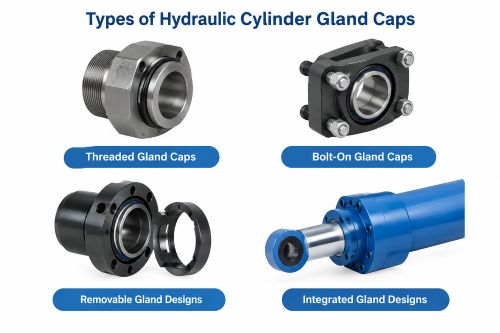
Gland designs vary according to cylinder construction and maintenance requirements.
Threaded Gland Caps
Threaded designs screw into the cylinder barrel or related component. They can provide a secure connection while allowing the gland to be removed when servicing seals and other internal parts.
Bolt-On Gland Caps
Bolt-on designs are secured with bolts or other fasteners. This configuration can make disassembly relatively convenient for certain cylinder constructions.
Removable Gland Designs
Some cylinders use glands specifically designed for easier removal and servicing. This can be useful in applications where seals or guide components need to be replaced regularly.
Integrated Gland Designs
In some hydraulic cylinders, the gland is more closely integrated into the cylinder construction. The exact arrangement depends on the cylinder manufacturer and intended application.
There is no single gland design that suits every hydraulic cylinder. The correct configuration depends on the cylinder’s dimensions, pressure rating, mounting arrangement, and maintenance requirements.
Applications of Hydraulic Cylinder Gland Caps
Because gland caps are part of hydraulic cylinders, they can be found across a wide range of equipment.
In construction machinery, hydraulic cylinders control components such as booms, arms, buckets, and attachments. These cylinders often operate under high loads and in dirty environments.
In agricultural machinery, cylinders are used for implements, lifting mechanisms, steering systems, and other functions. Reliable sealing is important because equipment may operate in dusty, muddy, or wet conditions.
In industrial machinery, hydraulic cylinders can provide controlled linear movement for presses, material-handling systems, production equipment, and automation applications.
They are also common in mining equipment, mobile machinery, lifting equipment, and material-handling systems, where cylinders may experience frequent movement and demanding operating conditions.
Factors to Consider When Choosing a Hydraulic Cylinder Gland Cap
Selecting a gland cap should involve more than simply matching the outside dimensions. Several factors should be checked.
Cylinder Bore and Rod Diameter
The gland must be compatible with the cylinder bore and piston rod dimensions. The rod opening needs to provide the correct fit for the sealing and guiding components.
Operating Pressure
The gland and its seals must be suitable for the cylinder’s working pressure. Higher-pressure applications may require specific sealing arrangements and stronger materials.
Operating Temperature
Temperature affects seal performance and material behavior. The gland assembly should be suitable for the minimum and maximum temperatures expected during operation.
Seal Compatibility
The rod seal, wiper, and other sealing components need to be compatible with the hydraulic fluid and operating conditions.
Operating Environment
Outdoor, marine, mining, agricultural, and other harsh environments may require greater corrosion resistance and stronger contamination protection.
Mounting Method
The gland must match the cylinder’s connection and retention method, whether it uses threads, bolts, retaining rings, or another design.
Maintenance Requirements
If regular seal replacement is expected, a removable gland design may make servicing easier. Maintenance requirements should be considered when choosing the overall cylinder configuration.
Checkout these other resources ⬇️⬇️⬇️
What Are Hydraulic Cone Plugs and How Do They Work?
Hydraulic Flare Caps: Types, Uses, and Applications
What Are Hydraulic Cylinder Vent Plugs and How Do They Work?
Common Hydraulic Cylinder Gland Cap Problems
Even a properly designed gland assembly can eventually experience wear or damage.
Hydraulic Fluid Leakage
External leakage around the piston rod is one of the most noticeable signs of a gland or seal problem. A worn rod seal is a common cause, although damaged rods, incorrect installation, or excessive pressure can also contribute.
Rod Misalignment
If the guide or bearing becomes worn, the piston rod may no longer remain properly centered. This can increase friction and cause uneven wear.
Contamination
A damaged or worn wiper seal may allow dirt and moisture to enter the cylinder. Contamination can then accelerate wear of internal seals and surfaces.
Corrosion or Mechanical Damage
Glands exposed to moisture, chemicals, salt, or other harsh conditions may develop corrosion. Physical damage during installation or operation can also affect sealing performance.
Excessive Wear
Frequent cycling, side loading, contamination, poor alignment, and unsuitable sealing materials can all contribute to premature gland component wear.
Hydraulic Cylinder Gland Cap Maintenance
Regular inspection can help identify gland problems before they become larger hydraulic system issues.
Start by checking the piston rod for scratches, dents, corrosion, or other surface damage. A damaged rod can quickly wear the rod seal even when the seal itself is new.
Inspect the area around the gland for hydraulic fluid leakage. Small leaks should not be ignored because they can become more serious as seals continue to deteriorate.
The rod should also be kept reasonably clean, particularly in applications exposed to dust, mud, or abrasive particles. The wiper seal should be inspected periodically to make sure it remains in good condition.
During cylinder maintenance, worn seals, guides, and other damaged components should be replaced with compatible parts. Following the cylinder manufacturer’s installation and maintenance recommendations is also important.
Hydraulic Cylinder Gland Cap vs. Cylinder End Cap
The terms gland cap and end cap are sometimes confused because both are associated with the ends of a hydraulic cylinder.
A gland cap is normally located at the rod end and provides the passage through which the piston rod moves. It houses or supports components such as rod seals, guides, and wipers.
A cylinder end cap, on the other hand, generally closes the opposite end of the cylinder and helps form the pressure chamber. Depending on the cylinder design, it may also contain mounting features or ports.
Although both components contribute to the cylinder’s structure, their functions are different. Understanding this distinction helps when ordering replacement parts or discussing cylinder repairs.
Why the Gland Cap Matters for Hydraulic Cylinder Performance
The gland cap may not be the largest component in a hydraulic cylinder, but its functions are essential.
It provides a controlled interface around the moving piston rod, helps prevent hydraulic fluid leakage, supports rod alignment, and protects the cylinder from external contamination. When these functions work together properly, the cylinder can operate more reliably and maintain its performance over repeated cycles.
For equipment manufacturers and hydraulic system designers, choosing the appropriate gland configuration and sealing arrangement is therefore an important part of cylinder design.
FAQs
What is a hydraulic cylinder gland cap?
A hydraulic cylinder gland cap is the component located at the rod end of a hydraulic cylinder. It supports sealing and guiding components around the piston rod and helps prevent fluid leakage and contamination.
What does a gland cap do on a hydraulic cylinder?
It helps seal hydraulic fluid, guide the piston rod, protect internal components from contamination, and support smooth cylinder operation.
What components are inside a hydraulic cylinder gland cap?
Depending on the design, a gland assembly may contain a rod seal, wiper seal, rod guide or bearing, retaining elements, and other sealing components.
What materials are hydraulic cylinder gland caps made from?
Common materials include carbon steel, stainless steel, aluminum, and other engineered materials. The appropriate material depends on pressure, corrosion exposure, temperature, and application requirements.
How do I know when a gland cap needs replacement?
Hydraulic leakage, excessive rod movement, damaged seals, corrosion, physical damage, or abnormal rod wear can indicate that the gland assembly or its internal components need inspection or replacement.
What is the difference between a gland cap and an end cap?
The gland cap is generally located at the rod end and surrounds the moving piston rod, while the end cap typically closes the opposite end of the cylinder. Their designs and functions are different.
How can I prevent hydraulic cylinder gland cap leakage?
Use compatible seals, maintain the piston rod surface, avoid excessive side loading, keep contaminants away from the cylinder, and inspect the gland and seals regularly. Proper installation is also essential for preventing premature leakage.
Conclusion
A hydraulic cylinder gland cap plays a central role in the sealing, guiding, and protection of a hydraulic cylinder. It works with rod seals, guides, bearings, and wipers to control piston rod movement while helping keep hydraulic fluid inside and contaminants outside.
The right gland cap depends on factors such as cylinder dimensions, pressure, temperature, materials, sealing requirements, mounting method, and operating environment. Regular inspection of the gland, piston rod, and seals can also help identify problems early and extend cylinder service life.
For hydraulic equipment operating under demanding conditions, a properly designed and maintained gland assembly can make a significant difference in reliable cylinder performance.
Post time: Sep-24-2026