

Hydraulic cylinder end caps are structural components that close the ends of a hydraulic cylinder while helping contain pressure, maintain sealing, and support other cylinder components. Although an end cap may look like a relatively simple machined part, its dimensions, material, connection method, and sealing arrangement all affect the reliability of the hydraulic cylinder.
Hydraulic cylinders are used in equipment that handles significant forces, from excavators and agricultural machinery to industrial presses and material-handling systems. In these applications, every cylinder component needs to work together properly. A poorly designed or damaged end cap can contribute to fluid leakage, pressure loss, mechanical damage, and premature cylinder failure.
This guide looks at what hydraulic cylinder end caps are, how they work, their common types and materials, manufacturing methods, and the factors to consider when selecting one.
What Are Hydraulic Cylinder End Caps?
A hydraulic cylinder end cap is a component fitted to one end of a hydraulic cylinder assembly. Its primary job is to close the cylinder and help create a sealed pressure chamber.
Depending on the cylinder design, the end cap may also provide mounting features, support sealing elements, hold other components in position, or provide an opening for the piston rod or other connections.
The exact terminology can vary between manufacturers. Some designs may use terms such as end cover, cylinder head, or head cap for components that perform similar functions. However, their specific shape and role depend on the construction of the hydraulic cylinder.
An end cap is typically machined to precise dimensions so that it fits securely with the cylinder barrel and associated sealing components. The connection may use threads, bolts, welding, a flange, or another mechanical arrangement.
How Do Hydraulic Cylinder End Caps Work?
The basic principle is straightforward. A hydraulic cylinder uses pressurized fluid to move a piston, and the end caps help keep that pressurized fluid inside the cylinder while maintaining the structural integrity of the assembly.
1. Containing Hydraulic Pressure
When hydraulic fluid enters the cylinder, pressure acts against the piston. The cylinder body and end components must withstand the resulting internal forces.
The end cap forms part of the boundary around the pressurized fluid. Its material and geometry therefore need to be appropriate for the cylinder’s operating pressure.
For high-pressure applications, the end cap must have enough mechanical strength to resist deformation or cracking. The connection between the cap and cylinder barrel is equally important because a strong cap cannot compensate for an inadequate connection.
2. Maintaining a Seal
Hydraulic systems depend on controlled fluid containment. Even a small leak can reduce system performance and create maintenance problems.
Hydraulic cylinder end caps commonly incorporate sealing elements such as O-rings or other specially designed seals. These seals sit in precisely machined grooves or sealing areas between mating components.
When properly installed, the seal helps prevent hydraulic fluid from escaping through the joint between the end cap and cylinder body.
The sealing arrangement needs to match the operating pressure, temperature, hydraulic fluid, and material of the cylinder components. An incorrect seal can wear quickly or fail under operating conditions.
3. Supporting Cylinder Components
Depending on the design, an end cap can also help position or support other components.
For example, some cylinder designs use an end-cap assembly to support a gland or guide arrangement around the piston rod. Other designs incorporate mounting points or additional mechanical features directly into the cap.
This makes the end cap more than just a closure. It can be an important part of the cylinder’s overall mechanical structure.
4. Transferring Mechanical Loads
Hydraulic cylinders generate substantial linear forces. Those forces eventually have to be transferred to the equipment through the cylinder’s mounting structure.
End caps can incorporate mounting eyes, flanges, threaded connections, or other attachment features. These features allow the cylinder to connect to machinery and transfer loads during operation.
For this reason, an end cap should be designed for both hydraulic pressure and the mechanical forces created by the application.
Main Components and Features of a Hydraulic Cylinder End Cap
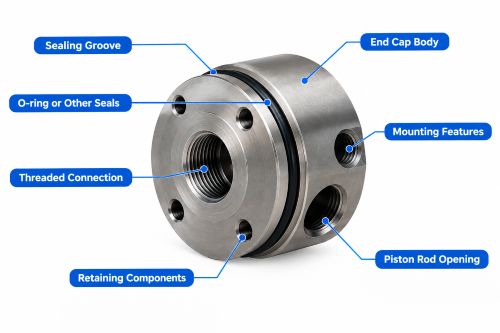
Hydraulic cylinder end caps come in many designs, so not every model contains the same features. However, several elements are commonly found.
End Cap Body
The body provides the main structural support. It closes the cylinder and withstands the forces generated during operation.
Its dimensions and geometry depend on factors such as cylinder bore, pressure rating, mounting arrangement, and overall cylinder design.
Sealing Groove
A machined groove may be included to hold an O-ring or another sealing element. The groove needs accurate dimensions to ensure proper compression and sealing.
If the groove is too deep, too shallow, or incorrectly positioned, the seal may not work as intended.
Threaded Connection
Some end caps use external or internal threads to connect with the cylinder barrel or another cylinder component.
Thread dimensions, tolerances, thread form, and installation torque all need to be considered when using a threaded design.
Bolted Connection
A bolted end cap uses bolts or fasteners to secure the cap to the cylinder body. This arrangement can make disassembly easier when the cylinder needs to be serviced.
The bolt pattern and fastener specifications must be suitable for the forces generated by the cylinder.
Rod Opening
On some hydraulic cylinder designs, the end-cap or head assembly includes an opening through which the piston rod passes. This area may incorporate a rod seal, guide, wiper, or bearing arrangement.
Mounting Features
End caps may also include mounting holes, clevises, flanges, threaded sections, or other features that allow the hydraulic cylinder to be installed on machinery.
Common Types of Hydraulic Cylinder End Caps
The best end cap design depends on how the hydraulic cylinder is constructed and how it will be used.
Threaded Hydraulic Cylinder End Caps
Threaded end caps are secured to the cylinder barrel or another component through a threaded connection.
One advantage of this design is that the cylinder can often be disassembled more easily than a permanently welded construction. This can be useful for maintenance and component replacement.
However, the threads must be accurately manufactured and properly tightened to ensure a secure connection.
Bolted Hydraulic Cylinder End Caps
Bolted end caps are attached using multiple fasteners. The bolts distribute the clamping force around the connection and can allow the cylinder to be opened for inspection or repair.
These designs are commonly considered where serviceability is important.
Welded Hydraulic Cylinder End Caps
A welded end cap is permanently joined to the cylinder barrel. Welding can provide a strong and compact connection and is frequently used in hydraulic cylinder designs where disassembly is not a primary requirement.
The welding process needs to be properly controlled because distortion or poor weld quality can affect the cylinder’s dimensions and performance.
Flanged Hydraulic Cylinder End Caps
Flanged designs use a flange and fasteners to connect the end cap to the cylinder assembly.
A flange can provide a robust mechanical connection and may also simplify installation or maintenance, depending on the overall design.
Custom Hydraulic Cylinder End Caps
Many hydraulic cylinders are designed for specific machines rather than built around a single universal configuration.
Custom end caps can include application-specific dimensions, mounting points, threads, sealing arrangements, ports, and other features. This allows manufacturers to optimize the cylinder for its intended equipment.
Checkout these other resources ⬇️⬇️⬇️
What Is a Hydraulic Fitting with Orifice and How Does It Work?
What Is a Hydraulic Steering Adapter and How Does It Work?
ORB Hydraulic Caps vs ORB Plugs: What’s the Difference?
Materials Used for Hydraulic Cylinder End Caps
Material selection has a direct effect on strength, weight, corrosion resistance, machinability, and service life.
Carbon Steel
Carbon steel is widely used for hydraulic components because it provides good mechanical strength and durability.
It is particularly suitable for industrial and mobile equipment where the cylinder may experience high mechanical loads.
Surface treatments or coatings may be applied to improve corrosion resistance.
Stainless Steel
Stainless steel provides stronger resistance to corrosion than standard carbon steel in many environments.
It can be useful in applications exposed to moisture, chemicals, salt, or other corrosive conditions. The specific stainless-steel grade should be selected according to the environment and mechanical requirements.
Aluminum
Aluminum can be used when reducing component weight is important. It is lighter than steel and can be machined efficiently.
However, aluminum end caps are not automatically suitable for every hydraulic application. Pressure, mechanical loading, thread strength, wear, and environmental conditions all need to be considered before selecting the material.
How Are Hydraulic Cylinder End Caps Manufactured?
Manufacturing accuracy is important because the end cap needs to fit with several other components.
A typical manufacturing process may include the following steps.
Material Preparation
The selected metal is cut or prepared into a suitable blank for machining.
CNC Machining
CNC turning, milling, drilling, and boring operations can be used to produce the required dimensions and features.
Critical areas such as sealing surfaces and connection points require appropriate dimensional control.
Thread Machining
If the end cap uses threaded connections, threads are machined to the required specifications. Thread accuracy is important for both mechanical engagement and sealing performance.
Seal Groove Machining
Where an O-ring or other seal is used, the corresponding groove is machined to the required dimensions.
The groove geometry directly affects seal compression and performance.
Surface Treatment
Depending on the material and application, the finished component may receive a coating, plating, passivation treatment, or another surface treatment.
The purpose may be to improve corrosion resistance, wear resistance, or surface performance.
Inspection
Finished end caps should be inspected for dimensional accuracy, thread quality, surface condition, and other requirements.
For demanding hydraulic applications, manufacturers may also perform additional testing according to the cylinder design and customer requirements.
Why Are Hydraulic Cylinder End Caps Important?
The end cap may be only one component of a hydraulic cylinder, but it performs several important functions.
First, it helps close the pressure chamber and keep hydraulic fluid contained. Second, it provides surfaces or features needed for sealing. Third, it can support internal or external cylinder components. Finally, it can provide the mechanical connection between the cylinder and the equipment.
If the end cap is incorrectly designed, several problems can occur.
A weak cap may deform under load. An incorrectly machined sealing surface may cause leakage. Damaged threads can prevent proper assembly. Corrosion can reduce the component’s service life.
This is why end-cap design needs to consider the entire hydraulic cylinder rather than treating the cap as an isolated component.
Where Are Hydraulic Cylinder End Caps Used?
Hydraulic cylinder end caps can be found in many types of hydraulic equipment.
Construction Equipment
Excavators, loaders, bulldozers, and other construction machines use hydraulic cylinders to operate booms, buckets, arms, and attachments.
These cylinders often operate in demanding environments with high loads, vibration, dirt, and moisture.
Agricultural Machinery
Tractors, harvesters, sprayers, and other agricultural machines use hydraulic cylinders for steering, lifting, positioning, and adjustment functions.
End caps used in these systems need to withstand mechanical loads as well as outdoor operating conditions.
Industrial Machinery
Hydraulic cylinders are common in presses, production equipment, material-handling machinery, and automated systems.
Depending on the equipment, the cylinders may be required to provide precise movement or generate very high forces.
Mining Equipment
Mining machinery can place substantial demands on hydraulic components. Cylinders may operate under high loads, vibration, dust, and harsh environmental conditions.
End-cap strength, sealing, and corrosion resistance can therefore be important considerations.
Mobile Hydraulic Equipment
Forklifts, lifting platforms, forestry equipment, and other mobile machines commonly use hydraulic cylinders.
These applications often require a combination of compact design, mechanical strength, and reliable sealing.
How to Choose the Right Hydraulic Cylinder End Cap
Selecting an end cap involves more than matching its outside diameter. Several specifications should be evaluated.
Cylinder Dimensions
Check the cylinder bore, barrel dimensions, cap dimensions, rod size, and available installation space.
Even a small dimensional mismatch can prevent proper assembly.
Operating Pressure
The end cap must be capable of handling the cylinder’s intended operating pressure.
Consider both normal working pressure and any pressure spikes that may occur during operation.
Material
Select a material according to mechanical loading, weight requirements, temperature, corrosion exposure, and hydraulic application.
Connection Type
Determine whether the cylinder requires a threaded, bolted, welded, flanged, or another connection.
The connection must work with the cylinder barrel and provide adequate mechanical strength.
Seal Compatibility
The seal material and geometry should be compatible with the hydraulic fluid, pressure, and operating temperature.
Mechanical Loads
Do not focus only on hydraulic pressure. The cylinder may also experience side loads, impact, vibration, and external mechanical forces.
Environmental Conditions
Outdoor equipment may require better corrosion protection than indoor machinery. Applications involving water, chemicals, salt, or abrasive contamination may require additional material or surface-treatment considerations.
Maintenance Requirements
If the cylinder needs regular servicing, a design that allows easier disassembly may be preferable to a permanently joined construction.
Common Problems With Hydraulic Cylinder End Caps
Like other hydraulic components, end caps can develop problems through wear, incorrect installation, excessive loading, or environmental exposure.
Hydraulic Fluid Leakage
Leakage around the end cap can result from damaged seals, incorrect seal installation, worn sealing surfaces, or a loose connection.
Before replacing the entire end cap, it is important to identify the actual source of the leak.
Cracks or Structural Damage
Cracks may occur when a component is subjected to excessive mechanical stress, impact, pressure, or fatigue.
A visibly cracked end cap should be evaluated before the cylinder is returned to service.
Thread Damage
Threaded end caps can suffer from cross-threading, over-tightening, corrosion, or repeated improper assembly.
Damaged threads can prevent the cap from achieving a secure connection.
Corrosion
Corrosion can affect both the appearance and structural integrity of an end cap. Severe corrosion around sealing surfaces or threaded areas can also create leakage problems.
Seal Failure
A seal may fail because of wear, contamination, incompatible fluid, excessive temperature, improper installation, or unsuitable pressure conditions.
Replacing a seal without addressing the underlying cause may only provide a temporary solution.
Maintenance Tips for Hydraulic Cylinder End Caps
Regular inspection can help identify problems before they develop into larger hydraulic failures.
Look for signs of fluid leakage around the end cap and other cylinder joints. Check the condition of exposed threads, mounting areas, and sealing surfaces during scheduled maintenance.
When replacing seals, keep the sealing surfaces clean and avoid damaging the seal during installation. Use the correct installation procedure and tightening torque for threaded or bolted connections.
It is also useful to inspect the cylinder for corrosion, unusual movement, rod damage, and other signs that may indicate a larger problem.
Proper hydraulic fluid cleanliness is important as well. Contaminated fluid can accelerate wear throughout the cylinder and hydraulic system.
Hydraulic Cylinder End Cap vs. Other Cylinder Components
Hydraulic cylinder terminology can sometimes be confusing because manufacturers may use different names for similar components.
An end cap generally closes or supports one end of the cylinder assembly.
A cylinder head may refer to the end assembly located around the piston rod, often incorporating rod seals and guiding components.
A gland is typically associated with the sealing and guiding arrangement around the piston rod.
The cylinder barrel forms the main pressure chamber in which the piston moves.
The piston separates the two sides of the hydraulic chamber and transfers hydraulic pressure into mechanical movement.
Understanding these differences helps when ordering replacement components or communicating specifications with a hydraulic cylinder manufacturer.
Frequently Asked Questions
What is the purpose of a hydraulic cylinder end cap?
A hydraulic cylinder end cap closes an end of the cylinder and helps contain hydraulic pressure. Depending on the design, it may also provide sealing, mounting, component support, and load-transfer functions.
What materials are hydraulic cylinder end caps made from?
Common materials include carbon steel, stainless steel, and aluminum. The appropriate material depends on pressure, mechanical loads, corrosion exposure, weight requirements, and the intended application.
Can hydraulic cylinder end caps be customized?
Yes. End caps can be manufactured with customized dimensions, threads, mounting features, seal grooves, ports, and other specifications to match a particular hydraulic cylinder.
How do hydraulic cylinder end caps prevent leaks?
End caps commonly use O-rings or other sealing elements positioned in accurately machined sealing areas. Proper seal selection, installation, and surface condition are essential for reliable sealing.
Are hydraulic cylinder end caps replaceable?
Many end caps can be replaced, particularly on threaded or bolted cylinder designs. Whether replacement is practical depends on the cylinder construction and the condition of the barrel and other components.
How do I choose the correct hydraulic cylinder end cap?
Start by checking the cylinder dimensions, connection type, operating pressure, material, seal requirements, mounting arrangement, temperature, and environmental conditions. For replacement parts, matching the original manufacturer’s specifications is also important.
What causes hydraulic cylinder end cap failure?
Common causes include excessive pressure or mechanical loading, incorrect installation, damaged seals, thread damage, corrosion, contamination, fatigue, and using a component that does not match the cylinder’s operating requirements.
Conclusion
Hydraulic cylinder end caps play an important role in keeping hydraulic cylinders strong, sealed, and functional. They help close the pressure chamber, support sealing elements, connect the cylinder to other components, and transfer mechanical loads.
Choosing the right end cap requires attention to more than dimensions alone. Material, pressure rating, connection method, sealing arrangement, environmental conditions, and maintenance requirements all need to be considered.
For equipment manufacturers and hydraulic system users, a properly designed and manufactured end cap can contribute to reliable cylinder operation and longer service life.
Post time: Sep-18-2026