

ORB hydraulic caps and ORB plugs are both used to close hydraulic connections, but they are designed for different connection configurations. In simple terms, an ORB cap is generally used to close or protect a male ORB connection, while an ORB plug is designed to close a female ORB port or fitting.
Although these components may look similar at first glance, using the wrong one can result in poor sealing, thread damage, or an unsuitable connection. Understanding the difference between ORB hydraulic caps and plugs makes it easier to select the right component for hydraulic equipment, hose assemblies, manifolds, and other fluid power applications.
What Is an ORB Hydraulic Cap?
An ORB hydraulic cap is a component used to cover and close a hydraulic connection. ORB stands for O-Ring Boss, a hydraulic connection that uses an O-ring as the primary sealing element.
Caps are commonly used when a male hydraulic connection needs to be protected or closed. Depending on the design, the cap may engage with the external threads of the connection while its sealing element helps prevent hydraulic fluid leakage or contamination.
One common reason for using an ORB cap is to protect an unused connection during transportation, storage, assembly, or maintenance. A cap can help keep dirt, dust, moisture, and other contaminants away from the sealing surface and internal passage.
ORB caps can also be useful when a hydraulic line or component is temporarily disconnected. Rather than leaving the connection exposed, a suitable cap can provide additional protection until the system is ready to be reassembled.
What Is an ORB Hydraulic Plug?
An ORB hydraulic plug is designed to close a hydraulic port or fitting, typically by engaging with a female connection.
Like an ORB cap, the plug can use an O-ring to create a reliable seal. The plug is inserted into the appropriate port and tightened according to the applicable installation requirements.
ORB plugs are often used on hydraulic manifolds, valves, adapters, cylinders, pumps, and other components with unused ports. They can be used to block a port that is not currently required or to close a passage during maintenance and assembly.
The plug’s shape usually includes a threaded section for installation and a hexagonal or other drive section that allows a wrench or suitable tool to be used.
ORB Hydraulic Caps vs ORB Plugs: The Main Difference
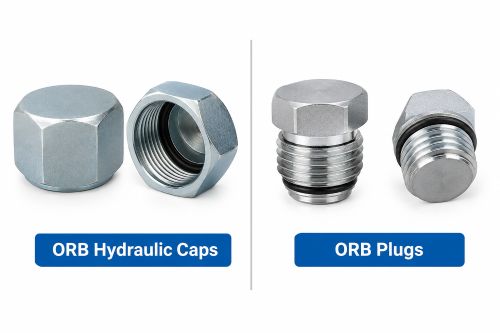
The easiest way to understand the difference is to look at what type of connection each component is designed to close.
An ORB cap generally closes or protects a male connection, whereas an ORB plug generally closes a female port.
The two components can have different physical configurations even when they perform a similar overall function. Their thread arrangement, sealing location, dimensions, and installation method must match the connection they are intended to close.
This is why a cap and a plug should not automatically be considered interchangeable.
Connection Type
The connection type is the most important difference.
A cap is normally designed to fit onto or over a male connection. A plug, on the other hand, is designed to engage with a female port.
Before ordering either component, identify whether the connection that needs to be closed is male or female.
Installation Method
ORB caps and plugs can also differ in how they are installed.
A cap is positioned over the connection and secured according to its design. A plug is inserted into the corresponding female port and threaded into place.
Both require proper alignment. Cross-threading can damage the connection and make it difficult to achieve a reliable seal.
Sealing Arrangement
ORB connections rely on an O-ring to create the primary seal. The O-ring is compressed against an appropriate sealing surface as the component is installed.
The exact sealing arrangement depends on the particular fitting or port design. For this reason, simply matching the thread size is not always enough. The O-ring dimensions, groove configuration, and sealing surface also need to be compatible.
Typical Applications
Caps and plugs are both useful in hydraulic systems, but their applications can differ.
Caps are often selected for protecting exposed connections, particularly during transportation, storage, assembly, and maintenance.
Plugs are commonly used for closing unused ports on hydraulic components such as manifolds, valves, adapters, and other equipment.
ORB Hydraulic Caps vs ORB Plugs Comparison
|
Feature |
ORB Hydraulic Caps |
ORB Hydraulic Plugs |
|
Primary purpose |
Close or protect a connection |
Close a hydraulic port |
|
Typical connection |
Male ORB connection |
Female ORB port |
|
Sealing |
Commonly uses an O-ring |
Commonly uses an O-ring |
|
Installation |
Fits onto the corresponding connection |
Threads into the corresponding port |
|
Common use |
Protection, storage, maintenance |
Port closure, assembly, maintenance |
|
Available materials |
Steel, stainless steel, and others |
Steel, stainless steel, and others |
|
Application |
Hydraulic equipment and assemblies |
Hydraulic equipment, manifolds, valves, and ports |
The table provides a general comparison. The actual configuration can vary between products, so manufacturers’ specifications should always be checked before selecting a component.
How Do ORB Caps and Plugs Seal?
The sealing principle is one of the most important features of an ORB connection.
Unlike some tapered-thread connections that rely heavily on thread interference or sealant, an O-Ring Boss connection uses an elastomeric O-ring to create the seal.
When the fitting, cap, or plug is installed correctly, the O-ring is compressed against the mating sealing surface. This creates a barrier that helps prevent hydraulic fluid from escaping.
The threads primarily provide mechanical engagement and help hold the component in position. The O-ring performs the critical sealing function.
This makes the condition and compatibility of the O-ring particularly important. An O-ring that is cut, flattened, incorrectly sized, or made from an unsuitable material can lead to leakage even when the threads appear to be correctly installed.
Why O-Ring Selection Matters
Choosing the right O-ring is just as important as choosing the correct cap or plug.
Hydraulic systems can operate under high pressure and a wide range of temperatures. The sealing material therefore needs to be compatible with the hydraulic fluid and operating conditions.
When selecting an ORB cap or plug, consider factors such as:
1. O-ring size
2. O-ring material
3. Hydraulic fluid compatibility
4. Operating temperature
5. Pressure requirements
6. Chemical exposure
7. Installation conditions
A seal that works well in one hydraulic application may not be suitable for another.
Common Sizes and Materials
ORB hydraulic caps and plugs are available in different sizes to accommodate different hydraulic connections.
ORB connections are commonly identified using dash sizes, with the exact dimensions depending on the applicable specification and connection design. Buyers should verify the actual port and thread dimensions instead of relying only on appearance.
Carbon Steel
Carbon steel is widely used for hydraulic caps and plugs because it offers good mechanical strength and is suitable for many general-purpose hydraulic applications.
Surface treatments such as zinc plating may also be applied to improve corrosion resistance.
Stainless Steel
Stainless steel can be selected when greater corrosion resistance is required. It is often useful in demanding environments where the component may be exposed to moisture, chemicals, or corrosive conditions.
Other Materials
Depending on the application, hydraulic sealing components may also be manufactured from other materials. The appropriate choice depends on pressure, temperature, fluid compatibility, corrosion conditions, and system requirements.
Where Are ORB Hydraulic Caps and Plugs Used?
ORB caps and plugs can be found in many types of hydraulic equipment.
Construction Equipment
Excavators, loaders, cranes, and other construction machines contain numerous hydraulic connections. Caps and plugs can be used to protect or close connections during maintenance, transportation, and assembly.
Agricultural Machinery
Tractors, harvesters, sprayers, and other agricultural equipment often operate in environments with significant exposure to dirt, moisture, and debris. Protecting unused hydraulic ports can help reduce contamination.
Industrial Hydraulic Systems
Industrial machinery may contain hydraulic manifolds, valves, cylinders, pumps, and other components with multiple connection points. Plugs can be used to close ports that are not required in a particular configuration.
Hydraulic Hose Assemblies
Caps can be useful for protecting exposed hydraulic connections during assembly, shipping, or storage. Keeping connection areas clean can make later installation easier and reduce the risk of contamination.
Hydraulic Manifolds
Manifolds often have several ports, and not every port is necessarily used in every system configuration. Suitable ORB plugs can close unused ports while maintaining the intended configuration.
How to Choose Between an ORB Cap and an ORB Plug
Choosing the correct component starts with identifying the connection you need to close.
1. Identify the Connection
First determine whether the connection is male or female.
If you are protecting or closing a male connection, an appropriate cap may be required. If you are closing a female ORB port, a suitable plug may be the correct choice.
2. Confirm the Thread Size
Thread size must match the mating connection. Do not assume that components with similar outside dimensions will be compatible.
Check the manufacturer’s dimensional information and applicable specifications.
3. Check the O-Ring
Verify the O-ring size, material, and sealing arrangement. The correct thread does not guarantee a proper seal if the O-ring is incorrect.
4. Consider Pressure
Hydraulic systems can operate at very different pressures. Make sure the selected cap or plug is designed for the intended application.
The pressure rating should be considered together with the material, thread design, sealing system, and operating conditions.
5. Consider the Environment
For equipment exposed to water, salt, chemicals, dust, or outdoor conditions, corrosion resistance can be an important consideration.
Material and surface finish should be selected according to the working environment.
6. Verify Fluid Compatibility
The hydraulic fluid can affect sealing materials. Make sure the O-ring and other wetted materials are compatible with the fluid being used.
Common Mistakes When Using ORB Caps and Plugs
Even a relatively simple component can cause problems when it is incorrectly selected or installed.
Using the Wrong Connection Type
One of the most common mistakes is choosing a plug when a cap is needed, or vice versa. Always identify the mating connection before ordering.
Choosing the Wrong Size
A component may look close to the correct size but still have incompatible threads or sealing dimensions.
Always verify the specifications rather than relying on visual comparison.
Reusing a Damaged O-Ring
O-rings can become damaged during installation or removal. Cuts, cracks, flattening, and other deformation can compromise the seal.
Inspect the O-ring before installation and replace it when necessary.
Cross-Threading
Starting a cap or plug at an incorrect angle can damage the threads. Begin installation carefully and make sure the component is properly aligned.
Overtightening
More tightening does not necessarily mean better sealing. Excessive torque can damage threads, distort components, or affect the O-ring.
Use the appropriate installation procedure and torque requirements for the specific component.
Ignoring Contamination
Dirt or debris on the sealing surface can prevent the O-ring from sealing properly. Clean the connection before installation and protect open ports whenever possible.
Tips for Proper ORB Cap and Plug Installation
Proper installation can help extend component life and reduce leakage problems.
Start by cleaning the connection and checking the threads for damage. Inspect the sealing surface and make sure the O-ring is clean and free from cuts or deformation.
If the manufacturer’s instructions call for lubrication, use a lubricant compatible with the O-ring material and hydraulic fluid. Position the component correctly and begin threading carefully to avoid cross-threading.
Once the component is properly engaged, tighten it according to the manufacturer’s recommended procedure. Avoid using excessive force.
After installation, inspect the connection for signs of leakage when the hydraulic system is operated. Never inspect a suspected high-pressure hydraulic leak with your bare hand because escaping fluid can cause serious injury.
Are ORB Hydraulic Caps and Plugs Interchangeable?
Generally, no. ORB hydraulic caps and plugs are designed for different connection configurations.
A cap intended for a male connection does not perform the same mechanical function as a plug designed to enter a female port. Even if both products are used to close hydraulic connections, their dimensions and sealing arrangements can be different.
The correct component should therefore be selected based on the connection type, thread dimensions, sealing arrangement, pressure requirements, and application.
ORB Hydraulic Caps vs ORB Plugs: Which One Do You Need?
The answer depends mainly on the connection you need to close.
If the connection is a male ORB connection, an appropriately designed ORB cap is generally used to cover and protect it. If you need to close a female ORB port, an ORB plug is generally the appropriate type.
However, connection type alone should not determine the final selection. You should also verify the size, thread specifications, O-ring dimensions, material, pressure rating, and environmental requirements.
For B2B buyers and hydraulic equipment manufacturers, checking these details before placing an order can help avoid compatibility issues and unnecessary replacements.
Frequently Asked Questions
Are ORB hydraulic caps and plugs the same?
No. Although both can be used to close hydraulic connections, they are generally designed for different connection configurations. Caps are typically used with male connections, while plugs are commonly installed into female ports.
What does ORB mean in hydraulic fittings?
ORB means O-Ring Boss. It refers to a hydraulic connection that uses an O-ring to create the primary seal between mating components.
Can an ORB plug be used instead of an ORB cap?
Not generally. An ORB plug and cap have different physical configurations and are intended for different mating connections. Always check the connection type and manufacturer’s specifications.
Do ORB hydraulic caps and plugs require O-rings?
Many ORB caps and plugs use O-rings as their sealing elements. The exact sealing arrangement depends on the product design and applicable specification.
How do I know what size ORB cap or plug I need?
Identify the ORB port or connection size and verify the thread and sealing dimensions against the manufacturer’s specifications. Dash size can help identify an ORB connection, but it should not be the only basis for selection.
Are ORB hydraulic caps suitable for high-pressure applications?
Some ORB caps are designed for high-pressure hydraulic applications, but suitability depends on the specific product’s design, materials, sealing system, and pressure rating. Always check the manufacturer’s specifications before use.
Conclusion
ORB hydraulic caps and ORB plugs perform a similar overall job closing and protecting hydraulic connections but they are designed for different connection configurations. Caps are generally used for male connections, while plugs are generally used to close female ORB ports.
The right choice also depends on thread size, O-ring specifications, material, pressure, hydraulic fluid, and operating environment. By checking these details before installation or purchase, you can select an ORB cap or plug that fits correctly and provides the sealing and protection your hydraulic system requires.
Post time: Sep-17-2026