

Tube connections play an important role in hydraulic systems, industrial machinery, and fluid transfer applications. Every connection must be secure enough to handle operating pressure while preventing leaks and maintaining reliable fluid flow. One component that helps achieve this is the tube nut adapter.
Although it may look like a small part, a tube nut adapter can make a significant difference in the safety, efficiency, and maintenance of a fluid system. It helps connect compatible tubing and fittings, providing the mechanical retention and connection interface needed for reliable operation.
In this guide, we will explain what a tube nut adapter is, how it works, the common types and materials available, and how to choose the right one for your application.
What Is a Tube Nut Adapter?
A tube nut adapter is a component used in tube-fitting assemblies to help secure tubing or connect a tube fitting to another compatible connection. Depending on its design, it may include a threaded nut, an adapter body, and other components such as a ferrule or sealing element.
The term can refer to different products depending on the manufacturer and fitting system. In some assemblies, the tube nut is a separate fastening component. In others, the adapter body provides a transition between different connection types, sizes, or thread configurations.
Tube nut adapters are commonly used in hydraulic equipment, pneumatic systems, industrial machinery, and other applications where fluids or gases move through tubing.
Their primary functions include:
1. Securing connections: The threaded nut helps hold compatible components together.
2. Supporting sealing: The connection design creates the required sealing contact to prevent leakage.
3. Connecting different interfaces: Certain adapter configurations connect tubing to threaded ports or other fittings.
4. Simplifying maintenance: Standardized connections can make inspection, replacement, and servicing easier.
It is important to remember that a tube nut does not automatically provide a complete fluid connection by itself. Its function depends on the fitting design and the other components used in the assembly.
Key Components of a Tube Nut Adapter
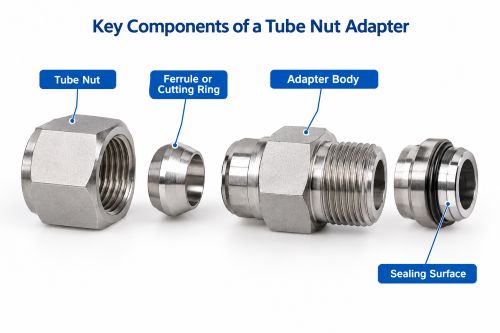
Tube nut adapters come in different configurations, but many tube-fitting assemblies share several basic components.
1. Tube Nut
The tube nut is the threaded fastening component that applies clamping force when tightened against a compatible fitting body. This force helps secure the tube and associated components in their intended positions.
The nut must match the fitting’s thread type, size, and connection standard. Using an incompatible nut can damage the threads or prevent the assembly from sealing correctly.
2. Adapter Body
The adapter body provides the main structure of the connection. Depending on the design, it may connect tubing to another fitting, a hydraulic port, or a threaded interface.
It also contains the fluid passage when the component is designed to carry fluid. Its shape, dimensions, and connection geometry determine how it fits into the overall system.
3. Ferrule or Cutting Ring
Some compression-style tube fittings use a ferrule or cutting ring between the tube and fitting body. When the nut is tightened, the ferrule grips the tube and helps create a secure connection.
The exact mechanism depends on the fitting design. For example, DIN compression fittings may use a cutting ring that engages with the tube surface. Other systems use different retention and sealing arrangements.
Not every tube nut adapter includes a separate ferrule, so it is important to identify the correct assembly before purchasing replacement components.
4. Sealing Surface
The sealing surface prevents fluid or gas from escaping through the connection. Depending on the design, sealing may occur through metal-to-metal contact, a formed flare, an O-ring, or another specified sealing arrangement.
Proper alignment and clean sealing surfaces are essential. Even a high-quality fitting may leak if the wrong components are combined or the sealing area is damaged.
How Does a Tube Nut Adapter Work?
A tube nut adapter works by bringing compatible components together and applying the mechanical force needed to secure the connection. The exact process varies according to the fitting standard, but the general principle is similar.
Step 1: Position the Tube and Fitting
First, the tube must be prepared according to the manufacturer’s instructions. This may involve cutting the tube squarely, removing burrs, and cleaning the end.
The tube is then positioned in the appropriate fitting body. In a compression fitting, the tube, ferrule, and nut must be arranged in the specified order.
Correct tube preparation helps prevent damage to sealing surfaces and improves connection reliability.
Step 2: Tighten the Tube Nut
The nut is threaded onto the compatible fitting body and tightened according to the manufacturer’s specifications.
As the nut advances, it applies axial force to the components inside the connection. In a compression-style fitting, this movement causes the ferrule or cutting ring to engage with the tube and fitting body.
The required tightening method depends on the connection design. Some fittings use a specified number of turns, while others require a torque value or a particular assembly procedure.
Step 3: Secure the Connection
Once properly assembled, the nut and associated components help hold the tube in place. The fitting’s geometry determines how the tube is retained and how mechanical loads are transferred through the connection.
A properly installed assembly should resist movement under its intended operating conditions. However, the connection must still be used within its rated pressure, temperature, and mechanical limits.
Step 4: Create a Reliable Seal
The sealing mechanism engages as the components are tightened. A compression fitting may use a ferrule to establish contact with the tube, while a flare fitting relies on matching angled sealing surfaces.
Other adapter designs may use an O-ring or another sealing element.
The nut provides the necessary clamping force, but it is the complete connection design that determines how the seal is formed. Tightening the nut excessively does not necessarily improve sealing and may instead damage the components.
Step 5: Check the Finished Connection
After assembly, inspect the connection for proper alignment, visible damage, and other installation issues. Where required, test the system according to the equipment manufacturer’s procedures and applicable safety requirements.
Never check for a hydraulic leak with your bare hands. High-pressure fluid can penetrate the skin and cause serious injury. Depressurize the system before loosening or servicing a connection.
Common Types of Tube Nut Adapters
Tube nut adapters are available in different sizes and configurations to suit specific connection systems. Understanding these options makes it easier to identify the right product.
1. Metric Tube Nut Adapters
Metric tube nut adapters are designed for compatible fittings that use metric tube dimensions or thread specifications. They are widely used in industrial machinery and hydraulic equipment built around metric standards.
When selecting a metric component, check the tube’s outside diameter, thread dimensions, pitch, and fitting standard. A metric thread alone does not guarantee compatibility with every metric fitting.
2. Inch-Size Tube Nut Adapters
Inch-size tube nut adapters are used in systems that specify tubing and connection dimensions in inches. They are common in equipment designed around inch-based hydraulic and industrial fitting standards.
Always confirm the actual tube diameter and connection specification before ordering. Similar-looking inch and metric components may not fit together correctly.
3. DIN Compression Tube Nut Adapters
DIN-style compression fittings are used in many hydraulic and industrial fluid systems. Depending on the specific design, they may incorporate a tube nut, cutting ring, and fitting body.
The nut helps drive the cutting ring into its intended position, creating tube retention and a sealing interface. These components must match the applicable fitting series and tube dimensions.
DIN compression fittings are available in different configurations, including straight connectors, elbows, tees, and adapters.
4. JIC Tube Nut Adapters
JIC fittings commonly use a 37-degree flared sealing connection. The nut draws the matching flare surfaces together, helping create a metal-to-metal seal.
JIC connections are widely used in hydraulic systems because they offer a standardized connection design and can be disconnected for maintenance when handled correctly.
A JIC nut must be compatible with the corresponding fitting geometry. It should not be confused with a compression-fitting nut, because the sealing and retention mechanisms differ.
5. Straight and Angled Adapter Configurations
Tube adapters may be available in straight, 45-degree, 90-degree, and other configurations.
Straight adapters are useful when connections can be aligned directly. Angled adapters help route tubing around nearby components, reduce installation conflicts, and make better use of limited space.
The appropriate configuration depends on the available installation area, tube routing, and required connection interfaces.
Common Materials Used in Tube Nut Adapters
Material selection affects corrosion resistance, mechanical performance, service life, and overall cost. The best option depends on the operating environment and the requirements of the complete connection.
Carbon Steel
Carbon steel is commonly used for hydraulic tube nuts and adapters because it offers good mechanical strength and is suitable for many industrial applications.
Protective finishes, such as zinc-based coatings, may improve corrosion resistance. The specific coating and performance depend on the treatment process and operating environment.
Carbon steel is often a practical choice for general hydraulic machinery, mobile equipment, and industrial systems where the material and pressure ratings meet the application requirements.
Stainless Steel
Stainless steel is often selected for applications where corrosion resistance is especially important. It can be suitable for marine environments, chemical processing equipment, and machinery exposed to moisture or certain corrosive substances.
Its performance depends on the stainless steel grade, fluid compatibility, temperature, and environmental conditions. Stainless steel components must also be compatible with the mating fittings and tube materials.
Brass
Brass is used in selected pneumatic, instrumentation, and fluid-handling applications. It offers useful corrosion resistance in many environments and is relatively easy to machine.
However, brass is not appropriate for every hydraulic system. Its suitability depends on the required pressure rating, temperature, media compatibility, and mechanical loads.
Surface Treatments and Finishes
Surface treatments can help protect tube nut adapters from corrosion and environmental exposure. Common options include zinc plating and other protective coatings for carbon steel, while stainless steel may receive passivation treatments.
When comparing products, consider the coating specification, expected exposure, and maintenance requirements rather than relying on appearance alone.
Applications of Tube Nut Adapters
Tube nut adapters are used across a range of industries where tubing must be connected securely.
Hydraulic power units: They help connect tubing to compatible hydraulic components, supporting fluid delivery between pumps, valves, cylinders, and other equipment.
Construction and agricultural machinery: Hydraulic connections are used in excavators, loaders, tractors, and other machines that rely on fluid power to operate moving components.
Industrial automation: Tube fittings and adapters connect fluid lines in automated machinery, production equipment, and selected pneumatic systems.
Mobile hydraulic systems: Agricultural, material-handling, and other mobile equipment use fittings that must withstand operating pressure, vibration, and changing environmental conditions.
Instrumentation and process equipment: Depending on the fitting design and material, tube nut adapters may be used in compatible measurement, control, and fluid-transfer installations.
In all these applications, the correct connection must be selected for the fluid, pressure, temperature, vibration, and installation conditions involved.
Tube Nut Adapter vs. Standard Tube Nut: What Is the Difference?
The terms tube nut and tube nut adapter are sometimes used loosely, but they do not always refer to the same component.
A tube nut is generally a fastening component. It has internal threads and is designed to work with a compatible fitting body or connection assembly.
A tube adapter, on the other hand, provides a connection between components or interfaces. It may have different thread types, sizes, or end configurations, depending on its purpose.
|
Feature |
Tube Nut |
Tube Adapter |
|
Main function |
Applies clamping force |
Connects compatible interfaces |
|
Typical structure |
Threaded nut |
Fitting body with one or more connection ends |
|
Fluid passage |
Usually not a standalone flow passage |
Commonly includes a fluid passage |
|
Typical use |
Secures a fitting assembly |
Connects tubing, ports, or other fittings |
|
Replacement considerations |
Must match the fitting assembly |
Must match both connection interfaces and operating requirements |
A tube nut and an adapter may be supplied as separate parts or incorporated into a larger fitting assembly. Always confirm the manufacturer’s product description and drawing before ordering.
How to Choose the Right Tube Nut Adapter
Choosing the correct tube nut adapter requires more than matching its appearance. Several technical details determine whether it will fit properly and operate reliably.
1. Confirm the Tube Outside Diameter
Measure or verify the tube’s outside diameter against the fitting specification. A component designed for the wrong tube size may not secure the tube or form a proper seal.
2. Check Thread Type and Size
Identify the thread diameter, pitch, and thread form. Depending on the application, the connection may use metric, UN/UNF, or another specified thread system.
Do not assume that two threads are compatible simply because they appear to engage.
3. Identify the Connection Standard
Determine whether the assembly uses DIN compression, JIC flare, or another connection design. Each standard has its own geometry and assembly requirements.
Matching the connection standard helps ensure that the nut, fitting body, tube, and sealing components work together correctly.
4. Select the Appropriate Material
Consider the operating fluid, surrounding environment, corrosion exposure, temperature, and mechanical requirements.
Carbon steel may be suitable for many general-purpose applications, while stainless steel may be preferable where corrosion resistance is a priority. Brass may suit certain pneumatic or instrumentation applications.
5. Verify Pressure and Temperature Ratings
Check the operating limits for the complete connection assembly. The pressure rating may depend on the fitting series, tube dimensions, material, temperature, and installation method.
A component should never be selected based on pressure rating alone if other parts of the assembly have lower limits.
6. Consider Installation Space and Maintenance
Choose a configuration that provides sufficient clearance for installation and future servicing. An angled adapter may help where a straight connection would interfere with nearby equipment.
Also consider whether the connection will need to be disconnected regularly and follow the manufacturer’s instructions for reassembly and component replacement.
Common Installation Mistakes to Avoid
Even a correctly specified tube nut adapter can cause problems if it is installed incorrectly. The following mistakes are worth avoiding.
1. Mixing incompatible components: Combining nuts, ferrules, tubes, and fitting bodies from incompatible systems can compromise the connection.
2. Incorrect tube preparation: Rough cuts, burrs, contamination, or damaged tube ends can interfere with assembly and sealing.
3. Over-tightening: Excessive tightening can damage threads, deform components, or compromise the seal.
4. Under-tightening: Insufficient tightening may prevent the connection from achieving the required retention or sealing performance.
5. Ignoring sealing surfaces: Scratched, contaminated, or damaged sealing areas may lead to leaks.
6. Exceeding operating limits: Pressure, temperature, vibration, and fluid compatibility must remain within the component’s specified limits.
Always follow the manufacturer’s installation procedure and use the specified tools and tightening method. If leakage occurs, depressurize the system before inspecting or repairing the connection.
Why Choose a Reliable Tube Nut Adapter Manufacturer?
A reliable manufacturer can help buyers obtain tube nut adapters that meet their dimensional, material, and application requirements. This is especially important for OEMs, hydraulic equipment manufacturers, distributors, and industrial maintenance teams.
When evaluating a supplier, consider the following factors:
1. Dimensional accuracy: Consistent machining and thread quality help ensure compatibility with mating components.
2. Material options: Availability of carbon steel, stainless steel, and suitable protective finishes supports different operating environments.
3. Quality control: Inspection procedures help verify product dimensions, material requirements, and other specified characteristics.
4. Customization capabilities: OEM/ODM services can support application-specific sizes, configurations, finishes, and branding requirements.
5. Technical support: A knowledgeable supplier can help clarify connection standards and product specifications before an order is placed.
6. Production and delivery capacity: Reliable manufacturing processes and realistic lead times help customers plan purchasing and inventory.
Sannke specializes in hydraulic fittings and adapters for industrial applications. For buyers sourcing tube-fitting components, working with a manufacturer that understands connection standards, material selection, and OEM/ODM requirements can help simplify product selection and sourcing.
Before placing an order, provide the supplier with the tube dimensions, connection standard, thread specifications, material requirements, operating pressure, and intended application. These details make it easier to identify a compatible product.
Frequently Asked Questions
1. What is a tube nut adapter used for?
A tube nut adapter is used in compatible tube-fitting assemblies to secure tubing or connect one interface to another. Its exact function depends on the product design and connection standard.
2. How does a tube nut adapter work?
The threaded nut applies clamping force as it is tightened against a compatible fitting body. Depending on the design, this force helps engage a ferrule, bring sealing surfaces together, or secure the connection through another specified mechanism.
3. Are tube nuts and tube adapters the same thing?
No. A tube nut is generally a threaded fastening component, while a tube adapter provides a connection between interfaces. Some products or assemblies combine these functions, so the manufacturer’s specifications should be checked.
4. What materials are commonly used for tube nut adapters?
Common materials include carbon steel, stainless steel, and brass. The appropriate choice depends on pressure, temperature, corrosion exposure, fluid compatibility, and the requirements of the fitting system.
5. How do I identify the correct tube nut adapter size?
Check the tube outside diameter, thread diameter, thread pitch, and connection standard. Use the manufacturer’s drawings or specifications rather than relying on visual comparison alone.
6. Can tube nut adapters be reused?
Some tube-fitting components can be disconnected and reassembled, but reuse depends on the fitting design and the condition of its components. Inspect threads, sealing surfaces, ferrules, and other parts, and follow the manufacturer’s reuse instructions.
7. How can I prevent leaks in tube nut adapter connections?
Use compatible components, prepare the tube correctly, keep sealing surfaces clean, and follow the specified tightening procedure. Also verify that the assembly is suitable for the operating pressure and temperature.
8. How do I choose a tube nut adapter for a high-pressure hydraulic system?
Confirm the connection standard, tube dimensions, material, and pressure rating of the complete assembly. Consider vibration, temperature, fluid compatibility, and installation conditions, and select components rated for the intended service.
Conclusion
A tube nut adapter helps secure tubing and connect compatible components in hydraulic and industrial fluid systems. Although the component may be small, its design and installation can affect connection reliability, leakage prevention, and maintenance requirements.
To choose the right product, verify the tube size, thread specifications, connection standard, material, and operating ratings. It is equally important to use compatible components and follow the manufacturer’s installation instructions.
Whether you are maintaining existing hydraulic equipment or sourcing components for new machinery, understanding how tube nut adapters work will help you make better technical and purchasing decisions.
Post time: Oct-29-2026