

SAE 45 degree flare fittings are widely used in tubing systems where secure, leak-resistant, and removable connections are required. Their distinctive 45-degree flared sealing surface creates a metal-to-metal connection that helps prevent fluid leakage without requiring a separate O-ring at the standard flare interface.
These fittings are commonly found in automotive systems, refrigeration equipment, air conditioning units, and various industrial fluid-handling applications. They are available in different configurations, including straight connectors, elbow fittings, tees, unions, and adapters. Each type serves a specific purpose depending on the tubing layout and connection requirements.
Choosing the right SAE 45 degree flare fitting involves more than selecting a suitable shape. Engineers and equipment manufacturers must also consider tubing dimensions, thread specifications, material compatibility, operating pressure, and temperature requirements.
In this guide, we will explore the common types of SAE 45 degree flare fittings, their structural features, and where each type is typically used.
What Are SAE 45 Degree Flare Fittings?
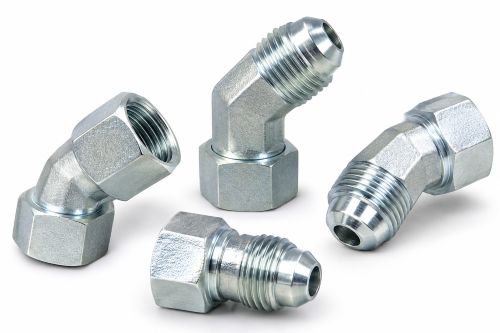
SAE 45 degree flare fittings are mechanical connectors designed to join metal tubing with other tubes, hoses, or fluid system components. Their primary sealing feature is a 45-degree conical surface that mates with the flared end of a compatible tube.
During installation, the end of the tube is expanded outward using a suitable flaring tool. A flare nut then holds the prepared tube against the matching conical seat inside the fitting body.
When the nut is tightened, it creates clamping force between the two metal surfaces. This contact forms a seal that helps prevent fluid from escaping through the connection.
A typical SAE 45-degree flare connection consists of several components:
1. Fitting body: Provides the main structure and internal fluid passage.
2. 45-degree flare seat: Creates the sealing interface with the flared tube.
3. Flare nut: Holds the tubing securely against the fitting seat.
4. Threaded section: Provides mechanical engagement and clamping force.
One important distinction is that SAE 45-degree flare fittings are different from JIC 37-degree flare fittings. Although both use metal-to-metal sealing, their flare angles and mating surfaces are different. They should never be treated as interchangeable.
Common Types of SAE 45 Degree Flare Fittings
SAE 45 degree flare fittings are available in several configurations to accommodate different tubing arrangements. Understanding their structural differences makes it easier to select the right connector for a particular application.
Straight Flare Fittings
Straight flare fittings are among the simplest and most commonly used configurations. They provide an in-line connection between two compatible components without changing the direction of the tubing.
Their basic structure consists of a fitting body, a 45-degree flare seat, and the necessary threaded connection. Depending on the design, they can join two flared tube ends or connect a flared tube to another compatible port.
Straight flare fittings are particularly useful when tubing needs to follow a direct path between equipment components.
Common applications include:
1. Refrigeration and air conditioning tubing.
2. Automotive fluid lines.
3. Copper tube connections.
4. General-purpose fluid transfer systems.
5. Equipment requiring removable tubing connections.
Their straightforward design makes them easy to install, inspect, and replace during routine maintenance.
45-Degree Flare Elbow Fittings
45-degree flare elbow fittings allow tubing to change direction by 45 degrees. They are useful when a straight connection is unsuitable because of nearby components, limited installation space, or the required tubing layout.
The angled body changes the direction of the fluid passage while maintaining compatible flare connections at the ends.
Compared with a straight connector, a 45-degree elbow provides greater flexibility when routing tubing around obstacles.
Common applications include:
1. Compact refrigeration assemblies.
2. Automotive fluid connections.
3. Air conditioning equipment.
4. Machinery with restricted installation spaces.
5. Tubing systems requiring angled connections.
When selecting a 45-degree elbow, consider the available clearance, connection orientation, and potential flow restrictions.
90-Degree Flare Elbow Fittings
90-degree flare elbow fittings create a right-angle connection between two tubing sections. They are particularly useful when a fluid line needs to turn sharply without requiring the tubing itself to be bent.
These fittings help simplify installation in equipment where components are positioned at different angles.
Their main design advantage is the ability to change tubing direction within a relatively small space.
Common applications include:
1. Automotive refrigeration systems.
2. Air conditioning assemblies.
3. Compact machinery.
4. Equipment with perpendicular tubing connections.
5. Fluid lines routed around structural components.
A 90-degree elbow can make an installation more organized and reduce the need for complicated tube bending. However, engineers should also consider the fitting’s internal passage and the effect of the bend on fluid flow.
Flare Tee Fittings
Flare tee fittings feature three connection points arranged in a T-shaped configuration. They allow a single fluid line to branch into two separate paths or combine compatible flow paths.
Each connection uses a matching flare interface to provide a secure mechanical connection.
Tee fittings are available in different configurations and sizes. Some have three equal-sized ports, while reducing versions have different connection dimensions.
Common applications include:
1. Refrigeration distribution lines.
2. Automotive fluid systems.
3. Equipment requiring branch connections.
4. Fluid distribution assemblies.
5. Auxiliary tubing circuits.
When selecting a flare tee, check the dimensions of all three ports and ensure the fitting is suitable for the intended flow direction and operating conditions.
Flare Unions
Flare unions are designed to connect two compatible flared tube ends. They provide a convenient way to join separate tubing sections without welding, brazing, or other permanent joining methods.
A typical flare union consists of a central body with matching 45-degree sealing seats and the necessary flare nuts.
During installation, the flared ends of both tubes are positioned against the corresponding seats. Tightening the nuts secures the tubes and creates the required metal-to-metal seals.
Common applications include:
1. Extending existing tubing lines.
2. Connecting separate copper tube sections.
3. Refrigeration maintenance.
4. Automotive fluid line repairs.
5. Equipment assembly and replacement.
One of the main advantages of flare unions is their serviceability. Technicians can disconnect the tubing when maintenance or component replacement is necessary.
Flare-to-Thread Adapters
Flare-to-thread adapters connect a 45-degree flare tube assembly to another compatible threaded connection.
One end provides the flare sealing interface, while the opposite end uses a specified thread configuration. Depending on the adapter design, the threaded end may connect to an equipment port or another fitting.
These adapters are particularly useful when different connection styles need to be incorporated into the same fluid system.
Common applications include:
1. Connecting copper tubing to equipment ports.
2. Automotive fluid assemblies.
3. Refrigeration equipment connections.
4. Industrial fluid-handling systems.
5. Replacing or adapting existing connections.
When choosing a flare-to-thread adapter, verify the thread type, diameter, pitch, and sealing method of the threaded end. Similar-looking threads do not necessarily have the same connection requirements.
Flare Reducer Fittings
Flare reducer fittings connect tubing sections with different outside diameters. Their design allows a larger tube connection to transition to a smaller one without requiring separate adapters.
Depending on the configuration, they may feature different flare connection sizes at opposite ends.
Reducer fittings are useful when equipment has different tubing requirements or when an existing system needs to accommodate a change in tube size.
Common applications include:
1. Refrigeration tubing assemblies.
2. Automotive fluid connections.
3. Compact equipment installations.
4. Fluid line modifications.
5. Systems connecting different tube diameters.
Before installation, confirm that both tube sizes match the fitting specifications. The reducer must also be rated for the system’s operating pressure and temperature.
Materials Used in SAE 45 Degree Flare Fittings
The material used to manufacture a fitting influences its strength, corrosion resistance, durability, and compatibility with the working fluid.
Different applications require different material characteristics. The following are some commonly used options.
Brass SAE 45 Degree Flare Fittings
Brass is widely used for SAE 45-degree flare fittings, particularly in refrigeration and copper tubing applications.
Its good machinability makes it suitable for producing accurate flare seats and threaded connections. Brass also offers useful corrosion resistance in many service environments.
Main advantages include:
1. Good corrosion resistance in suitable environments.
2. Excellent machinability.
3. Compatibility with many copper tubing applications.
4. Convenient installation and maintenance.
5. Good performance in appropriately rated systems.
Brass fittings are a common choice for refrigeration equipment, air conditioning systems, and certain automotive applications.
Stainless Steel SAE 45 Degree Flare Fittings
Stainless steel fittings are suitable for applications where corrosion resistance and mechanical durability are important.
They are available in different grades, each offering specific properties. The correct grade should be selected according to the working fluid, temperature, and surrounding environment.
Main advantages include:
1. High corrosion resistance in suitable environments.
2. Good mechanical strength.
3. Durability in demanding service conditions.
4. Compatibility with various industrial fluids.
Stainless steel is often preferred in industrial environments where moisture, chemical exposure, or frequent cleaning may affect fitting performance.
Carbon Steel SAE 45 Degree Flare Fittings
Carbon steel offers good mechanical strength and is commonly used in industrial fitting manufacturing.
Depending on the application, manufacturers may apply protective surface treatments to improve corrosion resistance.
Main advantages include:
1. Good mechanical strength.
2. Suitable durability for industrial applications.
3. Multiple surface treatment options.
4. Cost-effective material selection for many applications.
However, carbon steel is more susceptible to corrosion than stainless steel when protective coatings are damaged or unsuitable for the operating environment.
Applications of SAE 45 Degree Flare Fittings
SAE 45 degree flare fittings are used across several industries because of their practical connection design and ease of maintenance.
Automotive Systems
In automotive applications, 45-degree flare fittings are used in compatible fuel, fluid, and tubing assemblies.
Their removable structure makes them convenient for vehicle systems that require inspection, repair, or component replacement.
They can be found in certain fuel line connections, refrigeration circuits, and other compatible automotive tubing arrangements.
When used in safety-critical applications, the fitting must meet the specific vehicle manufacturer’s requirements and applicable performance standards.
Refrigeration and Air Conditioning
Refrigeration and air conditioning are important application areas for SAE 45-degree flare connections.
These fittings are commonly used to connect compatible copper tubing in refrigeration circuits. Their mechanical sealing structure allows technicians to assemble and service tubing connections without permanent joining methods.
Common applications include:
1. Refrigeration equipment.
2. Air conditioning units.
3. Cooling systems.
4. Commercial refrigeration installations.
5. Compatible copper refrigerant tubing assemblies.
Proper flare preparation is essential because an uneven or damaged sealing surface can cause refrigerant leakage.
Industrial Fluid Systems
Certain industrial fluid systems use SAE 45-degree flare fittings for auxiliary tubing connections and compatible fluid-handling applications.
Their removable design is useful when equipment needs regular servicing or when tubing arrangements may change during maintenance.
Typical applications include instrumentation connections, auxiliary fluid lines, and general equipment assemblies.
However, engineers should confirm that the selected fitting is specifically suitable for the working fluid and operating conditions. Not every SAE 45-degree flare fitting is designed for high-pressure hydraulic service.
Transportation Equipment
Transportation equipment may use compatible flare fittings in different fluid and tubing assemblies.
Their compact configurations help manufacturers connect tubing around limited installation spaces. The availability of straight connectors, elbows, tees, and adapters also provides flexibility during equipment design.
Applications depend on the specific vehicle or equipment system and its technical requirements.
How to Choose the Right SAE 45 Degree Flare Fittings
Selecting the correct fitting is essential for achieving reliable sealing and long-term performance. Before purchasing, consider the following factors.
Identify the Fitting Configuration
Start by determining the type of connection required.
A straight fitting works well for in-line connections, while elbows are useful for changing tubing direction. Tee fittings create branch connections, and unions join two separate tube sections.
Choosing the correct configuration helps simplify installation and avoid unnecessary adapters.
Confirm the Tube Size
Measure the outside diameter of the tubing before selecting a fitting.
SAE 45-degree flare fittings are available in different sizes. The fitting must match the tube dimensions to ensure correct flare engagement and sealing.
Do not rely on visual estimates alone. Use suitable measuring tools to confirm the actual tube diameter.
Check Thread Specifications
Thread compatibility is another important consideration.
Check the thread diameter, pitch, and series of the fitting. If the connector includes a threaded equipment port, also verify its sealing arrangement.
Incorrect thread selection can result in poor engagement, damaged threads, and leakage.
Select the Appropriate Material
Consider the working environment and fluid compatibility.
Brass is commonly used in refrigeration and compatible copper tubing systems. Stainless steel is suitable for environments requiring greater corrosion resistance, while carbon steel may be appropriate for certain industrial applications.
The selected material should meet the mechanical and chemical requirements of the system.
Verify Pressure and Temperature Ratings
Every fitting has operating limitations.
Check the manufacturer’s pressure and temperature specifications before installation. The working pressure of the complete assembly should not exceed the rating of its lowest-rated component.
Also consider pressure fluctuations, vibration, and temperature changes that may affect connection performance.
Check Applicable Standards
Standards help ensure consistent dimensions and connection compatibility.
Depending on the intended application, relevant standards include:
1. SAE J512: Automotive tube fittings.
2. SAE J513: Refrigeration tube fittings.
3. SAE J533: Flares for tubing.
Always confirm the specific fitting type and applicable standard rather than assuming that every 45-degree flare connector follows identical dimensional requirements.
SAE 45 Degree Flare Fittings vs. Other Fitting Types
SAE 45 degree flare fittings are sometimes confused with other mechanical connection types, especially JIC 37-degree flare fittings and compression fittings.
Understanding their differences helps prevent incorrect selection.
|
Feature |
SAE 45-Degree Flare |
||
|
Sealing method |
Metal-to-metal |
Metal-to-metal |
Ferrule compression |
|
Flare angle |
45 degrees |
37 degrees |
No flare angle |
|
Main sealing component |
Flared tube and fitting seat |
Flared tube and fitting seat |
Compression ring or ferrule |
|
Common applications |
Refrigeration and automotive |
Hydraulic systems |
Instrumentation and tubing systems |
|
Reusable |
Subject to surface condition |
Subject to surface condition |
Depends on fitting design and manufacturer instructions |
The most important distinction between SAE 45-degree flare and JIC 37-degree flare fittings is their sealing angle.
Although some thread dimensions may appear similar, the different sealing surfaces prevent proper interchangeability.
Compression fittings use a different sealing mechanism. Instead of relying on a prepared flared tube end, they use a ferrule or compression ring to grip and seal the tubing.
Installation and Maintenance Tips
Correct installation is essential for maintaining the sealing performance of SAE 45 degree flare fittings.
Even a high-quality fitting can leak if the tubing is poorly prepared or the connection is assembled incorrectly.
Here are several practical recommendations:
Prepare the tubing properly. Cut the tube squarely and remove burrs before flaring. Uneven tube ends can result in inconsistent flare dimensions.
Use the correct flaring tool. Choose a tool specifically designed for 45-degree flaring and compatible with the tubing material and size.
Inspect the flare surface. Check for cracks, scratches, wrinkles, and other defects before assembly. Damaged flares should be replaced.
Keep sealing surfaces clean. Remove dirt, metal particles, and other contaminants that could interfere with metal-to-metal contact.
Tighten according to specifications. Use the recommended tightening torque or installation procedure. Overtightening can deform the flare or damage the fitting seat.
Perform a leakage test. After installation, inspect and test the connection using an appropriate procedure for the system and working fluid.
Replace damaged components. If a flare nut, fitting seat, or tube end is damaged, replace the affected component instead of trying to compensate by applying additional tightening force.
Regular inspection is especially important in equipment exposed to vibration, temperature fluctuations, and repeated maintenance.
Common Problems with SAE 45 Degree Flare Fittings
Several installation and operating problems can affect the performance of flare connections.
Understanding their causes makes troubleshooting easier.
Leakage at the Flare Connection
Leakage is often caused by damaged sealing surfaces, improper flare dimensions, or insufficient contact between the tube and fitting seat.
Inspect the flare and fitting body carefully. If either sealing surface is damaged, replace the affected component.
Incorrect Flare Dimensions
An improperly formed flare may not sit evenly against the fitting seat.
This can happen when the wrong flaring tool is used or the tubing is not prepared correctly.
Use the appropriate tooling and follow the manufacturer’s flare preparation instructions.
Thread Mismatch
Using incompatible threads can prevent proper engagement and result in an unreliable connection.
Always verify the thread diameter, pitch, and series before assembly.
Overtightening
Excessive tightening can deform the flared tube end, damage the fitting seat, or cause thread problems.
Follow the manufacturer’s installation specifications and avoid applying unnecessary force.
Corrosion and Material Incompatibility
Exposure to moisture, chemicals, or incompatible fluids may cause corrosion and premature fitting deterioration.
Choose suitable materials and protective treatments according to the operating environment.
Frequently Asked Questions
Q1: What are the most common types of SAE 45 degree flare fittings?
The common configurations include straight flare fittings, 45-degree elbows, 90-degree elbows, tees, unions, flare-to-thread adapters, and reducer fittings. Each type is designed for a different tubing arrangement or connection requirement.
Q2: What is the difference between straight and elbow flare fittings?
Straight flare fittings connect components along the same axis, while elbow fittings change the direction of the tubing. Straight connectors are suitable for direct tubing arrangements, whereas elbows help accommodate restricted spaces and angled connections.
Q3: Are SAE 45 degree flare fittings suitable for high-pressure applications?
Their suitability depends on the fitting design, material, tube dimensions, and manufacturer’s pressure rating. They should not automatically be considered suitable for high-pressure hydraulic systems without verifying the complete assembly specifications.
Q4: What materials are commonly used for SAE 45 degree flare fittings?
Brass is widely used in refrigeration and copper tubing applications. Stainless steel provides greater corrosion resistance in suitable environments, while carbon steel is used in certain industrial applications requiring mechanical strength.
Q5: Can SAE 45 degree flare fittings be reused?
Yes, provided the fitting body, flare nut, and tubing sealing surfaces remain in good condition. Always inspect the components before reassembly and replace damaged or deformed parts.
Q6: Are SAE 45 degree flare fittings interchangeable with JIC 37-degree fittings?
No. SAE 45-degree flare fittings and JIC 37-degree flare fittings have different sealing angles and mating surfaces. Using them together can result in improper sealing and leakage.
Q7: How do I identify the correct size of a 45-degree flare fitting?
Measure the tubing outside diameter and check the fitting’s thread dimensions. You should also verify the flare angle and applicable fitting standard to ensure proper compatibility.
Conclusion
SAE 45 degree flare fittings are available in several configurations to accommodate different tubing layouts and fluid connection requirements. Straight fittings, elbows, tees, unions, adapters, and reducers each serve specific purposes in refrigeration, automotive, transportation, and compatible industrial applications.
Selecting the right type requires careful consideration of tube dimensions, thread specifications, material properties, operating pressure, and temperature requirements. Proper tubing preparation and installation are equally important for maintaining reliable metal-to-metal sealing.
For equipment manufacturers and fluid system suppliers, working with an experienced fitting manufacturer can help ensure consistent dimensions, suitable materials, and dependable product quality.
Sannke specializes in hydraulic fittings and adapters, providing OEM and ODM manufacturing services, custom connection solutions, and different material and surface treatment options to meet industrial requirements.
Post time: Nov-12-2026