

A hydraulic steering adapter is a fitting used to connect hydraulic steering components while maintaining a secure, pressure-resistant path for hydraulic fluid. It helps connect hoses, tubes, steering control units, pumps, cylinders, and other components when their ports have different thread types, sizes, or orientations.
In tractors, forklifts, excavators, agricultural machinery, and other mobile equipment, hydraulic steering systems need reliable connections to transfer fluid pressure accurately. A properly selected hydraulic steering adapter makes installation easier, helps prevent leaks, and allows different components to work together without redesigning the entire hydraulic circuit.
What Is a Hydraulic Steering Adapter?
A hydraulic steering adapter is a specially designed hydraulic fitting that creates a connection between two components in a steering system.
The adapter normally consists of a strong metal body with one or more connection ends. Depending on the design, these ends may use male or female threads, different thread standards, swivel connections, or other connection configurations.
The main purpose is simple: to create a compatible and reliable connection between hydraulic steering components.
For example, a steering control unit may have a particular port size while the hydraulic hose uses another. Instead of replacing the hose or steering component, an adapter can provide the correct transition between the two.
Hydraulic steering adapters are commonly available in straight and angled configurations. Some are also designed with swivel ends to make hose installation easier and reduce twisting during assembly.
How Does a Hydraulic Steering Adapter Work?
The working principle of a hydraulic steering adapter is relatively straightforward.
Hydraulic fluid flows through the internal passage of the adapter from one connected component to another. The adapter itself does not normally control the direction or pressure of steering fluid. Instead, it provides a secure passage and mechanical connection between components.
When the adapter is installed correctly, its connection ends engage with the corresponding ports or hoses. The threads or connection surfaces hold the components together, while the sealing system prevents hydraulic fluid from escaping.
During steering operation, the hydraulic pump generates pressure and the steering control system directs hydraulic fluid toward the appropriate actuator or steering mechanism. The adapter remains part of this flow path and must withstand the pressure, vibration, temperature, and mechanical conditions of the application.
This is why an adapter that looks like a small component can still have an important role in overall steering-system reliability.
Main Components of a Hydraulic Steering Adapter
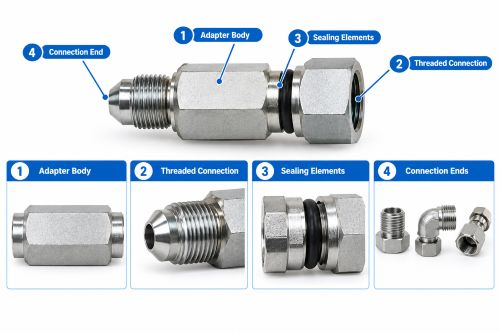
Although hydraulic steering adapters come in many shapes and sizes, most designs include several basic components.
Adapter Body
The adapter body is the main structural part of the fitting. It contains the internal fluid passage and determines the overall shape and length of the adapter.
The body needs sufficient mechanical strength to withstand hydraulic pressure and external loads. For mobile equipment, it may also be exposed to vibration, shock, dirt, moisture, and changing temperatures.
Threaded Connections
Threads provide the mechanical connection between the adapter and the steering components.
Depending on the application, an adapter may have male threads, female threads, or different thread types on each end. Common hydraulic connection standards include metric, JIC, BSP, and NPT configurations, although the correct standard depends on the equipment and system design.
Thread size alone is not enough to identify a fitting. Thread form, pitch, sealing method, and connection geometry should also be confirmed before installation.
Sealing Elements
A hydraulic connection needs more than mechanical strength. It also needs an effective sealing method.
Depending on the adapter design, sealing may be achieved through an O-ring, bonded seal, sealing washer, tapered thread, or metal-to-metal sealing surface.
The correct sealing method is important because using an incompatible seal can result in leaks even when the adapter appears to fit properly.
Connection Ends
The connection ends determine how the adapter attaches to the rest of the hydraulic system.
Straight adapters are useful when the hose and port are already correctly aligned. Angled adapters can help route a hydraulic line around nearby components. Swivel adapters provide additional flexibility during installation and can help reduce unwanted hose twisting.
Common Types of Hydraulic Steering Adapters
Hydraulic steering adapters are available in many configurations because steering systems differ from one machine to another.
Straight Hydraulic Steering Adapters
Straight adapters connect two components along the same general axis. They are commonly used when there is sufficient space around the connection and no change in hose direction is required.
Their relatively simple design also makes them easy to install and inspect.
45-Degree and 90-Degree Adapters
Angled adapters change the direction of the hydraulic connection.
A 45-degree adapter provides a moderate change in routing, while a 90-degree adapter is useful when a hose needs to turn sharply around a component.
These designs can be particularly helpful in compact equipment where hoses and fittings have limited installation space.
Swivel Hydraulic Steering Adapters
Swivel adapters allow a connection to rotate during installation or positioning.
They can make hose assembly easier because the hose does not necessarily need to be rotated to align the connection. This can reduce installation difficulties and help prevent unnecessary twisting of the hose.
Male-to-Male Adapters
A male-to-male adapter has male connection ends on both sides. It can be used when two components with compatible female ports need to be connected.
Male-to-Female Adapters
These adapters have different connection genders on each end and are useful when connecting components with different port configurations.
Metric and Inch-Based Adapters
Hydraulic steering systems may use metric or inch-based connection standards depending on the equipment manufacturer and market.
For this reason, it is important to identify the exact thread specification rather than assuming that two connections are interchangeable simply because their dimensions look similar.
Where Are Hydraulic Steering Adapters Used?
Hydraulic steering adapters are used in many types of equipment that rely on hydraulic steering or hydraulic-assisted steering systems.
Agricultural Equipment
Tractors and agricultural machinery frequently use hydraulic steering systems. Adapters can connect steering control units, hoses, pumps, cylinders, and other hydraulic components.
Construction Equipment
Excavators, loaders, and other construction machines operate under demanding conditions. Hydraulic adapters help create reliable connections between steering-related components and hydraulic lines.
Forklifts and Material-Handling Equipment
Forklifts and similar machines often have compact hydraulic layouts. Angled or swivel adapters can help route hydraulic lines around other components while maintaining a secure connection.
Mobile Hydraulic Equipment
Many forestry, utility, transportation, and specialized machines use hydraulic steering systems. The correct adapter allows replacement components and hoses to fit existing hydraulic circuits.
Key Specifications to Consider
Choosing a hydraulic steering adapter based only on its appearance or nominal size can lead to installation problems. Several specifications should be checked.
Thread Type and Size
The thread must match the mating connection correctly. Common specifications include metric and inch-based threads, but the exact thread standard must be confirmed.
Pressure Rating
The adapter should have a pressure rating suitable for the steering system. Do not select a fitting based only on the normal operating pressure. Pressure spikes and demanding operating conditions should also be considered.
Port Configuration
Consider whether the application requires a straight, angled, swivel, bulkhead, or another configuration.
The correct configuration can simplify hose routing and prevent excessive bending.
Material
Carbon steel is widely used for hydraulic adapters because it offers good mechanical strength and durability.
Stainless steel may be selected when greater corrosion resistance is required, particularly in harsh or wet environments.
Surface Treatment
Steel adapters may use protective finishes such as zinc plating or other surface treatments to improve corrosion resistance.
The appropriate finish depends on the working environment and required service life.
Sealing Method
Check whether the connection uses an O-ring, bonded seal, sealing washer, tapered thread, or another sealing system.
The adapter and mating component must use compatible sealing surfaces.
Benefits of Using the Right Hydraulic Steering Adapter
A properly selected adapter offers several practical advantages.
Reliable connections: A correctly matched adapter creates a secure connection between hydraulic components.
Leak prevention: Compatible threads and sealing surfaces help minimize hydraulic fluid leakage.
Simpler installation: Adapters can connect components with different configurations without requiring extensive modifications.
Better hose routing: Angled and swivel designs can help position hydraulic hoses more effectively.
Easier maintenance: Standardized adapters make it easier to remove and replace hoses or components during servicing.
Longer service life: Using an adapter with the correct pressure rating, material, and sealing system helps reduce premature failure.
How to Choose the Right Hydraulic Steering Adapter
The selection process should start with the actual hydraulic system rather than the adapter itself.
First, identify the two components that need to be connected. Check their port sizes, thread types, connection styles, and sealing methods.
Next, determine the required adapter configuration. A straight adapter may be sufficient for a simple connection, while a 45-degree, 90-degree, or swivel design may be better for restricted spaces.
Then check the working pressure and temperature of the system. The adapter should be rated appropriately for the application.
Material and surface finish should also be considered. Standard carbon steel may be suitable for many applications, while stainless steel can be a better choice in corrosive environments.
Finally, verify the dimensions before ordering. Important measurements can include thread diameter, pitch, overall length, connection orientation, and sealing geometry.
Common Problems With Hydraulic Steering Adapters
Even a high-quality adapter can cause problems if it is incorrectly selected or installed.
Hydraulic Leaks
Leaks are one of the most common problems. They can result from damaged seals, incorrect threads, poor installation, contaminated sealing surfaces, or insufficient tightening.
Incorrect Thread Selection
Threads that appear similar may not actually be compatible. Mixing different thread standards can damage the connection and create a serious leakage risk.
Over-Tightening
Excessive tightening can damage threads, seals, or fitting bodies. It is better to follow the appropriate installation and torque requirements for the specific connection.
Under-Tightening
Insufficient tightening can allow the connection to loosen during operation, particularly when the equipment is exposed to vibration.
Corrosion
Adapters operating in wet, dusty, or chemically aggressive environments may experience corrosion. Selecting a suitable material and surface treatment can help reduce this problem.
Pressure-Related Failure
Using an adapter below the system’s required pressure rating can lead to deformation, leakage, or fitting failure. Pressure ratings should always be considered before installation.
Hydraulic Steering Adapter Installation Tips
Proper installation is just as important as selecting the correct adapter.
Start by cleaning the connection points and removing dirt or debris. Contamination inside a hydraulic system can damage components and affect system performance.
Inspect the threads and sealing surfaces for damage. Do not force an adapter into a connection that does not match correctly.
Make sure the adapter is properly aligned before tightening. Cross-threading can permanently damage both the adapter and the mating port.
Use the correct sealing method for the connection. Do not automatically apply thread sealant to every hydraulic fitting because some connection types rely on specific sealing surfaces rather than the threads themselves.
After installation, inspect the connection carefully and check for leakage during system operation. If a leak is found, shut down and depressurize the system before investigating the connection.
Checkout these other resources ⬇️⬇️⬇️
Hydraulic Nut Adapter: Types, Uses, and Applications
What Are Hydraulic Flange Plugs and How Are They Used?
What Is a Hydraulic Extension Adapter and How Does It Work?
How to Maintain Hydraulic Steering Adapters
Hydraulic steering adapters generally require little maintenance when properly installed, but regular inspection is still worthwhile.
During routine equipment maintenance, look for signs of hydraulic fluid around fittings and connections. Check for corrosion, cracks, damaged threads, or physical deformation.
Pay particular attention to areas exposed to vibration or repeated movement. A connection that repeatedly experiences mechanical stress may eventually loosen or damage the sealing surface.
If a fitting or seal shows signs of damage, replacement is usually preferable to trying to reuse a compromised component.
Keeping hydraulic connections clean also helps technicians identify leaks and other problems early.
Frequently Asked Questions
What is the main purpose of a hydraulic steering adapter?
The main purpose is to connect hydraulic steering components with compatible and secure connection points. It can also adapt different thread sizes, connection types, or orientations.
Can a hydraulic steering adapter be used for other hydraulic systems?
Yes. Many hydraulic steering adapters can also be used in other hydraulic applications if their pressure rating, connection type, material, and sealing method are suitable for the system.
How do I know which hydraulic steering adapter I need?
Identify the connection types on both components first. Then check thread size, pitch, sealing method, pressure rating, material, and required adapter shape.
Do hydraulic steering adapters prevent leaks?
An adapter helps create a leak-resistant connection when it is correctly matched and installed. However, the adapter alone does not guarantee leak prevention. Proper sealing, alignment, tightening, and maintenance are also important.
Are hydraulic steering adapters available in stainless steel?
Yes. Stainless steel adapters are available for applications where increased corrosion resistance is required. Carbon steel is also widely used for general hydraulic applications.
Conclusion
A hydraulic steering adapter may be a relatively small component, but it plays an important role in creating reliable connections within hydraulic steering systems. By adapting thread sizes, connection types, or hose orientations, it makes installation and maintenance much easier.
The most important factors when choosing one are connection type, thread size, sealing method, pressure rating, material, and configuration. Selecting an adapter based on the actual requirements of the steering system helps reduce leaks, installation problems, and premature component failure.
For tractors, forklifts, construction machinery, and other mobile hydraulic equipment, using the right hydraulic steering adapter is a simple but important step toward maintaining a safe and dependable hydraulic system.
Post time: Sep-14-2026