

Hydraulic systems often combine flexible hoses, rigid pipes, tubing, pumps, valves, and other components. Connecting these parts is not always straightforward because they may use different thread types, connection sizes, or sealing designs. This is where hydraulic hose transition fittings become essential.
Hydraulic hose transition fittings provide a reliable way to connect hydraulic hoses with other components that have different connection interfaces. They help maintain continuous fluid flow while ensuring secure connections and reducing the risk of leakage.
These fittings are widely used in construction equipment, agricultural machinery, industrial hydraulic systems, and mobile equipment. Depending on the application, they are available in different shapes, materials, thread configurations, and sizes.
In this guide, we will explain what hydraulic hose transition fittings are, how they work, their common types, materials, applications, and how to choose the right fittings for your hydraulic system.
What Are Hydraulic Hose Transition Fittings?
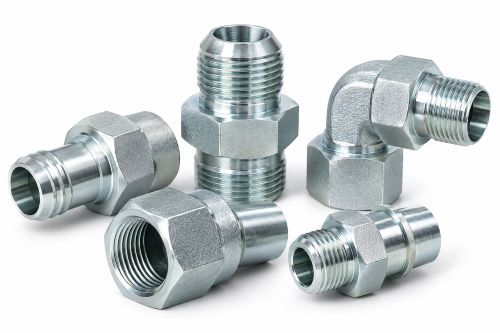
Hydraulic hose transition fittings are specialized connectors designed to join hydraulic hoses with other hydraulic components that have different connection configurations.
For example, a hydraulic system may use a flexible hose with a JIC connection on one end and a threaded port with an NPT or BSP connection on the other. A transition fitting provides the necessary interface between these two connection types.
Unlike standard hose fittings that typically connect a hose to a compatible port or component, transition fittings are specifically used when the connection requirements differ.
They can accommodate differences in:
1. Thread types and standards
2. Connection sizes and diameters
3. Male and female connection configurations
4. Hose, pipe, and tube interfaces
5. Connection angles and installation directions
Hydraulic hose transition fittings are available in various configurations, including straight adapters, elbow adapters, reducer adapters, and specialized threaded connectors.
Their main purpose is to make hydraulic system assembly easier while maintaining connection strength, pressure resistance, and sealing performance.
How Do Hydraulic Hose Transition Fittings Work?
Hydraulic hose transition fittings work by creating a mechanical connection between two hydraulic components with different connection interfaces.
When installed correctly, they provide a continuous passage for hydraulic fluid while keeping the connection secure under operating pressure.
The working process generally involves several steps.
Step 1: Connecting different interfaces
The fitting is selected according to the connection requirements of the hose and the receiving component. Each end may have a different thread type, size, or connection design.
Step 2: Securing the threaded connections
The fitting is installed by engaging its threaded ends with the corresponding hose assembly or hydraulic component. Proper thread matching and tightening help maintain mechanical stability.
Step 3: Creating a reliable seal
Depending on the fitting design, sealing may be achieved through an O-ring, metal-to-metal contact, a flare surface, or a suitable thread seal.
The sealing mechanism prevents hydraulic fluid from escaping during system operation.
Step 4: Allowing hydraulic fluid to flow
Once installed, the fitting provides an internal passage that allows hydraulic fluid to move between the connected components.
Step 5: Maintaining connection performance
During operation, the fitting must withstand working pressure, vibration, temperature changes, and mechanical loads without compromising the connection.
A properly selected and installed transition fitting helps maintain reliable hydraulic performance and reduces the likelihood of unexpected leakage.
Common Types of Hydraulic Hose Transition Fittings
Hydraulic hose transition fittings come in different configurations to accommodate various installation requirements. Understanding these designs makes it easier to select the right connector for a particular application.
Hose-to-Pipe Adapters
Hose-to-pipe adapters connect flexible hydraulic hoses to rigid piping systems.
They are commonly used when a hydraulic system combines flexible hose assemblies with fixed pipe sections. One end connects to the hose assembly, while the other connects to the pipe or its corresponding fitting.
These adapters are frequently found in industrial machinery, hydraulic power units, and manufacturing equipment.
Hose-to-Tube Adapters
Hose-to-tube adapters provide connections between flexible hydraulic hoses and rigid hydraulic tubing.
They are useful in systems where flexible hoses are needed to accommodate movement or vibration, while tubing provides a fixed fluid pathway.
Depending on the design, these adapters may use compression, flare, or other standardized connection systems.
They are commonly used in agricultural machinery, construction equipment, and industrial hydraulic installations.
Thread-to-Thread Hydraulic Adapters
Thread-to-thread adapters connect hydraulic components with different thread configurations.
For example, a system may require a connection between JIC and BSP threads or between metric and NPT interfaces.
These adapters allow components with different connection standards to work together without replacing the entire hose assembly or hydraulic component.
However, thread compatibility alone is not enough. The sealing method must also match the requirements of both connection interfaces.
Straight Hydraulic Transition Fittings
Straight transition fittings provide direct connections between two hydraulic components.
Their simple design makes them suitable for installations where the hose and connected components are aligned.
They are commonly used to connect hoses, pipes, tubes, valves, and hydraulic ports while keeping the assembly compact.
45-Degree and 90-Degree Elbow Adapters
Elbow transition fittings change the direction of hydraulic connections.
A 45-degree adapter provides a moderate directional change, while a 90-degree adapter creates a sharper turn.
These fittings are particularly useful in compact equipment where hoses must be routed around other components.
They can also help simplify hose routing and reduce unnecessary bending, provided the installation maintains the hose manufacturer’s minimum bend radius.
Hydraulic Reducer Adapters
Hydraulic reducer adapters connect components with different connection sizes.
For example, they may provide a transition between a larger hydraulic hose connection and a smaller threaded port.
These fittings help accommodate different line dimensions without requiring extensive changes to the hydraulic assembly.
When selecting a reducer adapter, it is important to consider flow requirements, pressure ratings, and potential pressure losses caused by changes in internal passage size.
Key Components and Design Features
Although hydraulic hose transition fittings are available in many shapes and configurations, most share several important design elements.
Each component contributes to connection strength, sealing performance, and fluid flow.
Fitting Body
The fitting body is the main structural part of the adapter. It contains the internal fluid passage and connects the different interfaces.
Its dimensions, wall thickness, and material determine important mechanical characteristics, including pressure resistance and durability.
Threaded Ends
Threaded ends provide the mechanical connection between the adapter and the hydraulic components.
Depending on the design, they may feature male threads, female threads, or different thread configurations on opposite ends.
Common options include JIC, BSP, NPT, ORFS, and metric threads.
Sealing Surface
The sealing surface creates the contact area needed to prevent hydraulic fluid leakage.
Different fittings use different sealing arrangements, including flare seats, flat-face connections, tapered threads, and O-ring sealing surfaces.
The correct sealing design must match the connected components.
O-Rings and Sealing Elements
Some transition fittings use O-rings or other sealing elements to improve leak resistance.
These components help maintain a seal under pressure and accommodate minor surface irregularities.
The sealing material should be compatible with the hydraulic fluid and operating temperature.
Hex Section
Many hydraulic adapters include a hexagonal section that allows technicians to tighten the fitting with a wrench.
This feature makes installation and removal easier while providing a practical surface for applying the specified installation torque.
Materials Used in Hydraulic Hose Transition Fittings
Material selection plays an important role in determining the strength, corrosion resistance, and service life of hydraulic hose transition fittings.
The most common materials include carbon steel, stainless steel, and brass.
Carbon Steel
Carbon steel is widely used in hydraulic fitting manufacturing because of its strength, durability, and cost-effectiveness.
It is suitable for many industrial and mobile hydraulic applications, including construction machinery, agricultural equipment, and hydraulic power systems.
Carbon steel fittings can also receive protective surface treatments to improve corrosion resistance.
Common finishing options include zinc plating and zinc-nickel plating.
Stainless Steel
Stainless steel hydraulic adapters offer excellent corrosion resistance and are suitable for demanding operating environments.
They are commonly used in applications exposed to moisture, chemicals, and corrosive conditions.
Stainless steel fittings are also suitable for industries where equipment cleanliness and material durability are important.
Depending on the application, different stainless steel grades may be selected to meet mechanical and environmental requirements.
Brass
Brass offers good corrosion resistance and machinability.
It is used in selected hydraulic and fluid-handling applications where its mechanical properties and compatibility meet system requirements.
However, brass is not suitable for every high-pressure hydraulic application. Its pressure limitations and mechanical characteristics should be carefully evaluated before selection.
Common Thread Types and Connection Standards
Thread compatibility is one of the most important considerations when selecting hydraulic hose transition fittings.
Different hydraulic systems use different connection standards, and fittings that appear similar may have different thread dimensions or sealing mechanisms.
Here are some commonly used connection types.
JIC (37-Degree Flare)
JIC fittings use a 37-degree flare sealing design. They are widely used in hydraulic systems because they provide reliable connections and are available in many configurations.
SAE J514 is a commonly referenced standard for these connections.
BSPP and BSPT
BSPP uses parallel threads, while BSPT uses tapered threads.
These connection types are commonly found in hydraulic and fluid-handling equipment, particularly in systems designed around British Standard Pipe connections.
NPT fittings use tapered threads to create a connection that can provide sealing when properly installed with a suitable sealing method.
NPTF connections use a dry-seal thread design intended to achieve sealing through thread interference.
ORFS fittings use an O-ring positioned on the face of the male fitting to create a reliable seal against the female connection.
They are commonly used in high-pressure hydraulic systems where leak prevention is important.
Metric fittings are widely used in European-designed hydraulic equipment and many international machinery applications.
They are available in different configurations, including metric threaded connections and standardized cutting-ring systems.
When selecting transition fittings, always verify the thread standard, pitch, diameter, sealing design, and connection dimensions rather than relying on visual appearance alone.
Applications of Hydraulic Hose Transition Fittings
Hydraulic hose transition fittings are used across many industries because hydraulic systems often combine components from different manufacturers or connection standards.
Some common applications include:
Construction and Earthmoving Equipment
Excavators, loaders, bulldozers, and other construction machines use hydraulic hoses to transfer fluid between pumps, valves, cylinders, and motors.
Transition fittings help connect different hydraulic interfaces and simplify hose routing.
Agricultural Machinery
Tractors, harvesters, sprayers, and other agricultural machines rely on hydraulic systems for lifting, steering, and operating attachments.
These machines often require different hose and port configurations, making transition fittings useful for installation and maintenance.
Industrial Hydraulic Systems
Manufacturing equipment, hydraulic presses, injection molding machines, and automated production systems use transition adapters to connect hydraulic lines with different components.
Hydraulic Power Units
Hydraulic power units contain pumps, reservoirs, valves, and pressure-control components.
Transition fittings help connect these parts while accommodating different thread types and port configurations.
Mining and Heavy-Duty Equipment
Mining machinery and heavy-duty equipment operate under demanding conditions.
Suitable transition fittings help maintain secure hydraulic connections under pressure, vibration, and mechanical stress.
Material Handling Equipment
Forklifts, lifting platforms, and industrial handling systems use hydraulic cylinders and motors to perform lifting and movement operations.
Transition adapters help connect hoses to the different components within these systems.
How to Choose the Right Hydraulic Hose Transition Fittings
Choosing the correct hydraulic hose transition fittings requires more than matching thread sizes. Buyers and engineers should evaluate several technical factors before selecting a product.
Here are seven important considerations.
1. Check Connection Compatibility
Identify the connection type on both ends of the fitting.
Determine whether the system requires JIC, BSP, NPT, ORFS, metric, or another connection standard.
Make sure the threads and sealing designs are compatible.
2. Verify Working Pressure
Select fittings with pressure ratings suitable for the hydraulic system.
Consider normal operating pressure as well as pressure spikes and other dynamic conditions.
The complete assembly should be rated according to its lowest-rated component.
3. Confirm Hose and Port Sizes
Check the hose size, port dimensions, thread diameter, and internal flow passage.
Incorrect sizing can create installation problems, restrict fluid flow, or increase pressure losses.
4. Choose the Right Material
Consider the working environment when selecting fitting materials.
Carbon steel is suitable for many general hydraulic applications, while stainless steel may be preferable in corrosive environments.
Brass should only be selected when its pressure and mechanical properties meet the application requirements.
5. Evaluate Sealing Requirements
Determine whether the connection uses an O-ring, flare seat, metal-to-metal seal, or tapered thread.
Using an incorrect sealing method can result in leakage even when the threads appear to fit properly.
6. Consider Installation Space
Check the available space around the connection.
Straight adapters work well in aligned installations, while 45-degree and 90-degree elbows can help accommodate restricted spaces and improve hose routing.
7. Review Operating Conditions
Consider temperature, hydraulic fluid compatibility, vibration, external exposure, and mechanical loading.
These conditions influence the appropriate material, sealing elements, and fitting configuration.
Common Problems with Hydraulic Hose Transition Fittings and How to Avoid Them
Even high-quality hydraulic adapters can experience problems when they are incorrectly selected, installed, or maintained.
Understanding common issues helps improve system reliability.
Incorrect Thread Matching
One of the most common mistakes is connecting fittings with similar-looking but incompatible threads.
For example, BSP and NPT threads may appear similar, but their dimensions and thread profiles differ.
Always identify the exact thread standard before installation.
Hydraulic Fluid Leakage
Leaks can occur because of damaged sealing surfaces, worn O-rings, incorrect thread connections, or improper tightening.
Inspect all sealing areas before assembly and replace damaged sealing elements when necessary.
Overtightening
Applying excessive torque can damage threads, deform sealing surfaces, or cause fitting failure.
Follow the manufacturer’s recommended installation torque and use the correct tools.
Insufficient Pressure Rating
Using a fitting with an inadequate pressure rating can create serious reliability and safety problems.
Always verify that the fitting is suitable for the system’s operating conditions.
Corrosion and Surface Damage
Fittings exposed to moisture, chemicals, or harsh environments may experience corrosion.
Selecting appropriate materials and protective surface treatments can help extend service life.
Improper Hose Routing
Poor hose routing can create excessive bending, twisting, and mechanical stress.
Use suitable elbow adapters where needed and follow the hose manufacturer’s minimum bend radius requirements.
Custom Hydraulic Hose Transition Fittings: OEM and ODM Manufacturing Solutions
Standard hydraulic hose transition fittings are suitable for many applications, but some hydraulic systems require customized connection designs.
Specialized machinery may use uncommon thread combinations, nonstandard dimensions, specific sealing arrangements, or unique installation requirements.
In these situations, custom hydraulic hose transition fittings offer a more practical solution.
Working with an experienced hydraulic fittings manufacturer allows equipment manufacturers and distributors to obtain products that match their technical specifications.
Custom Design and Engineering Support
Custom transition fittings can be manufactured according to customer drawings, samples, or application requirements.
OEM and ODM services make it possible to adjust fitting dimensions, connection configurations, thread types, and other design features.
Engineering support also helps ensure that the proposed design meets the intended application requirements.
Multiple Material Options
Different applications require different material properties.
Sannke offers hydraulic fitting manufacturing in:
➡️ Carbon steel
➡️ Stainless steel
➡️ Brass
Customers can select materials according to their operating environments, pressure requirements, and corrosion resistance needs.
Surface Treatment Options
Protective surface treatments can improve the corrosion resistance and appearance of hydraulic fittings.
Available options include zinc plating, zinc-nickel plating, and other finishing treatments.
Stainless steel fittings can also receive passivation treatments, while electroless nickel plating may be considered for suitable applications.
Precision Manufacturing
Accurate dimensions and consistent machining are essential for hydraulic fitting performance.
Sannke combines engineering expertise with advanced manufacturing equipment to produce hydraulic adapters and fittings according to customer specifications.
The company supports customized product designs, optional logo printing, and manufacturing solutions for different hydraulic applications.
OEM and ODM Services from Sannke
As a hydraulic fittings manufacturer, Sannke provides customized solutions for distributors, hydraulic equipment manufacturers, and industrial buyers.
Its services include:
➡️ OEM and ODM hydraulic fitting manufacturing.
➡️ Custom hose fittings, adapters, ferrules, flanges, and accessories.
➡️ Product design and engineering support.
➡️ Multiple material and surface finishing options.
➡️ Free samples for product evaluation.
➡️ Optional logo printing and customized product identification.
➡️ Bulk production for different industrial requirements.
For buyers who need more than standard catalog products, Sannke can help develop hydraulic hose transition fittings based on specific drawings and technical requirements.
Whether the project involves a new hydraulic assembly or a replacement connection for existing equipment, customized manufacturing can help achieve a better fit between components.
Frequently Asked Questions (FAQs)
Q1. What are hydraulic hose transition fittings used for?
Hydraulic hose transition fittings connect hydraulic hoses to components with different connection types, sizes, or configurations. They are commonly used to join hoses with pipes, tubes, valves, pumps, and hydraulic ports.
Q2. What is the difference between hydraulic hose fittings and transition fittings?
Standard hydraulic hose fittings connect hydraulic hoses to compatible hydraulic components. Transition fittings are designed to accommodate differences between connection interfaces, such as thread types, sizes, or connection configurations.
Q3. Can hydraulic hose transition fittings connect different thread types?
Yes. Certain transition adapters are designed to connect different thread standards, such as JIC to BSP or metric to NPT. However, the thread dimensions and sealing methods must be compatible with the intended application.
Q4. What materials are commonly used to manufacture hydraulic transition fittings?
Carbon steel, stainless steel, and brass are commonly used materials. The appropriate choice depends on operating pressure, corrosion exposure, mechanical requirements, and hydraulic fluid compatibility.
Q5. How do I prevent leaks in hydraulic hose transition connections?
Use compatible fittings, inspect sealing surfaces, install the correct O-rings or sealing elements, and follow the manufacturer’s tightening specifications. Avoid mixing incompatible thread standards or sealing designs.
Q6. Can hydraulic hose transition fittings be customized?
Yes. Manufacturers can produce custom fittings based on drawings, samples, or specific technical requirements. Customization may include thread combinations, dimensions, materials, shapes, and surface treatments.
Q7. How do I determine the correct pressure rating for a transition fitting?
Check the system’s maximum operating pressure, including pressure spikes and dynamic loads. Select a fitting rated for the intended operating conditions and verify that the entire hydraulic assembly meets the required pressure specifications.
Conclusion
Hydraulic hose transition fittings play an important role in connecting different components within hydraulic systems. By accommodating different thread types, sizes, and connection configurations, they help create secure fluid pathways across a wide range of industrial and mobile equipment.
Choosing the right fitting requires careful consideration of connection compatibility, pressure ratings, materials, sealing methods, and installation requirements.
For applications with specialized connection requirements, custom manufacturing provides greater flexibility than relying exclusively on standard fittings.
Sannke offers OEM and ODM hydraulic fitting solutions, including custom adapters, hose fittings, and other hydraulic connection components. With multiple material options, surface treatments, engineering support, and precision manufacturing capabilities, Sannke helps customers source hydraulic fittings designed around their specific requirements.
If you are looking for a reliable manufacturing partner for standard or custom hydraulic hose transition fittings, Sannke can support your project from product design to bulk production.
Post time: Nov-16-2026