

Hydraulic systems often require more than standard connections. Different equipment designs, installation spaces, pressure requirements, and thread configurations can make off-the-shelf adapters unsuitable. In these situations, custom hydraulic adapters provide a practical solution by offering connection designs tailored to specific applications.
For equipment manufacturers, hydraulic system integrators, and industrial distributors, working with an experienced custom hydraulic adapter manufacturer can make product development and sourcing much easier. Through Original Equipment Manufacturer (OEM) and Original Design Manufacturer (ODM) services, businesses can obtain hydraulic adapters that meet their technical requirements while maintaining consistent product quality.
This guide explains how custom hydraulic adapters are designed and manufactured, the differences between OEM and ODM services, important specifications to consider, and how to choose the right manufacturing partner.
What Are Custom Hydraulic Adapters?
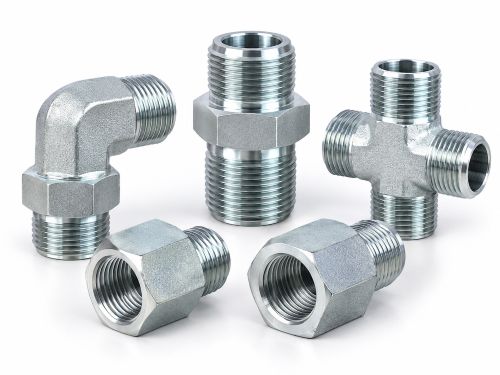
Custom hydraulic adapters are specially designed components used to connect hydraulic hoses, tubes, pipes, valves, pumps, cylinders, and other hydraulic equipment. Unlike standard adapters, which follow predefined dimensions and connection configurations, custom adapters are manufactured according to specific customer requirements.
These requirements may involve unique thread combinations, special dimensions, different connection angles, material selections, or particular sealing arrangements.
For example, a hydraulic machine may require an adapter that connects a metric port to a JIC hose connection. If a standard product cannot meet the required dimensions or installation conditions, a custom adapter can be developed to provide the correct connection.
Common Types of Custom Hydraulic Adapters
Custom hydraulic adapters are available in various configurations depending on the hydraulic system and connection requirements.
Common types include:
1. JIC hydraulic adapters: Use 37-degree flare connections and are commonly found in mobile and industrial hydraulic systems.
2. ORFS hydraulic adapters: Feature an O-ring face seal designed to provide reliable sealing in high-pressure applications.
3. SAE ORB adapters: Use O-ring boss connections for sealing against hydraulic ports.
4. BSP adapters: Available in BSPP and BSPT thread configurations for different hydraulic and industrial connections.
5. NPT and NPTF adapters: Commonly used in pipe connection systems.
6. Metric hydraulic adapters: Designed for metric threaded connections, including DIN-style fittings.
7. Hydraulic elbow adapters: Provide angled connections, commonly in 45-degree and 90-degree configurations.
8. Hydraulic tee adapters: Allow hydraulic flow to branch into multiple directions.
9. Bulkhead adapters: Provide connections through panels, tanks, or equipment walls.
Each type can be customized to meet particular dimensional, material, and connection requirements.
When Are Custom Hydraulic Adapters Needed?
Custom adapters are useful when standard hydraulic fittings cannot provide the required connection or installation arrangement.
Some common situations include:
1. Connecting hydraulic components with different thread standards.
2. Accommodating limited installation space.
3. Meeting special dimensional or clearance requirements.
4. Developing hydraulic assemblies for specialized machinery.
5. Selecting materials for corrosive or demanding environments.
6. Matching existing equipment connections.
7. Designing adapters for specific pressure and temperature conditions.
Custom manufacturing gives equipment designers greater flexibility when developing hydraulic systems with unique connection requirements.
What Are OEM and ODM Hydraulic Adapter Manufacturing Services?
OEM and ODM are two common manufacturing models used in the hydraulic fittings industry. Both allow businesses to obtain customized products, but they differ in how product design and development are handled.
Understanding these differences helps buyers choose the most suitable manufacturing arrangement.
What Is OEM Hydraulic Adapter Manufacturing?
OEM stands for Original Equipment Manufacturer. In hydraulic adapter manufacturing, OEM services generally mean that a manufacturer produces products according to the customer’s existing design and specifications.
The customer may provide engineering drawings, technical documents, physical samples, or detailed product requirements. The manufacturer then uses these materials as the basis for production.
OEM hydraulic adapter services may include:
1. Manufacturing according to customer drawings.
2. Producing adapters based on existing samples.
3. Customizing thread sizes and connection configurations.
4. Selecting specified materials and surface treatments.
5. Printing customer logos or product identification.
6. Providing customized packaging and labeling.
OEM manufacturing is particularly useful for equipment manufacturers and distributors who already have established product designs but need a reliable production partner.
What Is ODM Hydraulic Adapter Manufacturing?
ODM stands for Original Design Manufacturer. Unlike OEM manufacturing, ODM services involve more direct participation from the manufacturer in product design and development.
A customer may have a general idea of the required adapter but lack a complete engineering drawing. In this situation, the manufacturer can provide technical assistance to develop a suitable product design.
ODM services may involve:
1. Reviewing application requirements.
2. Developing product drawings and dimensions.
3. Recommending suitable materials.
4. Evaluating connection configurations.
5. Supporting prototype development.
6. Optimizing designs for production.
7. Helping customers develop specialized hydraulic components.
ODM manufacturing is a practical option for businesses introducing new equipment or developing hydraulic products that require unique connection solutions.
OEM vs. ODM Hydraulic Adapters: Key Differences
Although OEM and ODM services both support customized hydraulic adapter production, their responsibilities differ.
|
Comparison Factor |
OEM Manufacturing |
ODM Manufacturing |
|
Product design |
Provided by the customer |
Developed with manufacturer support |
|
Technical drawings |
Usually supplied by customer |
Can be developed by manufacturer |
|
Engineering involvement |
Mainly production-related |
Includes design and development |
|
Customization |
Based on customer specifications |
Based on agreed design requirements |
|
Product development |
Existing product designs |
New or modified product designs |
|
Best suited for |
Established product lines |
New product development |
The right option depends on your business needs. If you already have detailed technical drawings, OEM manufacturing may be more appropriate. If you need help developing a new adapter design, ODM services may offer greater flexibility.
The Custom Hydraulic Adapter Manufacturing Process
Producing reliable custom hydraulic adapters requires careful coordination between product design, material selection, machining, finishing, and quality inspection.
Although manufacturing processes vary depending on the adapter design, most projects follow several important stages.
1. Requirement Analysis and Technical Consultation
The manufacturing process begins with understanding the customer’s requirements.
Before production, the manufacturer needs to identify the adapter’s intended application and connection specifications. This information helps determine the appropriate design, material, and manufacturing process.
Important details include:
➡️ Hydraulic system application.
➡️ Connection types and thread standards.
➡️ Thread sizes and dimensions.
➡️ Required operating pressure.
➡️ Temperature conditions.
➡️ Material preferences.
➡️ Sealing requirements.
➡️ Estimated order quantity.
Customers can provide technical drawings, physical samples, or product specifications. Clear communication at this stage helps reduce design errors and unnecessary production changes.
2. Product Design and Engineering
After reviewing the requirements, engineers develop or evaluate the adapter design.
For OEM projects, this usually involves checking the customer’s existing drawings and confirming that the dimensions and connection specifications are suitable for manufacturing.
For ODM projects, the manufacturer may develop technical drawings based on the customer’s application requirements.
The design process considers several factors:
➡️ Overall adapter dimensions.
➡️ Thread specifications and engagement.
➡️ Connection orientation.
➡️ Sealing surface geometry.
➡️ Hex dimensions for installation.
➡️ Material strength.
➡️ Manufacturing tolerances.
Computer-aided design (CAD) software can help engineers create accurate product drawings and identify potential design issues before production begins.
3. Material Selection
Material selection directly affects the strength, corrosion resistance, durability, and overall performance of hydraulic adapters.
Common materials include:
Carbon Steel
Carbon steel is widely used for hydraulic adapters because of its mechanical strength, machinability, and cost-effectiveness. It is suitable for many general industrial and mobile hydraulic applications.
Surface treatments such as zinc plating and zinc-nickel plating can improve corrosion resistance.
Stainless Steel
Stainless steel hydraulic adapters are commonly selected for applications where corrosion resistance is important. They are suitable for marine environments, chemical processing equipment, and other demanding operating conditions.
Grades such as 304 and 316 stainless steel may be considered depending on the environment and application requirements.
Brass
Brass adapters are used in selected hydraulic, pneumatic, and fluid connection applications. Their corrosion resistance and machining characteristics make them suitable for certain specialized requirements.
The final material should be selected according to working pressure, temperature, fluid compatibility, environmental exposure, and mechanical requirements.
4. CNC Machining and Production
Once the design and material have been confirmed, manufacturing can begin.
CNC machining is an important process in producing precision hydraulic adapters. It allows manufacturers to produce components with consistent dimensions and accurate connection features.
Common machining operations include:
➡️ CNC turning for producing cylindrical adapter bodies.
➡️ CNC milling for creating hexagonal sections and special shapes.
➡️ Drilling for forming internal flow passages.
➡️ Thread cutting for producing accurate male and female connections.
➡️ Finishing operations for improving surface quality.
Machining accuracy is particularly important for threaded hydraulic adapters. Incorrect thread dimensions, damaged sealing surfaces, or poor dimensional control can lead to installation difficulties and leakage.
Advanced manufacturing equipment and controlled production procedures help maintain consistency across production batches.
5. Surface Treatment and Finishing
After machining, hydraulic adapters may undergo surface treatments to improve their corrosion resistance and appearance.
Common finishing options include:
➡️ Zinc plating: Provides a protective coating for carbon steel components.
➡️ Zinc-nickel plating: Offers enhanced corrosion resistance compared with conventional zinc plating in suitable applications.
➡️ Trivalent chromium treatment: Used in certain finishing systems to support corrosion protection and meet environmental requirements.
➡️ Stainless steel passivation: Helps improve the corrosion resistance of stainless steel surfaces.
➡️ Electroless nickel plating: Produces a uniform nickel-based coating that can improve corrosion and wear resistance.
The appropriate finishing process depends on the base material, operating environment, customer specifications, and applicable coating requirements.
6. Quality Inspection and Testing
Quality control is essential because hydraulic adapters must provide secure connections and withstand the operating conditions of their intended applications.
Manufacturers typically inspect several product characteristics before shipment.
These may include:
➡️ Thread size, pitch, and accuracy.
➡️ Overall dimensions and tolerances.
➡️ Sealing surface condition.
➡️ Machined surface quality.
➡️ Material specifications.
➡️ Coating thickness and appearance.
➡️ Pressure performance, where required.
Pressure testing should follow the agreed product specifications and applicable testing procedures.
A reliable manufacturer should also maintain appropriate inspection records and production controls to support consistent product quality.
7. Packaging and Delivery
The final stage involves preparing finished adapters for shipment.
Proper packaging helps protect threads, sealing surfaces, and finished coatings from damage during transportation.
Depending on customer requirements, manufacturers may provide:
➡️ Individual product packaging.
➡️ Custom labels and identification.
➡️ Customer logo printing.
➡️ Batch identification.
➡️ Export packaging.
➡️ Customized shipping arrangements.
Clear packaging and product identification also make it easier for distributors and equipment manufacturers to manage inventory.
Important Specifications to Consider When Customizing Hydraulic Adapters
Before placing an order, buyers should confirm several technical details to ensure that the finished adapters are compatible with their hydraulic systems.
Thread Types and Connection Standards
Hydraulic adapters are available in different thread standards and connection systems. Selecting compatible connections is essential for proper installation and sealing.
Common standards include:
1. JIC / SAE J514: Uses a 37-degree flare sealing design.
2. ORFS / SAE J1453: Uses an O-ring face seal.
3. SAE ORB / SAE J1926: Uses an O-ring boss connection.
4. BSPP: A parallel pipe thread commonly used with a separate sealing arrangement.
5. BSPT: A tapered pipe thread.
6. NPT and NPTF: American pipe thread systems with different sealing characteristics.
7. Metric DIN connections: Commonly used in hydraulic tube connection systems.
Thread compatibility should be confirmed carefully. Similar-looking threads do not necessarily have the same pitch, diameter, or sealing method.
Adapter Dimensions and Configurations
The adapter’s physical dimensions determine whether it can fit properly within the hydraulic assembly.
Important measurements include:
1. Thread diameter.
2. Thread pitch.
3. Overall length.
4. Hex size.
5. Internal passage diameter.
6. Connection depth.
7. Sealing surface dimensions.
8. Adapter angle and orientation.
Straight, 45-degree, and 90-degree configurations may be required depending on the available installation space.
Providing a complete technical drawing is one of the best ways to avoid dimensional misunderstandings.
Pressure and Temperature Requirements
Custom hydraulic adapters must be suitable for the operating conditions of the hydraulic system.
Buyers should identify the maximum working pressure, expected pressure fluctuations, operating temperature, and hydraulic fluid type.
Pressure suitability depends on the complete adapter design, including material, wall thickness, thread engagement, sealing geometry, and manufacturing quality.
The rated pressure should be established and validated for the actual product configuration rather than assumed from the thread type alone.
Sealing Methods
Different hydraulic connections use different sealing arrangements.
Common sealing methods include:
1. O-ring sealing.
2. Metal-to-metal sealing.
3. 37-degree flare sealing.
4. Flat-face sealing.
5. Bonded seal arrangements.
6. Tapered thread sealing.
Choosing the correct sealing method helps prevent leakage and maintain connection reliability.
Benefits of Choosing Custom Hydraulic Adapters
Custom hydraulic adapters provide several advantages for businesses that manufacture or maintain specialized hydraulic equipment.
Better Compatibility with Hydraulic Systems
Standard adapters may not always match the required thread combinations or dimensions of a particular hydraulic assembly.
Custom adapters can be designed to connect components with different thread standards, sizes, and configurations. This helps simplify equipment integration and reduce the need for multiple connection components.
Improved Installation Flexibility
Space limitations are common in hydraulic machinery, particularly in construction equipment, agricultural machinery, and mobile hydraulic systems.
Custom adapter lengths, angles, and connection arrangements can help accommodate restricted installation spaces and improve hose routing.
More Suitable Material and Surface Treatment Options
Different applications require different levels of corrosion resistance, strength, and durability.
Custom manufacturing allows buyers to select suitable materials and surface treatments based on the operating environment and technical requirements.
Consistent Product Quality
Working with an experienced manufacturer that follows controlled machining and inspection procedures can help maintain consistent dimensions and product quality.
This is particularly important for OEM customers who need repeatable specifications across multiple production batches.
Support for OEM Product Development
Custom adapters allow equipment manufacturers to develop hydraulic assemblies around their own product designs.
With appropriate engineering support, businesses can develop specialized connection components that meet their equipment requirements and production goals.
How to Choose a Reliable Custom Hydraulic Adapter Manufacturer
Choosing the right manufacturing partner is just as important as selecting the adapter design. A reliable supplier should offer more than basic machining services. It should understand hydraulic connection standards, material requirements, and the technical demands of industrial applications.
Here are several factors worth considering.
Manufacturing Experience and Technical Expertise
Look for manufacturers with practical experience producing hydraulic adapters, hose fittings, tube fittings, and related components.
Knowledge of international connection standards is particularly valuable because it helps prevent thread compatibility and sealing problems.
OEM and ODM Capabilities
Check whether the manufacturer can support both existing product designs and new product development.
A capable partner should be able to review technical drawings, work with physical samples, discuss design requirements, and recommend suitable manufacturing solutions.
Material and Surface Treatment Options
Confirm that the manufacturer can provide the materials and finishes required for your application.
Having access to carbon steel, stainless steel, brass, and different surface treatments gives buyers more flexibility when developing custom products.
Quality Control and Testing Capabilities
Ask about the manufacturer’s inspection procedures, machining tolerances, thread inspection equipment, and pressure testing capabilities.
Quality documentation and inspection records can also help buyers evaluate product consistency.
Production Capacity and Delivery Time
Consider whether the manufacturer can handle your required order quantity and delivery schedule.
Discuss minimum order quantities, sample availability, production lead times, and shipping arrangements before confirming an order.
Communication and After-Sales Support
Good communication helps prevent misunderstandings during product development and manufacturing.
A responsive supplier should be able to clarify technical specifications, provide production updates, and assist with product-related questions.
Why Choose Sannke for Custom Hydraulic Adapter Manufacturing?
Choosing an experienced hydraulic fittings manufacturer can make custom product sourcing more straightforward. Sannke provides hydraulic fitting and adapter manufacturing solutions for customers seeking standard products as well as customized connection components.
With 15 years of manufacturing experience, Sannke supports OEM and ODM requirements for different hydraulic applications.
OEM and ODM Manufacturing Support
Sannke can work with customer drawings, samples, and technical specifications to produce customized hydraulic adapters. Engineering support is also available for customers who need assistance developing product designs.
Multiple Material Options
Depending on the product requirements, customers can choose from carbon steel, stainless steel, and brass materials.
Surface Treatment Options
Available finishing options include zinc plating, zinc-nickel plating, chromium-based treatments, stainless steel passivation, and electroless nickel plating.
Customized Product Solutions
Sannke’s manufacturing capabilities cover hydraulic adapters, hose fittings, ferrules, flanges, and related hydraulic accessories. Customers can discuss specific dimensions, thread combinations, connection configurations, and product requirements.
Engineering and Manufacturing Capabilities
With experienced engineers and advanced manufacturing equipment, Sannke supports customized product development and precision manufacturing.
Sample Support and Export Services
Free samples are available for product evaluation, subject to product and project confirmation. Sannke also supports export orders and customized packaging requirements.
Whether you are an equipment manufacturer looking for an OEM production partner or a distributor sourcing specialized hydraulic adapters, Sannke can help evaluate your requirements and discuss suitable manufacturing solutions.
Contact Sannke with your drawings, samples, or technical specifications to discuss your custom hydraulic adapter project.
Frequently Asked Questions About Custom Hydraulic Adapters
1. What information is needed to order custom hydraulic adapters?
Buyers should provide technical drawings, thread standards, dimensions, material requirements, operating pressure, sealing specifications, and estimated order quantities. Physical samples can also help manufacturers understand existing product designs.
2. What is the difference between OEM and ODM hydraulic adapters?
OEM manufacturing involves producing adapters according to customer-provided designs and specifications. ODM manufacturing includes greater manufacturer involvement in product design, engineering, and development.
3. What materials are available for custom hydraulic adapters?
Common materials include carbon steel, stainless steel, and brass. The best option depends on the application, working pressure, temperature, corrosion exposure, and hydraulic fluid compatibility.
4. Can hydraulic adapters be customized with different thread types?
Yes. Custom hydraulic adapters can be developed with different thread combinations, provided the connection geometry, sealing arrangement, and application requirements are technically compatible.
5. Can custom hydraulic adapters be manufactured for high-pressure applications?
Yes. Custom adapters can be designed for high-pressure hydraulic systems. However, their pressure ratings must be determined through engineering evaluation and appropriate validation testing of the complete connection design.
6. How long does it take to manufacture custom hydraulic adapters?
Production time depends on design complexity, material availability, machining requirements, order quantity, surface treatment, and production scheduling. Prototype development may also affect the overall lead time.
7. What is the minimum order quantity for custom hydraulic adapters?
MOQ varies according to product type, material, machining process, and customization requirements. Buyers should confirm the minimum quantity with the manufacturer before placing an order.
Conclusion
Custom hydraulic adapters help businesses solve connection challenges that standard products cannot always address. Through OEM and ODM manufacturing services, buyers can obtain hydraulic adapters designed around specific thread combinations, dimensions, materials, sealing arrangements, and application requirements.
From initial design and material selection to CNC machining, surface treatment, and quality inspection, every manufacturing stage contributes to the final product’s performance and reliability.
For businesses looking for a dependable manufacturing partner, Sannke offers OEM and ODM support, multiple material options, customized surface treatments, and hydraulic fitting manufacturing experience.
Looking for a custom hydraulic adapter manufacturer? Contact Sannke to discuss your drawings, samples, and product specifications.
Post time: Nov-13-2026