

DIN 2353 tube connectors are widely used in hydraulic systems where reliable, leak-resistant connections are essential. Designed for metric tube connections, these fittings use a 24-degree cone and cutting ring mechanism to create a secure connection between hydraulic tubes and other system components.
They are commonly found in industrial machinery, construction equipment, agricultural machinery, and mobile hydraulic systems. Their standardized design makes them suitable for applications that require consistent connection dimensions, mechanical strength, and dependable sealing performance.
Understanding how DIN 2353 tube connectors work can help engineers, equipment manufacturers, and hydraulic fitting buyers select the right connection for their applications.
In this guide, we will explore the design, working principle, common types, materials, applications, and selection considerations of DIN 2353 tube connectors.
What Are DIN 2353 Tube Connectors?
DIN 2353 tube connectors are mechanical fittings designed to connect hydraulic tubes to other tubes, pipes, hoses, valves, pumps, and hydraulic components.
They are associated with the 24-degree cone cutting ring connection system, which uses a fitting body, cutting ring, and tube nut to secure the tube in place.
The connection works by tightening the nut, which pushes the cutting ring against the fitting body’s 24-degree cone. As the cutting ring moves forward, its cutting edge penetrates the outer surface of the tube, creating a mechanical grip and a reliable sealing connection.
One of the main advantages of DIN 2353 fittings is their standardized design. They are available in different configurations, sizes, and pressure ratings to accommodate various hydraulic system requirements.
These fittings are generally classified into two main series:
➡️ Light Series (L): Designed for applications with comparatively lower pressure and mechanical requirements.
➡️ Heavy Series (S): Designed for higher-pressure applications and generally used with thicker-walled tubes.
DIN 2353 tube connectors are also closely associated with ISO 8434-1, which covers 24-degree cone connectors with cutting rings and O-ring sealing elements.
How Do DIN 2353 Tube Connectors Work?
DIN 2353 tube connectors work through a mechanical compression process. Instead of relying only on thread engagement to create a seal, the connection uses a cutting ring that grips the tube and forms a sealing interface with the fitting body.
The installation process is relatively straightforward, although proper tube preparation and tightening are important.
Here is how the connection works.
Step 1: Insert the Hydraulic Tube
The hydraulic tube is cut to the required length and prepared according to the fitting manufacturer’s instructions. The tube end should be clean, properly deburred, and free from damage.
Step 2: Install the Tube Nut and Cutting Ring
The tube nut and cutting ring are placed over the tube in the correct order and orientation. The cutting ring must be positioned correctly to ensure proper engagement with the fitting body.
Step 3: Insert the Tube into the Fitting Body
The prepared tube is inserted into the fitting body until it reaches the designated stop. Proper alignment helps prevent uneven cutting ring engagement.
Step 4: Tighten the Tube Nut
As the tube nut is tightened, it pushes the cutting ring toward the fitting body’s 24-degree cone.
The cutting ring moves forward and its cutting edge penetrates the tube surface. This creates a mechanical connection that helps prevent the tube from pulling out under pressure.
Step 5: Complete the Connection
Once the prescribed assembly procedure has been completed, the connection provides mechanical retention and sealing.
The finished assembly can then be inspected and tested according to the manufacturer’s recommendations and applicable hydraulic system requirements.
The cutting ring is an important part of this connection system. Its design allows the fitting to maintain a secure connection without requiring welding or permanent deformation of the entire tube assembly.
Main Components of DIN 2353 Tube Connectors
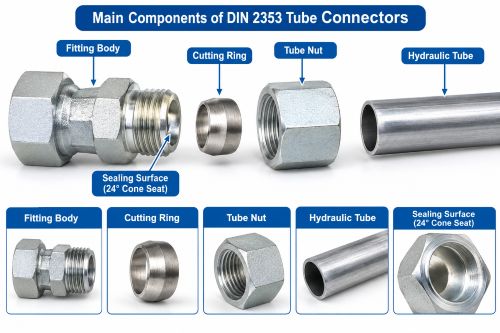
A typical DIN 2353 tube connector consists of several components that work together to create a secure hydraulic connection.
Fitting Body
The fitting body is the main structural component of the connection. It provides the connection port, internal fluid passage, and 24-degree cone seat.
It is designed to accommodate the cutting ring and tube assembly while maintaining the required connection geometry.
Fitting bodies are available in different configurations, including straight, elbow, tee, and bulkhead designs.
Cutting Ring
The cutting ring is responsible for gripping the hydraulic tube and helping establish a leak-resistant connection.
During assembly, the ring is compressed between the tube nut and fitting body. Its cutting edge penetrates the tube’s outer surface to create a mechanical holding point.
Cutting rings are available in different designs depending on the connection system and manufacturer.
Tube Nut
The tube nut secures the tube assembly to the fitting body.
When tightened, it generates the force needed to move the cutting ring toward the 24-degree cone. The correct tightening procedure is essential to achieve proper cutting ring engagement.
Hydraulic Tube
The hydraulic tube carries pressurized fluid throughout the hydraulic system.
DIN 2353 connectors are designed for metric tube dimensions. Tube outside diameter, wall thickness, and material must be compatible with the selected fitting series.
Sealing Surface
The sealing interface is formed through the engagement of the cutting ring, tube, and fitting body.
Proper surface condition and correct assembly help prevent hydraulic fluid leakage and maintain connection performance under operating pressure.
Common Types of DIN 2353 Tube Connectors
DIN 2353 tube connectors are available in different configurations to accommodate hydraulic system layouts and installation requirements.
The appropriate type depends on the direction of fluid flow, connection position, available installation space, and required tube arrangement.
Straight DIN 2353 Tube Connectors
Straight connectors provide a direct connection between two hydraulic components or tube sections.
Their simple design makes them suitable for installations where the connected tubes and ports are aligned.
Common applications include:
1. Hydraulic pump connections.
2. Hydraulic cylinder connections.
3. Industrial production machinery.
4. Hydraulic power units.
5. General-purpose hydraulic tube assemblies.
Straight connectors are commonly used because they offer a compact connection design and straightforward installation.
Elbow DIN 2353 Tube Connectors
Elbow connectors change the direction of a hydraulic tube connection. Common configurations include 45-degree and 90-degree elbows.
They are useful when hydraulic components are positioned at different angles or when straight connections would create installation difficulties.
Typical applications include:
1. Construction machinery.
2. Agricultural equipment.
3. Compact hydraulic systems.
4. Industrial machinery.
5. Hydraulic manifolds and power units.
Elbow connectors help simplify tube routing and make it easier to accommodate limited installation space.
Tee DIN 2353 Tube Connectors
Tee connectors feature three connection ports arranged in a T-shaped configuration.
They allow hydraulic fluid lines to branch from a main connection, making them useful in systems that distribute fluid to multiple components.
Common applications include:
1. Multi-cylinder hydraulic circuits.
2. Hydraulic fluid distribution systems.
3. Industrial machinery.
4. Hydraulic power units.
5. Equipment with multiple hydraulic branches.
When selecting a tee connector, check the port sizes, connection types, pressure requirements, and intended flow arrangement.
Bulkhead DIN 2353 Tube Connectors
Bulkhead connectors are designed to connect hydraulic tubes through panels, frames, or equipment walls.
They typically feature a threaded section and locking nut that secure the connector to a mounting surface.
These fittings are particularly useful when hydraulic lines need to pass through equipment partitions while maintaining an organized connection arrangement.
Common applications include hydraulic control cabinets, mobile machinery, industrial equipment, and hydraulic power systems.
Reducing DIN 2353 Tube Connectors
Reducing connectors allow hydraulic tubes or connection ports with different sizes to be joined.
They are useful in hydraulic systems where different tube dimensions are required to accommodate fluid flow, equipment design, or existing connection layouts.
Before choosing a reducing connector, verify the tube dimensions, thread specifications, series compatibility, and pressure requirements.
DIN 2353 Light Series (L) vs Heavy Series (S)
One important consideration when selecting DIN 2353 tube connectors is choosing between the Light Series (L) and Heavy Series (S).
Both series use the same general 24-degree cutting ring connection principle, but they differ in dimensional design and intended operating conditions.
Light Series (L)
The Light Series is designed for hydraulic applications where a lighter connection design is suitable.
These fittings are commonly used with metric tubes that have comparatively thinner walls than those used in Heavy Series applications.
Typical applications include:
1. General industrial hydraulic systems.
2. Agricultural machinery.
3. Mobile equipment.
4. Hydraulic control systems.
5. Medium-pressure fluid connections.
The Light Series is a practical choice when the system’s pressure, tube dimensions, and mechanical requirements fall within the manufacturer’s specified ratings.
Heavy Series (S)
The Heavy Series is designed for more demanding hydraulic applications.
Compared with the Light Series, Heavy Series fittings generally have a more robust dimensional design and are used with thicker-walled tubes.
Common applications include:
1. High-pressure hydraulic systems.
2. Construction equipment.
3. Heavy industrial machinery.
4. Hydraulic presses.
5. Demanding mobile hydraulic applications.
The Heavy Series is suitable when the system requires greater mechanical strength and pressure-handling capability.
Key Differences Between Light and Heavy Series
|
Feature |
Light Series (L) |
Heavy Series (S) |
|
Design |
Lighter construction |
Heavier construction |
|
Tube requirements |
Generally thinner-walled tubes |
Generally thicker-walled tubes |
|
Pressure capability |
Lower relative pressure range |
Higher relative pressure range |
|
Applications |
General hydraulic systems |
More demanding hydraulic systems |
|
Fitting dimensions |
More compact |
More robust |
It is important to understand that pressure ratings are not determined by series classification alone. Actual working pressure depends on tube diameter, wall thickness, material, fitting design, temperature, and operating conditions.
Always consult the manufacturer’s pressure tables before selecting a fitting.
Materials Used in DIN 2353 Tube Connectors
Material selection affects the strength, durability, corrosion resistance, and service life of DIN 2353 tube connectors.
Different materials are available to accommodate various working environments and hydraulic system requirements.
Carbon Steel
Carbon steel is one of the most common materials used for DIN 2353 hydraulic fittings.
It offers good mechanical strength, durability, and cost efficiency, making it suitable for many industrial and mobile hydraulic applications.
Carbon steel fittings are often supplied with protective surface treatments to improve corrosion resistance.
Stainless Steel
Stainless steel DIN 2353 connectors are suitable for applications where corrosion resistance is an important requirement.
They are commonly used in:
1. Marine environments.
2. Chemical processing equipment.
3. Food and beverage machinery.
4. Outdoor industrial installations.
5. Equipment exposed to moisture or corrosive substances.
Stainless steel grades should be selected according to the operating environment, fluid compatibility, and mechanical requirements.
Brass
Brass fittings are used in selected fluid and low-pressure applications where their corrosion resistance and machining properties are beneficial.
However, brass does not offer the same mechanical strength as many steel fitting designs. Its suitability must be evaluated against the system’s pressure, temperature, and mechanical requirements.
Surface Treatments and Finishes
Surface treatment is another important factor when choosing DIN 2353 tube connectors.
For carbon steel fittings, protective coatings help reduce corrosion and improve resistance to environmental exposure.
Common surface treatments include:
Zinc Plating: A widely used protective finish that helps improve the corrosion resistance of carbon steel fittings.
Zinc-Nickel Plating: Provides enhanced corrosion protection compared with conventional zinc coatings and is suitable for more demanding environments.
Cr3 Surface Treatment: Trivalent chromium passivation is commonly used with zinc-plated components to improve corrosion resistance.
Cr6-Free Zinc Plating: Uses trivalent chromium-based passivation instead of hexavalent chromium-based treatments.
Stainless Steel Passivation: Helps remove free iron and improve the natural corrosion resistance of stainless steel surfaces.
Electroless Nickel Plating: Provides a relatively uniform nickel-phosphorus coating that can improve surface hardness and corrosion resistance.
The appropriate finish depends on the installation environment, corrosion requirements, applicable regulations, and customer specifications.
Common Applications of DIN 2353 Tube Connectors
DIN 2353 tube connectors are widely used in hydraulic systems because of their standardized connection design and different available configurations.
Their applications include:
Industrial Hydraulic Machinery
Manufacturing equipment, hydraulic presses, and production machinery use DIN 2353 fittings to connect hydraulic tubes to valves, pumps, and cylinders.
Construction Equipment
Excavators, loaders, cranes, and other construction machines require reliable hydraulic connections to support lifting, steering, and movement functions.
Agricultural Machinery
Tractors, harvesters, and agricultural implements use hydraulic tube connectors in lifting mechanisms, steering systems, and other hydraulic circuits.
Hydraulic Power Units
Hydraulic power units use tube connectors to connect pumps, reservoirs, valves, and other hydraulic components.
Mobile Hydraulic Systems
Mobile equipment often operates under vibration, changing temperatures, and demanding working conditions. Properly selected DIN 2353 connectors help maintain reliable tube connections in these environments.
DIN 2353 vs ISO 8434-1: What’s the Difference?
DIN 2353 and ISO 8434-1 are closely related standards covering 24-degree cone hydraulic tube connections.
DIN 2353 is the traditional German standard associated with this connection system, while ISO 8434-1 provides an international standard for 24-degree cone connectors with cutting rings and O-ring sealing elements.
Both are associated with metric tube connections and the 24-degree cone connection principle.
Here are some important considerations:
|
Feature |
DIN 2353 |
|
|
Standard background |
German standard |
International standard |
|
Connection principle |
24-degree cone cutting ring |
24-degree cone cutting ring |
|
Tube system |
Metric |
Metric |
|
Series |
Light (L) and Heavy (S) |
Light (L) and Heavy (S) |
|
Applications |
Hydraulic tube systems |
Hydraulic tube systems |
ISO 8434-1 is the relevant international reference for modern 24-degree cone connectors.
However, buyers should not assume that every fitting described as DIN 2353 is automatically interchangeable with every ISO 8434-1 product. Dimensions, component designs, tolerances, and manufacturer specifications should be checked before combining components from different suppliers.
How to Choose the Right DIN 2353 Tube Connectors
Selecting the right DIN 2353 tube connector requires more than matching the fitting size. Engineers and purchasing professionals should consider several technical factors to ensure the connection meets the system’s requirements.
Here are some important points to check.
Identify the Connection Type
Determine whether the application requires a straight connector, elbow, tee, bulkhead, or reducing fitting.
The configuration should match the equipment layout and hydraulic tube routing requirements.
Select the Correct Series
Choose between Light Series (L) and Heavy Series (S) based on the operating pressure, tube dimensions, and mechanical requirements.
Never select a series based only on appearance or fitting size.
Check Tube Dimensions
Verify the tube outside diameter and wall thickness.
The fitting body, cutting ring, and tube nut must be compatible with the selected tube dimensions.
Verify Thread Specifications
DIN 2353 connectors are available with different connection and port configurations.
Check the thread type, size, and compatibility with the hydraulic components being connected.
Consider Operating Pressure and Temperature
The fitting must withstand the system’s maximum working pressure and operating temperature.
Also consider pressure fluctuations, vibration, and other operating conditions that may affect connection performance.
Choose Suitable Materials and Surface Finishes
Select carbon steel, stainless steel, or another suitable material based on the operating environment.
For carbon steel components, consider whether standard zinc plating or enhanced corrosion-resistant coatings are necessary.
Check Manufacturer Specifications
Always verify dimensional drawings, material specifications, pressure ratings, and installation instructions before purchasing.
A reliable manufacturer should be able to provide technical information to support product selection.
Common DIN 2353 Tube Connector Installation Mistakes
Even well-designed DIN 2353 fittings can experience leakage or connection problems when installed incorrectly.
Understanding common installation mistakes can help improve connection reliability and reduce maintenance costs.
Incorrect Tube Preparation
Rough cuts, burrs, contamination, and damaged tube ends can interfere with proper cutting ring engagement.
Always prepare the tube according to the fitting manufacturer’s instructions.
Incorrect Cutting Ring Installation
Installing the cutting ring in the wrong orientation can prevent it from gripping the tube correctly.
Check the component arrangement before tightening the connection.
Over-Tightening the Tube Nut
Excessive tightening can damage the cutting ring, tube, or fitting components.
Use the manufacturer’s recommended assembly procedure rather than relying on excessive tightening force.
Under-Tightening the Connection
Insufficient tightening may prevent the cutting ring from achieving proper engagement, increasing the risk of leakage or tube movement.
Mixing Incompatible Components
Combining fitting bodies, nuts, and cutting rings from incompatible connection systems can lead to poor assembly performance.
Use compatible components from the same approved fitting system.
Ignoring Tube Alignment
Misaligned tubes can introduce unwanted mechanical stress into the connection.
Make sure the tube is properly positioned before tightening the fitting.
After installation, inspect and test the connection under controlled conditions in accordance with the manufacturer’s instructions and applicable safety requirements.
Why Choose Sannke for DIN 2353 Tube Connectors?
Choosing a reliable hydraulic fitting manufacturer is important for maintaining product consistency, connection reliability, and supply chain efficiency.
Sannke specializes in hydraulic fittings and adapters, providing products for industrial and mobile hydraulic applications.
With manufacturing experience and engineering capabilities, Sannke supports customers looking for standard and customized hydraulic connection solutions.
Key services and capabilities include:
1. OEM and ODM Manufacturing: Customized hydraulic fittings and connectors developed according to customer drawings, samples, or technical requirements.
2. Material Options: Carbon steel, stainless steel, and brass components for different applications.
3. Surface Treatments: Zinc plating, zinc-nickel plating, Cr3 passivation, and other finishing options.
4. Custom Hydraulic Components: Manufacturing support for tube connectors, adapters, hose fittings, ferrules, flanges, and related accessories.
5. Engineering Support: Assistance with product design, specifications, and manufacturing requirements.
6. Product Customization: Optional logo marking and customized product designs for OEM customers.
7. Sample Support: Free samples available for suitable product and project requirements.
Whether you need standard DIN 2353 tube connectors or customized hydraulic connection components, Sannke can support your sourcing and manufacturing requirements.
For distributors, equipment manufacturers, and hydraulic system suppliers, working with an experienced manufacturer can help simplify product sourcing and maintain consistent component quality.
Frequently Asked Questions (FAQs)
1. What does DIN 2353 mean in hydraulic fittings?
DIN 2353 refers to a German standard historically associated with 24-degree cone cutting ring hydraulic tube connections. These fittings are designed to connect metric hydraulic tubes to other components through a mechanical compression connection.
2. How do DIN 2353 tube connectors work?
DIN 2353 tube connectors work by tightening a tube nut, which pushes a cutting ring against the fitting body’s 24-degree cone. The cutting ring penetrates the tube surface to create a mechanical grip and sealing connection.
3. What is the difference between DIN 2353 Light and Heavy Series?
The Light Series (L) is designed for comparatively lower-pressure applications and generally uses thinner-walled tubes. The Heavy Series (S) has a more robust design and is intended for higher-pressure applications. Actual pressure ratings depend on the fitting and tube specifications.
4. Are DIN 2353 tube connectors suitable for high-pressure applications?
Yes. Heavy Series DIN 2353 connectors are commonly used in high-pressure hydraulic systems. However, the maximum allowable working pressure depends on the fitting size, tube dimensions, materials, temperature, and manufacturer’s specifications.
5. What materials are used for DIN 2353 tube connectors?
Common materials include carbon steel, stainless steel, and brass. Carbon steel is widely used for general hydraulic applications, while stainless steel is preferred in environments requiring greater corrosion resistance.
6. Can DIN 2353 tube fittings be reused?
Fitting bodies and other components may sometimes be reused if they remain within the manufacturer’s acceptance criteria and are undamaged. However, cutting rings that have already been assembled should not automatically be reused. Follow the manufacturer’s replacement and inspection recommendations.
7. What is the difference between DIN 2353 and ISO 8434-1?
DIN 2353 is the traditional German standard, while ISO 8434-1 is an international standard covering 24-degree cone connectors with cutting rings and O-ring sealing elements. Both are associated with metric hydraulic tube connections, but component compatibility should always be verified.
8. How do you prevent leaks in DIN 2353 tube connections?
Use compatible fitting components, prepare the tube correctly, maintain proper alignment, and follow the recommended assembly procedure. Inspect and test the completed connection before placing the hydraulic system into normal operation.
Conclusion
DIN 2353 tube connectors are an important part of modern hydraulic systems. Their 24-degree cone and cutting ring design provides a reliable mechanical connection for metric hydraulic tubes across a wide range of industrial and mobile applications.
Understanding their working principle, components, available configurations, and Light and Heavy Series classifications makes it easier to select the right fittings for different operating conditions.
Material selection, surface treatment, correct installation, and component compatibility are equally important for maintaining long-term connection performance.
For equipment manufacturers, hydraulic distributors, and system integrators, choosing a dependable DIN 2353 tube connector manufacturer is an important step toward building reliable hydraulic systems.
Post time: Nov-26-2026