

Hydraulic systems rely on secure, reliable connections to transfer pressurized fluid between hoses, pipes, tubes, pumps, valves, and cylinders. Choosing the right hydraulic adapter is essential for maintaining system efficiency, preventing leaks, and ensuring long-term equipment performance. Among the materials used in hydraulic connection components, 304 stainless steel is a popular choice because of its corrosion resistance, mechanical strength, and durability.
304 stainless steel hydraulic adapters are available in various configurations, including JIC, ORFS, NPT, BSP, SAE ORB, metric, hose, and bulkhead adapters. Each type is designed for specific connection requirements, thread standards, and operating conditions.
Understanding these adapter types makes it easier for engineers, equipment manufacturers, and purchasing managers to select suitable components for their hydraulic applications. In this guide, we’ll explore the most common types of 304 stainless steel hydraulic adapters, their advantages, and where they are typically used.
What Are 304 Stainless Steel Hydraulic Adapters?
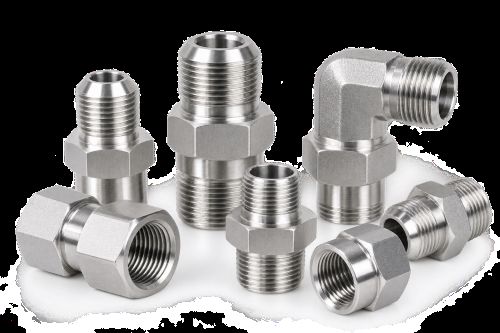
304 stainless steel hydraulic adapters are mechanical connection components manufactured from 304-grade stainless steel. Their primary function is to connect different hydraulic components, such as hoses, tubes, pipes, pumps, valves, and cylinders.
They help establish secure fluid pathways while accommodating different thread sizes, connection standards, and installation configurations.
304 stainless steel is an austenitic stainless steel containing approximately 18% chromium and 8% nickel. This composition provides good corrosion resistance, strength, and formability, making it suitable for many industrial environments.
Some of its main characteristics include:
1. Corrosion resistance: Provides good resistance to moisture, oxidation, and many common industrial environments.
2. Mechanical strength: Offers suitable strength for manufacturing durable hydraulic connection components.
3. Durability: Maintains its structural properties under appropriate operating conditions.
4. Machinability: Can be machined into different thread types, shapes, and adapter configurations.
5. Low maintenance: Its corrosion-resistant properties can help reduce maintenance requirements in suitable environments.
Although 304 stainless steel offers good general corrosion resistance, it is not suitable for every chemical or chloride-rich environment. Applications involving seawater or aggressive chemicals may require 316 stainless steel or another material with greater corrosion resistance.
Common Types of 304 Stainless Steel Hydraulic Adapters and Their Applications
304 stainless steel hydraulic adapters are manufactured in different designs to meet specific connection requirements. The main differences involve thread geometry, sealing methods, connection structures, and installation configurations.
Here are eight common types used in hydraulic and industrial fluid systems.
JIC Hydraulic Adapters
JIC hydraulic adapters are widely used in hydraulic systems that require reliable metal-to-metal sealing. They follow the SAE J514 standard and feature a 37-degree flared sealing surface.
A typical JIC connection consists of a male adapter with a 37-degree cone and a female fitting with a matching flared seat. When tightened correctly, the two surfaces create a metal-to-metal seal that helps prevent fluid leakage.
304 stainless steel JIC adapters are available in different configurations, including:
➡️ JIC male to male adapters
➡️ JIC female swivel adapters
➡️ JIC male to NPT adapters
➡️ JIC to BSP adapters
➡️ JIC elbow adapters
➡️ JIC bulkhead adapters
Applications:
JIC adapters are commonly used in agricultural machinery, construction equipment, industrial hydraulic systems, and mobile equipment. Their standardized connection design makes them useful when connecting hydraulic hoses and components from different manufacturers.
ORFS Hydraulic Adapters
ORFS stands for O-Ring Face Seal. These adapters use an elastomeric O-ring positioned in a groove on the male fitting’s flat face. When connected to a female ORFS fitting, the O-ring is compressed to create a reliable seal.
The ORFS connection design is particularly useful in applications where leakage prevention is important. Unlike connections that rely primarily on metal-to-metal contact, ORFS adapters use an O-ring to provide the primary sealing function.
Common configurations include:
➡️ ORFS male adapters
➡️ ORFS female swivel adapters
➡️ ORFS to JIC adapters
➡️ ORFS to NPT adapters
➡️ ORFS elbow adapters
➡️ ORFS bulkhead adapters
Applications:
304 stainless steel ORFS adapters are used in industrial machinery, hydraulic power units, construction equipment, and manufacturing systems.
They are especially useful in applications involving vibration or demanding operating conditions, provided that the adapter, O-ring material, and assembly specifications are suitable for the application.
NPT Hydraulic Adapters
NPT stands for National Pipe Taper. It is a tapered pipe thread standard commonly used in North American piping and fluid connection systems.
NPT adapters create a seal through the interaction of tapered male and female threads. Thread sealant or suitable sealing tape is generally required to help prevent leakage.
Common NPT adapter configurations include:
1. NPT male adapters
2. NPT female adapters
3. NPT to JIC adapters
4. NPT to BSP adapters
5. NPT elbow adapters
6. NPT reducing adapters
Applications:
304 stainless steel NPT adapters are commonly found in industrial piping systems, hydraulic equipment, fluid transfer lines, and general machinery.
They are useful when connecting hydraulic components to threaded ports or piping systems that use NPT standards. However, NPT threads should not be confused with BSP threads because their thread angles and geometries differ.
BSP Hydraulic Adapters
BSP stands for British Standard Pipe. These threads are widely used in hydraulic and industrial equipment across Europe, Asia, and other international markets.
BSP connections generally fall into two categories:
1. BSPP: British Standard Pipe Parallel, which uses straight threads.
2. BSPT: British Standard Pipe Taper, which uses tapered threads.
BSPP connections commonly rely on an O-ring, bonded seal, or another sealing arrangement, depending on the fitting design. BSPT connections use tapered threads and typically require an appropriate thread-sealing method.
Common BSP adapter types include:
1. BSPP male adapters
2. BSPP female adapters
3. BSPT male adapters
4. BSP to JIC adapters
5. BSP to NPT adapters
6. BSP elbow adapters
Applications:
304 stainless steel BSP adapters are frequently used in European machinery, industrial hydraulic equipment, agricultural systems, and international fluid handling applications.
Their availability in different configurations makes them suitable for connecting components that follow BSP thread standards.
SAE ORB Hydraulic Adapters
SAE ORB stands for SAE O-Ring Boss. These adapters use straight threads and an O-ring to create a pressure-tight connection.
The male adapter typically features an O-ring installed near the base of its threads. During installation, the O-ring is compressed against the port’s sealing surface to prevent fluid leakage.
SAE ORB connections are commonly manufactured according to SAE J1926 specifications.
Popular configurations include:
1. SAE ORB male adapters
2. SAE ORB female adapters
3. SAE ORB to JIC adapters
4. SAE ORB to NPT adapters
5. SAE ORB elbow adapters
6. SAE ORB bulkhead adapters
Applications:
SAE ORB adapters are commonly used in hydraulic manifolds, pumps, control valves, cylinders, and other hydraulic equipment.
Their compact design and O-ring sealing structure make them a practical choice for systems where reliable sealing and limited installation space are important.
Metric Hydraulic Adapters
Metric hydraulic adapters use metric thread dimensions and are widely found in machinery manufactured according to international metric standards.
These adapters are available in different configurations and sealing designs. Depending on the connection standard, sealing may be achieved through an O-ring, a cutting ring, a captive seal, or a metal-to-metal sealing surface.
Common metric adapter configurations include:
➡️ Metric male adapters
➡️ Metric female adapters
➡️ Metric to JIC adapters
➡️ Metric to BSP adapters
➡️ Metric elbow adapters
➡️ Metric bulkhead adapters
Some metric hydraulic connections follow DIN standards, including DIN 2353 tube fittings and other metric connection specifications.
Applications:
304 stainless steel metric adapters are commonly used in European industrial machinery, hydraulic power units, agricultural equipment, manufacturing systems, and construction machinery.
When selecting metric adapters, buyers should verify the thread diameter, pitch, sealing design, and applicable standard to ensure proper compatibility.
Hydraulic Hose Adapters
Hydraulic hose adapters connect flexible hydraulic hoses to pumps, valves, cylinders, pipes, and other system components.
They are available in different shapes and connection styles to accommodate various installation requirements.
Common configurations include:
1. Straight hose adapters
2. 45-degree elbow adapters
3. 90-degree elbow adapters
4. Swivel hose adapters
5. Hose-to-pipe adapters
6. Hose-to-thread adapters
304 stainless steel hose adapters offer good corrosion resistance and can be manufactured with different thread standards to match specific hose assemblies.
Applications:
These adapters are commonly used in mobile hydraulic equipment, industrial machinery, hydraulic power units, and fluid transfer systems.
Elbow and swivel configurations are particularly useful when installation space is limited or when hose routing needs to avoid interference with nearby components.
Hydraulic Bulkhead Adapters
Hydraulic bulkhead adapters are designed to connect fluid lines through panels, tanks, machine walls, or equipment enclosures.
Their structure typically includes a threaded body and a retaining nut. The nut secures the adapter through an opening, creating a stable connection on both sides of the mounting surface. Depending on the design, additional sealing components may be required.
Common bulkhead adapter configurations include:
1. JIC bulkhead adapters
2. ORFS bulkhead adapters
3. BSP bulkhead adapters
4. NPT bulkhead adapters
5. Metric bulkhead adapters
6. Straight and elbow bulkhead adapters
Applications:
304 stainless steel bulkhead adapters are used in hydraulic control panels, industrial machinery, equipment enclosures, fluid distribution systems, and hydraulic tanks.
They provide a practical way to route hydraulic lines through mounting surfaces while maintaining an organized and secure connection.
Key Benefits of Using 304 Stainless Steel Hydraulic Adapters
Choosing the right material is just as important as selecting the correct thread type. 304 stainless steel offers several advantages that make it suitable for a wide range of hydraulic connection applications.
Good Corrosion Resistance
One of the main reasons manufacturers use 304 stainless steel is its resistance to corrosion.
Its chromium content forms a thin protective oxide layer on the surface, helping protect the material from oxidation and many common corrosive conditions.
This makes 304 stainless steel hydraulic adapters suitable for applications involving moisture, humidity, and general industrial exposure.
However, prolonged exposure to saltwater, high chloride concentrations, or certain aggressive chemicals may cause pitting or crevice corrosion. In these environments, 316 stainless steel may be a more appropriate choice.
Mechanical Strength and Durability
Hydraulic adapters must withstand mechanical loads, pressure forces, and installation stresses.
304 stainless steel offers good mechanical properties and can be manufactured into durable connection components.
When properly designed and manufactured, these adapters can provide reliable service in industrial systems operating under demanding conditions.
Actual pressure capacity depends on several factors, including thread size, wall thickness, adapter geometry, machining quality, and connection design. Material selection alone does not determine the maximum working pressure.
Wide Application Compatibility
304 stainless steel hydraulic adapters are available in numerous thread standards and connection configurations.
This makes them suitable for different equipment designs and hydraulic system requirements.
For example, an industrial manufacturer may require JIC adapters for hydraulic hoses, ORFS adapters for leak-resistant connections, and metric adapters for machinery with metric ports.
Having different adapter configurations available in the same material can simplify material selection and purchasing.
Reduced Maintenance Requirements
Corrosion can gradually affect hydraulic connections, especially in environments exposed to moisture and industrial contaminants.
Using 304 stainless steel can help reduce corrosion-related maintenance in suitable operating conditions.
Its durable surface and general corrosion resistance make it a practical material for equipment that requires dependable connections and long service life.
Regular inspection is still important. Thread damage, incorrect installation, worn O-rings, and excessive vibration can affect connection performance regardless of the material used.
How to Choose the Right 304 Stainless Steel Hydraulic Adapter
Selecting the correct hydraulic adapter requires more than matching thread sizes. Engineers and purchasing teams should consider the entire operating environment and connection requirements.
Here are several important factors to check before purchasing.
Identify the Connection Type and Thread Standard
First, determine which connection standard your hydraulic system requires.
Common options include JIC, ORFS, NPT, BSP, SAE ORB, and metric threads.
Never assume that two adapters are interchangeable simply because their threads appear similar. Differences in thread pitch, diameter, angle, and sealing geometry can cause leakage or connection failure.
Check Operating Pressure and Temperature
Every hydraulic adapter must be suitable for the system’s maximum working pressure and operating temperature.
Check the manufacturer’s pressure ratings and temperature limits before selecting a product.
Remember that the pressure rating of an assembled connection may also depend on the hose, seals, mating components, and installation method.
Select the Appropriate Adapter Configuration
The shape and structure of the adapter affect installation and hose routing.
Straight adapters are suitable for direct connections, while 45-degree and 90-degree elbows help accommodate restricted spaces.
Swivel adapters can simplify hose alignment, and bulkhead adapters are useful when hydraulic lines need to pass through panels or equipment walls.
Consider Fluid Compatibility
Although 304 stainless steel is compatible with many industrial fluids, compatibility should always be evaluated based on the actual fluid composition, concentration, temperature, and exposure conditions.
Also, pay attention to the sealing material. NBR, FKM, and other elastomers have different chemical and temperature resistance properties.
The adapter body and its sealing components must work together to provide reliable performance.
Verify Dimensions and Sealing Methods
Before ordering, confirm the following specifications:
1. Thread type and standard
2. Thread diameter and pitch
3. Adapter length and overall dimensions
4. Connection configuration
5. Sealing method
6. O-ring or seal material
7. Required working pressure
These details help prevent installation problems and ensure that the adapter fits the intended hydraulic components.
Choose a Reliable Manufacturer
The quality of hydraulic adapters depends on material selection, machining accuracy, thread quality, surface condition, and inspection procedures.
Work with a manufacturer that can provide clear product specifications, consistent production quality, and customization support when required.
For OEM applications, the ability to manufacture special thread combinations and non-standard dimensions can also be an important advantage.
304 Stainless Steel vs. 316 Stainless Steel Hydraulic Adapters
Both 304 and 316 stainless steel are widely used in industrial connection components. However, they have different corrosion resistance characteristics and application suitability.
The main difference is their chemical composition.
|
Comparison |
304 Stainless Steel |
316 Stainless Steel |
|
Main composition |
Chromium and nickel |
Chromium, nickel, and molybdenum |
|
Corrosion resistance |
Good general corrosion resistance |
Better resistance to chlorides and many aggressive environments |
|
Chloride resistance |
More susceptible to pitting |
Improved pitting and crevice corrosion resistance |
|
Mechanical properties |
Good strength and durability |
Similar general mechanical characteristics |
|
Typical applications |
General industrial and hydraulic systems |
Marine, chemical, and more corrosive environments |
|
Material cost |
Generally lower |
Generally higher |
When Should You Choose 304 Stainless Steel?
304 stainless steel is a practical choice for general industrial applications where good corrosion resistance, mechanical strength, and reasonable material costs are important.
It is suitable for many hydraulic systems operating in indoor environments, manufacturing facilities, and applications with moderate exposure to moisture.
When Should You Choose 316 Stainless Steel?
316 stainless steel is generally preferred when hydraulic adapters are exposed to saltwater, chloride-containing environments, or more aggressive chemicals.
Its molybdenum content provides better resistance to localized corrosion, particularly pitting and crevice corrosion.
The final choice should depend on the actual operating environment, fluid compatibility, and required service life.
Custom 304 Stainless Steel Hydraulic Adapters for OEM Applications
Standard hydraulic adapters meet many common connection requirements, but some equipment manufacturers need special configurations to match their designs.
Custom 304 stainless steel hydraulic adapters provide a solution when standard products do not meet specific thread, dimensional, or installation requirements.
OEM and ODM manufacturing services can support different customization needs, including:
1. Custom thread configurations: Manufacturing adapters with specific thread combinations, such as JIC to metric or ORFS to BSP.
2. Special dimensions: Adjusting adapter length, diameter, hex size, and other dimensions.
3. Custom shapes: Producing straight, elbow, bulkhead, and other adapter configurations.
4. Material selection: Choosing suitable stainless steel grades based on operating conditions.
5. Logo and product identification: Adding customer logos or identification marks when required.
6. Drawing-based manufacturing: Producing components according to customer drawings, samples, and technical specifications.
For OEM buyers, working directly with an experienced manufacturer can simplify product development and improve consistency across repeated orders.
Before starting production, it is important to confirm the technical drawings, material specifications, thread standards, tolerances, and inspection requirements.
Common Applications of 304 Stainless Steel Hydraulic Adapters
Because of their corrosion resistance and mechanical properties, 304 stainless steel hydraulic adapters are used across different industrial sectors.
Some common applications include:
Industrial Hydraulic Machinery
Manufacturing equipment often uses hydraulic systems to control movement, pressure, and mechanical force.
Stainless steel adapters help connect hoses, pipes, pumps, and hydraulic control components in suitable industrial environments.
Agricultural Equipment
Agricultural machinery operates outdoors and is frequently exposed to moisture, dust, and changing weather conditions.
304 stainless steel adapters can be used in selected hydraulic connections where their corrosion resistance and mechanical properties meet the equipment requirements.
Construction and Earthmoving Machinery
Excavators, loaders, and other construction equipment rely on hydraulic systems to operate cylinders, motors, and attachments.
Stainless steel adapters can be used in suitable connection points, particularly where corrosion resistance is an important consideration.
Manufacturing and Automation Systems
Automated production equipment often uses hydraulic components for clamping, lifting, pressing, and positioning.
Different stainless steel adapter configurations help connect hydraulic lines and maintain organized fluid pathways.
Hydraulic Power Units
Hydraulic power units contain pumps, reservoirs, valves, filters, and other components that require secure fluid connections.
304 stainless steel adapters can connect different components where the material and connection specifications are appropriate.
Marine and Outdoor Equipment
Some marine and outdoor equipment uses stainless steel hydraulic connections because of their resistance to moisture and general environmental exposure.
However, 304 stainless steel may not provide sufficient resistance in direct seawater or high-chloride environments. For these conditions, 316 stainless steel is generally worth considering.
Why Choose Sannke for Stainless Steel Hydraulic Adapters?
Selecting the right manufacturer is important when sourcing hydraulic adapters for industrial equipment, OEM projects, and wholesale distribution.
Sannke specializes in hydraulic fittings and connection components, offering manufacturing solutions for customers with different hydraulic system requirements.
With more than 15 years of manufacturing experience, Sannke provides support for standard and customized hydraulic fitting requirements.
Key services include:
1. OEM and ODM manufacturing: Custom hydraulic adapters and fittings produced according to customer drawings, samples, or technical requirements.
2. Material options: Stainless steel, carbon steel, and brass options for different applications.
3. Custom product development: Special thread combinations, adapter configurations, dimensions, and other product modifications.
4. Engineering support: Experienced engineers and advanced manufacturing equipment support product development and production.
5. Logo customization: Customer logo printing and product identification options.
6. Free samples: Sample support for evaluating product specifications and suitability, subject to availability.
7. Surface finishing options: Available treatments include passivation for stainless steel and different plating options for applicable carbon steel products.
Whether you need standard stainless steel hydraulic adapters or custom components for OEM equipment, Sannke can help identify suitable manufacturing solutions.
For bulk orders and customized requirements, providing detailed drawings, thread specifications, material requirements, and expected quantities helps streamline the quotation and production process.
Frequently Asked Questions (FAQs)
1. What are 304 stainless steel hydraulic adapters used for?
304 stainless steel hydraulic adapters connect hoses, pipes, tubes, pumps, valves, and other hydraulic components. They are commonly used in industrial machinery, agricultural equipment, construction equipment, hydraulic power units, and fluid handling systems.
2. What is the difference between 304 and 316 stainless steel hydraulic adapters?
The main difference is corrosion resistance. 304 stainless steel offers good general corrosion resistance, while 316 stainless steel contains molybdenum, which improves resistance to chloride exposure and certain aggressive environments.
3. Are 304 stainless steel hydraulic adapters suitable for high-pressure applications?
Yes, 304 stainless steel hydraulic adapters can be designed for high-pressure applications. However, their working pressure depends on the adapter design, dimensions, thread configuration, manufacturing quality, and connection specifications. Always verify the manufacturer’s pressure rating before installation.
4. What thread types are available for stainless steel hydraulic adapters?
Common thread types include JIC, ORFS, NPT, BSPP, BSPT, SAE ORB, and metric threads. The correct type depends on the hydraulic system’s connection standards and sealing requirements.
5. Are 304 stainless steel hydraulic adapters corrosion-resistant?
Yes. 304 stainless steel provides good resistance to moisture, oxidation, and many common industrial environments. However, it is less resistant to chloride-induced corrosion than 316 stainless steel.
6. Can 304 stainless steel hydraulic adapters be customized?
Yes. Manufacturers can produce custom adapters with different thread combinations, dimensions, shapes, and connection configurations. OEM and ODM services can also support customer-specific drawings and product requirements.
7. How do I choose the correct stainless steel hydraulic adapter?
Start by identifying the required thread standard, connection type, and adapter configuration. Then check operating pressure, temperature, fluid compatibility, sealing requirements, and installation dimensions. Finally, confirm that the manufacturer can provide the required specifications and quality documentation.
Conclusion
304 stainless steel hydraulic adapters are available in various configurations to meet different connection requirements across industrial and hydraulic systems. Common types include JIC, ORFS, NPT, BSP, SAE ORB, metric, hose, and bulkhead adapters.
Each type has its own thread design, sealing method, and application advantages. Choosing the right one requires careful consideration of connection standards, operating pressure, temperature, fluid compatibility, and installation requirements.
For equipment manufacturers, distributors, and industrial buyers, working with a reliable hydraulic adapter manufacturer is equally important. With suitable material selection, accurate machining, and proper quality control, 304 stainless steel hydraulic adapters can provide dependable connections for many industrial applications.
Sannke offers standard and customized hydraulic adapter manufacturing solutions, including OEM and ODM services, to support different customer requirements.
Post time: Nov-17-2026