

Choosing the right hydraulic adapter is essential for maintaining a reliable, leak-free hydraulic system. Although adapters may look similar from the outside, the material used to manufacture them can significantly affect corrosion resistance, durability, maintenance requirements, and overall cost.
Stainless steel and carbon steel are two widely used materials for hydraulic adapters. Both can provide dependable performance when properly designed and manufactured, but they serve different needs. Stainless steel is often preferred in corrosive or demanding environments, while carbon steel remains a popular choice for general industrial applications because of its strength and cost-effectiveness.
For buyers sourcing a stainless steel adapter SAE China, understanding these differences can help simplify product selection and supplier evaluation. This guide compares stainless steel and carbon steel hydraulic adapters, explores their common applications, and explains what to consider when purchasing from a Chinese manufacturer.
What Are Stainless Steel SAE Hydraulic Adapters?
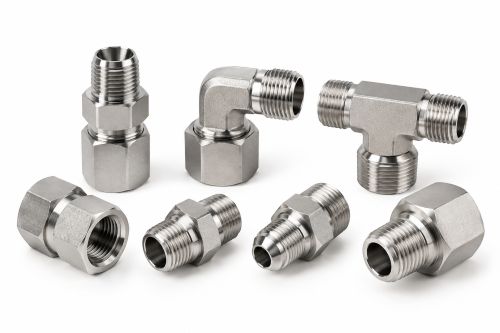
Stainless steel SAE hydraulic adapters are precision-machined components used to connect hydraulic hoses, tubes, pipes, valves, pumps, and other system components. They help create secure connections that withstand hydraulic pressure while maintaining the required fluid flow.
The term SAE refers to standards developed by SAE International. Depending on the product, an SAE-related adapter may follow a standard covering dimensions, connection configurations, or performance requirements. Buyers should always confirm the specific standard applicable to the adapter rather than assuming every SAE connection uses the same thread or sealing method.
A stainless steel adapter SAE fitting combines a compatible SAE connection design with stainless steel construction. Common configurations include straight adapters, elbows, tees, bulkhead adapters, and adapters with different thread or connection types at each end.
Key Benefits of Stainless Steel Adapters
Stainless steel adapters offer several advantages:
1. Corrosion resistance: Chromium in stainless steel forms a protective passive layer that helps resist corrosion.
2. Durability: Properly selected stainless steel grades can maintain their performance in demanding operating environments.
3. Reduced coating dependence: Many stainless steel grades do not require the same external corrosion-protection coatings used on carbon steel.
4. Versatile applications: Stainless steel adapters are available for industrial machinery, marine equipment, chemical processing, and other applications where material compatibility matters.
However, stainless steel is not completely corrosion-proof. Its performance depends on the grade, surface condition, temperature, fluid chemistry, and exposure to chlorides or other aggressive substances.
What Are Carbon Steel Hydraulic Adapters?
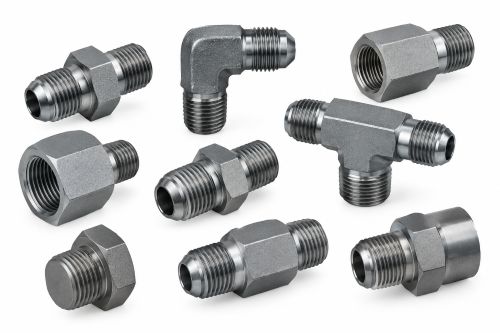
Carbon steel hydraulic adapters are connection components manufactured primarily from iron and carbon, with other alloying elements depending on the steel grade. They are widely used in hydraulic systems because they combine mechanical strength, machinability, and relatively low material costs.
Manufacturers can produce carbon steel adapters in a wide range of shapes, sizes, and connection configurations. Common examples include JIC adapters, metric adapters, ORFS adapters, threaded adapters, and flange connections.
Many carbon steel adapters receive a protective surface treatment, such as zinc plating or zinc-nickel plating, to improve corrosion resistance. The effectiveness of these coatings depends on their specification, thickness, quality, and the environment in which the adapter operates.
Key Benefits of Carbon Steel Adapters
Carbon steel remains a practical choice for many hydraulic applications for several reasons:
1. Cost-effectiveness: Carbon steel adapters generally have a lower initial purchase price than comparable stainless steel products.
2. Mechanical performance: Properly selected carbon steel grades can provide the strength needed for demanding hydraulic applications.
3. Manufacturing flexibility: Carbon steel is suitable for precision machining and high-volume production.
4. Broad availability: Many standard hydraulic adapter designs are readily available in carbon steel.
The main limitation is corrosion susceptibility. If the protective coating becomes damaged or the adapter is exposed to harsh conditions, corrosion can develop and eventually affect the component’s service life.
Stainless Steel vs. Carbon Steel Hydraulic Adapters: Key Differences
Although both materials can be used to manufacture reliable hydraulic adapters, they differ in several important areas. The right choice depends on the application, operating environment, technical specifications, and budget.
1. Corrosion Resistance
Corrosion resistance is one of the most significant differences between stainless steel and carbon steel.
Stainless steel contains enough chromium to form a passive surface layer that helps protect the material from corrosion. Grades such as 304 and 316 are commonly used where improved corrosion resistance is required. Grade 316 generally offers better resistance to chloride-related corrosion than grade 304, although neither is suitable for every corrosive environment.
Carbon steel, on the other hand, can rust when exposed to moisture and oxygen. Protective coatings help reduce this risk, but their performance depends on the coating system and operating conditions.
For example, a hydraulic system operating near the sea may benefit from a suitable stainless steel adapter because salt exposure can accelerate corrosion on carbon steel components. A machine operating indoors in a relatively dry environment may work well with properly coated carbon steel adapters.
Which is better? Stainless steel is generally the stronger option when corrosion resistance is a priority, provided the selected grade is compatible with the environment.
2. Strength and Pressure Performance
Both stainless steel and carbon steel can be used in high-pressure hydraulic systems. However, the material alone does not determine whether an adapter can safely handle a particular pressure.
Pressure performance depends on several factors, including:
➡️ Material grade and mechanical properties
➡️ Adapter geometry and wall thickness
➡️ Thread design and engagement
➡️ Sealing configuration
➡️ Manufacturing quality and dimensional accuracy
➡️ Operating temperature and pressure fluctuations
Carbon steel adapters are widely used in heavy-duty hydraulic equipment because suitable grades can provide excellent mechanical performance at a competitive cost.
Stainless steel adapters can also support demanding pressure requirements when designed and rated accordingly. However, stainless steel grades differ in strength, and their performance should not be assumed to exceed that of every carbon steel grade.
Before purchasing either type, check the manufacturer’s documented working pressure and ensure that the complete connection is suitable for the system.
Which is better? Neither material is universally superior. Select an adapter based on its verified pressure rating and the requirements of the complete hydraulic connection.
3. Durability and Service Life
The service life of a hydraulic adapter depends on more than its material. Corrosion, vibration, installation quality, pressure cycling, fluid compatibility, and maintenance all play a role.
Stainless steel adapters can offer a longer service life in corrosive environments because they are less dependent on an external coating for protection. This can reduce the frequency of corrosion-related replacements.
Carbon steel adapters can also provide long service life in suitable environments. When their protective coatings remain effective and operating conditions are controlled, they can perform reliably for many years.
However, damaged coatings, persistent moisture, and exposure to corrosive chemicals may shorten the service life of carbon steel components.
Which is better? Stainless steel often has an advantage in corrosive environments, while carbon steel can be a durable and economical choice in less aggressive conditions.
4. Initial Cost and Long-Term Value
Price is another important consideration, especially for OEMs, distributors, and industrial buyers placing large orders.
Stainless steel generally costs more because of its alloy composition and material-processing requirements. Depending on the grade and design, machining and finishing can also affect the final price.
Carbon steel is usually less expensive, making it attractive for large-volume purchases and standard hydraulic applications.
However, the lowest initial price does not always represent the lowest total cost. In a corrosive environment, frequent replacement of carbon steel adapters can increase maintenance expenses, labor costs, and equipment downtime.
For example, a stainless steel adapter may justify its higher initial cost when used on equipment exposed to salt spray or corrosive cleaning chemicals. In a protected indoor installation, a coated carbon steel adapter may offer better overall value.
Which is better? Compare the purchase price with expected service life, maintenance needs, replacement costs, and the consequences of equipment downtime.
5. Weight and Machinability
Stainless steel and carbon steel have broadly similar densities, so the weight difference between otherwise comparable adapters is usually modest. Design dimensions and the specific material grade can influence the final weight.
Machinability varies depending on the steel grade and manufacturing process. Many carbon steel grades are relatively straightforward to machine, which can support efficient production and competitive pricing.
Stainless steel machining may require more specialized tooling, suitable cutting conditions, and careful process control, particularly for grades that work-harden during machining. These requirements can influence manufacturing time and cost.
For buyers ordering custom adapters, it is worth discussing tolerances, geometry, material grade, and production quantities with the manufacturer.
Which is better? Carbon steel may offer manufacturing-cost advantages for many standard designs, while stainless steel provides material properties that may be more valuable in specialized operating environments.
6. Surface Treatment and Appearance
Surface treatment helps protect hydraulic adapters and can influence their suitability for specific environments.
Common carbon steel finishes include zinc plating, zinc-nickel plating, and other specified protective coatings. The choice depends on corrosion requirements, environmental exposure, and applicable specifications.
Stainless steel adapters typically rely on their inherent corrosion resistance rather than a conventional zinc coating. Depending on the application, surface finishing or passivation may be used to support corrosion performance.
It is important to distinguish between appearance and actual performance. A shiny surface does not automatically indicate superior corrosion resistance. Buyers should confirm the material grade, surface treatment, and relevant test results.
Stainless Steel vs. Carbon Steel Hydraulic Adapters: Comparison Table
|
Feature |
Stainless Steel Adapters |
Carbon Steel Adapters |
|
Corrosion resistance |
Generally high, depending on grade and environment |
Requires suitable protection in many environments |
|
Mechanical strength |
Depends on grade and design |
Depends on grade and design |
|
High-pressure suitability |
Suitable when properly designed and rated |
Suitable when properly designed and rated |
|
Initial cost |
Generally higher |
Generally lower |
|
Maintenance |
Often lower in corrosive environments |
May require coating inspection and corrosion control |
|
Surface protection |
Passivation or other suitable finishing when needed |
Often zinc, zinc-nickel, or another protective coating |
|
Machining |
Can require specialized machining controls |
Often economical to machine |
|
Common applications |
Marine, chemical, outdoor, and corrosion-sensitive systems |
Construction, agriculture, industrial machinery, and general hydraulics |
|
Best selection factor |
Corrosion resistance and material compatibility |
Cost-effectiveness and suitable mechanical performance |
This comparison provides general guidance. Actual performance depends on the specific material grade, product design, manufacturing quality, and service conditions.
Common Applications of Stainless Steel SAE Adapters
Stainless steel adapters are particularly useful when corrosion resistance, material compatibility, or reduced dependence on protective coatings is important.
Marine and Offshore Equipment
Marine equipment is frequently exposed to humidity, salt spray, and other corrosive conditions. A suitably selected stainless steel adapter can help reduce corrosion-related maintenance in hydraulic systems used on vessels and offshore equipment.
Grade selection remains important because seawater and chloride exposure can be aggressive, even for stainless steel.
Chemical Processing Systems
Chemical processing equipment may encounter cleaning agents, process fluids, or other substances that attack certain metals. Stainless steel can be a suitable option when the selected grade is compatible with the specific chemical and operating temperature.
Compatibility should be verified before installation, as no single stainless steel grade resists every chemical.
Food and Beverage Processing
Stainless steel adapters may be appropriate for hydraulic or auxiliary equipment used in food and beverage facilities, especially where washdown and corrosion resistance are concerns.
However, choosing stainless steel alone does not make a component suitable for direct food contact or hygienic service. The design, surface finish, cleaning requirements, and applicable industry standards must also be considered.
Outdoor and Mobile Equipment
Outdoor machinery can experience rain, temperature changes, humidity, and road or environmental contaminants. Stainless steel adapters may offer advantages in locations where corrosion is difficult to control or component replacement is inconvenient.
For other locations on the same machine, properly coated carbon steel may still be a practical and economical choice.
Common Applications of Carbon Steel Hydraulic Adapters
Carbon steel adapters remain widely used across industrial sectors where their mechanical performance and price provide a good balance.
Construction Machinery
Excavators, loaders, cranes, and other construction machines use hydraulic adapters to connect hoses, cylinders, pumps, and valves.
Carbon steel is often a suitable choice for these applications when the adapter meets the required pressure rating and has an appropriate protective finish.
Agricultural Equipment
Tractors, harvesters, irrigation equipment, and other agricultural machines commonly use carbon steel hydraulic adapters. Their affordability makes them attractive for equipment produced in large quantities.
Where machinery operates in wet or fertilizer-rich environments, buyers should pay particular attention to coating performance and corrosion exposure.
Industrial Hydraulic Power Units
Hydraulic power units in factories and workshops often operate in controlled environments. In these settings, coated carbon steel adapters can offer reliable service without the higher initial cost of stainless steel.
General Manufacturing Equipment
Manufacturing systems frequently require large numbers of standard hydraulic connections. Carbon steel adapters can help control procurement costs while meeting technical requirements when properly specified and maintained.
How to Choose the Right Hydraulic Adapter Material
Selecting the correct material requires a clear understanding of how the adapter will be used. Before placing an order, consider the following factors.
1. Evaluate the Operating Environment
Determine whether the adapter will encounter moisture, saltwater, chemicals, outdoor exposure, or frequent washdowns.
Stainless steel may be preferable when corrosion resistance is important. Carbon steel with a suitable protective coating may be sufficient in less aggressive environments.
2. Confirm Working Pressure and Temperature
Check the system’s maximum working pressure, operating temperature, and potential pressure spikes. Confirm that the adapter and its mating connection are rated for the intended conditions.
Do not select an adapter based on material alone. The manufacturer’s specifications should establish whether the complete connection is suitable.
3. Check Threads and Sealing Requirements
Verify the exact connection standard, thread size, thread pitch, sealing method, and mating component.
Depending on the application, the adapter may use JIC flare connections, ORFS connections, SAE straight threads with O-ring seals, or another compatible configuration.
These designs are not interchangeable simply because their threads appear similar. An incorrect connection can lead to leakage, damage, or unsafe operation.
4. Consider Fluid Compatibility
Hydraulic oil, additives, cleaning chemicals, and other process fluids can affect material performance. Confirm compatibility with the adapter material and sealing elements.
Pay particular attention to the O-ring or other seal, since a chemically incompatible seal may fail even when the metal body remains in good condition.
5. Compare Total Cost of Ownership
Consider purchase price, installation labor, inspection frequency, expected service life, and replacement costs.
A lower-cost carbon steel adapter may be ideal for a protected industrial installation. A stainless steel adapter may offer better value where corrosion can cause repeated maintenance or unplanned downtime.
6. Verify Product Quality
Look for a manufacturer that can provide clear specifications, dimensional inspection, material information, and appropriate pressure or performance test documentation.
For critical applications, request the documentation needed to verify that the product meets your engineering and procurement requirements.
Buying a Stainless Steel Adapter SAE China: What Should You Consider?
China is an important sourcing destination for hydraulic fittings and adapters, including custom components for OEMs, distributors, and equipment manufacturers. However, product quality and manufacturing capabilities vary, so buyers should evaluate suppliers carefully.
When sourcing a stainless steel adapter SAE China, the following considerations can help you make a more informed decision.
1. Confirm the Stainless Steel Grade
Ask the supplier to identify the exact material grade used in the adapter. Grades such as 304 and 316 have different corrosion-resistance characteristics and may not be suitable for the same environments.
For demanding applications, request material certificates or other traceability documents where appropriate.
2. Verify SAE and Connection Specifications
Provide the manufacturer with the applicable SAE standard, connection type, thread dimensions, sealing requirements, and drawings when available.
If the adapter has different connection types at each end, specify both ends separately. This reduces the risk of ordering a component that fits one port but not the other.
3. Review Manufacturing and Quality Control
Ask about machining capabilities, dimensional inspection, thread gauges, surface finishing, and production quality checks.
For pressure-critical products, confirm which tests are performed and whether the available documentation applies to the specific adapter model.
4. Check Customization Options
Some projects require nonstandard dimensions, special thread combinations, particular materials, or custom branding.
A capable hydraulic adapter manufacturer should be able to review technical drawings, confirm feasibility, and explain any minimum order quantities or tooling requirements.
5. Compare Lead Times and Order Requirements
Before placing a bulk order, confirm the minimum order quantity, sample availability, production lead time, packaging, and shipping arrangements.
For ongoing procurement, it is also helpful to discuss repeat-order consistency and how product specifications will be maintained across production batches.
6. Choose a Supplier with Hydraulic Fitting Experience
An experienced manufacturer can help clarify connection standards, material selection, sealing configurations, and production requirements.
Sannke, for example, focuses on hydraulic fittings and adapter solutions, including OEM/ODM customization. When evaluating Sannke or any other supplier, buyers should match the available products, documentation, and manufacturing capabilities to their specific application requirements.
Frequently Asked Questions
Are stainless steel hydraulic adapters better than carbon steel adapters?
Not in every situation. Stainless steel generally offers better corrosion resistance, making it useful in marine, chemical, and outdoor environments. Carbon steel is usually more economical and can provide dependable performance in general industrial applications when the grade, coating, and design are appropriate.
Are stainless steel SAE adapters suitable for high-pressure hydraulic systems?
Yes, provided the specific adapter is designed and rated for the intended pressure and temperature. Buyers should verify the material grade, connection design, dimensions, sealing method, and manufacturer’s pressure specifications.
Is 316 stainless steel better than 304 stainless steel for hydraulic adapters?
Grade 316 generally provides better resistance to chloride-related corrosion than grade 304 because of its alloy composition. However, the best choice depends on the actual environment, fluid chemistry, temperature, and exposure conditions.
Do carbon steel hydraulic adapters require surface treatment?
Many carbon steel adapters use protective coatings, such as zinc or zinc-nickel plating, to reduce corrosion. The appropriate treatment depends on the operating environment and required corrosion performance. Coatings should be inspected and maintained according to the application.
How can I find a reliable stainless steel adapter SAE China supplier?
Check the supplier’s hydraulic fitting experience, material specifications, manufacturing capabilities, quality-control processes, and relevant test documentation. Request samples or technical drawings when appropriate, and confirm lead times, order quantities, and customization options before committing to a bulk purchase.
Can stainless steel and carbon steel adapters be used in the same hydraulic system?
Yes, they can be used together when the connections are compatible and the design accounts for operating conditions and potential galvanic corrosion. The risk depends on the metals involved, the presence of an electrolyte such as moisture, and the installation environment. Engineering review may be necessary for corrosive or critical applications.
Conclusion
Stainless steel and carbon steel hydraulic adapters each offer practical advantages. Stainless steel is generally a better choice when corrosion resistance and material compatibility are major concerns, while carbon steel provides a cost-effective solution for many standard industrial and mobile hydraulic systems.
When selecting a stainless steel adapter SAE, look beyond the material name. Confirm the connection standard, working pressure, sealing design, material grade, and operating environment. Buyers sourcing from China should also evaluate manufacturing quality, technical documentation, customization capabilities, and delivery requirements.
By balancing performance, durability, and total cost of ownership, you can select hydraulic adapters that meet your system’s needs and support reliable long-term operation.
Post time: Oct-23-2026