

Hydraulic connections play an important role in maintaining the performance, safety, and reliability of hydraulic systems. Among the many connection types available, SAE JIC female hydraulic fittings are widely used because of their durable construction, reliable sealing design, and versatility across different industrial applications.
These fittings feature a 37-degree flare connection that creates a metal-to-metal seal when properly assembled with a compatible male JIC fitting. They are commonly found in hydraulic hose assemblies, construction equipment, agricultural machinery, industrial systems, and mobile hydraulic applications.
Whether you are a hydraulic equipment manufacturer, distributor, or maintenance professional, understanding how JIC female fittings work can help you select the right components and avoid common connection problems.
In this guide, we will explore their design, types, specifications, materials, applications, and selection considerations.
What Are SAE JIC Female Hydraulic Fittings?
SAE JIC female hydraulic fittings are mechanical connectors designed to join hydraulic hoses, tubes, and other components through a 37-degree flare connection.
JIC stands for Joint Industry Council. These fittings are commonly associated with SAE J514, which covers 37-degree flare hydraulic tube fittings.
A typical JIC female fitting consists of a female threaded connection and an internal 37-degree flare seating surface. It connects to a compatible male JIC fitting, which has a matching 37-degree flared nose.
When the two fittings are tightened together, their mating surfaces create a metal-to-metal seal. This design provides a dependable connection without requiring an additional O-ring at the standard JIC flare interface.
JIC female fittings are available in different configurations, sizes, and materials to accommodate various hydraulic system requirements.
Key Components and Design Features of JIC Female Fittings
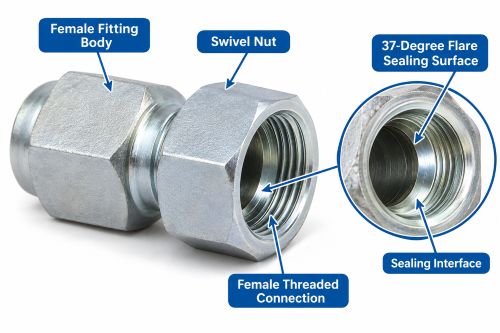
Although JIC female fittings come in different shapes and configurations, most share several basic design elements. Each component contributes to connection strength, sealing performance, and ease of installation.
Female Fitting Body
The fitting body is the main structural component. It houses the internal connection and provides the mechanical strength needed to withstand hydraulic pressure and external operating conditions.
Depending on the application, the body may be manufactured from carbon steel, stainless steel, or brass.
37-Degree Flare Sealing Surface
The 37-degree flare seating surface is one of the most important features of a JIC female fitting.
It mates with the corresponding 37-degree flare surface on a male JIC fitting. When tightened, the two metal surfaces create a seal that helps prevent hydraulic fluid from escaping.
The sealing surfaces must be properly aligned and free from scratches, dents, or contamination to maintain reliable performance.
Female Threaded Connection
The female threads provide mechanical engagement with the male fitting. JIC connections typically use UN/UNF straight threads.
Unlike tapered pipe threads, these straight threads are not responsible for creating the primary hydraulic seal. Instead, they provide the clamping force that brings the two flare surfaces together.
Swivel Nut
Many JIC female fittings feature a swivel nut that rotates independently of the fitting body.
This design makes installation easier because the hose or fitting assembly does not need to rotate during tightening. It is particularly useful in applications where hose positioning and installation space are limited.
Sealing Interface
The sealing interface consists of the mating 37-degree flare surfaces. Proper contact between these surfaces creates the metal-to-metal seal.
This design makes JIC fittings suitable for many high-pressure hydraulic applications when the fitting size, material, and pressure rating are correctly selected.
Common Types of SAE JIC Female Hydraulic Fittings
SAE JIC female fittings are available in several configurations to accommodate different connection directions, installation spaces, and hydraulic system layouts.
JIC Female Straight Fittings
Straight JIC female fittings provide a direct connection between hydraulic hoses, tubes, and compatible male fittings.
Their simple design makes them suitable for general-purpose hydraulic installations where there is sufficient room for straight-line connections.
JIC Female Swivel Fittings
JIC female swivel fittings feature a rotating nut that allows the connection to be tightened without twisting the attached hose.
They are especially useful in hydraulic hose assemblies where flexibility, convenient installation, and easier maintenance are important.
JIC Female Elbow Fittings
Elbow fittings change the direction of a hydraulic connection, helping installers route hoses around equipment structures and confined spaces.
Common configurations include:
➡️ 45-degree JIC female elbows: Used when a moderate change in connection direction is needed.
➡️ 90-degree JIC female elbows: Suitable for tighter installation spaces and applications requiring a sharper directional change.
These fittings help create more organized hose routing while reducing unnecessary bending.
JIC Female Tee Fittings
JIC female tee fittings provide three connection points for distributing hydraulic fluid between different lines.
They are commonly used in hydraulic manifolds, fluid distribution systems, and equipment where multiple hydraulic circuits need to be connected.
JIC Female Bulkhead Fittings
Bulkhead fittings are designed to pass through panels, tanks, or equipment walls while maintaining a secure hydraulic connection.
They typically include a threaded mounting section and locking nut to secure the fitting in position.
This configuration is useful when hydraulic lines need to connect across separate compartments or equipment panels.
JIC Female Adapter Fittings
JIC female adapters connect JIC interfaces with other compatible hydraulic connection types.
Depending on their design, they may combine JIC connections with BSP, NPT, metric, or other hydraulic thread standards.
When selecting these adapters, always verify the thread specifications and sealing methods on both ends.
SAE JIC Female Fittings: Standards, Thread Sizes, and Specifications
Understanding the applicable standards and thread dimensions is essential when selecting JIC female hydraulic fittings. Incorrect thread identification can result in poor engagement, damaged connections, or hydraulic leakage.
SAE J514 Standard
SAE J514 is an important industry standard associated with 37-degree flare hydraulic tube fittings.
It establishes requirements for fitting design, dimensions, and related performance characteristics. JIC fittings are widely manufactured and used according to this standard.
However, buyers should distinguish between the SAE J514 standard and the actual product specifications supplied by a manufacturer. The precise dimensions and pressure ratings depend on the fitting configuration and size.
JIC Female Thread Types
JIC female fittings generally use UN/UNF straight threads.
These threads provide the mechanical force needed to connect the male and female fitting components. The sealing function is performed by the mating 37-degree flare surfaces rather than the threads themselves.
This is an important distinction when comparing JIC fittings with NPT or other threaded hydraulic connections.
Common JIC Female Fitting Sizes
JIC fittings are commonly identified using dash sizes. Each dash number corresponds to a nominal tube size, while the thread diameter and pitch vary according to the fitting size.
The following table shows common JIC size and thread references:
|
JIC Dash Size |
Thread Size |
Threads Per Inch (TPI) |
|
-2 |
5/16″-24 |
24 |
|
-3 |
3/8″-24 |
24 |
|
-4 |
7/16″-20 |
20 |
|
-5 |
1/2″-20 |
20 |
|
-6 |
9/16″-18 |
18 |
|
-8 |
3/4″-16 |
16 |
|
-10 |
7/8″-14 |
14 |
|
-12 |
1-1/16″-12 |
12 |
|
-16 |
1-5/16″-12 |
12 |
|
-20 |
1-5/8″-12 |
12 |
|
-24 |
1-7/8″-12 |
12 |
|
-32 |
2-1/2″-12 |
12 |
These are common JIC thread references. Always confirm the tube size, thread dimensions, flare geometry, and applicable manufacturer specifications before ordering.
Materials and Surface Treatments
The material used in JIC female hydraulic fittings affects their mechanical strength, corrosion resistance, service life, and suitability for different working environments.
Carbon Steel JIC Female Fittings
Carbon steel is one of the most common materials used for hydraulic fittings.
It offers good mechanical strength, durability, and cost efficiency, making it suitable for construction machinery, agricultural equipment, industrial hydraulic systems, and general-purpose applications.
To improve corrosion resistance, carbon steel fittings are often treated with protective coatings such as zinc plating or zinc-nickel plating.
Stainless Steel JIC Female Fittings
Stainless steel JIC female fittings are designed for environments where corrosion resistance is a major consideration.
They are commonly used in marine equipment, chemical processing systems, food-related machinery, and outdoor industrial installations.
Although stainless steel generally provides better corrosion resistance than standard carbon steel, the specific grade should be selected according to the working environment and fluid compatibility.
Brass JIC Female Fittings
Brass fittings offer good corrosion resistance and machinability. They may be used in certain hydraulic, pneumatic, and fluid-handling applications where their mechanical properties and pressure capabilities are appropriate.
However, brass is not suitable for every high-pressure hydraulic application. Always verify the manufacturer’s pressure ratings before use.
Common Surface Treatments
Surface treatments help improve the durability and corrosion resistance of hydraulic fittings.
Common options include:
1. Zinc plating: Provides a protective coating against corrosion.
2. Zinc-nickel plating: Offers improved corrosion resistance compared with conventional zinc coatings.
3. Trivalent chromium passivation: Used as part of certain zinc plating systems to improve corrosion protection.
4. Electroless nickel plating: Creates a uniform nickel coating that can improve wear and corrosion resistance.
5. Stainless steel passivation: Helps improve the natural corrosion resistance of stainless steel surfaces.
The appropriate finish depends on the operating environment, customer specifications, and required corrosion protection.
How Do SAE JIC Female Hydraulic Fittings Work?
SAE JIC female fittings work through a mechanical connection that brings two matching 37-degree flare surfaces together.
The connection process is relatively straightforward, but proper alignment and tightening are essential.
First, the male JIC fitting is positioned against the female fitting. The male fitting has an external 37-degree flare surface, while the female fitting contains a matching internal seating surface.
Next, the male and female threads are engaged. As the connection is tightened, the threaded components draw the two flare surfaces together.
The resulting metal-to-metal contact creates the hydraulic seal. The threads maintain the mechanical clamping force that holds the connection in place.
Unlike tapered pipe connections, standard JIC fittings do not rely on thread deformation or thread sealant to create their primary seal.
For reliable performance, the following conditions are important:
1. The male and female fittings must have compatible thread specifications.
2. Both flare surfaces should be clean and undamaged.
3. The connection must be properly aligned before tightening.
4. The recommended installation torque should be followed.
5. The assembled connection should be inspected for leakage under suitable operating conditions.
Excessive tightening can damage the flare surfaces or threads, while insufficient tightening may result in leakage.
Common Applications of SAE JIC Female Hydraulic Fittings
Because of their versatile connection design, SAE JIC female fittings are used in a wide range of hydraulic systems.
Some common applications include:
Agricultural Machinery: Tractors, harvesters, sprayers, and other agricultural equipment use JIC fittings to connect hydraulic hoses and fluid lines.
Construction Equipment: Excavators, loaders, bulldozers, and other heavy machinery rely on hydraulic connections to operate cylinders, pumps, and motors.
Industrial Hydraulic Systems: Manufacturing equipment, hydraulic presses, and production machinery use JIC fittings to maintain reliable fluid connections.
Hydraulic Power Units: JIC female adapters connect hoses, tubes, valves, and other components within hydraulic power systems.
Material Handling Equipment: Forklifts, lifting platforms, and industrial handling machinery use hydraulic fittings in their lifting and control circuits.
Mobile Hydraulic Equipment: Transport vehicles, specialized machinery, and mobile hydraulic systems benefit from the availability of different JIC fitting sizes and configurations.
Their broad application range makes JIC female fittings a practical choice for many equipment manufacturers and hydraulic system designers.
SAE JIC Female Fittings vs. Other Hydraulic Fittings
JIC female fittings are sometimes confused with other hydraulic connection types because their threads or external shapes may appear similar.
However, their sealing designs and connection specifications are different.
JIC Female vs. SAE ORB Female Fittings
The main difference is the sealing mechanism.
JIC fittings use a 37-degree metal-to-metal flare connection, while SAE ORB fittings use an O-ring to seal against a port.
ORB connections are commonly used in hydraulic manifolds and components designed for O-ring boss ports. JIC fittings are frequently used in hydraulic hose and tube assemblies.
JIC Female vs. NPT Female Fittings
JIC and NPT fittings use different thread designs.
JIC fittings have straight UN/UNF threads and rely on a 37-degree flare surface for sealing.
NPT fittings use tapered threads, which create a seal through thread interference and typically require an appropriate thread sealant.
These connection types are not directly interchangeable.
JIC Female vs. BSP Female Fittings
JIC and BSP fittings differ in thread geometry and sealing arrangements.
JIC fittings use UN/UNF straight threads with a 37-degree flare seal. BSP connections may use parallel or tapered threads, depending on the specific type, and can employ different sealing methods.
Always identify the exact BSP connection type before selecting an adapter.
JIC Female vs. ORFS Female Fittings
JIC and ORFS fittings are both common hydraulic connection types, but their sealing designs are different.
JIC fittings use a 37-degree flare interface, whereas ORFS fittings use a flat-face connection with an O-ring.
ORFS connections are often selected when reducing leakage is a priority, while JIC fittings remain widely used because of their established design and broad availability.
How to Choose the Right SAE JIC Female Hydraulic Fittings
Choosing the correct JIC female fitting requires more than matching the thread size. Several factors should be considered to ensure compatibility and dependable performance.
1. Check the Connection Size
Identify the correct JIC dash size, thread diameter, and thread pitch.
Do not rely on visual appearance alone. Use suitable measuring tools or manufacturer dimension charts to confirm the specifications.
2. Select the Appropriate Fitting Configuration
Consider the connection layout and available installation space.
Straight fittings work well for direct connections, while elbow fittings help route hoses around obstacles. Swivel fittings are useful when hose rotation during installation needs to be avoided.
3. Choose the Right Material
Select the material based on the operating environment.
Carbon steel is suitable for many general hydraulic applications, stainless steel is useful in corrosive environments, and brass may be appropriate for specific lower-pressure applications.
4. Verify the Working Pressure
The fitting must be capable of handling the hydraulic system’s operating pressure.
Consider maximum working pressure, pressure fluctuations, and potential pressure spikes. Always check the manufacturer’s rated working pressure rather than assuming all JIC fittings have the same pressure capacity.
5. Consider Hydraulic Fluid Compatibility
The fitting material and any additional sealing components must be compatible with the hydraulic fluid being used.
Consider temperature, chemical exposure, and environmental conditions when making your selection.
6. Evaluate Installation Requirements
Check the available space, hose routing, accessibility, and connection orientation.
Swivel fittings and angled adapters can make installation easier in compact equipment assemblies.
7. Choose a Reliable Manufacturer
Work with a manufacturer that can provide consistent dimensions, reliable materials, appropriate testing, and clear technical specifications.
For OEM buyers and hydraulic equipment manufacturers, custom manufacturing capabilities and stable production capacity are also important considerations.
Common Installation Mistakes to Avoid
Even well-manufactured JIC female fittings can experience leakage or premature damage when installed incorrectly.
Here are several common mistakes to watch out for.
Mixing incompatible thread standards: JIC, NPT, BSP, and metric threads have different specifications. Never assume that fittings with similar dimensions are interchangeable.
Damaging the flare surface: Scratches, dents, and contamination can interfere with the metal-to-metal sealing interface. Inspect both mating surfaces before assembly.
Overtightening the connection: Excessive torque may deform the flare surfaces, damage the threads, or shorten the service life of the fitting.
Cross-threading during installation: Misalignment can damage the threads and prevent proper engagement. Start the connection carefully by hand before applying the recommended tightening torque.
Reusing damaged fittings: A fitting with worn threads, distorted flare surfaces, or visible corrosion should be replaced rather than reused.
Ignoring pressure requirements: Using fittings with insufficient pressure ratings can create serious reliability and safety problems.
Proper installation, inspection, and maintenance help extend the service life of hydraulic connections.
Why Choose a Reliable SAE JIC Female Fittings Manufacturer?
For hydraulic equipment manufacturers, distributors, and wholesale buyers, choosing the right supplier is just as important as selecting the correct fitting type.
A reliable manufacturer should provide consistent product quality, accurate dimensions, and dependable production capabilities.
Here are several factors worth considering:
1. Manufacturing experience: Experienced manufacturers understand hydraulic connection requirements and industry standards.
2. Material selection: A good supplier should offer suitable carbon steel, stainless steel, and other material options.
3. Precision machining: Accurate machining helps maintain consistent thread dimensions and flare sealing surfaces.
4. Surface treatment options: Different plating and finishing processes help meet specific corrosion resistance requirements.
5. OEM and ODM services: Custom designs, specifications, and branding options are valuable for equipment manufacturers.
6. Quality control: Dimensional inspection, material verification, and appropriate pressure testing help ensure product reliability.
7. Production capacity: Stable manufacturing and delivery schedules are important for long-term supply relationships.
Sannke is a hydraulic fittings manufacturer with 15 years of manufacturing experience. The company supplies a range of hydraulic adapters, hose fittings, plugs, caps, and related components for industrial and mobile hydraulic applications.
With OEM and ODM capabilities, Sannke supports customized fitting requirements, including material selection, product specifications, and logo options. Available materials include carbon steel, stainless steel, and brass, with surface treatments such as zinc plating, zinc-nickel plating, and stainless steel passivation.
For buyers sourcing SAE JIC female hydraulic fittings, working with an experienced manufacturer can help ensure consistent product specifications and a reliable supply of hydraulic connection components.
Frequently Asked Questions (FAQs)
1. What are SAE JIC female hydraulic fittings?
SAE JIC female hydraulic fittings are connectors that use a 37-degree flare sealing interface and UN/UNF straight threads. They connect with compatible male JIC fittings to create a secure metal-to-metal hydraulic seal.
2. What does JIC stand for in hydraulic fittings?
JIC stands for Joint Industry Council. The term is commonly used to describe hydraulic fittings with a 37-degree flare connection.
3. What is the SAE standard for JIC female fittings?
SAE J514 is the commonly referenced standard for 37-degree flare hydraulic tube fittings. It provides requirements related to fitting design and dimensions.
4. How does a 37-degree JIC female fitting seal?
A JIC female fitting seals through direct contact between its internal 37-degree seating surface and the matching external flare surface of a male JIC fitting. Tightening the connection creates the mechanical force needed to maintain the seal.
5. Are JIC female fittings interchangeable with SAE ORB fittings?
No. JIC and SAE ORB fittings use different sealing mechanisms. JIC fittings rely on a 37-degree flare, while ORB fittings use an O-ring to seal against a port.
6. What thread types are used in JIC female hydraulic fittings?
JIC female fittings generally use UN/UNF straight threads. The thread diameter and pitch depend on the fitting size.
7. How do you identify JIC female fitting sizes?
You can identify JIC fitting sizes by measuring the thread diameter, checking the thread pitch, and confirming the nominal tube size. A thread gauge and fitting size chart can help with identification.
8. Can JIC female fittings be reused?
Yes, JIC fittings can often be reused if their threads and flare sealing surfaces remain in good condition. However, damaged, deformed, or heavily corroded fittings should be replaced.
9. What materials are available for JIC female fittings?
Common materials include carbon steel, stainless steel, and brass. The best option depends on working pressure, corrosion exposure, fluid compatibility, and application requirements.
10. How do you prevent leaks in JIC female hydraulic connections?
Use compatible fittings, inspect the flare surfaces, ensure proper alignment, and follow the recommended installation torque. Avoid overtightening and replace components with damaged sealing surfaces.
Conclusion
SAE JIC female hydraulic fittings are widely used in hydraulic systems because of their practical 37-degree flare sealing design, durable construction, and versatile connection configurations.
Understanding their components, thread sizes, materials, and sealing principles makes it easier to select the right fittings for different hydraulic applications.
Whether you need straight connectors, swivel fittings, elbows, tees, or custom adapters, always consider connection compatibility, working pressure, material properties, and installation requirements.
Choosing a reliable manufacturer also helps ensure consistent quality and long-term performance in hydraulic systems.
Post time: Nov-10-2026