

Hydraulic systems rely on secure connections to transfer fluid under pressure without leakage. Even a small leak around a threaded connection can reduce system efficiency, cause equipment downtime, and increase maintenance costs. This is why choosing the right hydraulic fitting standard is important. SAE J1926 fittings are widely used in hydraulic applications because their O-Ring Boss (ORB) connection design provides reliable sealing and secure threaded engagement.
Unlike tapered pipe thread connections that depend on thread interference for sealing, SAE J1926 ORB fittings use an O-ring positioned between the fitting and the port. This design helps create a leak-resistant connection while allowing straightforward installation and maintenance.
In this guide, we will explore SAE J1926 standards, thread specifications, fitting components, common types, working principles, and industrial applications. We will also compare SAE J1926 fittings with other popular hydraulic connection standards and explain how to select the right configuration for your equipment.
What Are SAE J1926 Fittings?
SAE J1926 fittings are hydraulic connection components designed for use with inch-series O-Ring Boss (ORB) ports. They follow the SAE J1926 standard series, which defines requirements for straight-thread O-ring port connections and compatible fitting interfaces.
The main feature of these fittings is their sealing mechanism. Instead of relying on tapered threads or metal-to-metal contact alone, an elastomeric O-ring creates the primary seal between the fitting and the port.
When the fitting is installed, the O-ring is compressed against a designated sealing surface. This compression prevents hydraulic fluid from escaping through the connection.
SAE J1926 connections are commonly found in:
1. Hydraulic pumps and motors
2. Construction and agricultural machinery
3. Industrial hydraulic power units
4. Hydraulic cylinders and manifolds
5. Mobile hydraulic equipment
6. Manufacturing and material-handling systems
One reason ORB fittings are popular is their ability to provide reliable sealing without requiring thread sealant on the O-ring sealing interface. However, correct thread engagement, O-ring compatibility, and installation torque remain essential.
SAE J1926 Standards and Specifications
Understanding the SAE J1926 standard is important when selecting hydraulic fittings. The standard series establishes requirements for O-ring port connections, helping ensure that compatible components can be assembled reliably.
SAE J1926-1: O-Ring Port Connection Design
SAE J1926-1 covers the design requirements for inch-series straight-thread O-ring port connections.
It addresses important features such as:
1. Port dimensions and geometry
2. Straight-thread specifications
3. O-ring groove and sealing arrangements
4. Port preparation requirements
5. Connection compatibility
The purpose is to establish a consistent port design that allows compatible ORB fittings to create a dependable hydraulic seal.
SAE J1926-2 and SAE J1926-3
The SAE J1926 series also includes related requirements for port plugs and stud-end fittings.
These parts address different components of the connection system, so it is important not to treat them as interchangeable documents.
When sourcing SAE J1926 products, buyers should identify the applicable part of the standard and confirm that the fitting, port, and sealing components are designed to work together.
Thread Specifications
SAE J1926 ORB fittings use straight Unified inch-series threads, commonly UN/UNF thread forms depending on the applicable size and configuration.
Unlike NPT threads, which taper along their length, ORB threads maintain a consistent diameter. Their main function is to provide mechanical engagement and hold the fitting in the port.
The O-ring, rather than the threads, provides the primary fluid seal.
When identifying an ORB connection, check:
1. Nominal thread size
2. Threads per inch (TPI)
3. Thread form and diameter
4. Port dimensions
5. O-ring size and material
6. Compatible fitting configuration
Correct identification is particularly important when replacing existing hydraulic adapters or connecting equipment from different manufacturers.
Key Components of SAE J1926 Fittings
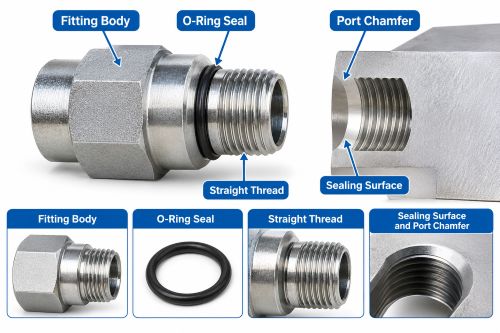
Although SAE J1926 fittings are available in different configurations, their basic connection design consists of several important components. Each part contributes to the mechanical strength and sealing performance of the assembly.
Fitting Body
The fitting body is the main structural component. It connects hydraulic hoses, tubes, ports, or other hydraulic components.
It is commonly manufactured from carbon steel or stainless steel, depending on the operating environment and application requirements.
The fitting body must provide sufficient mechanical strength to withstand system pressure, vibration, and installation loads.
O-Ring Seal
The O-ring is the primary sealing element in an SAE J1926 ORB connection.
It is positioned around the fitting’s male stud end, beneath the shoulder. When the fitting is tightened into the port, the O-ring is compressed against the port’s sealing surface.
This compression creates a seal that helps prevent hydraulic fluid from escaping.
Common O-ring materials include:
1. Nitrile rubber (NBR): Commonly used with petroleum-based hydraulic oils.
2. Fluorocarbon (FKM): Suitable for applications requiring higher temperature resistance and certain chemical compatibility.
3. EPDM: Used in compatible fluid applications where resistance to water-based fluids is required.
The correct material depends on hydraulic fluid type, temperature, pressure, and operating conditions.
Straight Thread
SAE J1926 fittings use straight threads that follow the ASME B1.1 Unified thread system.
These threads provide mechanical engagement between the male fitting and the female port. They hold the connection securely in place while the O-ring performs the sealing function.
Because the threads do not create the primary fluid seal, they should not be confused with tapered NPT connections.
Sealing Surface and Port Chamfer
The port includes a specially designed sealing area that supports the O-ring during installation.
The port chamfer and surrounding geometry help position and compress the O-ring correctly. A properly manufactured sealing surface is important for preventing damage and maintaining consistent sealing performance.
Scratches, burrs, contamination, or dimensional inaccuracies around this area can cause leakage even when the correct fitting is used.
Common Types of SAE J1926 Fittings
SAE J1926 connections are available in different configurations to accommodate various hydraulic system layouts. The appropriate design depends on installation space, connection direction, and equipment requirements.
Straight ORB Fittings
Straight ORB fittings provide a direct connection between a hydraulic port and another component.
They are commonly used in hydraulic manifolds, pumps, valves, and other equipment where a straight connection is suitable.
Elbow ORB Fittings
Elbow fittings change the direction of a hydraulic connection, commonly by 45 or 90 degrees depending on the design.
They are useful when hydraulic hoses or tubes need to pass around other equipment components or fit into limited installation spaces.
Tee ORB Fittings
Tee fittings provide three connection points, allowing hydraulic flow to branch into different directions.
They are used in hydraulic circuits that require multiple fluid paths or connections between different components.
Bulkhead ORB Fittings
Bulkhead fittings are designed to pass a hydraulic connection through a panel, mounting plate, or equipment wall.
A retaining nut secures the fitting to the mounting surface, helping create a stable connection where hydraulic lines need to pass through structural barriers.
Adjustable and Nonadjustable Stud Ends
Another important distinction in the SAE J1926 series is the difference between adjustable and nonadjustable stud ends.
1. Adjustable stud ends: Include features that allow the fitting to be oriented before final tightening. Locknuts and sealing washers are commonly used in the assembly.
2. Nonadjustable stud ends: Are designed to be tightened directly into the port without requiring the same orientation adjustment.
The applicable standard part and fitting design determine the correct installation method.
How Do SAE J1926 Fittings Work?
The sealing mechanism of SAE J1926 fittings is relatively simple, but correct installation is essential for reliable performance.
Here is how the connection works:
Step 1: Identify the correct port and fitting.
Before installation, confirm that the fitting’s thread size, thread form, and stud-end configuration match the hydraulic port.
Step 2: Inspect the O-ring.
Check the O-ring for cracks, cuts, deformation, or other signs of damage. Replace it if necessary.
Step 3: Position the fitting.
Insert the male stud end into the compatible female port. Make sure the O-ring is correctly positioned and does not become pinched or displaced.
Step 4: Tighten the connection.
Tighten the fitting according to the manufacturer’s installation instructions and applicable torque requirements.
Adjustable stud ends may require additional positioning and locking procedures.
Step 5: Inspect the connection.
After installation, operate the hydraulic system under controlled conditions and inspect the connection for leakage.
Never use your hand to check for hydraulic leaks. High-pressure fluid can penetrate the skin and cause serious injuries.
Main Applications of SAE J1926 Fittings
SAE J1926 ORB fittings are used in various hydraulic systems because their compact design and O-ring sealing arrangement make them suitable for many fluid power connections.
Construction and Agricultural Machinery
Excavators, loaders, tractors, and other heavy equipment use hydraulic systems to operate lifting mechanisms, steering systems, and working attachments.
ORB connections help provide reliable connections between hydraulic hoses, pumps, valves, and cylinders.
Industrial Hydraulic Systems
Manufacturing equipment often relies on hydraulic power units to control machinery and production processes.
SAE J1926 fittings can be used in compatible manifolds, valves, and hydraulic assemblies where dependable sealing is required.
Hydraulic Pumps and Motors
Hydraulic pumps and motors need secure connections for fluid supply, return, and pressure lines.
ORB fittings provide a practical connection option for compatible threaded ports on these components.
Mobile Hydraulic Equipment
Mobile hydraulic systems operate under changing loads, vibration, and demanding working conditions.
Properly selected and installed ORB fittings help maintain secure hydraulic connections in equipment such as forklifts, lifting platforms, and mobile machinery.
Hydraulic Cylinders and Power Units
Hydraulic cylinders and power units use different connection arrangements to transfer pressurized fluid.
SAE J1926 fittings can connect compatible ports to hoses, tubes, and other hydraulic components.
Advantages of SAE J1926 Hydraulic Fittings
The popularity of ORB connections comes from several practical advantages.
1. Reliable sealing performance
The O-ring provides the primary seal, reducing the risk of leakage when the fitting and port are properly matched and installed.
2. Straight-thread connection
Straight threads provide mechanical engagement without depending on thread interference to create the fluid seal.
3. Compact connection design
ORB fittings can be installed in relatively limited spaces, making them useful for hydraulic manifolds and compact equipment assemblies.
4. Reduced need for thread sealants
The O-ring provides the primary sealing function, so thread sealant is generally unnecessary on the sealing interface. This also helps avoid sealant contamination inside hydraulic circuits.
5. Maintenance convenience
O-rings can be inspected and replaced when necessary. This makes routine maintenance more manageable, although the fitting and port must also be checked for damage.
6. Different fitting configurations
Straight, elbow, tee, and other compatible adapter designs provide flexibility for different hydraulic layouts.
SAE J1926 vs. Other Hydraulic Fitting Standards
SAE J1926 fittings are often compared with other hydraulic connection types. Understanding their differences helps engineers and buyers select the right fitting for their equipment.
SAE J1926 vs. SAE J1453
Both standards use O-rings to create hydraulic seals, but their connection designs are different.
|
Feature |
SAE J1926 |
|
|
Connection type |
O-Ring Boss (ORB) |
O-Ring Face Seal (ORFS) |
|
Sealing location |
At the port and stud end |
At the fitting face |
|
Thread type |
Straight UN/UNF |
Straight threads |
|
Main sealing element |
O-ring |
O-ring |
|
Typical use |
Threaded hydraulic ports |
Face-seal hydraulic connections |
SAE J1926 fittings seal through an O-ring positioned beneath the male fitting shoulder. SAE J1453 ORFS fittings use an O-ring located in a groove on the fitting face.
Both designs offer reliable sealing when correctly manufactured and installed, but they are not interchangeable.
SAE J1926 vs. JIC Fittings
JIC fittings use a 37-degree flared metal-to-metal sealing surface, while SAE J1926 ORB connections rely on an O-ring.
|
Feature |
SAE J1926 ORB |
|
|
Sealing method |
O-ring |
37° flare |
|
Thread type |
Straight UN/UNF |
Straight UN/UNF |
|
Sealing location |
Beneath fitting shoulder |
Flared mating surfaces |
|
O-ring required |
Yes |
No |
|
Common application |
Hydraulic ports |
Hydraulic tube and hose connections |
The main difference is the sealing mechanism. JIC fittings rely on accurately machined flare surfaces, while ORB fittings use an elastomeric seal.
SAE J1926 vs. NPT Fittings
NPT fittings use tapered threads that create a seal through thread interference, typically with an appropriate thread sealant.
SAE J1926 fittings use straight threads and an O-ring for sealing.
|
Feature |
SAE J1926 ORB |
|
|
Thread design |
Straight |
Tapered |
|
Sealing method |
O-ring |
Thread interference |
|
Thread sealant |
Generally unnecessary |
Commonly required |
|
Thread standard |
ASME B1.1 |
ASME B1.20.1 |
|
Typical use |
Hydraulic port connections |
Pipe connections |
ORB connections are useful when a dedicated O-ring port is available, while NPT connections are commonly found in general pipe and fluid connections.
How to Choose the Right SAE J1926 Fittings
Selecting the correct SAE J1926 fitting involves more than matching the thread size. Buyers and engineers should consider several technical factors to ensure the connection meets the requirements of the hydraulic system.
Confirm the Applicable Standard
Check whether the required component is a port, adjustable stud end, nonadjustable stud end, or plug. Each has specific dimensional and performance requirements.
It is also important to consider the latest standard revisions and equipment design requirements.
Identify the Correct Thread Size
SAE J1926 fittings use inch-series straight threads. Confirm the thread diameter, pitch, and designation before ordering.
Incorrect thread matching can result in poor engagement, damaged threads, and connection failure.
Select the Right Fitting Configuration
Consider the available installation space and hydraulic line arrangement.
1. Choose straight fittings for direct connections.
2. Choose elbow fittings when the connection needs to change direction.
3. Choose tee fittings when the hydraulic circuit requires branching.
4. Choose bulkhead fittings when connections must pass through mounting panels.
Consider Working Pressure
The fitting must be suitable for the maximum operating pressure of the hydraulic system.
SAE J1926 standards include different performance requirements depending on the stud-end category. For example, the standard specifies different maximum working pressures for heavy-duty and light-duty connections.
However, actual pressure capability depends on material, design, operating conditions, and application. Always verify the manufacturer’s rated pressure rather than assuming every ORB fitting has the same pressure capacity.
Check O-Ring Compatibility
O-ring selection is essential for reliable sealing.
Consider the following factors:
1. Hydraulic fluid compatibility
2. Operating temperature
3. Pressure conditions
4. Resistance to aging and deformation
5. Expected service life
Using an incompatible O-ring can lead to swelling, hardening, cracking, or leakage.
Evaluate Material and Surface Treatment
Material selection affects fitting strength, corrosion resistance, and service life.
Common options include:
1. Carbon steel: Suitable for many general hydraulic applications.
2. Stainless steel: Offers improved corrosion resistance in demanding environments.
Surface treatments such as zinc plating, zinc-nickel plating, and other protective finishes can also help improve corrosion resistance.
Verify Manufacturing Quality
Dimensional accuracy is particularly important for ORB fittings because the O-ring depends on the correct sealing geometry.
Before purchasing, check the manufacturer’s quality control procedures, material specifications, dimensional inspection, and pressure testing capabilities.
Common Problems and Maintenance Tips
Even well-designed hydraulic fittings can develop problems if they are incorrectly installed or poorly maintained.
Here are some common issues associated with SAE J1926 connections.
O-Ring Damage
A damaged or improperly positioned O-ring is one of the most common causes of leakage.
Maintenance tip: Inspect the O-ring before installation. Replace damaged seals and use the correct material and dimensions.
Incorrect Thread Engagement
Using an incompatible thread size or pitch can damage the fitting or hydraulic port.
Maintenance tip: Verify thread specifications before installation. Avoid forcing a fitting into a port that does not match.
Over-Tightening
Excessive tightening can damage the O-ring, fitting shoulder, threads, or port.
Maintenance tip: Follow the recommended torque values and installation procedures provided by the manufacturer.
Contaminated Sealing Surfaces
Dirt, metal particles, and other contaminants can interfere with O-ring sealing.
Maintenance tip: Clean the port and fitting before assembly. Keep hydraulic components protected during storage and installation.
Corrosion and Surface Damage
Exposure to moisture, chemicals, and harsh environments can gradually damage fitting surfaces.
Maintenance tip: Select suitable materials and protective coatings. Inspect fittings regularly for corrosion, cracks, and mechanical damage.
Why Choose a Reliable SAE J1926 Fittings Manufacturer?
Choosing a reliable hydraulic fittings manufacturer is important for maintaining product quality and consistent system performance.
Not all fittings have the same manufacturing accuracy, material quality, or pressure ratings. Even small dimensional differences can affect thread engagement and O-ring sealing performance.
When evaluating a manufacturer, consider the following factors.
Manufacturing experience: Look for a company with experience producing hydraulic adapters, fittings, and related components.
Material options: A reliable supplier should offer suitable carbon steel and stainless steel options for different working environments.
Precision machining: CNC machining and accurate thread processing help ensure consistent fitting dimensions.
Surface treatment: Protective finishes such as zinc plating and zinc-nickel plating can improve corrosion resistance.
Quality control: Check whether the manufacturer performs dimensional inspections, material verification, and appropriate pressure testing.
OEM and ODM capabilities: Custom manufacturing can be useful for equipment manufacturers requiring specific thread sizes, fitting configurations, logos, or surface finishes.
At Sannke, we focus on manufacturing hydraulic fittings, adapters, and related connection components for industrial and mobile hydraulic applications. With OEM and ODM capabilities, material options, and different surface treatment solutions, we support customers looking for hydraulic connection products that meet their application requirements.
For buyers sourcing SAE J1926-compatible products, confirming the exact standard, port design, fitting dimensions, and performance requirements should always be the first step.
Important Considerations When Using SAE J1926 for New Hydraulic Designs
One technical point deserves special attention when working with SAE J1926 fittings.
Although SAE J1926 remains relevant for existing equipment, replacement components, and general-use connections, the standard’s current scope includes an important design recommendation for hydraulic fluid power systems.
SAE J1926/1 specifies that ISO 6149 should be used for threaded ports and stud ends in new hydraulic fluid power designs. This means engineers should not automatically specify SAE J1926 for every new hydraulic project simply because it is a familiar ORB connection.
The distinction is important:
1. Existing hydraulic equipment: SAE J1926-compatible replacement fittings may be appropriate when the original port design requires them.
2. New hydraulic designs: Engineers should evaluate ISO 6149 as the specified connection standard.
3. General-purpose applications: The appropriate standard should be selected according to the equipment design and applicable requirements.
Always consult the applicable standard and equipment manufacturer’s documentation before specifying or purchasing components.
Frequently Asked Questions About SAE J1926 Fittings
1. What does SAE J1926 mean?
SAE J1926 is a series of standards covering inch-series straight-thread ports and stud ends with O-ring sealing for general-use and fluid power connections.
2. What type of fitting is SAE J1926?
SAE J1926 is commonly associated with O-Ring Boss (ORB) hydraulic connections. These fittings use straight threads for mechanical engagement and an O-ring for sealing.
3. What threads do SAE J1926 fittings use?
SAE J1926 fittings use straight Unified inch-series threads in accordance with ASME B1.1. Depending on the size, they use UN or UNF thread designations.
4. How do SAE J1926 fittings prevent leakage?
They use an O-ring positioned beneath the male fitting shoulder. When installed in a compatible port, the O-ring is compressed against the sealing surface to prevent hydraulic fluid leakage.
5. Are SAE J1926 and SAE J1453 fittings interchangeable?
No. SAE J1926 uses an O-ring boss sealing arrangement, while SAE J1453 uses an O-ring face seal design. Their sealing locations and connection geometries are different.
6. What materials are used to manufacture SAE J1926 fittings?
Common fitting materials include carbon steel and stainless steel. The appropriate choice depends on operating pressure, corrosion exposure, hydraulic fluid, and environmental conditions.
7. Where are SAE J1926 fittings commonly used?
They are commonly found in construction machinery, agricultural equipment, hydraulic pumps, industrial power units, hydraulic manifolds, and mobile hydraulic systems.
8. What should I check before buying SAE J1926 fittings?
Confirm the applicable standard part, thread size, stud-end configuration, O-ring material, operating pressure, fitting material, and surface treatment. Also verify compatibility with the existing hydraulic port.
Conclusion
SAE J1926 fittings are important hydraulic connection components designed around straight threads and O-ring sealing technology. Their connection design provides reliable sealing when the fitting, port, and O-ring are correctly matched and installed.
Understanding the different parts of the SAE J1926 standard, thread specifications, fitting configurations, and sealing components helps engineers and purchasing professionals make better decisions when selecting hydraulic adapters.
Whether used in construction machinery, industrial hydraulic systems, mobile equipment, or hydraulic power units, choosing the correct fitting specification and maintaining proper installation practices are essential for dependable operation.
For manufacturers and buyers, working with an experienced hydraulic fittings supplier also helps ensure consistent product quality, dimensional accuracy, and compatibility with the intended hydraulic application.
Post time: Nov-05-2026