

Hydraulic systems often operate under high pressure, vibration, and demanding working conditions. In these environments, even a small fluid leak can affect equipment performance, increase maintenance costs, and create safety concerns. Choosing the right hydraulic connection is therefore essential. One popular solution is the SAE J1453 ORFS fitting, which uses an O-ring face seal design to provide reliable, leak-resistant connections.
SAE J1453 ORFS fittings are widely used in construction machinery, agricultural equipment, industrial hydraulic systems, and mobile equipment. Their sealing structure helps reduce fluid leakage while maintaining a secure connection between hydraulic components.
In this guide, we will explore what SAE J1453 ORFS fittings are, how their design works, the different types available, and where they are commonly used. We will also discuss their advantages and provide practical tips for selecting the right fittings for your hydraulic system.
What Are SAE J1453 ORFS Fittings?
SAE J1453 ORFS fittings are hydraulic connectors designed according to the SAE J1453 standard. ORFS stands for O-Ring Face Seal, referring to the sealing method used in this type of connection.
Unlike fittings that rely primarily on tapered threads or metal-to-metal contact, ORFS fittings use an elastomeric O-ring positioned in a groove on the fitting’s flat face. When the male and female fitting faces are connected and tightened, the O-ring is compressed to create a reliable seal.
This design helps prevent hydraulic fluid from escaping through the connection, making ORFS fittings suitable for demanding hydraulic applications.
An ORFS connection typically consists of a male fitting with a flat sealing face and an O-ring groove, along with a female fitting that provides a matching flat surface. The threaded connection supplies the clamping force needed to maintain contact between the two sealing faces.
Because of their effective sealing structure, SAE J1453 ORFS fittings are commonly selected for hydraulic systems where leakage control is especially important.
Key Design Features of SAE J1453 ORFS Fittings
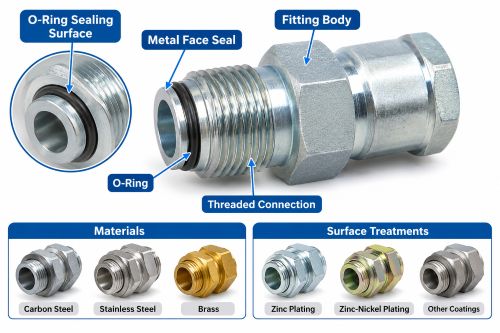
The performance of ORFS hydraulic fittings comes from the combination of their sealing structure, fitting body, and threaded connection. Each component has a specific function in maintaining a secure hydraulic connection.
O-Ring Sealing Surface
The O-ring is one of the most important components of an ORFS fitting. It is usually installed in a specially designed groove on the male fitting’s flat face.
When the connection is tightened, the O-ring is compressed against the female fitting’s mating surface. This compression creates a seal that prevents hydraulic fluid from leaking through the connection.
O-ring material selection is important because the seal must be compatible with the hydraulic fluid, operating temperature, and working environment. Common elastomer options include NBR and FKM, depending on application requirements.
Fitting Body
The fitting body provides the structural strength needed to connect hydraulic hoses, tubes, and other system components.
It is manufactured in different configurations, including straight, elbow, tee, and adapter designs. The body must withstand the mechanical loads and pressure conditions associated with its intended application.
Dimensional accuracy is also important. Poorly manufactured sealing faces or connection dimensions can affect installation and sealing performance.
Threaded Connection
ORFS fittings use straight threads to secure the male and female components.
Unlike tapered pipe threads, the threads are not the primary sealing mechanism. Instead, they generate the mechanical force that brings the two sealing faces together and compresses the O-ring.
This separation between fastening and sealing functions is an important feature of the ORFS connection design.
Metal Face Seal
The flat metal faces provide the mating surfaces for the O-ring seal.
When assembled correctly, these surfaces support controlled O-ring compression. The metal-to-metal contact around the sealing area also helps protect the O-ring from excessive deformation.
The sealing faces should remain clean and free from scratches, dents, and other damage before installation.
Materials and Surface Treatments
SAE J1453 ORFS fittings are available in different materials to meet various operating conditions.
Common material options include:
1. Carbon steel: A widely used option for general hydraulic applications because of its strength and cost-effectiveness.
2. Stainless steel: Suitable for environments where corrosion resistance is an important consideration.
3. Brass: Available for selected applications with appropriate pressure and compatibility requirements.
Surface treatments also influence fitting durability. Common options include zinc plating, zinc-nickel plating, and other protective coatings.
The appropriate material and finish depend on working pressure, environmental exposure, fluid compatibility, and equipment requirements.
Common Types of SAE J1453 ORFS Fittings
ORFS fittings are available in several configurations to accommodate different hydraulic system layouts. Selecting the correct type helps simplify installation and maintain proper fluid flow.
ORFS Straight Fittings
Straight ORFS fittings provide a direct connection between two hydraulic components.
They are commonly used when the hose or tube can be installed along a straight path without requiring a change in direction. Their simple structure makes them suitable for many standard hydraulic connections.
ORFS Elbow Fittings
ORFS elbow fittings allow hydraulic lines to change direction while maintaining a secure face seal connection.
Common configurations include 45-degree and 90-degree elbows. These fittings are useful when equipment has limited installation space or when hoses and tubes need to avoid nearby components.
ORFS Tee Fittings
ORFS tee fittings provide three connection points for distributing hydraulic fluid between different lines.
They are commonly used in hydraulic circuits that require a branch connection. Depending on the design, the three ports may have matching or different connection sizes.
ORFS Bulkhead Fittings
ORFS bulkhead fittings are designed to connect hydraulic lines through panels, walls, or equipment structures.
They typically include a threaded section and a locking nut that secure the fitting in position. This configuration helps create an organized connection point between hydraulic lines on opposite sides of a mounting surface.
ORFS Male and Female Fittings
Male and female ORFS fittings are designed to work together to form a sealed connection.
The male fitting generally features a flat face with an O-ring groove, while the female fitting provides the matching mating surface and threaded connection.
Correct matching is essential. Thread compatibility alone does not guarantee that two fittings will form a proper ORFS seal.
ORFS Hydraulic Adapters
ORFS hydraulic adapters connect ORFS ports with other hydraulic connection standards.
Depending on the design, adapters may combine ORFS connections with JIC, NPT, BSP, or metric threads.
These components are useful when connecting equipment with different port configurations. However, each end must match the corresponding connection standard and sealing method.
How Do SAE J1453 ORFS Fittings Work?
The working principle of ORFS fittings is based on controlled O-ring compression between two mating surfaces.
During installation, the O-ring is placed in the designated groove on the male fitting. The male and female components are then aligned and connected using their compatible threads.
As the connection is tightened, the threaded components generate axial clamping force. This force brings the flat sealing faces together and compresses the O-ring between them.
The compressed O-ring fills the small gaps between the mating surfaces, creating a barrier against hydraulic fluid leakage.
The threads maintain the mechanical connection, while the O-ring performs the primary sealing function.
For reliable performance, several installation details should be considered:
1. Inspect the O-ring for cuts, cracks, deformation, or other damage.
2. Clean both sealing faces before assembly.
3. Make sure the male and female threads are compatible.
4. Align the fittings correctly to avoid cross-threading.
5. Tighten the connection according to the manufacturer’s recommended torque specifications.
6. Inspect the assembled connection for leakage under appropriate operating conditions.
Avoid excessive tightening, as it can damage the O-ring or fitting components.
Main Applications of SAE J1453 ORFS Fittings
Because of their reliable sealing design, SAE J1453 ORFS fittings are used in many hydraulic systems. They are particularly useful in applications where fluid leakage can affect equipment performance or increase maintenance requirements.
Construction Machinery
Construction equipment such as excavators, loaders, bulldozers, and hydraulic cranes depends on reliable hydraulic connections.
ORFS fittings are used to connect hydraulic hoses, cylinders, pumps, and valves. Their sealing design helps maintain hydraulic fluid containment during demanding operating conditions.
Agricultural Equipment
Tractors, harvesters, sprayers, and other agricultural machines use hydraulic systems to control lifting, steering, and working attachments.
ORFS fittings provide connection options for these systems, helping maintain secure hydraulic lines in equipment exposed to vibration, dust, and changing environmental conditions.
Industrial Hydraulic Systems
Manufacturing equipment often operates with hydraulic power for pressing, lifting, clamping, and material handling.
ORFS hydraulic fittings are used in hydraulic presses, production machinery, and industrial power units where consistent sealing performance is important.
Mobile Hydraulic Equipment
Mobile hydraulic equipment frequently experiences vibration, movement, and changing operating loads.
Examples include lifting platforms, mobile cranes, and material-handling equipment. Properly selected ORFS fittings help maintain secure connections between hydraulic components.
Transportation and Heavy-Duty Vehicles
Some heavy-duty vehicles use hydraulic systems for steering, lifting, and auxiliary functions.
ORFS fittings can be used in compatible hydraulic circuits where their connection dimensions, pressure ratings, and material specifications meet equipment requirements.
Advantages of SAE J1453 ORFS Fittings
ORFS fittings offer several practical advantages that make them a popular choice in modern hydraulic systems.
Reliable leak prevention
The O-ring face seal design provides a dedicated sealing element that helps prevent hydraulic fluid from escaping through the connection.
Suitable for high-pressure applications
When manufactured and installed correctly, ORFS fittings can be used in demanding hydraulic systems. Actual pressure limits depend on the fitting size, material, configuration, and manufacturer’s specifications.
Good vibration resistance
The threaded connection maintains clamping force, while the O-ring provides the sealing interface. This combination makes ORFS connections useful in equipment exposed to vibration.
Multiple configurations
Straight, elbow, tee, bulkhead, and adapter designs allow engineers to select fittings that suit different hydraulic layouts.
Material flexibility
Carbon steel and stainless steel options provide flexibility for different operating environments and corrosion requirements.
Reduced maintenance concerns
A properly installed ORFS connection can help reduce leakage-related maintenance. However, regular inspection and timely O-ring replacement remain important.
SAE J1453 ORFS Fittings vs. Other Hydraulic Fittings
Different hydraulic fitting standards use different sealing methods and connection structures. Understanding these differences helps engineers and buyers select compatible components.
ORFS vs. JIC Fittings
ORFS and JIC fittings are both commonly used in hydraulic systems, but their sealing methods are different.
ORFS fittings use an elastomeric O-ring positioned on a flat face, while JIC fittings use a 37-degree flared metal-to-metal sealing surface.
ORFS connections are often preferred when reducing leakage risk is a priority. JIC fittings are widely used because of their established design and availability.
ORFS vs. BSP Fittings
BSP fittings use British Standard Pipe thread specifications and may rely on different sealing arrangements depending on the connection type.
For example, BSPP connections may use bonded seals or O-rings, while BSPT connections use tapered threads for sealing.
ORFS fittings use a dedicated O-ring face seal, so their sealing method and connection geometry are different.
ORFS vs. DIN Hydraulic Fittings
DIN hydraulic fittings commonly use metric connection designs and may incorporate cutting rings, sealing cones, or other sealing arrangements depending on the standard.
ORFS fittings use a flat face with an O-ring to create the seal.
The best choice depends on the equipment’s original connection standard, operating requirements, and compatibility needs.
|
Feature |
ORFS Fittings |
JIC Fittings |
DIN Fittings |
|
Sealing method |
O-ring face seal |
37-degree flare |
Depends on design |
|
Thread type |
Straight thread |
Straight thread |
Commonly metric |
|
Main sealing element |
Elastomeric O-ring |
Metal-to-metal contact |
Cutting ring, cone, or other seal |
|
Common applications |
High-pressure hydraulic systems |
Hydraulic hoses and equipment |
Industrial and mobile hydraulics |
|
Compatibility |
ORFS connections |
JIC connections |
Matching DIN connections |
These fitting standards are not interchangeable simply because their threads appear similar. Always verify the connection dimensions and sealing design before assembly.
How to Choose the Right SAE J1453 ORFS Fittings
Choosing the correct ORFS fitting requires more than matching the thread size. Buyers and engineers should evaluate several factors to ensure the fitting meets the requirements of the hydraulic system.
Check Thread Size and Connection Dimensions
Confirm the thread size, fitting configuration, and mating connection dimensions. Incorrect thread or sealing-face dimensions can cause installation problems and leakage.
Confirm Pressure and Temperature Requirements
Select fittings that meet or exceed the system’s required operating pressure and temperature range.
Do not assume that every ORFS fitting has the same pressure rating. Check the manufacturer’s specifications for the exact size and configuration.
Select Suitable Materials
Carbon steel is commonly selected for general hydraulic applications, while stainless steel may be more suitable for corrosive environments.
Consider the working environment, fluid compatibility, and expected service life before choosing a material.
Consider O-Ring Compatibility
The O-ring must be compatible with the hydraulic fluid and operating temperature.
NBR is commonly used in many petroleum-based hydraulic applications, while FKM may be suitable for certain higher-temperature or chemically demanding environments.
Always confirm compatibility with the seal manufacturer’s specifications.
Choose the Correct Fitting Configuration
Determine whether the system requires straight, elbow, tee, bulkhead, or adapter fittings.
The correct configuration can simplify hose routing, reduce installation difficulties, and help prevent unnecessary mechanical stress on hydraulic lines.
Evaluate Surface Treatment
Surface protection is important when fittings are exposed to moisture, chemicals, or outdoor conditions.
Options such as zinc plating and zinc-nickel plating can improve corrosion resistance. The appropriate finish depends on the operating environment and required corrosion performance.
Verify Manufacturing Quality
Work with a manufacturer that can provide consistent dimensions, reliable materials, and appropriate quality inspection.
Dimensional accuracy, sealing-face finish, thread quality, and O-ring groove precision all contribute to the overall performance of ORFS fittings.
Common Problems with ORFS Fittings and How to Avoid Them
Although ORFS fittings are designed to provide reliable sealing, improper selection, installation, or maintenance can still lead to problems.
Here are some common issues and ways to prevent them.
Damaged O-rings
Cuts, scratches, aging, or incorrect installation can prevent the O-ring from sealing properly. Inspect the seal before assembly and replace damaged O-rings.
Incorrect fitting compatibility
Using fittings with incompatible threads or sealing dimensions can cause leakage and connection failure. Always confirm the applicable standard and connection specifications.
Over-tightening
Excessive tightening can damage the O-ring, threads, or fitting components. Follow the recommended torque specifications instead of relying on excessive force.
Contaminated sealing surfaces
Dirt, metal particles, and other contaminants can interfere with the sealing interface. Clean the mating surfaces before installation.
Misalignment during installation
Poor alignment can damage threads and affect the sealing surfaces. Position the fittings correctly before tightening.
Incorrect seal material
An O-ring that is incompatible with the hydraulic fluid or operating temperature may deteriorate prematurely. Choose seal materials based on actual system conditions.
Why Choose a Professional SAE J1453 ORFS Fittings Manufacturer?
The quality of hydraulic fittings has a direct impact on connection reliability and equipment performance. For distributors, equipment manufacturers, and hydraulic system builders, choosing a capable supplier is an important part of the purchasing process.
A professional ORFS fittings manufacturer should offer several essential capabilities:
1. Manufacturing experience: Experience in producing hydraulic adapters and fittings for different industrial applications.
2. OEM and ODM services: Custom designs, dimensions, and product configurations to meet specific project requirements.
3. Material options: Carbon steel, stainless steel, and other suitable materials.
4. Surface treatments: Zinc plating, zinc-nickel plating, and other protective finishes.
5. Quality control: Inspection of dimensions, threads, sealing surfaces, and other critical product features.
6. Engineering support: Technical assistance with product selection and custom fitting requirements.
7. Reliable production: Consistent manufacturing capacity and delivery arrangements.
At Sannke, we focus on manufacturing hydraulic fittings, adapters, and related connection components for different industrial applications. With 15 years of manufacturing experience, we provide OEM and ODM services to support customers with standard and customized hydraulic fitting requirements.
Our product capabilities include custom hydraulic hose fittings, adapters, ferrules, flanges, and accessories. Customers can also choose from different material and surface treatment options based on their application needs.
For businesses sourcing SAE J1453 ORFS fittings, working with an experienced manufacturer can help simplify product selection, customization, and long-term supply planning.
Frequently Asked Questions (FAQs)
1. What does ORFS stand for in hydraulic fittings?
ORFS stands for O-Ring Face Seal. It refers to a hydraulic fitting connection that uses an elastomeric O-ring positioned on a flat sealing face to prevent fluid leakage.
2. What is SAE J1453?
SAE J1453 is an SAE standard covering O-ring face seal hydraulic tube fittings and their connection requirements. It provides specifications for compatible ORFS connections.
3. How do SAE J1453 ORFS fittings seal?
ORFS fittings seal through O-ring compression. When the male and female fittings are tightened together, the O-ring is compressed between their mating faces to create a leak-resistant connection.
4. Are ORFS fittings suitable for high-pressure hydraulic systems?
Yes. ORFS fittings are used in many high-pressure hydraulic applications. However, the allowable working pressure depends on the fitting size, material, configuration, and manufacturer’s rated specifications.
5. What is the difference between ORFS and JIC fittings?
ORFS fittings use an O-ring face seal, while JIC fittings use a 37-degree flare connection with metal-to-metal sealing. Their connection structures and sealing methods are different.
6. Can ORFS fittings be reused?
ORFS fitting bodies can generally be reused if their threads and sealing surfaces remain in good condition. However, the O-ring should be inspected and replaced when necessary, particularly during reconnection.
7. What materials are commonly used for ORFS hydraulic fittings?
Carbon steel and stainless steel are common materials. The choice depends on pressure requirements, corrosion exposure, hydraulic fluid compatibility, and operating conditions.
8. How do you prevent leaks in ORFS fittings?
Use compatible fittings, inspect the O-ring, clean the sealing surfaces, ensure proper alignment, and tighten the connection according to the manufacturer’s recommended torque specifications.
Conclusion
SAE J1453 ORFS fittings play an important role in hydraulic systems where reliable sealing and leakage prevention are essential. Their O-ring face seal design provides an effective sealing method by compressing an elastomeric seal between two flat mating surfaces.
Available in straight, elbow, tee, bulkhead, and adapter configurations, ORFS fittings can accommodate a wide range of hydraulic connection requirements. They are commonly used in construction machinery, agricultural equipment, industrial systems, and mobile hydraulic applications.
When selecting ORFS fittings, consider connection dimensions, pressure ratings, materials, O-ring compatibility, and manufacturing quality. Choosing the right components and following proper installation practices can help improve hydraulic system reliability and reduce unnecessary maintenance.
Post time: Nov-04-2026