

Hydraulic systems are the muscle of modern industry. From the massive excavators on construction sites to the precise robotic arms in manufacturing plants, these systems rely on pressurized fluid to transmit power. However, that power is only as effective as the system’s ability to contain it.
One of the most persistent challenges in fluid power is preventing leaks at port connections. Traditional sealing methods often struggle with high vibration or thermal expansion, leading to fluid loss, environmental hazards, and system failure. Enter the hydraulic plug with an O-ring, a simple yet sophisticated component designed to provide a fail-safe seal.
In this article, we’ll dive deep into how these plugs work, why they outperform traditional alternatives, and how to choose the right one for your application.
What Is a Hydraulic Plug with an O-Ring?
A hydraulic plug is a threaded fitting used to close off or “cap” an unused port in a hydraulic manifold, pump, or cylinder. While standard plugs rely on thread interference to seal, an O-ring–sealed plug (often referred to as an ORB or O-Ring Boss fitting) features a dedicated groove where a synthetic rubber ring sits.
An O-ring is a gasket in the shape of a torus (a doughnut). When the plug is screwed into a port, the O-ring is compressed between the plug’s underside and the port’s chamfered surface. This compression creates a physical barrier that prevents fluid from escaping, even under extreme pressure. Unlike metal-to-metal seals, the elastomer “flows” to fill microscopic imperfections in the metal surfaces.
Key Components of the Assembly
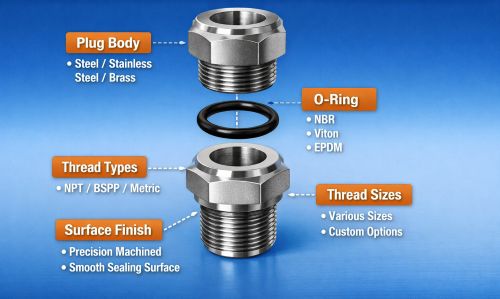
To understand its performance, we have to look at the sum of its parts:
1. The Plug Body: Usually machined from high-strength materials like carbon steel (for general use), stainless steel (for corrosive environments), or brass (for low-pressure or marine applications).
2. The O-Ring: This is the “active” sealing element. Material choice is critical:
➡️ NBR (Buna-N): Standard for petroleum-based oils.
➡️ Viton (FKM): High-temperature and chemical resistance.
➡️ EPDM: Used for phosphate ester fluids, but never with petroleum.
3. Thread Types: Common standards include SAE (Straight Thread O-Ring Boss), Metric, and BSPP (British Standard Parallel Pipe).
O-Ring Material Compatibility Table
Selecting the right elastomer is the difference between a long-lasting seal and a catastrophic leak. Below is a guide to the most common O-ring materials used in hydraulic plugs:
|
Material |
Trade Name |
Temp Range |
Best For… |
Avoid Using With… |
|
Buna-N |
-40°C to 120°C |
Petroleum oils, water, grease |
Brake fluid, ozone, ketones |
|
|
Viton™ |
-26°C to 205°C |
High temps, harsh chemicals |
Hot water/steam, amines |
|
|
EPDM |
-55°C to 150°C |
Phosphate esters (Skydrol), steam |
Petroleum oils and fuels |
|
|
AU/EU |
-40°C to 80°C |
High-pressure, abrasion resistance |
Acids, hot water |
How It Works: The Sealing Mechanism
The magic of the O-ring plug happens during installation. As you torque the plug, the O-ring is squeezed into a specially designed cavity.
1. Mechanical Compression: The initial “squeeze” creates a seal at zero pressure.
2. Pressure Activation: As hydraulic pressure increases, it pushes the O-ring against the side of the groove, actually increasing the sealing force.
3. Adaptability: Because elastomers are flexible, the O-ring can expand and contract with temperature changes, maintaining the seal where rigid metal seals might fail.
Detailed Sealing Geometry
To visualize how the plug interacts with the port, it helps to see the cross-section of an SAE J1926 (Straight Thread O-Ring Boss) connection.
As the plug is tightened:
1. The O-ring sits in the undercut (groove) of the plug.
2. It makes contact with the port chamfer (the angled edge at the top of the hole).
3. The compression forces the O-ring to fill the triangular cavity, creating a seal that is independent of the thread tightness. This is why you don’t need Teflon tape or pipe dope with these fittings, in fact, using tape can actually interfere with the O-ring’s ability to seat properly.
Troubleshooting O-Ring Failure
If you notice a leak from your hydraulic plug, the O-ring usually tells the story of what went wrong:
1. Extrusion: If the O-ring looks like it has “ears” or has been nibbled, the pressure was too high for the material’s hardness, or the gap between the plug and port was too wide.
2. Compression Set: If the O-ring looks flat and doesn’t bounce back to a round shape, it has likely been exposed to temperatures beyond its limit.
3. Swelling: If the O-ring is significantly larger than its original size, it is chemically incompatible with the hydraulic fluid.
Main Features and Advantages
Why are engineers moving away from old-school pipe tape and moving toward O-ring plugs?
1. Leak-Proof Performance: They provide a significantly more reliable seal than tapered threads (NPT), which often develop “spiral” leak paths.
2. Vibration Resistance: The O-ring acts as a tiny shock absorber, preventing the plug from loosening due to machine vibration.
3. Reusability: Unlike tapered threads that deform the metal when tightened, O-ring plugs can be removed and reinstalled multiple times. You simply replace the inexpensive O-ring if it looks worn.
4. Safety: By eliminating leaks, you reduce the risk of high-pressure fluid injections and slip-and-fall hazards in the workplace.
Common Applications
You will find these components across almost every sector that utilizes fluid power:
1. Industrial: Hydraulic presses, injection molding machines, and power units.
2. Construction: Closing ports on control valves in loaders and excavators.
3. Automotive: Braking systems and power steering reservoirs.
4. Oil & Gas: High-pressure manifolds where leak prevention is non-negotiable.
How to Choose the Right Plug
Selecting the wrong plug can lead to catastrophic failure. Consider these four factors:
|
Factor |
Consideration |
|
Thread Type |
Ensure the thread pitch and diameter match the port (e.g., SAE J1926). |
|
Material |
Match the plug material to the housing to avoid galvanic corrosion. |
|
Media |
Ensure the O-ring elastomer is compatible with your hydraulic fluid. |
|
Pressure |
Verify the plug’s burst pressure rating exceeds your system’s peak. |
Installation and Maintenance Tips
1. Lubricate: Always apply a thin film of system fluid to the O-ring before installation to prevent it from pinching or tearing.
2. Check for Burrs: Ensure the port chamfer is clean and free of sharp edges.
3. Torque Correctly: Over-tightening can crush the O-ring or strip the threads. Use a torque wrench and follow manufacturer specifications.
4. Inspection: During routine maintenance, look for “extrusion”—where the O-ring looks flattened or bitten. This usually indicates over-pressurization or the wrong O-ring hardness (Durometer).
Hydraulic Plug vs. Other Sealing Methods
Here’s a comparion of hydraulic plug vs other sealing methods:
|
Feature |
Tapered Thread (NPT) |
Metal-to-Metal |
|
|
Seal Type |
Elastomeric |
Thread Interference |
Mechanical Crush |
|
Reliability |
Highest |
Moderate (prone to leaks) |
High |
|
Ease of Use |
High |
Requires Sealing Tape/Paste |
High Torque Required |
|
Reusability |
Excellent |
Poor |
Limited |
Frequently Asked Questions (FAQ)
1. Can hydraulic plugs with O-rings be reused?
Yes. The metal plug body lasts indefinitely under normal conditions. You should, however, replace the O-ring every time the plug is removed to ensure a fresh seal.
2. What causes O-ring failure?
The most common causes are chemical incompatibility, excessive heat (causing the ring to become brittle), or “nibbling” caused by high-pressure spikes.
3. Are they suitable for high-pressure systems?
Absolutely. Many O-ring boss fittings are rated for 6,000 PSI and higher, making them the standard for modern high-pressure hydraulics.
Conclusion
The hydraulic plug with an O-ring may be a small component, but its impact on system efficiency is massive. By providing a reusable, vibration-resistant, and high-pressure seal, it reduces downtime and protects the environment from fluid leaks. When building or maintaining your equipment, investing in high-quality O-ring plugs is one of the simplest ways to ensure long-term reliability.
Post time: Jan-23-2026