

Thread compatibility issues are one of those problems in hydraulic and fluid power systems that don’t seem like a big deal until they are. A small mismatch between fittings can lead to leaks, pressure drops, wasted time, and, in some cases, costly equipment failure.
In many industrial setups, two commonly encountered thread types are NPSM (National Pipe Straight Mechanical) and ORB (O-Ring Boss). While both are widely used, they are not naturally compatible with each other. That’s where NPSM to ORB adapters come in.
These adapters act as the missing link between two different sealing systems, allowing engineers, technicians, and maintenance teams to connect components safely, efficiently, and without guesswork.
In this article, we’ll break down what makes these threads different, why compatibility issues happen in the first place, and how the right adapter eliminates those challenges entirely.
Understanding NPSM Threads
NPSM (National Pipe Straight Mechanical) threads are straight-thread fittings commonly used in fluid and hydraulic systems. Unlike tapered threads that seal by wedging together, NPSM threads are designed primarily for mechanical connection rather than sealing on the threads themselves.
Key Characteristics of NPSM Threads
NPSM threads have a few defining features:
1. They are straight (non-tapered) threads
2. They rely on a mechanical fit or sealing surface rather than thread deformation
3. They often require a gasket, washer, or mating surface to create a seal
4. They are widely used in low to moderate pressure systems
Because NPSM threads don’t inherently seal through thread interference, they depend heavily on proper mating components to prevent leaks.
Where You’ll Commonly Find NPSM
You’ll often encounter NPSM threads in:
1. Hydraulic hose assemblies
2. Industrial machinery
3. Fluid transfer lines
4. Some OEM equipment connections
They are valued for their simplicity and ease of assembly, but that simplicity comes with limitations when connecting to other thread types.
Understanding ORB Threads
ORB (O-Ring Boss) fittings are a SAE-standard connection type designed specifically for high-performance hydraulic systems. Unlike NPSM, ORB fittings use an elastomeric O-ring to create a reliable seal.
Key Characteristics of ORB Threads
ORB fittings are known for:
1. Straight threads (similar in appearance to NPSM)
2. A precision-machined sealing surface
3. An O-ring that provides the actual sealing function
4. Excellent performance in high-pressure hydraulic systems
The O-ring is compressed into a machined seat, creating a leak-free seal that is far more reliable than metal-to-metal or thread-dependent sealing methods.
Where ORB Fittings Are Used
ORB connections are commonly found in:
1. Hydraulic power units
2. Mobile equipment (construction and agricultural machinery)
3. High-pressure industrial systems
4. Valves, cylinders, and manifolds
Their reliability is the reason they are often preferred in modern hydraulic system design.
Why Thread Compatibility Issues Occur
At first glance, NPSM and ORB threads can look similar because both are straight-thread designs. However, appearances are misleading.
Different Sealing Mechanisms
The core issue lies in how each system creates a seal:
1. NPSM systems rely on mechanical fit or external sealing elements
2. ORB systems rely on an O-ring compressed against a sealing surface
This difference alone means they cannot safely seal against each other without an intermediary component.
Subtle but Critical Design Differences
Even though both are straight-thread systems, they differ in:
➡️ Thread pitch and dimensional standards
➡️ Sealing surface geometry
➡️ Tolerance specifications
➡️ Intended pressure ratings
These differences may seem minor on paper, but in hydraulic systems operating under pressure, even small mismatches can lead to failure.
What Happens When You Force Compatibility
Trying to directly connect incompatible fittings can result in:
1. Hydraulic fluid leaks
2. Thread damage or stripping
3. Loss of system pressure
4. Increased wear on components
5. Safety risks for operators
In short, forcing a connection is never worth the risk.
How NPSM to ORB Adapters Solve the Problem
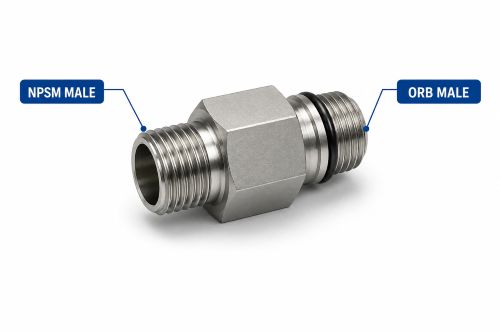
NPSM to ORB adapters are designed specifically to bridge this gap. Instead of forcing two incompatible systems to work together, the adapter creates a controlled transition between them.
A Purpose-Built Transition Point
The adapter essentially performs two roles:
1. One end interfaces with the NPSM connection
2. The other end provides an ORB-compatible sealing surface
This allows both systems to function as intended without compromise.
Preserving the Integrity of Both Systems
Rather than altering either fitting, the adapter maintains:
1. Proper thread engagement on both sides
2. Correct sealing method for each standard
3. Structural integrity under pressure
This ensures that neither system is forced outside its design limits.
Eliminating Guesswork in Assembly
One of the biggest advantages is simplicity. Technicians no longer need to:
1. Modify components
2. Force mismatched fittings
3. Experiment with sealants or workarounds
Instead, they can rely on a standardized solution designed for compatibility.
Key Benefits of Using NPSM to ORB Adapters
1. Reliable Leak Prevention
By preserving the ORB O-ring sealing method, these adapters significantly reduce the risk of leaks compared to improvised connections.
2. Improved System Safety
A properly sealed hydraulic system is a safer system. Preventing leaks also reduces slip hazards, equipment malfunction, and pressure-related failures.
3. Reduced Maintenance Costs
Fewer leaks and connection failures mean:
➡️ Less downtime
➡️ Fewer replacement parts
➡️ Lower maintenance frequency
Over time, this translates into meaningful cost savings.
4. Greater Flexibility in System Design
Adapters make it possible to integrate:
➡️ Older equipment with newer systems
➡️ Components from different manufacturers
➡️ Mixed-standard hydraulic setups
This flexibility is especially valuable in maintenance and retrofit projects.
5. Faster Installation and Repairs
Instead of redesigning or sourcing custom parts, technicians can quickly install an adapter and restore system function.
Common Applications
NPSM to ORB adapters are used across a wide range of industries where hydraulic systems are essential.
Hydraulic Machinery
➡️ Pumps
➡️ Cylinders
➡️ Valves
➡️ Manifolds
Construction Equipment
➡️ Excavators
➡️ Loaders
➡️ Bulldozers
➡️ Telehandlers
Agricultural Systems
➡️ Tractors
➡️ Harvesters
➡️ Sprayers
➡️ Irrigation equipment
Industrial Manufacturing
➡️ Automated production lines
➡️ Press systems
➡️ Fluid handling equipment
Mobile Equipment
➡️ Utility trucks
➡️ Waste management vehicles
➡️ Material handling systems
In all these applications, reliability and uptime are critical, making proper fitting compatibility essential.
How to Choose the Right NPSM to ORB Adapter
Not all adapters are created equal, and selecting the right one matters.
Verify Thread Sizes Carefully
Even small measurement errors can lead to incompatibility. Always confirm:
➡️ Thread diameter
➡️ Pitch
➡️ Standard designation
Match Pressure Ratings
Ensure the adapter is rated for the maximum system pressure, including safety margins.
Choose the Right Material
1. Steel: Best for heavy-duty, high-pressure applications
2. Stainless steel: Ideal for corrosive or outdoor environments
3. Brass: Suitable for lower-pressure or general-purpose systems
Consider Environmental Conditions
Temperature extremes, chemical exposure, and vibration all influence adapter performance.
Source from Reputable Manufacturers
Quality matters in hydraulic systems. Look for:
1. Certified manufacturing standards
2. Consistent machining tolerances
3. Reliable sealing components
Installation Best Practices
Even the best adapter won’t perform well if installed incorrectly.
Inspect Before Installation
Check for:
➡️ Damaged threads
➡️ Dirty sealing surfaces
➡️ Worn or missing O-rings
Avoid Cross-Threading
Start threads carefully by hand to ensure proper alignment.
Use Proper Torque
Over-tightening can damage threads or deform sealing surfaces, while under-tightening may cause leaks.
Perform Leak Testing
After installation:
➡️ Pressurize the system gradually
➡️ Inspect all connection points
➡️ Address issues immediately
Common Mistakes to Avoid
Even experienced technicians sometimes run into avoidable errors:
1. Assuming similar-looking threads are interchangeable
2. Reusing worn O-rings
3. Ignoring pressure specifications
4. Using excessive thread sealant where it is not needed
5. Over-tightening fittings in an attempt to “guarantee” a seal
Avoiding these mistakes significantly improves system reliability.
Conclusion
Thread compatibility issues between NPSM and ORB systems are common, but they don’t have to be a recurring problem. Because these two thread types rely on fundamentally different sealing methods, direct connection is not safe or reliable.
NPSM to ORB adapters solve this challenge by acting as a precise, engineered bridge between two standards. They preserve sealing integrity, simplify installation, reduce downtime, and improve overall system performance.
In hydraulic systems where reliability matters, the right adapter isn’t just a convenience—it’s a necessity.
Post time: Jun-15-2026