

Hydraulic systems power everything from loaders to steering on John Deere equipment, and one small part plays a big role in keeping them working: hydraulic fittings. Using the wrong fitting can cause leaks, pressure loss, or serious damage, driving up repair time and cost.
For farmers, technicians, and DIY owners, knowing the correct fitting type improves safety and keeps equipment running smoothly.
This guide explains the most common John Deere hydraulic fittings, JIC, ORB, ORFS, NPT, and metric/DIN, so you can identify and replace them with confidence.
What Are Hydraulic Fittings in John Deere Equipment?
Hydraulic fittings connect hoses, valves, pumps, and cylinders to form a sealed pathway for high-pressure hydraulic fluid. They perform several essential functions:
➡️ Maintain system pressure by preventing leaks.
➡️ Seal and contain hydraulic fluid, even under vibration and load.
➡️ Enable safe assembly and service, allowing components to be removed or replaced.
Choosing the correct fitting means matching the thread pattern, sealing method, material, and flare angle. John Deere follows a mix of SAE (Society of Automotive Engineers) and ISO standards, along with some manufacturer-specific components on newer models or imported attachments.
Overview of Common John Deere Hydraulic Fitting Types
Before diving into each fitting, here’s a quick list of what you’ll commonly find on John Deere machinery:
|
Fitting Type |
Thread Style |
Seal Method |
Identification Features |
Common Uses |
|
JIC (37° Flare) |
Straight thread |
Metal-to-metal 37° flare |
37° cone flare, straight threads |
Hose assemblies, loaders, implements |
|
ORB (O-Ring Boss) |
Straight thread |
O-ring at the thread base |
Visible O-ring inside fitting, straight threads |
Valve blocks, cylinders, transmission housings |
|
ORFS (O-Ring Face Seal) |
Straight thread |
O-ring in flat face |
Flat face with embedded O-ring |
High-pressure, high-vibration systems, newer equipment |
|
NPT (Pipe Thread) |
Tapered thread |
Thread deformation (sealant required) |
Tapered threads; requires Teflon tape or sealant |
Older tractors, low-pressure return circuits |
|
DIN / Metric |
Metric thread |
24° cone or other metric sealing |
Metric thread markings, 24° flare on many DIN types |
Imported attachments, newer European-built components |
JIC Fittings
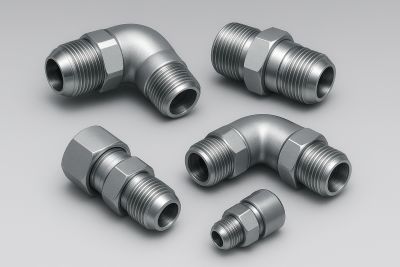
JIC fittings use a 37° flare design that creates a metal-to-metal seal. These are widely used across agriculture and construction and are standard in many John Deere models.
Advantages
1. High-pressure capability
2. Durable, easy to assemble
3. Reusable, making them popular for field repairs
Where You’ll Find Them on John Deere
1. Loader hydraulic lines
2. Hose assemblies
3. Rear SCV (Selective Control Valve) connections
4. Hydraulic implements and attachments
Identification Tips
1. Look for a 37° flare cone
2. Straight threads
3. Common sizes: 1/4”, 3/8”, 1/2”, 3/4”
ORB (O-Ring Boss) Fittings
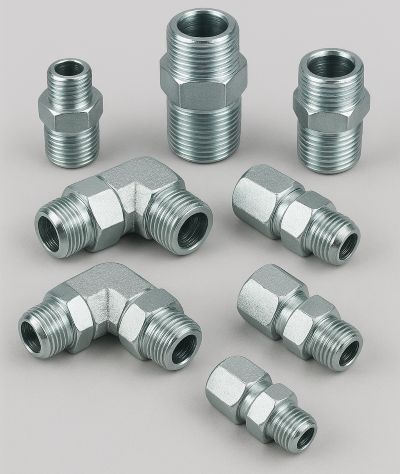
ORB fittings use straight threads for strength and an O-ring at the base to create a secure, leak-free seal.
Advantages
1. Outstanding vibration resistance
2. Reliable at very high pressures
3. Easy to torque correctly due to O-ring sealing
Common John Deere Applications
1. Valve blocks
2. Hydraulic cylinders
3. Transmission housings
4. Rockshaft and steering components
Identification Tips
1. Look for the O-ring inside the fitting
2. Threads are straight, not tapered
ORFS (O-Ring Face Seal) Fittings
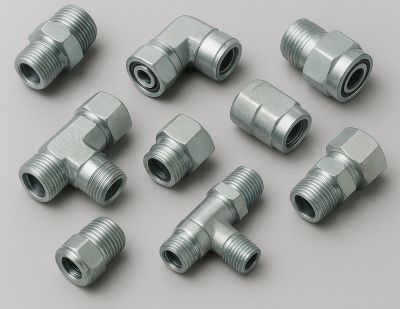
ORFS fittings have a flat face with an O-ring embedded into the sealing surface. They’re designed for the harshest environments.
Advantages
1. Virtually leak-proof
2. Excellent performance in high-vibration conditions
3. Ideal for ultra-high-pressure systems
John Deere Applications
1. Newer high-performance machines
2. Industrial and heavy-duty models
3. Equipment used in constant vibration environments
Identification Tips
1. Flat-faced design with visible O-ring
2. Straight thread
NPT Fittings
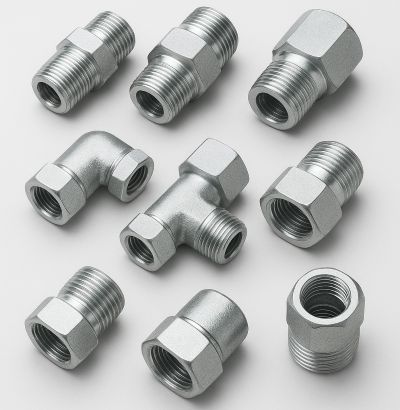
NPT fittings use a tapered thread that seals as the threads deform together.
Advantages
1. Simple, inexpensive, widely available
Disadvantages
1. More prone to leaks
2. Not ideal for repeated disassembly
3. Requires sealant or Teflon tape
Typical John Deere Usage
1. Older tractors (especially pre-1980s models)
2. Low-pressure return lines or hydraulic drains
Identification Tips
1. Threads visibly taper
2. Require thread sealant
Metric and DIN Fittings (Less Common but Increasingly Used)
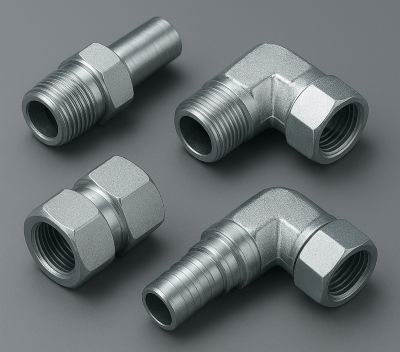
They usually appear in:
1. Imported attachments
2. Newer European-built John Deere components
3. Some skid-steer and compact tractor attachments
Characteristics
1. Often use 24° cone flare
2. Metric thread diameters and pitch
Identification Tips
1. Look for metric size markings
2. Flare angle differs from JIC’s 37°
How to Identify Which Hydraulic Fitting Your John Deere Equipment Uses
Use this quick checklist:
|
Step |
What to Check |
Details / What It Tells You |
|
1 |
Thread Type |
Straight thread → JIC, ORB, ORFSTapered thread → NPT |
|
2 |
Sealing Method |
Flare cone → JIC (37°)O-ring at thread base → ORBO-ring on flat face → ORFSThread sealant needed → NPT |
|
3 |
Measure Thread Diameter |
Use calipers to measure OD; compare to sizing charts |
|
4 |
Measure Thread Pitch |
Use a thread pitch gauge; determines SAE vs. metric |
|
5 |
Check Flare Angle |
37° → JIC24° → DIN/Metric |
|
6 |
Inspect Shape / Face |
Flat face = ORFSConed flare = JIC or DIN |
|
7 |
Look for Markings |
Metric fittings often have size markings (e.g., M18x1.5) |
|
8 |
Compare to Manual or Diagram |
Cross-check with John Deere parts diagrams for confirmation |
|
9 |
Use Recommended Tools |
Calipers, thread gauge, pitch gauge, ID charts |
Common Mistakes When Replacing Hydraulic Fittings
Avoid these common errors:
1. Mixing JIC with SAE straight-thread fittings
2. Using NPT in place of ORB
3. Over-tightening JIC or DIN fittings (causes flare cracking)
4. Reusing worn or flattened O-rings
5. Choosing the wrong material (e.g., brass instead of steel)
Compatibility and Replacement Tips
Here are compatibility and replacement tips you can follow:
1. Always ensure compatibility with OEM John Deere parts
2. Aftermarket fittings are acceptable if they meet SAE/ISO standards
3. Match hose type (2-wire, 4-wire, braided, etc.) to fitting type
4. Reuse fittings only if the threads and sealing surfaces are flawless
5. Follow torque specs to prevent leaks and damage
Safety Considerations When Working With Hydraulic Fittings
Hydraulics are dangerous, treat them with respect.
1. Hydraulic injection injuries can be life-threatening
2. Always depressurize the system before loosening fittings
3. Use the correct wrenches to avoid rounding
4. Inspect for cracks, corrosion, and hose wear
5. Clean up hydraulic fluid safely, it’s slippery and hazardous
Conclusion
Hydraulic fittings may be small, but they play a massive role in keeping John Deere equipment running safely and efficiently. The major types found on John Deere machinery include:
➡️ JIC – 37° flare metal-to-metal
➡️ ORB – straight thread with O-ring
➡️ ORFS – flat-face O-ring seal
➡️ NPT – tapered thread
➡️ DIN/Metric – emerging on newer or imported attachments
Correct identification prevents leaks, reduces downtime, and extends equipment life. When in doubt, consult manuals, match threads carefully, or ask a professional.
Post time: Dec-12-2025