

Modern irrigation systems focus on efficient, reliable water delivery with minimal waste. As agriculture and landscaped spaces expand, there is growing demand for flexible solutions that save water and reduce labor. Efficiency, adaptability, and proper water management are essential for effective irrigation.
Irrigation quick couplers meet these needs by providing fast, secure access to water at multiple points without leaks or pressure loss. In this article, you’ll learn what an irrigation quick coupler is, how it works, its main types and benefits, common applications, and how to choose, install, and maintain the right one for your irrigation system.
What Is an Irrigation Quick Coupler?
An irrigation quick coupler is a specialized valve installed in an irrigation pipeline that allows users to quickly connect and disconnect hoses, sprinklers, or other irrigation devices without shutting down the entire system.
The basic purpose of a quick coupler is to provide on-demand water access at specific points throughout an irrigation system. When not in use, the valve remains closed, preventing water flow. When activated with a compatible key or adapter, it opens instantly to supply water.
Common Environments Where Quick Couplers Are Used
➡️ Agriculture: For flexible watering, equipment cleaning, and temporary irrigation connections
➡️ Landscaping: In parks, gardens, and commercial landscapes
➡️ Sports fields: Football fields, golf courses, and stadium turf management
➡️ Commercial and residential irrigation: Campuses, housing developments, and estates
How Quick Couplers Differ from Permanent Irrigation Connections
Unlike fixed sprinklers or permanently attached hoses, quick couplers offer temporary, movable access points. They allow users to connect equipment only when needed and remove it afterward, keeping the system neat, secure, and leak-free.
Main Components of an Irrigation Quick Coupler
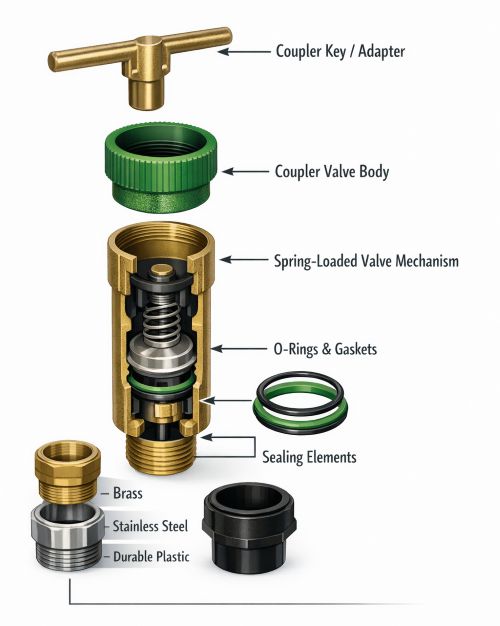
Understanding the components of a quick coupler helps explain how it functions so efficiently.
1. Coupler Valve (Body)
The main housing installed into the irrigation pipeline, typically underground or flush with the ground surface.
2. Coupler Key or Adapter
A removable tool that activates the valve. Without the key, water cannot flow.
3. Valve Mechanism
➡️ Spring-loaded or pressure-activated systems that automatically open and close the valve
➡️ Ensures water shuts off immediately when the key is removed
4. Sealing Elements
➡️ O-rings and gaskets prevent leaks and maintain water pressure
➡️ Essential for long-term performance
Materials Commonly Used
➡️ Brass: Durable, corrosion-resistant, and suitable for high-pressure systems
➡️ Stainless steel: Ideal for harsh or industrial environments
➡️ Plastic (polymer): Lightweight and cost-effective for lighter-duty applications
How Does an Irrigation Quick Coupler Work?
The operation of an irrigation quick coupler is simple and efficient.
Step-by-Step Operating Process
`1. Coupler valve installation: The valve is installed underground or directly into the irrigation pipeline.
2. Valve remains closed: When not in use, the internal mechanism keeps the valve sealed.
3. Coupler key insertion: The user inserts the coupler key into the valve.
4. Valve opens: The key pushes down or twists the internal mechanism, allowing water to flow.
5. Water delivery: Water flows through the key into the attached hose or sprinkler.
6. Automatic shut-off: When the key is removed, the valve instantly closes and stops the water flow.
Pressure Control and Leak Prevention
Quick couplers are designed to handle system pressure while maintaining a tight seal. The internal valve and O-rings ensure minimal pressure loss and prevent leaks, even with frequent use.
Safety and Convenience
Because the valve remains closed unless activated, quick couplers reduce accidental water discharge, improve safety, and keep irrigation points clean and discreet.
Types of Irrigation Quick Couplers
There are several types of irrigation quick couplers available to suit different systems and applications.
1. Key-operated quick couplers: Most common; require a specific key to operate
2. Push-type or twist-lock couplers: Allow quick engagement with minimal effort
3. Threaded vs. non-threaded designs: For compatibility with different pipe connections
4. Size variations: Available in multiple diameters to match system flow needs
5. Pressure ratings: Designed to handle low, medium, or high-pressure systems
Choosing the right type ensures proper performance and long service life.
Benefits of Using Irrigation Quick Couplers
Irrigation quick couplers offer numerous advantages:
1. Quick and easy connections for hoses and sprinklers
2. Improved water efficiency by reducing unnecessary flow
3. Reduced water waste and leaks
4. Flexibility to use multiple irrigation points
5. Time and labor savings for operators
6. Enhanced system safety and cleanliness
These benefits make quick couplers a smart investment for any irrigation system.
Common Applications of Irrigation Quick Couplers
Quick couplers are used across a wide range of industries and settings, including:
1. Agricultural irrigation systems
2. Greenhouses and plant nurseries
3. Landscape and garden irrigation
4. Golf courses and sports fields
5. Industrial and municipal water systems
Their versatility makes them suitable for both temporary and permanent irrigation needs.
How to Choose the Right Irrigation Quick Coupler
When selecting a quick coupler, consider the following factors:
1. System pressure and flow requirements
2. Material selection based on environment and water quality
3. Size and compatibility with existing pipelines
4. Durability and maintenance needs
5. Compliance with industry standards and certifications
Choosing the correct coupler ensures reliable performance and long-term efficiency.
Installation and Maintenance Basics
Installation Overview
Quick couplers are typically installed underground with a protective cover at ground level. Proper alignment and sealing are critical.
Best Practices
➡️ Install at convenient, accessible locations
➡️ Ensure correct depth to prevent damage
➡️ Use compatible fittings and seals
Maintenance Tips
➡️ Inspect O-rings and seals regularly
➡️ Clean debris from the valve
➡️ Replace worn components promptly
Common Mistakes to Avoid
➡️ Incorrect sizing
➡️ Poor sealing
➡️ Ignoring pressure ratings
Signs a Quick Coupler Needs Replacement
➡️ Persistent leaks
➡️ Difficulty operating the valve
➡️ Reduced water flow
Common Issues and Troubleshooting
Some common issues include:
1. Leaking couplers: Often caused by worn seals
2. Difficulty inserting or removing the key: May indicate debris or internal damage
3. Reduced water flow: Could result from blockages or pressure issues
4. Seal wear and tear: Normal over time and easy to replace
For complex issues, consulting an irrigation professional is recommended.
Frequently Asked Questions (FAQ)
.
1. What is the purpose of an irrigation quick coupler?
The main purpose of a quick coupler is to improve flexibility and efficiency in irrigation systems by providing temporary water access points for hoses, sprinklers, or cleaning tasks.
2. Where are irrigation quick couplers commonly used?
Irrigation quick couplers are widely used in agriculture, landscaping, gardens, golf courses, sports fields, greenhouses, and commercial or residential irrigation systems.
3. Do irrigation quick couplers help save water?
Yes. Quick couplers reduce water waste by staying closed when not in use, preventing leaks, and allowing controlled water delivery only where and when needed.
4. Are irrigation quick couplers safe to use?
Yes. Because they remain closed unless activated with a key, quick couplers reduce accidental water discharge, improve system safety, and keep irrigation access points clean and secure.
5. Can irrigation quick couplers be used in high-pressure systems?
Yes, as long as the quick coupler is rated for the system’s operating pressure. Always check pressure ratings before installation.
6. How long do irrigation quick couplers last?
With proper material selection and regular maintenance, irrigation quick couplers can last many years, even in demanding agricultural or commercial environments.
Conclusion
Irrigation quick couplers are essential components that enhance the flexibility, efficiency, and reliability of modern irrigation systems. By allowing fast, secure access to water at multiple points, they save time, reduce waste, and improve overall system performance.
From agriculture and landscaping to sports fields and municipal systems, quick couplers offer practical benefits across many applications. Evaluating your current irrigation setup and upgrading with quality quick couplers can lead to better water management and long-term cost savings.
Post time: Jan-16-2026