

Hydraulic systems often need to transfer fluid between components that move or rotate during operation. In these situations, standard hydraulic fittings may not provide enough flexibility. When hoses or pipes are connected to rotating equipment, continuous movement can cause twisting, stress, and premature wear. Hydraulic rotating connectors help solve this problem by allowing fluid to flow between stationary and rotating components while maintaining a secure connection.
These connectors are widely used in construction machinery, industrial automation, agricultural equipment, marine systems, and other applications involving rotational movement. Depending on the design, they can support different pressure levels, flow requirements, and rotation conditions.
Understanding how hydraulic rotating connectors work, their common types, and their applications can help engineers and equipment manufacturers select the right components for their systems.
What Are Hydraulic Rotating Connectors?
Hydraulic rotating connectors are specialized fluid connection components designed to transfer hydraulic oil between two parts that rotate relative to each other. They allow one section of a hydraulic system to rotate while maintaining a continuous fluid connection with another section.
Unlike standard hydraulic fittings, which generally create fixed connections, rotating connectors incorporate internal moving interfaces and dynamic sealing elements. These features allow rotational movement without disconnecting the hydraulic circuit.
A typical hydraulic rotating connector consists of a housing, rotating shaft or spindle, internal fluid passages, and sealing components. Depending on its design, it may support one or multiple hydraulic circuits.
For example, an excavator requires hydraulic connections between its stationary undercarriage and rotating upper structure. A suitable rotary hydraulic connection allows hydraulic fluid to reach the required circuits while the upper structure rotates.
By accommodating movement, hydraulic rotating connectors help prevent hose twisting, reduce mechanical stress, and improve the flexibility of hydraulic equipment.
How Do Hydraulic Rotating Connectors Work?
Hydraulic rotating connectors work by maintaining a sealed fluid passage between components that move relative to each other.
One part of the connector is attached to a stationary section, while another part connects to the rotating equipment. As the equipment turns, the internal rotating section moves while the external connection remains in place.
Hydraulic fluid travels through internal passages designed to maintain flow during rotation. Dynamic seals separate the fluid channels and prevent oil from leaking between passages or escaping from the connector.
The basic operating process involves several steps:
1. Fluid enters the connector: Hydraulic oil flows from the stationary hydraulic supply into the connector’s inlet port.
2. Fluid passes through internal channels: Internal passages guide the oil through the connector.
3. The rotating section moves: The shaft or rotating assembly turns relative to the housing.
4. Fluid reaches the rotating equipment: The outlet passages deliver hydraulic oil to the connected components.
5. Seals maintain pressure: Dynamic sealing elements help prevent leakage throughout the rotation process.
The exact construction varies depending on the connector type, number of fluid passages, operating pressure, and rotation requirements.
A properly selected hydraulic rotating connector must maintain reliable sealing and fluid transfer under the expected operating conditions.
Main Components of Hydraulic Rotating Connectors
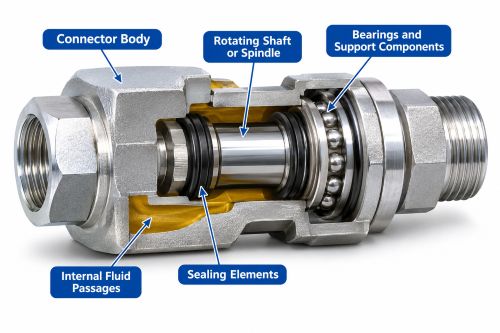
Although hydraulic rotating connectors are available in different designs, most contain several essential components that work together to provide fluid transfer and rotational movement.
Connector Body
The connector body is the main structural housing. It supports the internal components and provides the mechanical strength needed to withstand hydraulic pressure and external operating loads.
It is commonly manufactured from carbon steel or stainless steel, depending on the application and environmental conditions.
The body also contains the connection ports and internal fluid passages.
Rotating Shaft or Spindle
The rotating shaft or spindle allows one part of the connector to move relative to another.
It is designed to maintain proper alignment during rotation and provide a stable connection between the stationary and moving sections.
Its dimensions, surface finish, and manufacturing accuracy can influence rotational performance and sealing reliability.
Sealing Elements
Sealing elements prevent hydraulic fluid from escaping through the rotating interface or leaking between separate fluid passages.
Because these seals operate under relative movement, they must withstand friction, pressure, temperature changes, and continuous contact with hydraulic fluid.
Common sealing materials include:
1. NBR (Nitrile Rubber): Commonly used in hydraulic applications because of its oil resistance and practical sealing performance.
2. FKM (Fluoroelastomer): Suitable for applications requiring improved resistance to elevated temperatures and certain chemicals.
3. EPDM: Used in specific applications where fluid compatibility requirements make it appropriate.
The correct seal material depends on the hydraulic fluid, operating temperature, pressure, and equipment requirements.
Internal Fluid Passages
Internal fluid passages provide channels for hydraulic oil to travel through the connector.
Single-passage designs carry fluid through one circuit, while multi-passage designs can accommodate several independent hydraulic circuits.
The size and arrangement of these passages affect flow capacity and pressure loss.
Bearings and Support Components
Some hydraulic rotating connectors incorporate bearings or other support components to help maintain alignment and reduce friction during rotation.
These components support smooth movement and can help manage mechanical loads, depending on the connector’s construction.
Their design is particularly important in equipment that operates continuously or experiences frequent rotational movement.
Common Types of Hydraulic Rotating Connectors
Hydraulic rotating connectors are available in several configurations. Each type is designed to meet different fluid transfer, pressure, and rotational requirements.
Single-Passage Hydraulic Rotating Connectors
Single-passage hydraulic rotating connectors are designed to transfer fluid through one independent hydraulic circuit.
Their relatively simple internal structure makes them suitable for equipment that requires a single fluid connection between stationary and rotating components.
Typical applications include certain hydraulic rotary mechanisms, rotating equipment, and specialized machinery.
Multi-Passage Hydraulic Rotating Connectors
Multi-passage hydraulic rotating connectors contain multiple internal fluid channels within one assembly.
Each passage can carry hydraulic fluid to a separate circuit, allowing several hydraulic functions to operate through a single rotating connection.
These connectors are useful in complex machinery that requires multiple hydraulic lines to cross a rotating interface.
Their internal design must provide reliable separation between fluid channels to prevent cross-port leakage.
360-Degree Hydraulic Rotating Connectors
360-degree hydraulic rotating connectors are designed to accommodate a full rotation between connected components.
Depending on the design, they may support continuous or repeated rotation without requiring hydraulic hoses to twist around the connection.
They are commonly used in equipment such as excavators, industrial rotary platforms, and specialized construction machinery.
When selecting this type, buyers should check the permitted rotational speed, pressure rating, flow capacity, and service requirements.
High-Pressure Hydraulic Rotating Connectors
High-pressure hydraulic rotating connectors are designed for hydraulic systems operating under demanding pressure conditions.
Their housings, rotating interfaces, and sealing components must be suitable for the specified working pressure and potential pressure fluctuations.
These connectors may be used in heavy industrial equipment, construction machinery, and specialized hydraulic applications.
It is important to distinguish between maximum working pressure and peak pressure when selecting a high-pressure connector. The manufacturer’s rated specifications should always guide the selection.
Hydraulic Swivel Joints
Hydraulic swivel joints allow connected hydraulic components to rotate or change orientation while maintaining fluid communication.
They are commonly used in applications where hoses or pipes need greater movement flexibility.
Depending on their construction, swivel joints may support limited angular movement or full rotational movement.
Although the terms hydraulic swivel joint, rotary union, and rotating connector are sometimes used interchangeably, they do not always describe identical products. Their exact functions and capabilities depend on the manufacturer’s design.
Key Functions and Benefits of Hydraulic Rotating Connectors
Hydraulic rotating connectors provide several advantages in equipment that requires fluid transfer across moving interfaces.
Continuous Fluid Transfer
Their primary function is to maintain hydraulic fluid flow between stationary and rotating components.
This allows hydraulic equipment to perform rotational movements without interrupting the connected fluid circuits.
Prevention of Hose Twisting
When standard hydraulic hoses are connected directly to rotating components, repeated movement can create torsional stress.
A suitable rotating connector reduces this problem by allowing movement at the connection point rather than forcing the hose to twist.
Improved Equipment Flexibility
Rotating connectors provide greater freedom in equipment design.
Engineers can arrange hydraulic circuits around rotating platforms, joints, and other moving structures without relying entirely on flexible hose movement.
Reduced Leakage Risks
Properly designed rotating connectors use dynamic sealing elements to maintain a fluid-tight connection during operation.
Correct seal selection, manufacturing accuracy, and suitable installation are essential for achieving reliable sealing performance.
Improved Operational Efficiency
By supporting smooth rotational movement and continuous fluid transfer, these connectors help hydraulic equipment operate more efficiently.
They also reduce the likelihood of maintenance issues associated with excessive hose movement and connection stress.
Longer Component Service Life
When correctly selected and maintained, hydraulic rotating connectors can help reduce wear on connected hoses, fittings, and other hydraulic components.
This can contribute to more reliable equipment operation and lower maintenance requirements.
Common Applications of Hydraulic Rotating Connectors
Hydraulic rotating connectors are used across various industries where machinery requires rotational movement and continuous hydraulic fluid transfer.
Construction Machinery
Construction equipment is one of the most common application areas.
For example, excavators use hydraulic rotary joints to transfer fluid between the stationary undercarriage and rotating upper structure. This arrangement allows the upper structure to rotate while maintaining connections to the required hydraulic circuits.
Other applications include:
1. Hydraulic cranes
2. Concrete pumping equipment
3. Drilling machinery
4. Material handling equipment
Industrial Automation Equipment
Industrial machinery often includes rotating platforms, indexing tables, and automated production systems.
Hydraulic rotating connectors can supply fluid to moving mechanisms without requiring hoses to move excessively.
They are useful in equipment where compact installation and reliable fluid transfer are important.
Agricultural Machinery
Some agricultural machines use rotating hydraulic components to operate specialized attachments and implements.
Rotating connectors help maintain hydraulic connections while equipment sections change position or rotate during operation.
Applications may include specialized harvesting equipment and hydraulic implements.
Marine and Offshore Equipment
Marine and offshore machinery can require hydraulic fluid transfer across rotating equipment interfaces.
Hydraulic rotating connectors may be used in deck machinery, lifting systems, and other specialized equipment.
For these applications, corrosion resistance, seal compatibility, and environmental protection are particularly important.
Specialized Hydraulic Systems
Other applications include hydraulic rotary tables, industrial testing equipment, rotating work platforms, and heavy-duty machinery.
The required connector configuration depends on the number of hydraulic circuits, pressure conditions, rotational speed, and installation space.
Materials and Sealing Options for Hydraulic Rotating Connectors
Material selection plays an important role in the durability and performance of hydraulic rotating connectors.
The connector body must withstand operating pressure and mechanical stress, while its sealing components must remain compatible with the hydraulic fluid and working environment.
Common Manufacturing Materials
➡️ Carbon Steel
Carbon steel is widely used for hydraulic components because of its strength, machinability, and cost-effectiveness.
It is suitable for many industrial and mobile hydraulic applications when combined with an appropriate surface treatment.
➡️ Stainless Steel
Stainless steel offers improved corrosion resistance compared with ordinary carbon steel.
It is commonly selected for equipment exposed to moisture, chemicals, or demanding environmental conditions.
➡️ Brass
Brass can be used in certain lower-pressure or specialized fluid connection applications. Its suitability depends on the required mechanical strength, pressure rating, and fluid compatibility.
Surface Treatments
Surface treatments help protect metal components from corrosion and environmental damage.
Common options include:
1. Zinc plating: Provides a protective coating for carbon steel components.
2. Zinc-nickel plating: Offers enhanced corrosion protection in demanding environments.
3. Electroless nickel plating: Provides a uniform nickel coating with good wear and corrosion resistance.
4. Stainless steel passivation: Improves the corrosion resistance of stainless steel surfaces.
The appropriate finish depends on the operating environment and customer specifications.
Sealing Materials
Sealing materials should be selected according to hydraulic fluid compatibility, pressure, temperature, and rotational conditions.
NBR and FKM are common options in hydraulic applications, while EPDM may be suitable for certain compatible fluids and operating environments.
Using an unsuitable sealing material can lead to swelling, hardening, leakage, or premature seal failure.
Hydraulic Rotating Connectors vs. Standard Hydraulic Fittings
Hydraulic rotating connectors and standard hydraulic fittings both provide fluid connections, but their designs and functions are different.
Standard hydraulic fittings generally connect hoses, tubes, pipes, and other hydraulic components in fixed positions. Hydraulic rotating connectors are specifically designed to accommodate relative rotational movement while maintaining fluid transfer.
|
Feature |
Hydraulic Rotating Connectors |
Standard Hydraulic Fittings |
|
Main function |
Transfer fluid during rotation |
Connect hydraulic components |
|
Movement |
Allow relative rotational movement |
Generally fixed after installation |
|
Internal structure |
Rotating interface and dynamic seals |
Fixed connection and static sealing |
|
Typical applications |
Rotating machinery and platforms |
Hydraulic hoses, pipes, and tubes |
|
Design requirements |
Rotation, pressure, and dynamic sealing |
Pressure resistance and connection sealing |
|
Maintenance considerations |
Rotation and seal condition |
Connection tightness and seal condition |
Neither product is universally better than the other. The right choice depends on whether the hydraulic system requires rotational movement at the connection point.
How to Choose the Right Hydraulic Rotating Connector
Selecting the correct hydraulic rotating connector requires more than checking the connection size. Engineers and buyers should consider several operating parameters to ensure the component meets the requirements of the hydraulic system.
Operating Pressure
Check the connector’s rated working pressure and compare it with the hydraulic system’s maximum operating pressure.
Also consider pressure spikes and fluctuations that may occur during equipment operation.
Never select a connector based only on its physical dimensions or appearance.
Flow Rate
Determine the hydraulic flow rate required by the connected equipment.
The internal passage dimensions should accommodate the required flow without creating excessive pressure loss or unwanted fluid heating.
Rotation Requirements
Consider how the connected components will move.
Important factors include:
1. Limited or continuous rotation
2. Maximum rotational speed
3. Rotation direction
4. Frequency of movement
5. Expected service life
A connector designed for occasional rotation may not be appropriate for continuous high-speed operation.
Hydraulic Fluid Compatibility
Check whether the connector’s body materials and sealing elements are compatible with the hydraulic fluid.
This is particularly important when the system uses specialized hydraulic oils or operates under unusual temperature conditions.
Operating Temperature
Both the connector body and sealing materials must withstand the expected operating temperature range.
High temperatures can accelerate seal aging, while low temperatures may affect seal flexibility and performance.
Connection Types and Dimensions
Check the inlet and outlet connection specifications before purchasing.
These may include:
1. BSP threads
2. NPT threads
4. SAE connections
Other application-specific interfaces
Correct thread identification and dimensional compatibility are essential for proper installation and sealing.
Environmental Conditions
Consider the environment in which the equipment operates.
Factors such as moisture, dust, vibration, corrosion, and external mechanical loads can affect connector performance.
For outdoor or marine applications, corrosion-resistant materials and appropriate protective finishes may be necessary.
Common Problems with Hydraulic Rotating Connectors and How to Solve Them
Like other hydraulic components, rotating connectors can experience performance problems over time. Understanding the common causes can help maintenance teams identify issues before they lead to equipment downtime.
Hydraulic Fluid Leakage
Leakage is one of the most common problems.
Possible causes include worn seals, damaged sealing surfaces, incorrect installation, excessive pressure, or incompatible sealing materials.
Solution: Inspect the sealing elements and contact surfaces. Replace damaged seals and verify that the connector operates within its specified pressure and temperature limits.
Excessive Rotational Resistance
A connector that becomes difficult to rotate may indicate internal wear, contamination, misalignment, or mechanical damage.
Solution: Inspect the rotating assembly and supporting components. Check for contamination and follow the manufacturer’s maintenance recommendations.
Pressure Loss
Unexpected pressure loss may result from restricted internal passages, leakage, or an undersized connector.
Solution: Check the internal flow path and verify that the connector is suitable for the system’s required flow rate and pressure.
Premature Seal Failure
Seals may deteriorate when exposed to incompatible hydraulic fluids, excessive temperatures, contamination, or unsuitable operating conditions.
Solution: Select sealing materials based on actual fluid and temperature requirements. Maintain clean hydraulic fluid and inspect seals regularly.
Excessive Wear
Continuous rotation, vibration, contamination, and unsuitable operating loads can contribute to premature wear.
Solution: Check rotational speed, installation alignment, and operating conditions. Replace worn components according to the manufacturer’s recommendations.
Maintenance Tips for Hydraulic Rotating Connectors
Regular maintenance helps preserve sealing performance and extend the service life of hydraulic rotating connectors.
Here are some practical maintenance recommendations:
1. Inspect for leakage: Regularly check the connector housing, ports, and rotating interface for hydraulic oil leakage.
2. Monitor rotational movement: Pay attention to unusual resistance, noise, or vibration during operation.
3. Check sealing components: Replace worn or damaged seals before they cause more serious problems.
4. Maintain clean hydraulic fluid: Contamination can accelerate wear and damage internal components.
5. Inspect for corrosion: Check exposed metal surfaces for corrosion, particularly in outdoor and marine environments.
6. Verify operating conditions: Ensure that pressure, temperature, flow rate, and rotational speed remain within the manufacturer’s specifications.
7. Follow maintenance schedules: Use the manufacturer’s recommended inspection and replacement intervals.
A consistent maintenance routine can help reduce unexpected failures and improve the reliability of the overall hydraulic system.
Why Choose Sannke for Hydraulic Fittings and Custom Solutions?
Choosing a reliable hydraulic fitting manufacturer is important for maintaining connection quality and consistent product performance.
Sannke specializes in hydraulic fittings and connection components, offering manufacturing and customization services for customers with different industrial requirements.
With 15 years of manufacturing experience, Sannke supports OEM and ODM projects for hydraulic fitting products and related connection solutions.
Key manufacturing services include:
1. OEM and ODM Manufacturing: Customized hydraulic fittings and adapters produced according to customer drawings, samples, and technical specifications.
2. Material Selection: Carbon steel, stainless steel, and brass options for different applications.
3. Surface Treatment Options: Zinc plating, zinc-nickel plating, and other protective finishes based on customer requirements.
4. Custom Product Development: Support for specialized hose fittings, adapters, ferrules, flanges, and hydraulic accessories.
5. Engineering and Production Support: Experienced engineers and advanced manufacturing equipment help support product development and production requirements.
6. Free Samples: Available for customers who need to evaluate product dimensions and specifications before placing bulk orders.
For buyers developing specialized hydraulic systems, working with an experienced manufacturer can help simplify product customization and sourcing.
If you need custom hydraulic fittings or connection components, contact Sannke to discuss your drawings, technical requirements, and OEM or ODM manufacturing needs.
Frequently Asked Questions (FAQs)
1. What is a hydraulic rotating connector?
A hydraulic rotating connector is a fluid connection component that transfers hydraulic oil between stationary and rotating parts of a machine. It allows relative rotational movement while maintaining a sealed hydraulic connection.
2. How does a hydraulic rotating connector work?
It uses internal fluid passages and dynamic sealing elements to maintain hydraulic flow between connected components as they rotate relative to each other.
3. What is the difference between a hydraulic rotating connector and a rotary union?
The terms are sometimes used interchangeably. However, a rotary union generally refers to a device that transfers fluid between stationary and rotating equipment, while hydraulic rotating connector is a broader description that can include different rotating hydraulic connection designs.
4. Can hydraulic rotating connectors rotate 360 degrees?
Yes. Certain designs support full 360-degree rotation, including continuous rotation. However, the permitted rotational range and speed depend on the specific connector design.
5. What is the difference between single-passage and multi-passage rotating connectors?
A single-passage connector transfers fluid through one independent circuit. A multi-passage connector contains several separate channels, allowing multiple hydraulic circuits to pass through one rotating assembly.
6. What materials are used to manufacture hydraulic rotating connectors?
Common materials include carbon steel, stainless steel, and brass. The appropriate choice depends on pressure requirements, corrosion exposure, mechanical strength, and operating conditions.
7. How do hydraulic rotating connectors prevent fluid leakage?
They use dynamic seals between rotating and stationary surfaces. Proper seal material selection, surface finish, manufacturing accuracy, and installation are important for preventing leakage.
8. How do I choose the right hydraulic rotating connector?
Consider operating pressure, flow rate, rotational speed, rotation range, hydraulic fluid compatibility, temperature, connection dimensions, and environmental conditions.
9. How often should hydraulic rotating connectors be inspected?
Inspection frequency depends on operating conditions and manufacturer recommendations. Equipment used continuously or in harsh environments may require more frequent checks for leakage, wear, vibration, and abnormal rotational resistance.
10. Can hydraulic rotating connectors be customized?
Yes. Depending on the manufacturer’s capabilities, rotating hydraulic connection components can be customized according to port configurations, dimensions, materials, pressure requirements, and equipment installation needs.
Conclusion
Hydraulic rotating connectors play an important role in hydraulic equipment that requires fluid transfer between stationary and rotating components. By maintaining hydraulic flow during movement, they help prevent hose twisting, reduce mechanical stress, and improve equipment flexibility.
From single-passage connectors to multi-passage rotary unions and high-pressure rotating joints, different designs serve different operating requirements. Choosing the right component requires careful consideration of pressure, flow rate, rotational speed, sealing materials, and installation conditions.
For equipment manufacturers and hydraulic system designers, selecting reliable connection components is essential for long-term performance. Working with an experienced hydraulic fitting manufacturer such as Sannke can also provide access to customized hydraulic connection solutions that meet specific project requirements.
Post time: Nov-27-2026