

Hydraulic fittings with O-ring seals are designed to create reliable, leak-resistant connections in hydraulic systems. The O-ring provides the sealing function, while the fitting body and threads provide mechanical strength and secure the connection.
These fittings are widely used in construction equipment, agricultural machinery, industrial hydraulic systems, mobile equipment, pumps, valves, and cylinders. Their popularity comes from a relatively simple design that can provide dependable sealing even when systems operate under high pressure, vibration, and temperature changes.
But not every O-ring fitting is the same. The fitting design, O-ring material, thread type, pressure rating, and installation method all affect sealing performance. Understanding these factors makes it easier to select the right connection for a particular hydraulic application.
What Are Hydraulic Fittings with O-Ring?
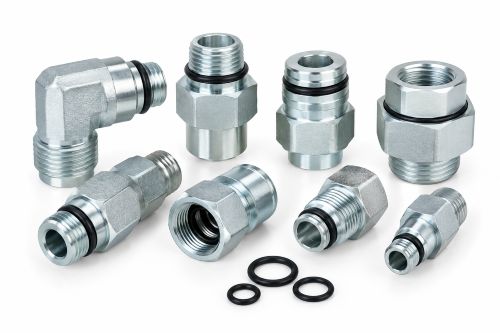
Hydraulic fittings with O-ring are connection components that use an elastomeric O-ring as the primary sealing element. Instead of relying only on metal-to-metal contact or thread sealant, the O-ring is compressed between mating surfaces to create a fluid-tight seal.
The fitting normally consists of a metal body, a threaded or mechanical connection, and an O-ring positioned in a specially designed groove or sealing area.
When the fitting is installed correctly, the O-ring becomes compressed between the fitting and its mating component. This deformation fills small surface irregularities and creates a barrier that helps prevent hydraulic fluid from escaping.
O-ring hydraulic fittings are available in many configurations. Common examples include O-ring face seal (ORFS) fittings, O-ring boss (ORB) fittings, O-ring flange connections, and various specialized hydraulic adapters.
How Do Hydraulic Fittings with O-Ring Work?
The basic sealing principle is straightforward.
When an O-ring is placed into its groove and the fitting is connected to the mating port, the two components compress the O-ring. The rubber seal deforms and fills the available sealing space.
As hydraulic pressure increases, the O-ring can also be pressed against the sealing surfaces, depending on the fitting design. This helps maintain the seal during normal operation.
The threads themselves do not necessarily provide the primary fluid seal in many O-ring fitting designs. Instead, their main function is to hold the components together and provide the required mechanical connection.
This is one reason O-ring fittings can provide reliable sealing without depending entirely on thread interference or thread sealants.
However, the seal only works properly when the O-ring, groove, mating surface, and fitting dimensions are correctly matched.
Main Components of a Hydraulic Fitting with O-Ring
Although designs vary, most hydraulic fittings with O-ring include several important components.
Fitting Body
The fitting body is the main structural component. It contains the fluid passage and provides the connection between hoses, tubes, ports, valves, cylinders, or other hydraulic components.
Fitting bodies are commonly manufactured from carbon steel, stainless steel, brass, or other materials selected according to the application.
O-Ring Seal
The O-ring is the main sealing element. It is normally manufactured from an elastomer selected for compatibility with the hydraulic fluid, temperature range, and operating conditions.
The correct O-ring size is important. An undersized, oversized, damaged, or incorrectly positioned O-ring may leak even when the fitting itself is correctly manufactured.
Threaded Section
The threaded section connects the fitting to the mating component. Depending on the fitting, this may be a straight thread, tapered thread, or another standardized connection.
The thread specification must match the mating port. Using incompatible thread types can cause leakage, damaged threads, or an unreliable connection.
Sealing Groove or Seat
The groove or sealing area positions the O-ring and controls how much it is compressed during assembly.
Its dimensions are important because excessive compression can damage the O-ring, while insufficient compression may result in leakage.
Hex Section
Many hydraulic fittings have a hexagonal section that allows a wrench or other suitable tool to be used during installation and removal.
The hex size and fitting geometry are designed to provide adequate tightening access without damaging the fitting.
Common Types of Hydraulic Fittings with O-Ring
Different O-ring connection designs are used for different hydraulic applications.
O-Ring Face Seal (ORFS) Fittings
ORFS fittings use an O-ring located on the flat face of the fitting. When the fitting is connected to its mating component, the O-ring is compressed between the two flat sealing surfaces.
This design provides an effective sealing arrangement and is commonly used in high-pressure hydraulic applications where minimizing leakage is important.
ORFS fittings are often found in mobile equipment, construction machinery, industrial hydraulic systems, and other demanding applications.
O-Ring Boss (ORB) Fittings
O-ring boss fittings use a straight thread together with an O-ring positioned near the base of the male fitting.
The O-ring seals against a specially machined surface in the port. The straight thread provides the mechanical connection, while the O-ring performs the primary sealing function.
ORB fittings are commonly used with hydraulic valves, pumps, cylinders, manifolds, and other components.
O-Ring Flange Connections
O-ring flange connections are designed for applications where a strong mechanical connection is required, particularly on larger hydraulic lines.
The O-ring is positioned in a groove on the flange face. When the flange halves are tightened together, the O-ring is compressed to create the seal.
These connections are commonly used in high-flow and high-pressure hydraulic systems.
O-Ring Swivel Fittings
O-ring swivel fittings combine an O-ring sealing arrangement with a swivel mechanism.
The swivel allows the hose or fitting to be oriented more easily during installation. This can be particularly useful where hose routing, movement, or alignment is an issue.
Materials Used for Hydraulic Fittings and O-Rings
Material selection is an important part of hydraulic fitting design.
Hydraulic Fitting Materials
Carbon steel is widely used because it offers good mechanical strength, durability, and cost efficiency. Surface treatments such as zinc plating can improve corrosion resistance.
Stainless steel is selected when greater corrosion resistance is required. It is often used in environments exposed to moisture, chemicals, salt, or other corrosive conditions.
Brass can be suitable for certain hydraulic or fluid applications where the pressure, mechanical load, and fluid compatibility are appropriate.
The fitting material should always be selected according to the actual operating environment rather than price alone.
O-Ring Materials
The O-ring material is equally important because different elastomers have different temperature and chemical resistance.
NBR (nitrile rubber) is commonly used with petroleum-based hydraulic fluids and offers a practical combination of sealing performance and cost.
FKM (fluorocarbon) provides good resistance to elevated temperatures and many chemicals, making it suitable for more demanding environments.
EPDM can be appropriate for certain water-based hydraulic fluids and applications where compatibility with petroleum-based fluids is not required.
The correct O-ring material should be determined based on the hydraulic fluid, operating temperature, pressure, and environmental conditions.
Benefits of Hydraulic Fittings with O-Ring
Hydraulic fittings with O-ring provide several advantages when properly selected and installed.
Reliable Leak Prevention
The O-ring creates a dedicated sealing barrier between mating surfaces. This can help reduce hydraulic fluid leakage and maintain system cleanliness.
Good Pressure-Sealing Performance
Many O-ring fitting designs are intended for high-pressure hydraulic service. Proper O-ring compression and fitting geometry help maintain sealing performance during operation.
Resistance to Vibration
Hydraulic equipment can experience significant vibration and movement. A properly designed O-ring connection can maintain effective sealing under these conditions.
Wide Range of Applications
O-ring fittings are available in many sizes, thread configurations, materials, and connection styles. This makes them suitable for everything from compact hydraulic systems to heavy equipment.
Replaceable Sealing Elements
In many designs, the O-ring can be replaced separately when it becomes damaged or worn. This can make routine maintenance more practical than replacing the complete fitting.
Where Are Hydraulic Fittings with O-Ring Used?
O-ring hydraulic fittings can be found across many industries.
Construction Equipment
Excavators, loaders, bulldozers, cranes, and other construction machines rely on hydraulic systems to operate cylinders, motors, and attachments.
Because these machines experience pressure, vibration, dirt, and changing environmental conditions, reliable hydraulic connections are essential.
Agricultural Machinery
Tractors, harvesters, sprayers, and other agricultural equipment use hydraulic circuits for steering, lifting, braking, and implements.
O-ring fittings can provide reliable connections while helping reduce fluid leakage during demanding field operations.
Industrial Machinery
Hydraulic presses, machine tools, injection molding equipment, production machinery, and hydraulic power units may use O-ring fittings throughout their hydraulic circuits.
Mobile Hydraulic Systems
Mobile hydraulic equipment often requires fittings that can tolerate vibration, movement, and limited installation space. O-ring fittings are available in configurations suited to these requirements.
Pumps, Valves, and Cylinders
Hydraulic pumps, control valves, manifolds, and cylinders contain numerous ports and connection points. O-ring fittings can be used to connect these components to hoses, tubes, and other hydraulic equipment.
How to Choose the Right Hydraulic Fitting with O-Ring
Choosing an O-ring hydraulic fitting involves more than simply matching the fitting size.
1. Identify the Connection Type
First determine whether the application requires an ORFS, ORB, flange, swivel, or another type of connection.
The mating port must be compatible with the fitting design.
2. Check the Thread Specification
Confirm the thread type, size, pitch, and applicable standard.
Do not assume that two fittings with the same nominal size will have compatible threads. Metric, JIC, NPT, BSP, and other connection systems have different specifications.
3. Check the Pressure Rating
The fitting should be suitable for the system’s maximum operating pressure.
Consider pressure spikes as well as normal working pressure, especially in systems with rapid actuator movement or changing loads.
4. Select the Correct O-Ring Material
Consider the hydraulic fluid and operating temperature before choosing the O-ring.
An O-ring that works well with one hydraulic fluid may not be suitable for another.
5. Consider Temperature
Both the fitting material and O-ring material need to withstand the actual temperature range.
High temperatures can accelerate elastomer aging, while very low temperatures can affect flexibility and sealing performance.
6. Consider the Environment
Moisture, salt, chemicals, dust, vibration, and outdoor exposure can all affect fitting performance.
For corrosive environments, a suitable fitting material or surface treatment may be necessary.
7. Confirm Dimensions
Check the O-ring size, fitting dimensions, port dimensions, and available installation space before ordering.
Correct dimensional matching is essential for achieving the intended sealing performance.
Installation and Maintenance Tips
Even a high-quality hydraulic fitting can leak if it is installed incorrectly.
Before installation, inspect the O-ring carefully. Look for cuts, cracks, flattening, twisting, or other signs of damage.
Clean the fitting and mating surfaces to remove dirt, metal particles, old seal material, and other contamination.
When required, use a lubricant that is compatible with the O-ring material and hydraulic fluid. This can help prevent damage during assembly.
Install the O-ring carefully and make sure it remains correctly positioned. Avoid twisting, pinching, or stretching the seal excessively.
The fitting should then be tightened according to the applicable manufacturer’s instructions. Avoid excessive tightening because too much torque can damage threads, deform components, or affect the O-ring.
During maintenance, inspect connections for visible leakage, damaged seals, corrosion, or loose fittings. If an O-ring has deteriorated, replacing it with the correct size and material is important.
Always depressurize the hydraulic system before removing or servicing a hydraulic connection.
Common Problems with O-Ring Hydraulic Fittings
O-Ring Leakage
Leakage can result from an incorrectly installed O-ring, damaged sealing surface, incorrect seal size, or incompatible material.
O-Ring Extrusion
At high pressure, an O-ring can be forced into a clearance gap if the fitting design or seal selection is unsuitable for the application.
O-Ring Hardening or Cracking
Excessive temperature, aging, or chemical incompatibility can cause an O-ring to become hard, brittle, or cracked.
Damaged Sealing Surfaces
Scratches, burrs, corrosion, or contamination on the mating surface can prevent the O-ring from creating a reliable seal.
Over-Tightening
Applying excessive torque does not necessarily produce a better seal. It can instead damage the fitting, threads, sealing groove, or O-ring.
Hydraulic Fittings with O-Ring vs. Standard Threaded Fittings
One of the main differences between O-ring fittings and conventional threaded connections is how they create the seal.
A traditional tapered-thread connection may rely on thread interference and, depending on the design, a suitable thread sealant. An O-ring fitting uses a dedicated elastomeric seal to close the gap between mating surfaces.
This does not mean O-ring fittings are automatically suitable for every application. The correct connection depends on pressure, fluid, temperature, thread standard, mechanical requirements, and equipment design.
For engineers and buyers, the most important point is to match the fitting design with the port and operating conditions rather than choosing a fitting based only on appearance or nominal size.
Final Thoughts
Hydraulic fittings with O-ring seals provide a practical solution for creating reliable connections in many hydraulic systems. Their sealing performance comes from the interaction between the O-ring, sealing groove, fitting body, mating surface, and mechanical connection.
When selecting an O-ring hydraulic fitting, pay attention to the connection type, thread specification, pressure rating, fitting material, O-ring material, temperature range, and hydraulic fluid compatibility. Proper installation and regular inspection are equally important.
For manufacturers and hydraulic equipment suppliers, choosing the right fitting design and sealing material can help improve system reliability while reducing leakage and maintenance problems. Sannke provides hydraulic fittings and customized hydraulic connection solutions for different industrial applications,
Post time: Oct-02-2026