

Hydraulic systems are the backbone of modern industry—powering everything from construction machinery and agricultural equipment to manufacturing lines and heavy-duty vehicles. At the core of these systems are hydraulic fittings, small but critical components responsible for connecting hoses, pipes, and tubes while maintaining a secure, leak-free flow of fluid under high pressure.
Choosing the right fitting is not just a technical detail—it directly impacts system performance, safety, and longevity. One of the most common challenges engineers, technicians, and buyers face is understanding the differences between hydraulic fitting standards SAE vs BSP vs NPT.
These three standards dominate the global market, yet they are not interchangeable. Using the wrong type can lead to leaks, equipment damage, or even system failure.
In this guide, we’ll break down the key differences between SAE, BSP, and NPT, explain how each works, and help you choose the right fitting for your application.
What Are Hydraulic Fitting Standards?
Hydraulic fitting standards define the thread design, dimensions, and sealing methods used to connect components in a hydraulic system. These standards ensure compatibility, safety, and performance across different equipment and industries.
Why Standards Matter
1. Interchangeability: Ensures components fit correctly
2. Safety: Prevents leaks and pressure failures
3. Efficiency: Maintains optimal system performance
4. Global Compatibility: Supports international manufacturing and supply chains
Without standardized fittings, hydraulic systems would be unreliable and difficult to maintain.
Overview of Hydraulic Fitting Standards SAE vs BSP vs NPT
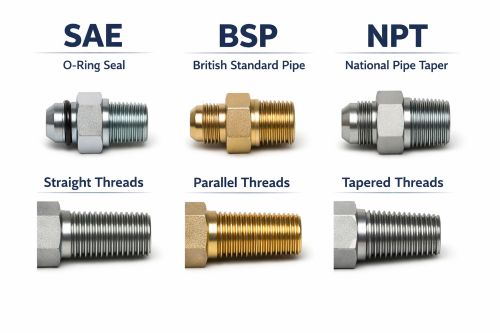
Before diving into details, here’s a quick overview:
|
Standard |
Full Name |
Thread Type |
Common Regions |
|
SAE |
Society of Automotive Engineers |
Straight threads |
North America |
|
BSP |
British Standard Pipe |
Parallel or tapered |
Europe, Asia, Australia |
|
NPT |
National Pipe Taper |
Tapered threads |
USA, Canada |
Each standard differs in thread geometry, sealing method, and application, making proper identification essential.
SAE Hydraulic Fittings
What Is SAE?
SAE stands for Society of Automotive Engineers, a U.S.-based organization that develops standards for automotive and industrial components.
Key Features
1. Straight threads (UN/UNF)
2. Sealing achieved through O-rings or metal-to-metal contact
3. Designed for high-pressure hydraulic systems
4. Highly reliable and reusable
Common Types of SAE Fittings
1. JIC (Joint Industry Council – 37° flare)
2. ORB (O-Ring Boss)
3. ORFS (O-Ring Face Seal)
Each type uses a different sealing mechanism but maintains consistent thread standards.
Applications
SAE fittings are widely used in:
➡️ Construction equipment
➡️ Agricultural machinery
➡️ Heavy-duty vehicles
➡️ Industrial hydraulic systems
They are especially popular in North America due to their durability and leak-resistant design.
BSP Hydraulic Fittings
What Is BSP?
BSP stands for British Standard Pipe, a widely used standard outside North America.
Types of BSP Threads
1. BSPP (British Standard Pipe Parallel)
2. BSPT (British Standard Pipe Tapered)
Key Features
1. 55° thread angle (Whitworth thread form)
2. BSPP uses parallel threads with sealing washers or O-rings
3. BSPT uses tapered threads for sealing
4. Widely used in both hydraulic and plumbing systems
Applications
BSP fittings are common in:
➡️ Europe
➡️ Asia
➡️ Australia
➡️ Industrial and fluid transfer systems
They are often found in imported equipment and international hydraulic systems.
NPT Hydraulic Fittings
What Is NPT?
NPT stands for National Pipe Taper, a U.S. standard for tapered thread fittings.
Key Features
1. Tapered threads only
2. 60° thread angle
3. Seals through thread interference (tightening creates a seal)
4. Requires thread sealant (e.g., PTFE tape)
Advantages
➡️ Strong mechanical connection
➡️ Widely available
➡️ Cost-effective
Limitations
➡️ More prone to leaks if improperly installed
➡️ Not ideal for repeated assembly/disassembly
➡️ Can damage threads if over-tightened
Applications
NPT fittings are used in:
➡️ General industrial piping
➡️ Hydraulic and pneumatic systems
➡️ Oil and gas industries
They are common in North America, especially in lower-pressure or general-purpose applications.
Hydraulic Fitting Standards SAE vs BSP vs NPT: Key Differences
Understanding the differences between these standards is critical to avoiding costly mistakes.
1. Thread Design
➡️ SAE: Straight threads
➡️ BSP: Parallel (BSPP) or tapered (BSPT)
➡️ NPT: Tapered threads only
2. Thread Angle
➡️ SAE: 60°
➡️ BSP: 55°
➡️ NPT: 60°
This difference alone makes BSP incompatible with SAE and NPT.
3. Sealing Methods
➡️ SAE: O-ring or metal-to-metal seal
➡️ BSP: Washer, O-ring, or thread seal
➡️ NPT: Thread deformation + sealant
4. Compatibility
One of the most important points:
➡️ SAE, BSP, and NPT fittings are NOT interchangeable.
Even if threads appear similar, differences in angle, pitch, and sealing method will lead to:
➡️ Leakage
➡️ Thread damage
➡️ System failure
Comparison Table: SAE vs BSP vs NPT
|
Feature |
SAE |
BSP |
NPT |
|
Thread Type |
Straight |
Parallel / Tapered |
Tapered |
|
Thread Angle |
60° |
55° |
60° |
|
Sealing Method |
O-ring / metal |
Washer / thread |
Thread interference |
|
Reusability |
High |
Medium |
Low |
|
Regions |
North America |
Europe, Asia |
USA, Canada |
How to Identify SAE vs BSP vs NPT Fittings
Correct identification is essential before installation or replacement.
1. Visual Inspection
➡️ Check if threads are straight or tapered
➡️ Look for O-rings or sealing washers
2. Measure Thread Angle
➡️ Use a thread gauge
➡️ 55° = BSP
➡️ 60° = SAE or NPT
3. Measure Thread Pitch and Diameter
➡️ Use calipers or measurement tools
➡️ Compare with standard charts
4. Use Identification Tools
➡️ Thread identification kits
➡️ Manufacturer catalogs
➡️ Hydraulic fitting charts
How to Choose the Right Hydraulic Fitting Standard
When selecting between hydraulic fitting standards SAE vs BSP vs NPT, consider the following:
1. System Requirements
➡️ Pressure rating
➡️ Temperature range
➡️ Fluid type
2. Existing Equipment
➡️ Match the current fitting standard
➡️ Avoid mixing thread types
3. Application Environment
➡️ High vibration → choose SAE (O-ring sealing)
➡️ General use → NPT may be sufficient
➡️ International systems → BSP is common
4. Ease of Maintenance
➡️ SAE fittings are easier to reuse
➡️ NPT may require re-sealing
Common Mistakes to Avoid
Mixing Standards
This is the most frequent and costly mistake.
Incorrect Sizing
Even small differences can cause leaks or failure.
Over-Tightening NPT Fittings
Can crack fittings or distort threads.
Ignoring Pressure Ratings
Always ensure fittings meet system requirements.
Conclusion
Understanding hydraulic fitting standards SAE vs BSP vs NPT: key differences is essential for anyone working with hydraulic systems. While these standards may appear similar, their differences in thread design, sealing methods, and applications make them incompatible in most cases.
➡️ SAE is ideal for high-pressure, leak-resistant systems
➡️ BSP is widely used internationally and offers flexibility
➡️ NPT is common and cost-effective but requires careful installation
Choosing the right fitting ensures system efficiency, safety, and long-term reliability.
FAQs
Can SAE, BSP, and NPT fittings be used together?
No. They are not interchangeable and should never be mixed.
Which is better: SAE vs BSP vs NPT?
It depends on your application. SAE is best for high pressure, BSP for global use, and NPT for general applications.
How do I know which fitting I have?
Use thread gauges, measure angles, and compare with standard charts.
Why do hydraulic fittings leak?
Common causes include incorrect fitting type, poor installation, or damaged threads.
What tools are needed to identify fittings?
Thread gauges, calipers, and identification charts are essential tools.
Post time: Apr-17-2026