

Hydraulic systems rely on precision-engineered fittings to transport pressurized fluid safely and efficiently. Among the many connection types available, hydraulic banjo unions stand out for their compact design and exceptional versatility in confined spaces. Unlike standard hydraulic fittings that require straight-line installation, banjo unions allow hydraulic lines to be positioned at different angles while maintaining a secure, leak-resistant seal.
From agricultural machinery and construction equipment to automotive braking systems and industrial hydraulic power units, hydraulic banjo unions are widely used wherever space is limited without compromising system performance.
In this guide, you’ll learn how hydraulic banjo unions work, their main components, available types, materials, advantages, applications, installation practices, troubleshooting methods, and expert maintenance tips.
What Is a Hydraulic Banjo Union?
A hydraulic banjo union is a specialized hydraulic fitting designed to connect hydraulic hoses or tubing to ports in locations where conventional fittings cannot be easily installed.
Its unique design consists of:
1. A circular banjo fitting (banjo body) with a central hole
2. A hollow banjo bolt that passes through the fitting
3. One or two sealing washers that create a leak-proof connection
4. A threaded hydraulic port
Unlike traditional hydraulic fittings, the banjo fitting can rotate freely before the bolt is fully tightened, allowing installers to position hoses at the ideal angle.
Key Features
1. Circular banjo fitting design
2. Hollow banjo bolt construction
3. Compact hydraulic connection
4. High-pressure fluid transfer
5. Excellent for space-saving installations
Hydraulic banjo unions provide reliable, leak-free hydraulic connections in applications where installation space is limited and flexible hose routing is essential.
How Does a Hydraulic Banjo Union Work?
The operating principle of a hydraulic banjo union is simple yet highly effective.
Step 1: Hydraulic Fluid Enters the Banjo Bolt
Pressurized hydraulic fluid enters the threaded end of the hollow banjo bolt.
Step 2: Fluid Travels Through the Internal Bore
The bolt contains a central passage that allows hydraulic oil to travel through its interior.
Step 3: Cross-Drilled Holes Distribute Fluid
Cross-drilled holes located near the head of the bolt allow fluid to exit into the circular chamber inside the banjo fitting.
Step 4: Fluid Flows Into the Hydraulic Hose
The hydraulic fluid then exits through the hose or tube connected to the banjo body.
Step 5: Sealing Washers Prevent Leakage
Copper, aluminum, bonded seals, or O-rings create a pressure-tight seal between the bolt, fitting, and mounting surface.
Working Characteristics
1. Internal fluid flow path minimizes restrictions.
2. Pressure sealing prevents hydraulic oil leaks.
3. Banjo fitting can rotate before tightening for proper hose alignment.
4. Leak prevention depends on correct torque and new sealing washers.
Main Components of a Hydraulic Banjo Union
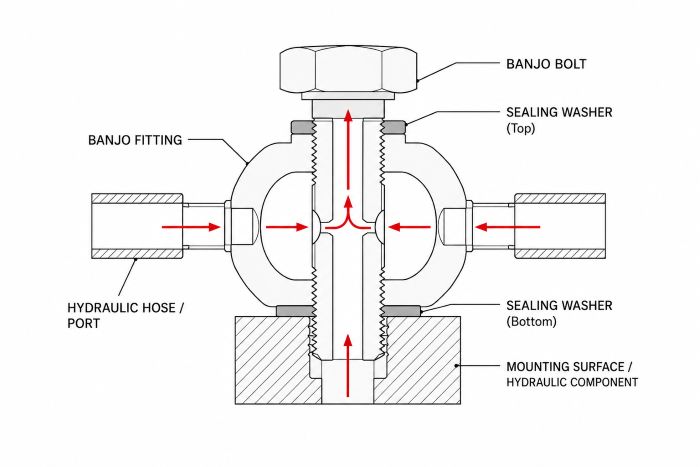
Here are the main components of a hydraulic banjo union:
1. Banjo Bolt
The banjo bolt serves as both the fastening and fluid-transfer component.
Features include:
➡️ Hollow center bore
➡️ Cross-drilled fluid ports
➡️ High-pressure hydraulic transfer
➡️ Threaded mounting section
2. Banjo Body
The banjo body has its signature circular eye that fits around the bolt.
Functions include:
➡️ Connecting hydraulic tubing or hoses
➡️ Allowing rotational adjustment before tightening
➡️ Providing compact installation
3. Sealing Washers
Washers create the hydraulic seal.
Common types include:
➡️ Copper washers
➡️ Aluminum washers
➡️ Bonded seals
➡️ O-rings (where applicable)
4. Hydraulic Port
The threaded hydraulic port secures the assembly to pumps, cylinders, valves, or manifolds while providing the mounting surface for the sealing washers.
Types of Hydraulic Banjo Unions
There are 7 types of Banjo unions, namely:
1. Straight Banjo Union
Ideal for direct hydraulic routing where the hose exits in a straight line.
Best for:
➡️ Hydraulic pumps
➡️ Cylinders
➡️ Direct connections
2. 45° Banjo Union
Offers moderate directional changes without creating sharp hose bends.
Best for:
➡️ Mobile equipment
➡️ Compact machinery
3. 90° Banjo Union
Designed for extremely tight installation spaces.
Best for:
➡️ Excavators
➡️ Engines
➡️ Brake systems
4. Adjustable Banjo Union
Allows precise hose orientation before final tightening.
Best for:
➡️ Hydraulic maintenance
➡️ Complex hose routing
5. Metric Banjo Union
Common in European and Asian hydraulic systems.
Applications:
➡️ Construction equipment
➡️ Industrial machinery
➡️ Agricultural equipment
6. BSP Banjo Union
Uses British Standard Pipe threads.
Applications:
➡️ European hydraulic systems
➡️ Marine equipment
➡️ Industrial hydraulics
7. SAE Banjo Union
Built to SAE standards commonly used in North America.
Applications:
➡️ Heavy equipment
➡️ Mobile hydraulics
➡️ Automotive systems
Common Materials Used
Selecting the proper material depends on operating pressure, environmental conditions, and corrosion exposure.
Carbon Steel
Pros:
➡️ High strength
➡️ Excellent pressure capability
➡️ Cost-effective
Applications:
➡️ Industrial hydraulics
➡️ Heavy machinery
➡️ Construction equipment
Stainless Steel
Pros:
➡️ Outstanding corrosion resistance
➡️ Excellent durability
➡️ Long service life
Applications:
➡️ Marine systems
➡️ Food processing
➡️ Chemical plants
➡️ Outdoor equipment
Brass
Advantages:
➡️ Naturally corrosion resistant
➡️ Easy to machine
➡️ Good conductivity
Applications:
➡️ Low-pressure hydraulic systems
➡️ Light industrial equipment
Limitations:
➡️ Lower pressure capacity than steel
➡️ Not recommended for heavy-duty hydraulics
|
Material |
Strength |
Corrosion Resistance |
Best Applications |
|
Carbon Steel |
High |
Moderate |
Industrial hydraulics |
|
Stainless Steel |
High |
Excellent |
Marine & chemical industries |
|
Brass |
Medium |
Good |
Low-pressure systems |
Advantages of Hydraulic Banjo Unions
Hydraulic banjo unions offer several important advantages:
1. Compact installation in confined spaces
2. Easy hose routing around obstacles
3. Reduced installation space requirements
4. High-pressure capability
5. Adjustable positioning before tightening
6. Reliable leak sealing with proper washers
7. Faster maintenance and replacement
These benefits make banjo unions a preferred solution for modern hydraulic systems with limited installation space.
Where Hydraulic Banjo Unions Are Used
Agricultural Equipment
Hydraulic banjo unions are commonly found on:
➡️ Tractors
➡️ Harvesters
➡️ Crop sprayers
Construction Machinery
Heavy-duty machines often use banjo fittings because of tight component spacing.
Examples include:
➡️ Excavators
➡️ Wheel loaders
➡️ Bulldozers
➡️ Cranes
Hydraulic Power Units
Applications include:
➡️ Compact manifold connections
➡️ Pump outlets
➡️ Pressure control systems
Industrial Machinery
Industrial hydraulic systems frequently use banjo unions in:
➡️ Hydraulic presses
➡️ Injection molding machines
➡️ CNC equipment
Automotive Hydraulic Systems
Banjo fittings are essential for:
➡️ Hydraulic brake systems
➡️ Clutch hydraulics
➡️ Power steering systems
Material Handling Equipment
Common equipment includes:
➡️ Forklifts
➡️ Lift tables
➡️ Warehouse handling systems
Marine Hydraulic Systems
Stainless steel banjo unions are widely used in marine environments where corrosion resistance is critical.
How to Choose the Right Hydraulic Banjo Union
Selecting the correct banjo union ensures safe operation and long service life.
|
Selection Factor |
What to Consider |
|
Thread Type |
BSP, BSPP, Metric, SAE, or NPT (where applicable) |
|
Pressure Rating |
Must exceed maximum system pressure with an adequate safety margin |
|
Hose Size |
Match the required flow rate and hose dimensions |
|
Material |
Choose based on corrosion, wear, and operating conditions |
|
Temperature Compatibility |
Ensure materials and seals can handle operating temperatures |
|
Chemical Compatibility |
Verify compatibility with hydraulic fluids and surrounding chemicals |
|
Port Orientation |
Select straight, 45°, 90°, or adjustable designs based on installation requirements |
Installation Best Practices
Proper installation is essential for leak-free performance.
Step 1: Inspect all components for damage or contamination.
Step 2: Always install new sealing washers.
Step 3: Position and align the banjo fitting.
Step 4: Hand-tighten the banjo bolt.
Step 5: Torque the bolt according to the manufacturer’s specifications.
Step 6: Pressure test the hydraulic system before returning it to service.
Common Torque Mistakes
1. Overtightening crushes sealing washers and may distort sealing surfaces.
2. Undertightening allows hydraulic leaks.
3. Reusing old washers often results in seal failure.
Common Problems and Troubleshooting
Here are the common problems and troubleshooting tips:
|
Problem |
Possible Cause |
Solution |
|
Hydraulic leak |
Damaged sealing washer |
Replace the washer |
|
Loose fitting |
Incorrect torque |
Retorque to specification |
|
Restricted flow |
Blocked banjo bolt |
Clean or replace the bolt |
|
Corrosion |
Incorrect material selection |
Upgrade to stainless steel |
|
Damaged threads |
Cross-threading |
Replace the fitting and bolt |
Hydraulic Banjo Union vs. Standard Hydraulic Fittings
We have compared Banjo union and standard hydraulic fittings:
|
Feature |
Hydraulic Banjo Union |
Standard Hydraulic Fitting |
|
Installation Space |
Excellent |
Moderate |
|
Adjustable Position |
Yes |
Limited |
|
Compact Design |
Yes |
No |
|
Flow Path |
Through hollow banjo bolt |
Direct fitting |
|
Best for Tight Spaces |
Excellent |
Fair |
|
Maintenance |
Easy |
Moderate |
Maintenance Tips
Regular maintenance improves safety and extends service life.
1. Inspect fittings for leaks during routine maintenance.
2. Replace sealing washers whenever the fitting is removed.
3. Verify torque periodically.
4. Protect fittings from corrosion.
5. Keep hydraulic fluid clean.
6. Replace worn or damaged fittings immediately.
7. Inspect banjo bolts for blocked internal passages.
Expert Tips
Hydraulic professionals recommend the following best practices:
1. Always install new sealing washers instead of reusing old ones.
2. Match the banjo union’s pressure rating to the hydraulic system.
3. Choose stainless steel for corrosive or marine environments.
4. Ensure thread compatibility to prevent leaks and thread damage.
Follow manufacturer torque specifications to avoid overtightening.
Frequently Asked Questions
What is a hydraulic banjo union?
A hydraulic banjo union is a compact hydraulic fitting that uses a hollow banjo bolt and circular banjo body to transfer hydraulic fluid while allowing flexible hose positioning.
How does a hydraulic banjo fitting work?
Hydraulic fluid flows through the hollow bolt, exits through cross-drilled ports into the banjo body, and continues into the connected hose or tube while sealing washers prevent leaks.
Are hydraulic banjo unions reusable?
Yes, the metal components are generally reusable if they are undamaged. However, sealing washers should always be replaced after disassembly.
Can banjo unions handle high-pressure hydraulics?
Yes. High-quality hydraulic banjo unions are designed to withstand high operating pressures when correctly specified and installed.
What materials are hydraulic banjo unions made from?
They are commonly manufactured from carbon steel, stainless steel, or brass, depending on the application and environmental conditions.
How do you stop a banjo union from leaking?
Replace damaged sealing washers, ensure the correct thread type, tighten the bolt to the recommended torque, and inspect all sealing surfaces for damage.
What is the difference between a banjo union and a standard hydraulic fitting?
Banjo unions offer adjustable positioning and a compact design that is ideal for tight spaces, while standard hydraulic fittings typically require more installation room and offer limited orientation flexibility.
Where are hydraulic banjo unions commonly used?
They are widely used in agriculture, construction equipment, industrial machinery, automotive hydraulic systems, hydraulic power units, material handling equipment, and marine applications.
Conclusion
Hydraulic banjo unions are an indispensable solution for hydraulic systems that demand reliable performance in compact installation spaces. Their hollow banjo bolt, circular fitting, and sealing washer design provide efficient high-pressure fluid transfer while allowing flexible hose positioning before final tightening.
Whether installed in agricultural equipment, construction machinery, industrial manufacturing systems, automotive hydraulics, or marine applications, hydraulic banjo unions offer excellent leak resistance, simplified maintenance, and dependable long-term performance.
By selecting the correct thread type, pressure rating, material, and fitting orientation, and by following proper installation and maintenance practices, you can maximize system reliability, minimize downtime, and ensure safe, leak-free hydraulic operation for years to come.
Post time: Jul-15-2026