

Hydraulic systems depend on secure connections to move pressurized fluid safely between pumps, valves, cylinders, hoses, and other components. Even a small leak or poorly matched connection can reduce system performance and lead to downtime.
This is where DIN 3861 fittings come into play. Designed according to established German DIN standards, these fittings are used to create dependable connections in hydraulic and fluid-transfer systems. Their design allows components to be connected securely while helping maintain proper sealing under demanding operating conditions.
But how exactly do DIN 3861 fittings work? What makes them reliable, and how should you choose and install them?
This guide explains the working principle, components, applications, benefits, and selection considerations of DIN 3861 fittings.
What Are DIN 3861 Fittings?
DIN 3861 fittings are hydraulic connection components manufactured to requirements associated with the DIN 3861 standard. They are designed to provide reliable connections between hydraulic lines and system components.
Depending on the specific fitting design, these components may be used to connect tubing, hoses, valves, manifolds, and other hydraulic equipment.
The fitting generally consists of a body with a connection interface, threaded sections, and sealing surfaces or components. When correctly assembled, these features work together to create a mechanically secure and fluid-tight connection.
DIN fittings are widely associated with European hydraulic equipment and industrial machinery. However, the exact dimensions, threads, pressure ratings, and sealing arrangements should always be checked against the manufacturer’s technical documentation rather than assuming that two fittings are interchangeable simply because they look similar.
How Do DIN 3861 Fittings Work?
The basic operating principle is straightforward: the fitting creates a secure mechanical connection while its sealing arrangement prevents hydraulic fluid from escaping.
The process generally involves several stages.
First, the appropriate fitting is selected based on the tube or hose size, connection type, thread, pressure requirements, material, and application.
The fitting is then assembled with the mating component. As the connection is tightened according to the manufacturer’s specifications, the mating surfaces and sealing elements are brought into the required position.
This creates two important functions:
1. Mechanical retention: The connection holds the hydraulic components together.
2. Fluid sealing: The sealing surfaces or sealing elements restrict hydraulic fluid from escaping.
Once the hydraulic system is pressurized, the fitting must withstand the resulting internal forces without allowing leakage or excessive movement.
The exact sealing principle depends on the specific DIN 3861 fitting configuration, so installation instructions and manufacturer specifications should always take priority.
Main Components of DIN 3861 Fittings
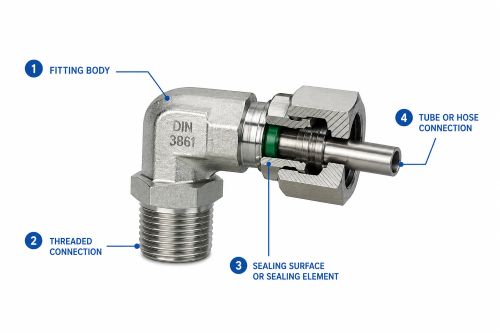
Although hydraulic fittings are relatively compact, every part has an important purpose.
1. Fitting Body
The fitting body provides the main structure of the connection. It contains the internal fluid passage and supports the connection interfaces.
The body must be strong enough to handle the mechanical loads created by hydraulic pressure, vibration, and installation.
Common manufacturing materials include carbon steel and stainless steel, although the appropriate material depends on the application.
2. Threaded Connection
Threads provide the mechanical connection between the fitting and its mating component.
The thread must match the corresponding connection in terms of type, size, and specification. Using incompatible threads can result in poor engagement, leakage, or permanent damage.
This is why identifying the thread correctly is an essential part of hydraulic fitting selection.
3. Sealing Surface or Sealing Element
The sealing portion is responsible for preventing hydraulic fluid from escaping through the connection.
Depending on the design, sealing may rely on specially machined surfaces, sealing rings, or other sealing components.
A clean, undamaged sealing area is essential. Scratches, contamination, or damaged seals can compromise the connection even when the fitting has been tightened correctly.
4. Tube or Hose Connection
The connection interface allows the fitting to attach to the hydraulic line or another system component.
The fitting must be correctly matched to the outside diameter, inside diameter, connection type, and other relevant specifications of the hydraulic line.
How Do DIN 3861 Fittings Create a Seal?
Sealing is one of the most important functions of any hydraulic fitting.
Hydraulic systems operate under pressure, which means even a small imperfection in a connection can become a leakage point. DIN 3861 fitting assemblies therefore rely on carefully designed mating surfaces and sealing arrangements.
During installation, tightening brings the mating components into their intended sealing position. The resulting contact prevents hydraulic fluid from passing through the connection.
Several factors affect sealing performance:
1. Correct fitting selection
2. Proper thread engagement
3. Clean sealing surfaces
4. Undamaged components
5. Correct installation procedure
6. Appropriate tightening torque
7. Compatible sealing materials
8. Proper tube preparation
Overtightening does not necessarily produce a better seal. Excessive force can damage threads, distort components, or harm sealing elements. On the other hand, insufficient tightening can allow movement or leakage.
For this reason, the manufacturer’s installation instructions should always be followed.
How Do DIN 3861 Fittings Handle Hydraulic Pressure?
Hydraulic pressure creates forces throughout a hydraulic connection. A properly selected fitting must be capable of handling these forces without failure.
The fitting body, threads, connection surfaces, and sealing components all contribute to the overall performance of the assembly.
Pressure capability depends on several variables, including:
1. Fitting size
2. Material
3. Connection design
4. Operating temperature
5. Hydraulic fluid
6. Tube or hose specifications
7. Installation quality
8. Manufacturer’s pressure rating
A fitting should never be selected based solely on appearance or nominal size. Always check the rated working pressure of the specific fitting and ensure that it is appropriate for the hydraulic system.
It is also important to distinguish between working pressure and short-term or test pressure. These values are not necessarily the same.
Common Types and Configurations
Hydraulic fittings are available in different configurations to accommodate various system layouts.
Depending on the product range, you may encounter configurations such as:
Straight Fittings
Straight fittings provide a direct connection between two components. They are useful when hydraulic lines can run in a relatively straight path.
Elbow Fittings
Elbow fittings change the direction of a hydraulic line. They can help route tubing around equipment and reduce the need for complicated hose routing.
Tee Fittings
Tee configurations allow a hydraulic line to branch into another circuit.
Adapters
Adapters allow components with different connection configurations to be joined when the combination is technically compatible.
Bulkhead Fittings
Bulkhead designs can provide a connection through a panel or mounting surface, making them useful in equipment where hydraulic lines must pass through structural components.
The exact availability and specifications of each configuration depend on the manufacturer’s DIN 3861 product range.
Materials Used for DIN 3861 Fittings
Material selection has a direct effect on fitting durability and environmental resistance.
Carbon Steel
Carbon steel is widely used for hydraulic fittings because it provides a good balance of strength, durability, and cost.
Many carbon steel hydraulic fittings receive protective surface treatments to improve corrosion resistance.
They are commonly found in industrial machinery, mobile equipment, and general hydraulic applications.
Stainless Steel
Stainless steel offers better corrosion resistance than standard carbon steel, making it useful in demanding environments.
Stainless steel fittings can be appropriate for applications involving moisture, corrosive environments, or specific fluid-handling requirements.
However, stainless steel does not automatically make a fitting suitable for every application. Pressure, temperature, thread compatibility, and fluid compatibility must still be considered.
Where Are DIN 3861 Fittings Used?
DIN hydraulic fittings can be found across many types of equipment and hydraulic systems.
Common applications include:
1. Industrial machinery
2. Construction equipment
3. Agricultural machinery
4. Mobile hydraulic equipment
5. Manufacturing equipment
6. Hydraulic power units
7. Material-handling equipment
8. Fluid-control systems
9. Heavy-duty machinery
Their main purpose in these applications is to provide dependable connections between hydraulic components while maintaining the required fluid pressure.
For example, a hydraulic machine may use fittings to connect a pump to a valve, a valve to an actuator, or a hydraulic line to a manifold.
Benefits of DIN 3861 Fittings
Using an appropriately specified DIN fitting can provide several advantages.
Reliable Connections
A correctly selected and installed fitting provides a secure connection between hydraulic components.
Reduced Risk of Leakage
Proper sealing and installation help minimize unwanted hydraulic fluid leakage.
Good Mechanical Strength
Suitable fitting materials and designs can withstand the mechanical demands associated with hydraulic applications.
Versatile Configurations
Different fitting configurations allow hydraulic designers to create practical piping and hose layouts.
Standardized Connections
Using recognized standards can make component specification and replacement easier, provided the exact standard and dimensions are verified.
Suitable for Demanding Applications
With the correct material, size, and pressure rating, DIN fittings can be used in many industrial and mobile hydraulic systems.
DIN 3861 Fittings vs. Other Hydraulic Fittings
Hydraulic fittings can look remarkably similar even when they are manufactured to different standards.
For example, two fittings may have similar external dimensions but use different thread profiles or sealing methods.
The main differences between hydraulic fitting standards can include:
1. Thread type
2. Thread dimensions
3. Sealing method
4. Tube dimensions
5. Connection geometry
6. Pressure ratings
7. Material options
8. Application requirements
This is why fittings should not be mixed based only on visual similarity.
If you are replacing an existing fitting, identify the original fitting’s standard, thread, size, material, and connection type before ordering a replacement.
How to Choose the Right DIN 3861 Fittings
Selecting the right fitting involves more than choosing a size that appears to fit.
1. Check the Tube or Hose Size
Determine the dimensions of the hydraulic line being connected. The fitting must be compatible with the line specification.
2. Identify the Thread
Verify the exact thread type and size. Thread compatibility is critical for creating a secure connection.
3. Consider Working Pressure
Select a fitting with a suitable rated working pressure for the system.
The fitting should be rated for the actual operating conditions rather than just the expected average pressure.
4. Check Operating Temperature
Temperature can affect fitting materials and sealing elements. Consider both the minimum and maximum operating temperatures.
5. Consider Hydraulic Fluid Compatibility
The fitting and its sealing components should be compatible with the hydraulic fluid being used.
6. Select the Appropriate Material
Choose carbon steel, stainless steel, or another available material based on corrosion conditions, mechanical requirements, and application needs.
7. Choose the Correct Configuration
Determine whether you need a straight fitting, elbow, tee, adapter, bulkhead fitting, or another configuration.
8. Verify Manufacturer Specifications
Always check the manufacturer’s technical data for dimensions, pressure ratings, materials, and installation requirements.
How to Install DIN 3861 Fittings
Correct installation is just as important as selecting the right fitting.
Step 1: Inspect the Components
Before installation, inspect the fitting, threads, sealing surfaces, and mating components.
Look for:
➡️ Damaged threads
➡️ Scratches
➡️ Deformation
➡️ Corrosion
➡️ Contamination
➡️ Damaged sealing elements
Do not install visibly damaged components.
Step 2: Clean the Connection
Remove dirt, metal particles, dust, and other contaminants from the connection.
Clean hydraulic connections help reduce the risk of leaks and protect sensitive hydraulic components from contamination.
Step 3: Verify Compatibility
Confirm that the fitting, tube or hose, thread, and mating component are compatible.
Never force a fitting into a connection that does not match.
Step 4: Assemble the Connection
Position the components correctly and begin assembly according to the manufacturer’s instructions.
Avoid cross-threading. If the fitting does not engage smoothly, stop and check the connection.
Step 5: Tighten Correctly
Use the recommended installation procedure and tightening torque where specified.
Avoid the temptation to tighten the fitting as much as possible. Excessive tightening can damage the connection.
Step 6: Inspect and Test
After installation, inspect the connection and safely pressurize the system according to appropriate procedures.
Check for signs of leakage or abnormal movement before placing the equipment into normal service.
Common Problems With DIN 3861 Fittings
Even high-quality fittings can experience problems when they are incorrectly selected, installed, or maintained.
Hydraulic Fluid Leakage
Leaks may result from:
1. Incorrect fitting selection
2. Damaged sealing surfaces
3. Worn seals
4. Incorrect assembly
6. Improper tightening
7. Excessive vibration
A leaking hydraulic connection should be investigated promptly.
Loose Connections
A connection may loosen because of vibration, incorrect installation, insufficient tightening, or unsuitable components.
Regular inspection is particularly important for mobile machinery and equipment exposed to vibration.
Damaged Threads
Cross-threading and excessive tightening can damage threads.
Once threads are significantly damaged, the fitting or mating component may need replacement.
Corrosion
Corrosion can weaken components and affect sealing surfaces.
Material selection and protective coatings should therefore match the operating environment.
How to Maintain DIN 3861 Hydraulic Connections
Routine inspection can help identify problems before they cause major hydraulic failures.
Useful maintenance practices include:
1. Inspect fittings regularly.
2. Look for signs of hydraulic leakage.
3. Check for corrosion.
4. Inspect exposed threads and connection areas.
5. Replace damaged sealing components as recommended.
6. Keep hydraulic connections clean.
7. Check for signs of vibration or movement.
8. Avoid unnecessary retightening.
9. Replace fittings showing significant damage or wear.
10. Follow the manufacturer’s maintenance recommendations.
If a hydraulic fitting repeatedly leaks after proper installation, simply tightening it further may not solve the problem. The fitting, mating component, sealing surface, or installation method should be investigated.
Why Proper DIN 3861 Fitting Selection Matters
A hydraulic fitting is a small component, but its failure can affect an entire hydraulic system.
An incorrect fitting can lead to leakage, pressure loss, equipment downtime, component damage, and safety concerns.
For this reason, fitting selection should consider the complete operating environment.
Before purchasing or installing a DIN 3861 fitting, verify:
➡️ Standard
➡️ Size
➡️ Thread
➡️ Connection type
➡️ Material
➡️ Working pressure
➡️ Temperature range
➡️ Hydraulic fluid compatibility
➡️ Sealing method
➡️ Manufacturer’s specifications
Taking these factors into account makes it easier to build a dependable hydraulic connection.
Frequently Asked Questions
What are DIN 3861 fittings used for?
DIN 3861 fittings are hydraulic connection components used to connect hydraulic lines and system components. Their purpose is to provide a secure mechanical connection and reliable fluid sealing when correctly selected and installed.
How do DIN 3861 fittings seal?
The sealing method depends on the specific fitting configuration. The connection is designed so that mating surfaces and/or sealing elements prevent hydraulic fluid from escaping when properly assembled.
Are DIN 3861 fittings suitable for high-pressure hydraulic systems?
They can be used in demanding hydraulic applications when the specific fitting has an appropriate pressure rating. Always verify the manufacturer’s rated working pressure for the exact size and configuration.
What materials are DIN 3861 fittings made from?
Common materials include carbon steel and stainless steel. Material selection depends on factors such as pressure, corrosion exposure, temperature, and the application environment.
How do I choose the correct DIN 3861 fitting?
Start by identifying the required fitting standard, size, thread, connection type, pressure rating, material, temperature range, and hydraulic fluid compatibility. Manufacturer specifications should be used to confirm the selection.
Can DIN 3861 fittings be reused?
Whether a fitting can be reused depends on its specific design, sealing method, condition, and manufacturer’s instructions. Damaged or worn components should not be reused simply to reduce replacement costs.
How can hydraulic leaks be prevented?
Use compatible components, keep sealing surfaces clean, avoid damaged fittings, follow the correct assembly procedure, and tighten connections according to the manufacturer’s specifications.
Conclusion
DIN 3861 fittings play an important role in creating reliable connections within hydraulic systems. Their fitting body, threaded connection, sealing surfaces, and connection interface work together to secure hydraulic components and contain pressurized fluid.
However, good performance depends on more than the fitting itself. Correct selection, compatibility, installation, and maintenance are equally important.
When choosing DIN 3861 fittings, always consider the connection size, thread, pressure rating, material, temperature, hydraulic fluid, and specific application. Following the manufacturer’s specifications can help reduce leakage, improve reliability, and extend the service life of the hydraulic system.
For hydraulic equipment operating under demanding conditions, choosing the right fitting may be a small decision, but it can make a significant difference to overall system performance.
Post time: Aug-27-2026