

When you’re working on plumbing, HVAC, or gas-related projects, the quality of your connections determines the safety, durability, and performance of the entire system. Fittings play a critical role in creating leak-free, long-lasting connections between pipes and tubing. Among the most common types are compression fittings and flare fittings, each with its own strengths, limitations, and ideal use cases.
In this guide, we’ll break down both types, compare them side-by-side, and help you determine which one is best suited for your project.
What Are Compression Fittings?
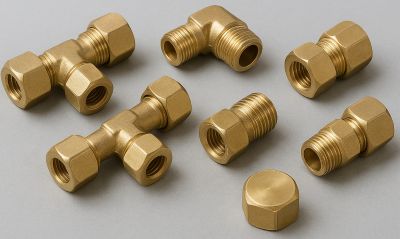
Compression fittings are mechanical connectors that create a seal by compressing a metal ring, known as a ferrule, between a nut and the body of the fitting. When the nut is tightened, the ferrule is squeezed tightly against the tubing and the fitting body, forming a leak-resistant joint.
This simple design makes compression fittings one of the most user-friendly connection types.
Common Applications
Compression fittings are widely used in:
➡️ Household plumbing lines
➡️ Water supply lines
➡️ Low-pressure systems
➡️ DIY-friendly repairs and upgrades
Because they require no special tools and are fast to install, they’re a favorite for homeowners and beginner technicians.
Key Benefits
➡️ Easy installation — Great for beginners
➡️ No special tools required — A wrench is typically all you need
➡️ Widely available — Found in nearly every hardware store
Limitations
➡️ Not ideal for high-vibration or high-pressure environments — The connection may loosen over time
➡️ Ferrules may deform with over-tightening — Once deformed, they cannot be reused
Compression fittings are best when convenience and simplicity matter more than pressure performance.
What Are Flare Fittings?
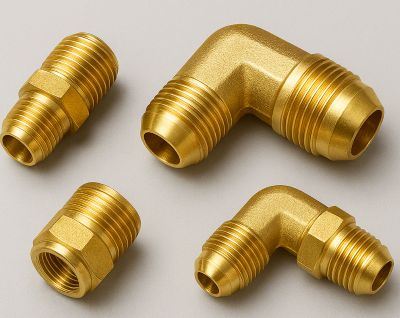
Flare fittings create a secure connection by flaring the end of the tubing usually to a 45° angle, and securing it against a cone-shaped fitting. This design creates a strong metal-to-metal seal that is both durable and reliable.
Common Applications
You’ll commonly find flare fittings in:
➡️ Refrigeration and HVAC systems
➡️ Gas lines (propane, natural gas)
➡️ High-pressure systems
➡️ Automotive and hydraulic systems
Their strength and reliability make them essential where safety is a priority.
Key Benefits
➡️ Extremely strong, reliable seal
➡️ Excellent for high-pressure or high-vibration setups
➡️ Reusable and serviceable — The tubing can be re-flared if needed
Limitations
➡️ Requires a flaring tool — Not ideal for beginners
➡️ More time-consuming installation
➡️ Not ideal for soft or brittle tubing — The tubing must withstand the flaring process
Flare fittings are the top choice when performance and long-term reliability are non-negotiable.
Side-by-Side Comparison: Compression vs. Flare Fittings
|
Category |
Compression Fitting |
Flare Fitting |
|
Installation Difficulty |
Simple, tool-free, beginner-friendly |
Requires skill and special tools |
|
Pressure Rating |
Best for moderate pressure |
Superior for high-pressure systems |
|
Vibration Resistance |
May loosen over time |
Excellent resistance due to metal-to-metal seal |
|
Reliability & Longevity |
Reliable but ferrules deform permanently |
Very durable, reusable, long-lasting |
|
Cost |
Generally lower cost |
Slightly higher upfront cost (tools + precision) |
|
Materials Compatibility |
Ideal for copper, brass, and softer tubing |
Typically used with harder tubing suitable for flaring |
|
Typical Applications |
Plumbing, water lines, DIY repairs |
HVAC, refrigeration, gas lines, fuel systems |
|
Tools Required |
Basic wrench |
Flaring tool + wrenches |
|
Maintenance |
Not reusable once ferrule is compressed |
Fittings can be reused; tubing can be re-flared |
When Should You Use Compression Fittings?
Compression fittings are ideal for:
1. Indoor plumbing projects
2. Quick repairs or retrofits
3. Simple, fast, tool-free installations
4. Lower-pressure environments
If you need a quick, clean, and reliable connection without special tools, compression fittings are the way to go.
When Should You Use Flare Fittings?
Flare fittings should be used for:
1. HVAC or refrigeration systems
2. Gas piping where code requires flared connections
3. High-pressure systems such as fuel, hydraulic, or cooling lines
4. Projects where vibration is a concern
When safety and pressure performance are critical, flare fittings are the superior choice.
Choosing the Right Fitting for Your Project
A. Key Questions to Consider
Ask yourself:
1. What pressure level will the system operate at?
2. Will the system experience vibration or movement?
3. Do you have the tools or expertise for flaring?
4. Do local codes require a specific type of fitting?
5. Are you working with copper, steel, or other tubing types?
Your answers determine which fitting style is the safest and most practical.
B. Simple Decision Flow
Use this quick decision guide:
1. High-pressure or vibration-heavy system? → Choose flare fittings.
2. Low- to moderate-pressure with no vibration? → Choose compression fittings.
3. Working with gas lines? → Check local code (often requires flare).
4. Need a fast, simple installation? → Compression is better.
5. Need long-term durability and reusability? → Go with flare.
Common Mistakes to Avoid
1. Over-tightening compression nuts — Can deform ferrules
2. Incorrect flaring angles — Leads to leaks
3. Using incompatible tubing — Wrong materials can crack or fail
4. Reusing compression ferrules — They are single-use only
5. Not checking local regulations for gas fittings — Safety codes vary
Avoiding these pitfalls ensures your fittings perform safely and reliably.
Conclusion
Both compression and flare fittings have a place in plumbing, HVAC, and gas systems. Compression fittings offer convenience, ease of use, and fast installation, perfect for low- to moderate-pressure projects. Flare fittings, on the other hand, provide superior strength, reliability, and performance in high-pressure or vibration-prone environments.
The best fitting for your project ultimately depends on the system’s pressure requirements, the materials you’re using, and how much long-term performance you need. By choosing the right fitting style, you ensure safety, durability, and long-lasting results.
So, explore our catalog for your hydraulic needs. You may contact us, and our expert team will wholeheartedly assist you.
Post time: Dec-02-2025