

Pneumatic systems rely on reliable connectors and fittings to deliver compressed air efficiently and safely. Choosing the right type of fitting can significantly affect system performance, maintenance requirements, and long-term operating costs. Two commonly used options are bulkhead pneumatic connectors and standard pneumatic fittings. While they may appear similar at first glance, their design, installation, and applications differ in important ways.
This article explores the key differences between bulkhead pneumatic connectors and standard fittings to help engineers, technicians, and buyers make informed decisions.
What Are Bulkhead Pneumatic Connectors?
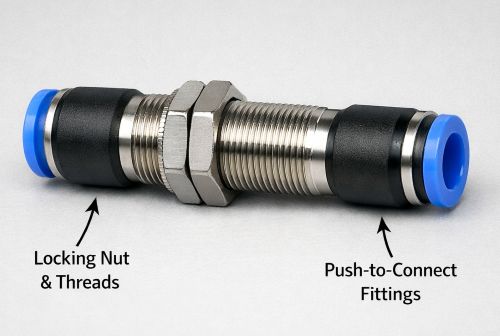
Bulkhead pneumatic connectors are fittings designed to pass through a panel, wall, or enclosure while maintaining a secure and leak-tight air connection on both sides. They are mounted through a drilled hole and secured using a lock nut, often with sealing washers or O-rings.
Key Characteristics:
1. Panel-mounted design
2. Threaded body with lock nut
3. Secure and vibration-resistant
4. Common materials: brass, stainless steel, plastic
5. Available in push-to-connect, threaded, and elbow styles
Bulkhead pneumatic connectors are widely used in control panels, machine enclosures, and OEM equipment, where air lines must pass cleanly and safely through a barrier.
What Are Standard Pneumatic Fittings?
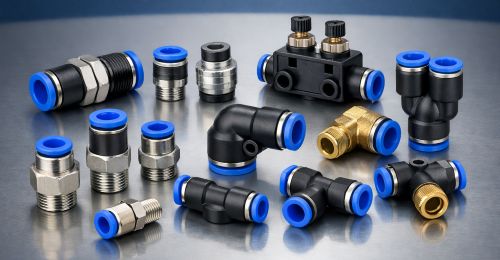
Standard pneumatic fittings are general-purpose connectors used to join air hoses, tubes, or pipes within an open pneumatic system. They are typically threaded directly into components such as valves, cylinders, or manifolds.
Common Types:
1. Straight connectors
2. Elbow and tee fittings
3. Reducers and adapters
4. Push-to-connect and compression fittings
Standard fittings are flexible, easy to install, and commonly used in open air lines, modular systems, and general industrial applications.
Structural Design Differences
When compared to the standard fittings, the most significant difference lies in design and mounting.
Bulkhead connectors are specifically engineered for panel mounting. They include a long threaded body, lock nut, and sealing elements to maintain stability and airtightness through a wall or enclosure.
On the other hand, Standard fittings are not designed to pass through panels. They rely on direct threading into components and are better suited for open or exposed systems.
Bulkhead connectors provide better mechanical support and alignment, especially where hoses need to remain fixed and organized.
Installation and Mounting Comparison
Bulkhead Pneumatic Connectors:
1. Installed through a drilled panel hole
2. Secured with a lock nut
3. Requires accurate hole sizing
4. Provides a clean, professional appearance
5. Less movement once installed
Standard Pneumatic Fittings:
1. Threaded directly into components
2. Faster installation
3. More flexible for changes or reconfiguration
4. Less structural support in vibrating environments
If your system requires permanent panel mounting, bulkhead connectors are the superior choice.
Sealing and Leak Prevention
Air leaks reduce efficiency and increase operating costs.
➡️ Bulkhead connectors often use O-rings, sealing washers, or gaskets, providing consistent sealing even under vibration.
➡️ Standard fittings rely more heavily on thread sealants such as PTFE tape or liquid sealants.
For long-term installations where leak prevention is critical, bulkhead pneumatic connectors generally offer better reliability.
Performance and Pressure Handling
Both types can handle similar pressure ranges when properly rated, but performance differs under real-world conditions.
1. Bulkhead connectors perform better in high-vibration and high-cycle environments
2. Fixed mounting reduces stress on tubing and fittings
Standard fittings are adequate for most general pneumatic applications but may loosen over time if subjected to movement
Application-Specific Use Cases
Best Uses for Bulkhead Pneumatic Connectors:
➡️ Control panels and cabinets
➡️ Machine enclosures
➡️ OEM and factory-built equipment
Systems requiring clean cable and hose routing
Best Uses for Standard Pneumatic Fittings:
➡️ Open pneumatic lines
➡️ Temporary or modular setups
➡️ Prototyping and testing environments
➡️ Simple air distribution systems
Many industrial systems use both types together to balance flexibility and stability.
Maintenance and Serviceability
Bulkhead connectors allow easy access from either side of a panel, simplifying inspection and replacement.
On the other hand, standard fittings are easier to remove but may require more frequent re-tightening.
Proper installation significantly reduces maintenance needs for both options.
Cost and Value Comparison
1. Initial cost: Bulkhead connectors are usually more expensive per unit.
2. Installation cost: Slightly higher due to panel preparation.
3. Long-term value: Bulkhead connectors often reduce air leaks, downtime, and maintenance costs.
For industrial and OEM systems, bulkhead connectors often provide better long-term value, despite higher upfront costs.
Advantages and Limitations Summary
Bulkhead Pneumatic Connectors
Advantages
1. Secure panel mounting
2. Excellent sealing
3. Clean system layout
4. High vibration resistance
Limitations
1. Higher initial cost
2. Less flexible once installed
Standard Pneumatic Fittings
Advantages
➡️ Low cost
➡️ Easy installation
➡️ High flexibility
Limitations
➡️ Not suitable for panel mounting
➡️ Greater risk of leaks in high-vibration environments
How to Choose the Right Option
When selecting between bulkhead pneumatic connectors and standard fittings, consider:
1. System layout and panel requirements
2. Operating pressure and vibration levels
3. Maintenance access
4. Long-term reliability needs
5. Budget constraints
Choosing the correct fitting improves system efficiency, safety, and lifespan.
Conclusion
While both bulkhead pneumatic connectors and standard fittings play essential roles in pneumatic systems, they are designed for different purposes. Bulkhead connectors excel in panel-mounted, permanent installations, while standard fittings offer flexibility and simplicity for general air line connections.
Understanding their differences ensures better system design, fewer leaks, and lower operating costs.
Post time: Feb-02-2026