

Hydraulic systems power countless machines used in construction, agriculture, mining, manufacturing, transportation, and many other industries. These systems operate under high pressure and rely on precisely engineered components to deliver reliable performance. While hydraulic fluid plays a critical role in transmitting power, proper lubrication is equally important for protecting moving parts from wear and extending the life of equipment.
Hydraulic lubricating fittings make routine lubrication simple, efficient, and consistent. They provide secure access points for applying grease or other lubricants directly to bearings, bushings, pins, and other moving components. Selecting the right fitting helps prevent friction, corrosion, contamination, and costly equipment failures.
In this guide, we’ll explore the most common types of hydraulic lubricating fittings, how they work, their applications, and how to choose the best option for your hydraulic system.
What Are Hydraulic Lubricating Fittings?
Hydraulic lubricating fittings, often called grease fittings or lubrication fittings, are small threaded or press-fit connectors installed on machinery to provide a convenient point for adding lubricant. They are designed to work with manual grease guns or automatic lubrication systems, allowing lubricant to reach internal moving parts without disassembling the equipment.
Although they are commonly associated with grease lubrication, hydraulic lubricating fittings are essential components in many hydraulic-powered machines because they keep pivot points, bearings, and joints properly lubricated.
Proper lubrication minimizes friction between moving parts while preventing contaminants such as dirt, dust, and moisture from entering the lubrication channels.
Why Hydraulic Lubricating Fittings Matter
High-quality hydraulic lubricating fittings provide several important benefits:
1. Reduce metal-to-metal friction
2. Extend component and equipment lifespan
3. Improve machine efficiency
4. Lower maintenance costs
5. Prevent rust and corrosion
6. Reduce unexpected downtime
7. Increase overall system reliability
Without regular lubrication, even the most durable hydraulic equipment can suffer from accelerated wear, overheating, and premature failure.
How Hydraulic Lubricating Fittings Work
Hydraulic lubricating fittings provide a sealed pathway for grease or lubricant to enter a component while preventing contaminants from entering the lubrication system.
When a grease gun is connected to the fitting, pressure pushes a small spring-loaded ball check valve inward. This opens the passage and allows lubricant to flow directly into the bearing, pin, or bushing.
Once the grease gun is removed, the spring forces the ball back into place, sealing the fitting against dirt, water, and debris.
This simple yet effective design allows technicians to lubricate equipment quickly without dismantling components.
Main Components of a Hydraulic Lubricating Fitting
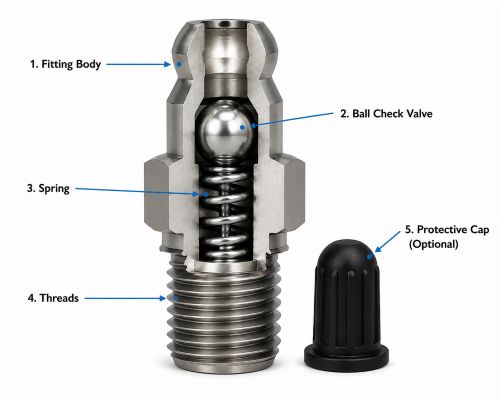
1. Fitting Body
The body contains the threaded or press-fit connection that secures the fitting to the equipment.
2. Ball Check Valve
A hardened steel ball seals the lubrication channel when the fitting is not in use.
3. Spring
The spring keeps the ball firmly seated, preventing contamination.
4. Threads
Threaded fittings are available in several standards, including Metric, BSP, NPT, and UNF, ensuring compatibility with different machines.
5. Protective Cap (Optional)
Some fittings include rubber or plastic caps that provide additional protection against dust and moisture in harsh environments.
Common Types of Hydraulic Lubricating Fittings
Different machines require different fitting designs depending on available space, lubrication frequency, and operating conditions.
Below are the most common hydraulic lubricating fitting types.
1. Straight Hydraulic Lubricating Fittings
Straight fittings are the most widely used hydraulic lubricating fittings. Their simple design allows lubricant to flow directly into the lubrication point with minimal resistance.
Features
➡️ Straight design
➡️ Easy installation
➡️ Cost-effective
➡️ Excellent grease flow
Suitable for most maintenance applications
Advantages
Straight fittings are ideal when the lubrication point is easily accessible. They provide reliable performance while keeping maintenance quick and straightforward.
Common Applications
Straight hydraulic lubricating fittings are commonly found in:
➡️ Hydraulic cylinders
➡️ Industrial bearings
➡️ Pumps
➡️ Manufacturing machinery
➡️ Agricultural equipment
➡️ Conveyor systems
2. 45-Degree Hydraulic Lubricating Fittings
Some lubrication points are partially obstructed by surrounding components. A 45-degree fitting provides better access while maintaining efficient grease flow.
Features
➡️ Angled outlet
➡️ Easier grease gun connection
➡️ Improves accessibility
➡️ Reduces maintenance time
Advantages
Technicians can lubricate difficult-to-reach components without removing nearby parts, making maintenance safer and more efficient.
Common Applications
45-degree fittings are frequently used in:
➡️ Tractors
➡️ Backhoes
➡️ Hydraulic loaders
➡️ Farm implements
➡️ Industrial presses
➡️ Packaging equipment
3. 90-Degree Hydraulic Lubricating Fittings
When lubrication points are located in extremely confined spaces, 90-degree fittings provide the best accessibility.
Their right-angle design allows technicians to attach a grease gun where a straight fitting would be impossible to reach.
Features
➡️ Right-angle outlet
➡️ Excellent for tight spaces
➡️ Easy maintenance access
➡️ Prevents awkward grease gun positioning
Advantages
These fittings reduce maintenance time while improving operator safety by eliminating difficult lubrication angles.
Common Applications
90-degree hydraulic lubricating fittings are commonly installed on:
➡️ Excavators
➡️ Bulldozers
➡️ Wheel loaders
➡️ Mining equipment
➡️ Heavy trucks
➡️ Hydraulic cranes
➡️ Forestry machinery
Choosing between Straight, 45°, and 90° fittings:
Each fitting style serves a different purpose, and selecting the right one depends on the location of the lubrication point.
|
Fitting Type |
Best For |
Accessibility |
|
Straight |
Open, easily accessible lubrication points |
Excellent |
|
45-Degree |
Partially obstructed locations |
Very Good |
|
90-Degree |
Tight or confined spaces |
Excellent |
Choosing the correct angle helps reduce maintenance time while ensuring lubricant reaches the intended component efficiently.
4. Flush Hydraulic Lubricating Fittings
Flush hydraulic lubricating fittings are designed with a low-profile head that sits nearly level with the equipment’s surface. Unlike standard grease fittings that protrude outward, flush fittings minimize the risk of being struck or damaged by surrounding objects.
These fittings require a special grease gun coupler to deliver lubricant effectively.
Features:
➡️ Low-profile design
➡️ Reduced risk of accidental damage
➡️ Better protection against impacts
➡️ Clean appearance
➡️ Suitable for harsh working environments
Advantages:
Flush fittings are ideal for equipment operating in areas where exposed fittings may become damaged by rocks, debris, or moving components. Their compact design also helps reduce contamination.
Common Applications:
Flush hydraulic lubricating fittings are commonly used in:
➡️ Mining equipment
➡️ Earthmoving machinery
➡️ Material handling equipment
➡️ Industrial presses
➡️ Manufacturing systems
➡️ Heavy construction equipment
5. Button Head Hydraulic Lubricating Fittings
Button head fittings are designed for applications requiring large amounts of lubricant delivered under high pressure. Their larger head allows special grease gun couplers to create a secure connection during lubrication.
These fittings are widely used on heavy machinery with oversized bearings and pivot points.
Features:
➡️ Large button-shaped head
➡️ High-volume grease delivery
➡️ Designed for heavy-duty applications
➡️ Excellent sealing performance
Advantages:
Button head fittings simplify the lubrication of large industrial components that require frequent grease replenishment. They also minimize grease leakage during servicing.
Common Applications:
Typical uses include:
➡️ Steel mills
➡️ Mining equipment
➡️ Excavators
➡️ Large hydraulic cranes
➡️ Heavy industrial machinery
➡️ Marine equipment
6. Drive-Type Hydraulic Lubricating Fittings
Unlike threaded fittings, drive-type fittings are installed by pressing them directly into a properly sized hole.
Their simple installation makes them useful when threaded connections are not practical or when replacing damaged fittings quickly.
Features:
➡️ Press-fit installation
➡️ No threads required
➡️ Fast installation
➡️ Economical solution
Advantages:
Drive-type fittings reduce installation time and work well for equipment that experiences only moderate operating pressures.
Common Applications:
Drive-type fittings are often found in:
➡️ Automotive suspension components
➡️ Agricultural machinery
➡️ Industrial equipment
➡️ Manufacturing machinery
➡️ Equipment repairs
7. Threaded Hydraulic Lubricating Fittings
Threaded fittings are the industry standard because they provide secure installation and are available in numerous thread types to fit different hydraulic equipment.
They are easy to remove, replace, and service.
Features:
➡️ Secure threaded connection
➡️ Available in multiple thread standards
➡️ Excellent sealing performance
➡️ Wide range of sizes
Advantages:
Threaded fittings provide dependable lubrication while making future maintenance simple and cost-effective.
Common Applications:
Threaded hydraulic lubricating fittings are widely used in:
➡️ Hydraulic cylinders
➡️ Pumps
➡️ Gearboxes
➡️ Bearings
➡️ Construction machinery
➡️ Manufacturing equipment
➡️ Agricultural machinery
Common Thread Types
Hydraulic lubricating fittings are manufactured with different thread standards to ensure compatibility with equipment worldwide.
Metric Threads
Metric threads are widely used throughout Europe and Asia and are common on modern industrial machinery.
Advantages:
➡️ International standard
➡️ Precise fit
➡️ Easy availability
BSP Threads
British Standard Pipe (BSP) threads are commonly found in hydraulic equipment manufactured in Europe, Australia, and many international markets.
Advantages:
➡️ Excellent sealing
➡️ Reliable performance
➡️ Common in hydraulic systems
NPT Threads
National Pipe Thread (NPT) fittings are widely used throughout North America.
These tapered threads create a secure mechanical seal during installation.
Advantages:
➡️ Strong sealing capability
➡️ Widely available
➡️ Common in industrial equipment
UNF Threads
Unified National Fine (UNF) threads are frequently used in hydraulic fittings because of their excellent holding strength and precise fit.
Advantages:
➡️ Strong thread engagement
➡️ High vibration resistance
➡️ Reliable sealing
Industries That Use Hydraulic Lubricating Fittings
Hydraulic lubricating fittings are found in nearly every industry that relies on hydraulic-powered equipment.
Construction
Construction machinery operates under severe conditions where regular lubrication is essential.
Common equipment includes:
➡️ Excavators
➡️ Bulldozers
➡️ Wheel loaders
➡️ Backhoes
➡️ Cranes
Agriculture
Agricultural equipment experiences continuous movement and heavy loads throughout planting and harvesting seasons.
Typical machinery includes:
➡️ Tractors
➡️ Harvesters
➡️ Balers
➡️ Sprayers
➡️ Seeders
Manufacturing
Manufacturing equipment depends on consistent lubrication to maintain production efficiency.
Examples include:
➡️ CNC machines
➡️ Presses
➡️ Injection molding machines
➡️ Conveyor systems
➡️ Robotic equipment
Mining
Mining equipment works in dusty, abrasive environments that place extreme demands on lubrication systems.
Applications include:
➡️ Crushers
➡️ Drilling rigs
➡️ Haul trucks
➡️ Hydraulic shovels
➡️ Conveyors
Marine
Marine equipment must withstand constant exposure to moisture and saltwater.
Common applications include:
➡️ Hydraulic steering systems
➡️ Deck cranes
➡️ Winches
➡️ Cargo handling equipment
Transportation
Commercial transportation fleets rely on hydraulic lubricating fittings to reduce maintenance costs and maximize uptime.
Applications include:
➡️ Heavy-duty trucks
➡️ Trailers
➡️ Waste collection vehicles
➡️ Utility equipment
How to Choose the Best Hydraulic Lubricating Fittings
Selecting the right hydraulic lubricating fitting is essential for ensuring efficient lubrication, minimizing maintenance, and extending equipment life. While many fittings may look similar, choosing the wrong type, material, or thread can lead to leaks, poor lubrication, or premature component failure.
Here are the most important factors to consider.
1. Consider the Operating Pressure
Different lubrication points experience different pressure levels. Select fittings that can withstand your equipment’s operating conditions without deforming or leaking.
Heavy-duty construction and mining equipment typically require stronger fittings than light industrial machinery.
2. Choose the Correct Fitting Style
The location of the lubrication point determines the ideal fitting style.
1. Straight fittings are best for easily accessible locations.
2. 45-degree fittings improve access where components partially block the grease fitting.
3. 90-degree fittings are ideal for confined spaces.
4. Flush fittings protect against accidental impacts.
5. Button head fittings are recommended for high-volume lubrication.
Using the correct fitting design makes maintenance faster and more efficient.
3. Select the Proper Thread Type
Always match the fitting thread with the equipment manufacturer’s specifications.
Common thread standards include:
➡️ Metric
➡️ BSP
➡️ NPT
➡️ UNF
Installing the wrong thread can damage equipment and create lubrication leaks.
4. Choose the Right Material
The operating environment greatly influences material selection.
Carbon Steel
Ideal for:
➡️ General industrial applications
➡️ Construction equipment
➡️ Agricultural machinery
Stainless Steel
Recommended for:
➡️ Marine environments
➡️ Chemical plants
➡️ Food processing
➡️ Outdoor equipment exposed to moisture
Brass
Suitable for:
➡️ Light-duty machinery
➡️ Commercial equipment
➡️ Moderate-pressure applications
5. Evaluate Environmental Conditions
Equipment operating in harsh environments requires fittings with greater corrosion resistance and durability.
Consider factors such as:
➡️ Rain
➡️ Saltwater
➡️ Chemicals
➡️ Dust
➡️ Mud
➡️ Extreme temperatures
Choosing the appropriate material reduces maintenance costs and extends service life.
6. Buy from a Trusted Manufacturer
High-quality hydraulic lubricating fittings are manufactured to precise dimensional tolerances using durable materials.
A reputable supplier provides:
➡️ Consistent quality
➡️ Reliable performance
➡️ Accurate thread dimensions
➡️ Corrosion-resistant finishes
➡️ Long product life
Investing in premium fittings helps prevent unexpected equipment failures.
Installation Best Practices
Correct installation ensures leak-free performance and efficient lubrication.
Clean the Installation Area
Remove dirt, grease, and debris before installing the fitting to prevent contamination.
Verify Thread Compatibility
Always confirm that the thread type matches the equipment before installation.
Never force mismatched threads into the lubrication port.
Tighten Correctly
Overtightening may damage threads or crack the fitting.
Undertightening may result in grease leakage.
Follow the manufacturer’s recommended torque specifications whenever available.
Inspect the Fitting
Before use, verify that:
1. Threads are undamaged
2. Ball check valve moves freely
3. No visible defects exist
Replacing damaged fittings before installation saves future maintenance costs.
Test Lubrication
After installation, apply grease to ensure lubricant flows smoothly into the component.
If grease does not flow, inspect for blockages or installation errors.
Maintenance Tips
Routine maintenance maximizes the lifespan of hydraulic lubricating fittings and the equipment they serve.
Inspect Regularly
Check fittings for:
➡️ Corrosion
➡️ Physical damage
➡️ Loose installation
➡️ Blocked grease passages
Replace Worn Fittings
Damaged fittings should be replaced immediately to prevent contamination and lubricant loss.
Keep Fittings Clean
Always wipe dirt from the fitting before connecting the grease gun.
This prevents contaminants from entering the lubrication system.
Lubricate on Schedule
Follow the equipment manufacturer’s recommended lubrication intervals.
Skipping lubrication increases friction and accelerates component wear.
Monitor Grease Flow
If grease becomes difficult to inject, investigate the cause immediately.
Possible issues include:
➡️ Blocked fitting
➡️ Hardened grease
➡️ Damaged bearing
➡️ Internal contamination
Common Problems and Solutions
|
Problem |
Possible Cause |
Recommended Solution |
|
Grease will not enter fitting |
Blocked fitting |
Clean or replace the fitting |
|
Grease leaks around fitting |
Loose or damaged fitting |
Tighten or replace the fitting |
|
Corrosion on fitting |
Moisture exposure |
Use stainless steel fittings |
|
Broken fitting head |
Physical impact |
Install flush fittings or protective caps |
|
Damaged threads |
Incorrect installation |
Replace fitting with the correct thread type |
|
Excessive grease consumption |
Worn seals or over-lubrication |
Inspect components and follow proper lubrication intervals |
Early detection of these issues can prevent expensive repairs and reduce equipment downtime.
Benefits of Using High-Quality Hydraulic Lubricating Fittings
Selecting premium hydraulic lubricating fittings offers long-term benefits for both equipment owners and maintenance teams.
Key advantages include:
1. Longer equipment lifespan
2. Reduced friction and wear
3. Improved lubrication efficiency
4. Lower maintenance costs
5. Reduced downtime
6. Better corrosion resistance
7. Improved equipment reliability
8. Increased workplace safety
9. Consistent machine performance
10. Lower overall operating costs
Even though lubricating fittings are relatively small components, they have a significant impact on the overall performance and reliability of hydraulic machinery.
Frequently Asked Questions
What are hydraulic lubricating fittings used for?
Hydraulic lubricating fittings provide convenient access points for applying grease or lubricant to bearings, bushings, pins, and other moving components. They help reduce friction, minimize wear, and extend equipment life.
What is the difference between grease fittings and hydraulic lubricating fittings?
The terms are often used interchangeably. Hydraulic lubricating fittings are grease fittings installed on hydraulic-powered equipment to lubricate moving mechanical components rather than carry hydraulic fluid.
Which material is best for hydraulic lubricating fittings?
The best material depends on the application.
1. Carbon steel is ideal for general industrial use.
2. Stainless steel is preferred for corrosive environments.
3. Brass works well in light-duty applications.
How often should hydraulic lubricating fittings be replaced?
Replace fittings whenever they become damaged, blocked, corroded, or fail to seal properly. During routine maintenance, inspect all fittings and replace any that show signs of wear.
Can hydraulic lubricating fittings be used in high-pressure applications?
Yes. Many hydraulic lubricating fittings are designed for demanding industrial environments. Always choose fittings that meet your equipment’s pressure and lubrication requirements.
Which thread type should I use?
Always follow the equipment manufacturer’s specifications. Common options include Metric, BSP, NPT, and UNF threads.
Are stainless steel hydraulic lubricating fittings worth the extra cost?
For equipment exposed to moisture, chemicals, or saltwater, stainless steel fittings provide superior corrosion resistance and often deliver a lower total cost of ownership due to their longer service life.
Conclusion
Hydraulic lubricating fittings are essential for reducing wear, improving lubrication, and extending the lifespan of hydraulic equipment. By choosing the right fitting type, material, and thread standard, you can improve maintenance efficiency and keep your machinery operating reliably.
Invest in high-quality hydraulic lubricating fittings from a trusted supplier to ensure long-lasting performance and minimize downtime.
Post time: Aug-03-2026